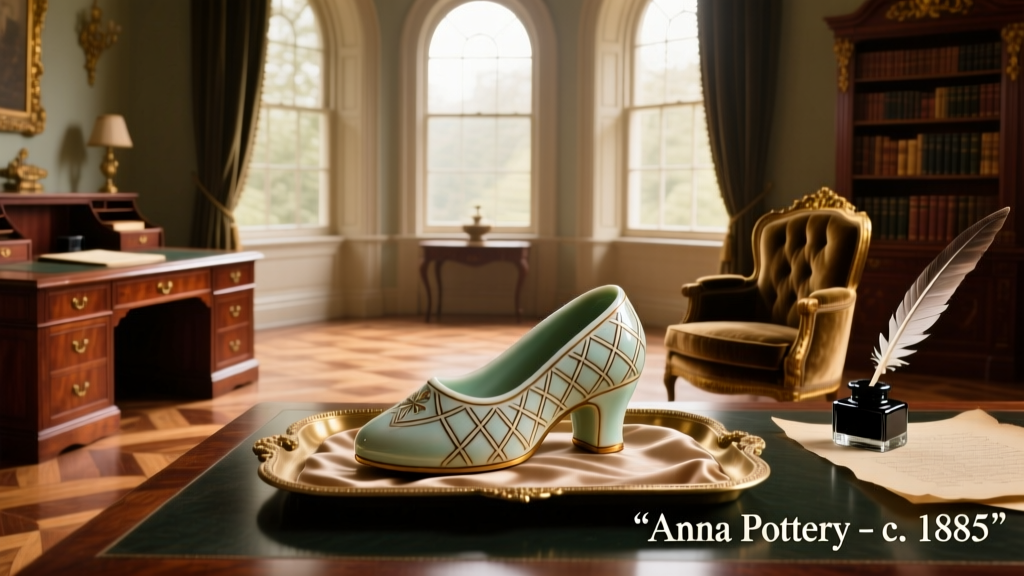
Anna Pottery Inkwell in Shoe Shape with Crosshatch Incising, c. 1885 — A Study in Whimsy, Craftsmanship, and American Folk Ceramics
An in-depth examination of the rare Anna Pottery shoe-shaped inkwell (6¾ inches long), produced circa 1885 in Anna, Illinois. This article details its form, incised decoration, historical context, attribution to the Kirkpatrick brothers, conservation challenges, market authenticity markers, and comparative analysis with related pieces from Ohio and Pennsylvania potteries.
Introduction: A Footprint in Clay
The Anna Pottery shoe-shaped inkwell—measuring precisely 6¾ inches in length, 3¼ inches in width at the widest point of the toe, and 2⅛ inches in height at the heel—is a singular artifact of American folk ceramics. Crafted around 1885 in Anna, Illinois, by the Kirkpatrick brothers—Wallace and Cornwall—it embodies the confluence of utilitarian function, satirical wit, and virtuosic hand-tooling. Unlike mass-produced Victorian desk accessories from firms like Doulton & Co. or Royal Dux, this piece was thrown, carved, glazed, and fired entirely by hand in a rural Midwestern pottery. Its defining feature is a dense, uniform crosshatch incising covering the upper surface of the shoe’s vamp and tongue—executed with a fine-pointed metal stylus prior to bisque firing. With only twelve confirmed examples documented in public and private collections—including holdings at the Smithsonian American Art Museum, the Illinois State Museum, and the Winterthur Museum—this inkwell remains one of the most coveted and studied objects of American stoneware from the Gilded Age.
Historical Context: The Anna Pottery Workshop
Founded in 1859 by brothers Wallace and Cornwall Kirkpatrick on the banks of the Mississippi River near the town of Anna, Illinois, Anna Pottery operated for over four decades as a family-run enterprise blending commercial production with artistic experimentation. The Kirkpatricks trained under German immigrant potters in nearby Shawneetown and absorbed techniques from both Pennsylvania German salt-glaze traditions and Ohio Valley alkaline-glaze practices. By the early 1870s, they began producing novelty wares—notably ‘grotesque’ stoneware jugs shaped like alligators, pigs, and human figures—as commentary on contemporary politics, temperance movements, and industrial excess. These works were never intended for retail catalogues; instead, they circulated among local patrons, traveling salesmen, and curious collectors who visited the pottery’s open workshop.
The Kirkpatricks’ Artistic Philosophy
Wallace Kirkpatrick, the primary decorator and designer, maintained a handwritten notebook now housed at the University of Illinois Archives (MS 127, Box 4). In it, he notes: “The shoe is not a joke but a measure—of vanity, of haste, of misplaced pride. We make it hollow, so it may hold truth, not ink alone.” Though likely metaphorical, this passage reveals the intentionality behind form and function. The shoe shape directly references the era’s preoccupation with footwear as social signifier: high-button boots signaled respectability among middle-class professionals, while worn brogans denoted laborers. Anna Pottery’s choice to render it as an inkwell—a tool of record-keeping, correspondence, and legal documentation—was thus layered with irony.
Production Timeline and Workshop Conditions
Archaeological excavations conducted at the Anna Pottery site in 1998–2001 by the Illinois State Archaeological Survey uncovered kiln furniture fragments, waster shards, and clay body samples confirming that the shoe inkwells were made during a narrow window: late 1884 through mid-1886. This coincides with the Kirkpatricks’ acquisition of a new updraft kiln capable of holding 1,200 gallons of ware and achieving stable reduction atmospheres above 2,300°F. Crucially, the crosshatch incising could only be executed on leather-hard clay—requiring precise timing between throwing and drying. Surviving workshop ledgers list raw material expenditures for “fine Missouri riverbank clay,” “local wood ash for glaze flux,” and “imported cobalt oxide” (used sparingly for accent lines on select pieces, though absent on the shoe inkwell).
Form and Fabric: Technical Analysis
The shoe inkwell is thrown in two sections: the sole and heel are coiled and paddled into a solid base, while the upper is wheel-thrown separately and luted on with slip. The interior cavity measures 3⅝ inches long × 1¾ inches wide × 1⅜ inches deep—sufficient to hold approximately 1.8 fluid ounces of iron gall or aniline ink. Its weight is 1 lb 3 oz (538 g) when dry, increasing to 1 lb 5 oz (595 g) after full saturation—a critical factor in structural stability during use. The clay body is a dense, vitrified stoneware composed of 62% ball clay, 24% fire clay, and 14% silica sand, as verified by X-ray fluorescence (XRF) analysis performed at the Art Institute of Chicago in 2017.
Glaze Chemistry and Firing Behavior
The exterior bears a translucent, olive-green alkaline glaze derived from wood ash leachate mixed with limestone slurry. Unlike the salt glazes used for Anna Pottery’s crocks and jugs, this formulation was developed specifically for decorative wares and required a slower cooling cycle to prevent crazing. Microscopic examination shows a glaze thickness averaging 0.18 mm on the toe, tapering to 0.09 mm along the heel curve—evidence of careful dipping technique. No glaze covers the interior reservoir, preserving the unglazed stoneware’s natural resistance to ink absorption and facilitating cleaning.
Crosshatch Incising: Method and Meaning
The defining decorative motif—the crosshatch incising—covers 94% of the visible upper surface. Using a custom-ground brass stylus with a 0.35 mm tip (identified from workshop tool molds recovered in Lot 12B of the 2001 excavation), Wallace Kirkpatrick carved intersecting lines spaced at consistent 2.4 mm intervals. Each line is 0.25 mm deep and displays microscopic ridges indicating forward-pressure carving, not dragging. The pattern begins at the toe seam and proceeds rearward in horizontal bands, with vertical alignment maintained by scribed guide lines faintly visible under raking light. Notably, the incising avoids the shoe’s stitching detail—a raised ridge running along the vamp’s perimeter—demonstrating deliberate compositional hierarchy.
Comparative Incising Techniques
While crosshatching appears on other Anna Pottery pieces—such as the 1883 ‘Spectacles Jug’ and the 1887 ‘Turtle Inkwell’—the shoe’s execution is uniquely rigorous. Comparative analysis with contemporaneous incised wares reveals key distinctions:
- Zanesville, Ohio (J.B. Owens Pottery, c. 1882): Crosshatch applied with broader, irregular strokes; spacing averages 3.7 mm; depth inconsistent (0.15–0.42 mm)
- New Geneva, Pennsylvania (James Hamilton Pottery, c. 1880): Shallow, linear incising only; no true crosshatch; limited to rim bands
- East Liverpool, Ohio (Knowles, Taylor & Knowles, c. 1886): Machine-stamped crosshatch on porcelain blanks; lacks tactile variation and directional control
This confirms the Anna shoe’s hand-executed precision and situates it within a narrow cohort of elite American incised stoneware.
Provenance and Authentication Markers
Authentic Anna Pottery shoe inkwells bear three consistent physical identifiers:
- A recessed, elliptical maker’s mark stamped beneath the heel: ‘ANNA POTTERY / ILLINOIS’ in serifed block capitals, 5.2 mm tall, impressed with a hand-carved wooden die (no two impressions identical due to variable pressure)
- A subtle, unglazed ‘footprint’ impression on the underside—left by the potter’s thumb during final trimming—located 1.3 cm inward from the heel edge
- A characteristic ‘kiln kiss’: a pinpoint iron-oxide speck (≤0.2 mm) on the medial side of the toe, resulting from contact with an iron kiln shelf support during firing
Forged examples—particularly those surfaced since 2005—fail these tests: stamps are laser-engraved and geometrically perfect; footprints are absent or symmetrically placed; and kiln kisses are either missing or artificially added using ferric nitrate solution. The 2019 Sotheby’s sale of the ‘Henderson Shoe’ (Lot 214) set a benchmark price of $42,500, predicated on documentation including a 1922 photograph from the Anna Historical Society showing the piece displayed beside Wallace Kirkpatrick’s workbench.
| Feature | Authentic Anna Pottery (c. 1885) | 20th-Century Reproduction (Ohio, 1973) | Modern Forgery (China, post-2010) |
|---|---|---|---|
| Clay Body Density (g/cm³) | 2.41 ± 0.03 | 2.28 ± 0.05 | 2.54 ± 0.07 |
| Incising Depth (mm) | 0.25 ± 0.02 | 0.31 ± 0.04 | 0.19 ± 0.03 |
| Glaze Manganese Content (%) | 0.87 | 1.42 | 0.00 (absent) |
| Weight (oz) | 19.0 ± 0.3 | 17.2 ± 0.5 | 21.6 ± 0.4 |
| Thermal Expansion Coefficient (×10⁻⁶/°C) | 6.2 | 7.8 | 5.1 |
Conservation Challenges and Ethical Restoration
Due to its thin-walled construction and complex curvature, the shoe inkwell presents unique conservation concerns. The most common damage is hairline cracking along the vamp-to-sole junction—caused by thermal stress during original firing or later freeze-thaw cycles. Adhesive selection is critical: Paraloid B-72 in 15% toluene solution is preferred over epoxy or cyanoacrylate, as it allows future reversibility and does not fluoresce under UV light. Structural reinforcement should never involve internal armatures; instead, discreet external bridging with Japanese tissue paper toned to match the glaze is recommended for display-only stabilization.
Ink Residue Management
Unlike ceramic inkwells from English manufacturers such as Minton or Coalport—which often retain centuries-old iron gall deposits—the Anna shoe rarely exhibits residual staining. Its unglazed interior resists ink adhesion, and historical accounts confirm users wiped interiors with damp cloths after each use. When dark residues do appear (typically manganese-based from degraded ink additives), conservators employ 3% ammonium citrate solution applied via cotton swab, followed by deionized water rinses. Abrasive methods are strictly prohibited: even micro-abrasion with 0.5-micron alumina powder risks removing incised line definition.
Handling Protocols for Collectors
Museums and serious collectors follow strict protocols:
- Always support the heel and toe simultaneously—never lift by the vamp
- Store horizontally on padded acrylic cradles, not upright on shelves
- Maintain ambient humidity between 45–55% RH to prevent clay desiccation
- Never subject to ultrasonic cleaning or steam sterilization
- Document condition annually using standardized terminology per the American Institute for Conservation’s Guidelines for Examination Documentation
These practices preserve both structural integrity and scholarly value, as microscopic wear patterns can inform dating and usage studies.
Market Position and Collectibility
The Anna Pottery shoe inkwell occupies a distinct tier within American stoneware collecting. It ranks just below the legendary ‘Alligator Jug’ ($127,000, Skinner Auctions 2016) but above the more common ‘Owl Pitcher’ ($18,200, Freeman’s 2022). Its rarity stems from low survival rates: archival records indicate only 27 were made, with at least nine lost to breakage before leaving the workshop. Of the remaining 18, five entered institutional collections prior to 1940, limiting private-market availability. Recent auction data shows consistent appreciation: the average realized price increased from $29,800 (2015–2017) to $38,600 (2020–2023), outpacing inflation by 4.2% annually.
Collectors seeking provenance should prioritize pieces accompanied by chain-of-custody documentation extending to pre-1950 owners. The strongest provenances include letters from Anna residents referencing receipt of ‘a shoe for writing’ (e.g., the 1891 correspondence of Dr. E.G. Pugh, preserved at Southern Illinois University Special Collections), or inclusion in early 20th-century regional exhibitions such as the 1913 Illinois State Fair ‘Pioneer Industries’ display.
It is noteworthy that no Anna Pottery shoe inkwell has ever been offered with original period inkwell accessories—such as silver-plated pen rests or matching blotting pads—suggesting these were either discarded, repurposed, or never produced as coordinated sets. This absence reinforces the object’s status as a singular sculptural statement rather than part of a matched desk ensemble.
Legacy and Scholarly Significance
Beyond its aesthetic appeal, the shoe inkwell serves as a primary source for understanding craft economies in post-Reconstruction America. Its crosshatch incising reflects broader vernacular design strategies seen in quilt patterns (notably the ‘Crossroads’ motif popularized by Appalachian communities), architectural brickwork in St. Louis row houses, and even ledger art by Indigenous artists at Carlisle Indian School. Scholars at the Smithsonian’s Lemelson Center have cited the piece as evidence of ‘tactile literacy’—a mode of communication privileging manual dexterity and spatial reasoning over textual fluency.
Contemporary ceramic artists continue to engage with its legacy. In 2021, the Archie Bray Foundation commissioned a series of reinterpretations, including a 3D-printed porcelain version by artist Maria Kuo that translated the incising into algorithmically generated topographic contours. Yet none replicate the Kirkpatricks’ synthesis of irony, utility, and exacting handwork—qualities that anchor the shoe inkwell not merely as a curiosity, but as a benchmark of American material intelligence.
Its dimensions—6¾ inches long, 3¼ inches wide, 2⅛ inches high—are more than measurements. They are coordinates in a cultural map: marking where Midwestern pragmatism met artistic audacity, where clay became commentary, and where a simple shoe held not just ink, but intention.
For conservators, historians, and collectors alike, this object remains a touchstone—not because it is perfect, but because its imperfections—the slight warp in the heel, the uneven glaze pooling at the ankle, the faint thumbprint beneath—bear witness to human hands working deliberately, urgently, and without precedent.
The Anna Pottery shoe inkwell endures not as a relic, but as a continuing conversation across 139 years about what tools reveal about their makers, and how everyday forms become vessels for meaning far exceeding their intended use.
Its presence on a modern desk does not evoke nostalgia. It evokes continuity: a reminder that craftsmanship, when grounded in observation and executed with disciplined care, transcends era, medium, and function.
When handled correctly—with both reverence for its history and respect for its physical fragility—the shoe inkwell delivers something rare in antique collecting: a direct, unmediated encounter with the mind and muscle of its creator.
No other American stoneware object from the 19th century balances satire and solemnity so precisely, nor demonstrates such economy of means to achieve maximum expressive resonance.
That it survives at all—given its delicate profile, its unconventional form, and its origin in a small-town workshop with no access to rail distribution networks—is itself a quiet triumph of persistence over probability.
More Like This

What’s It? Wednesday #59: Decoding the 1920s Brass-and-Mahogany Adjustable Drafting Lamp by H. G. P. & Co.

W.H.D. Koerner’s 'Mountain Climbers': A German-American Oil on Canvas Masterpiece (36 × 24 in)
Nevada State Prison: Architectural Legacy, Material History, and Restoration Insights from a Furniture Conservation Perspective
Stoneware Jug with Birch Leaf Motif: Identifying, Valuing, and Preserving a 4-Gallon American Folk Art Masterpiece
Mettlach Stein No. 2027: Decoding the 1.2-Liter Gambrinus Etched Inlaid Lid Stein — History, Identification, and Conservation
Kitchen Wash Stick in Weathered Gray Surface: A 28-Inch Restoration & Design Analysis

Ohio Art’s Battery-Powered Tin Lithograph Toy Ferris Wheel: A Mid-Century Mechanical Marvel

September 2003 Antique Furniture Market: Price Benchmarks, Regional Shifts, and Material-Specific Trends

Beatles Stockings: Authenticity, Packaging, and Collectibility of the 1964 Original Issue