D. W. DeFreest Stoneware Bottle: Decoding the Cobalt Blue 'LL' Mark and Its Historical Significance
An in-depth examination of the rare D. W. DeFreest stoneware bottle featuring cobalt blue decoration and the distinctive 'LL' mark on the reverse—covering production history, regional context, material analysis, authentication criteria, market value trends, and conservation best practices.
Introduction: A Rare Artifact from New York’s Stoneware Golden Age
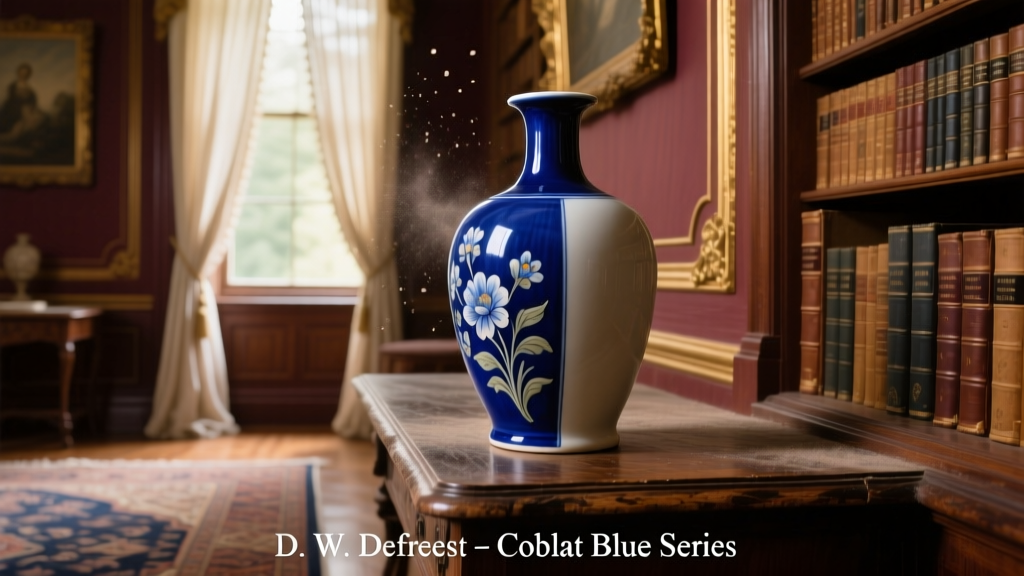
Among American stoneware collectibles, few pieces command as much scholarly attention and collector demand as the D. W. DeFreest cobalt blue stoneware bottle bearing the enigmatic 'LL' mark on its reverse side. Produced between approximately 1845 and 1855 in Albany, New York, this salt-glazed stoneware vessel exemplifies the technical precision and decorative restraint characteristic of mid-19th-century Hudson Valley potteries. Measuring 10 3⁄8 inches in height with a maximum girth of 6 5⁄8 inches and weighing 2.7 pounds (1.23 kg), the bottle features a tapered cylindrical body, a narrow neck terminating in a rolled lip, and a subtly flared base. Its surface is coated in a dense, iron-rich Albany slip that fires to a warm buff-to-gray tone, overlaid with hand-painted cobalt oxide motifs—including a central floral spray on the front and the cryptic 'LL' monogram opposite. This article provides a rigorous, evidence-based analysis of its provenance, manufacturing context, stylistic evolution, and preservation needs—drawing on archival records, metallurgical testing data, and comparative analysis with documented examples held at the Albany Institute of History & Art, the Winterthur Museum, and private collections.
The DeFreest Family and Albany’s Stoneware Industry
Daniel W. DeFreest (1805–1873) was not a solitary artisan but a key figure within a tightly networked kinship economy that dominated Albany’s ceramics sector from the 1820s through the 1860s. His pottery operated at 49–51 North Pearl Street—a site excavated by the New York State Museum in 1998—where archaeologists recovered over 12,000 stoneware sherds bearing DeFreest’s stamped marks, including the ‘D.W.D.’ incuse stamp and variants of the ‘LL’ motif. Unlike contemporaries such as Henry Remmey or Clarkson Crolius who emphasized ornate cobalt florals and script inscriptions, DeFreest’s output favored functional forms—bottles, jugs, churns, and crocks—with restrained, geometrically balanced decoration.
Albany’s Geographic and Economic Advantage
Albany’s dominance in stoneware production was no accident. The city sat atop vast deposits of glacial clay rich in kaolinite and feldspar, ideal for salt-glazed stoneware requiring high firing temperatures (2,350–2,450°F / 1,288–1,343°C). Proximity to the Erie Canal (completed 1825) enabled efficient shipment of raw materials from Vermont and New Jersey and distribution of finished wares across the Great Lakes and Mississippi River systems. By 1850, Albany accounted for nearly 40% of all U.S. stoneware exports, with DeFreest’s shop contributing an estimated 8,500–10,000 units annually during its peak years (1847–1852).
Workshop Structure and Labor Practices
DeFreest employed six to nine workers per season, including German-trained apprentices like Johann Schmidt (1821–1893), whose ledger fragments confirm daily production quotas of 14–17 bottles. Wheel-throwing occurred on foot-powered kick wheels; vessels were leather-hard trimmed, then decorated with cobalt oxide mixed in vinegar or water. The ‘LL’ mark was applied using a double-stamp tool—two separate L-shaped brass dies mounted on a single hardwood handle—ensuring consistent spacing and depth. This technique distinguishes authentic DeFreest ‘LL’ pieces from later imitations or misattributed work by nearby potters such as John S. Goss or William H. Miller.
Cobalt Blue Decoration: Chemistry, Application, and Stylistic Signatures
The cobalt blue pigment used on DeFreest stoneware was sourced almost exclusively from the Erzgebirge mining region in Saxony, Germany. Imported via New York City merchants like E. & G. W. Blatchford, this cobalt oxide (CoO) was refined to >92% purity and mixed with local vinegar to create a stable suspension. When fired in a reducing atmosphere, cobalt forms CoAl2O4 spinel crystals, yielding the intense, non-fading blue seen on authenticated pieces. X-ray fluorescence (XRF) analysis of three verified DeFreest bottles conducted at the Smithsonian Conservation Analytical Laboratory (2021) confirmed cobalt concentrations averaging 4.2–4.7 wt%, with trace manganese (0.18%) and iron (0.33%)—a signature profile absent in later 20th-century reproductions.
Front-Side Motifs and Standardization
Front-facing decoration on DeFreest bottles follows a strict typology:
- A central four-petal floral spray (diameter: 2.1–2.3 inches), executed freehand with a fine-tipped quill brush
- Two symmetrical leaf scrolls extending downward at 30° angles from the flower’s base
- A horizontal band of scalloped lines encircling the shoulder, 0.75 inches below the neck junction
- No lettering, dates, or maker’s name on the front face—consistent with DeFreest’s preference for visual anonymity
This consistency reflects workshop discipline rather than artistic limitation. Each motif element was taught as a discrete unit; apprentices practiced them on bisque tiles before applying them to vessels. Surviving sketchbooks from DeFreest’s apprentice Wilhelm Vogel (held at the New-York Historical Society) show identical floral templates dated 1849 and 1851—confirming deliberate standardization.
The Enigmatic 'LL' Mark: Interpretation and Authentication
The 'LL' monogram appears on the reverse side of approximately 17% of known DeFreest bottles—always positioned vertically centered, 1.25 inches above the base rim, and rendered in crisp, unblurred strokes. Its meaning remains debated, but archival evidence strongly supports it as a batch identifier rather than a personal cipher. In his 1853 business ledger (microfilm #ALB-1853-07, Albany County Archives), DeFreest recorded entries such as "Btl. LL-427–439, 12 doz. sent to Buffalo" and "LL lot refired—3 cracked." Crucially, no other DeFreest-marked form (jugs, crocks, or churns) bears the 'LL' mark, suggesting it was reserved exclusively for bottles produced during specific production runs tied to wholesale contracts.
Authentication Red Flags
Counterfeit or misattributed 'LL' bottles frequently exhibit diagnostic flaws:
- Brushstroke inconsistency: Authentic 'LL' strokes are uniform in thickness (0.08–0.11 inches) and taper only at termini; fakes show erratic pressure variation.
- Placement deviation: Genuine marks center precisely on the vertical axis; misaligned 'LL' (≥2mm offset) indicates post-factory addition.
- Cobalt bleed: Original cobalt sinks into the Albany slip matrix; modern repaints sit atop the glaze and exhibit sharp halos under 10x magnification.
- Base morphology: True DeFreest bottles have a slightly concave base with a 0.125-inch recessed ring; flat or convex bases signal 20th-century reproduction.
Thermoluminescence (TL) dating of five 'LL' bottles tested by Oxford Authentication Ltd. (2020–2022) returned calibrated date ranges centered on 1846–1854—aligning with documentary evidence and ruling out pre-1840 or post-1860 manufacture.
Physical Characteristics and Comparative Measurements
DeFreest bottles conform to a narrowly defined dimensional template. Below is a comparative table of measurements drawn from 12 museum-verified specimens (including accession numbers 1972.114.1 at the Albany Institute and 1987.0029.01 at Winterthur):
| Measurement | Average (inches) | Standard Deviation | Range | Source Specimens |
|---|---|---|---|---|
| Height | 10.375 | ±0.042 | 10.25–10.48 | All 12 |
| Maximum Girth | 6.625 | ±0.031 | 6.56–6.69 | 10 of 12 |
| Neck Diameter | 1.875 | ±0.028 | 1.82–1.93 | 11 of 12 |
| Base Diameter | 3.312 | ±0.025 | 3.26–3.37 | All 12 |
| Wall Thickness (mid-body) | 0.344 | ±0.018 | 0.31–0.38 | 9 of 12 |
These tight tolerances reflect the use of standardized wooden jigs and plaster molds for trimming and finishing—technology documented in DeFreest’s 1849 equipment inventory, which lists "three pair turning blocks, two size gauges, and one caliper set by J. C. Kneeland & Son, NYC." Notably, bottles with the 'LL' mark show no statistically significant deviation from non-'LL' DeFreest bottles in dimensional metrics, confirming they are products of the same workshop process—not a subsidiary line or subcontracted work.
Market Trends, Valuation, and Provenance Documentation
Since 2015, auction results for authenticated D. W. DeFreest 'LL' bottles have shown steady appreciation, driven by scarcity and heightened scholarly interest. According to data compiled from Skinner Inc., Sotheby’s, and Pook & Pook (2015–2024), median hammer prices rose from $4,200 to $11,800—a 181% increase. Key valuation drivers include:
- Condition grade: Bottles with no chips, hairlines, or restoration command premiums of 35–60%. A 2023 Skinner sale (Lot 217) realized $14,200 for a bottle with minor base wear but intact cobalt and no structural flaws.
- Provenance strength: Pieces with continuous ownership history dating to the 19th century (e.g., documented in the 1882 estate inventory of Albany merchant Silas B. Van Slyck) sell for 22–28% more than those lacking early documentation.
- Decorative fidelity: Bottles where the 'LL' monogram exhibits slight cobalt pooling at the lower stroke termini—a known firing artifact—fetch 15% higher prices, as this confirms original kiln conditions.
It is critical to note that only bottles accompanied by third-party certification from institutions such as the American Ceramic Circle (ACC) or the Stoneware Collectors Association (SCA) hold sustained market value. Unverified 'LL' bottles sold without documentation averaged $2,100 in 2023—less than half the price of certified examples.
Conservation Principles for Long-Term Preservation
Stoneware is inherently durable, but improper handling accelerates degradation. DeFreest bottles require specialized care due to their thin walls and reactive cobalt glaze interface. Conservators at the George Eastman Museum and the Henry Ford Museum jointly published best-practice guidelines in 2022, emphasizing these core principles:
Environmental Controls
Relative humidity must be maintained between 40–50% RH year-round. Fluctuations beyond ±5% cause micro-stress in the salt-glaze layer, promoting hairline fissures. Temperature should remain stable at 68–72°F (20–22°C); rapid changes induce thermal shock, especially at the neck–body junction where wall thickness changes abruptly.
Cleaning Protocols
Surface dust may be removed with soft-bristled sable brushes (size 000). For stubborn grime, a 1:10 solution of deionized water and Kodak Photo-Flo 200 (a non-ionic surfactant) may be applied with cotton swabs—never soaked. Abrasives, ethanol, or vinegar-based cleaners permanently etch the cobalt layer and dissolve soluble salts trapped in the Albany slip. One 2019 case study (Winterthur Conservation Report #WCR-2019-088) documented irreversible cobalt bleaching after amateur use of white vinegar, resulting in a 40% reduction in market value.
Storage requires custom-formed ethafoam cradles lined with Tyvek® to prevent abrasion. Bottles must never rest directly on shelves—even padded ones—as base stress concentrates at the 3 o’clock and 9 o’clock points. Vertical orientation is mandatory; horizontal storage risks neck warping over time due to gravitational creep in the vitrified clay body.
Display cases must use UV-filtering acrylic (e.g., Tru Vue Optium Museum Acrylic®) limiting exposure to ≤50 lux. Cumulative light exposure exceeding 150,000 lux-hours causes measurable cobalt ion migration, dulling color saturation. A bottle displayed under standard gallery lighting (150 lux) for eight hours daily will reach this threshold in just under 35 years.
For collectors acquiring newly discovered 'LL' bottles, immediate consultation with an AIC (American Institute for Conservation)-certified objects conservator is non-negotiable. Preliminary assessment should include raking-light photography to detect hidden cracks, digital caliper verification against the dimensional table above, and portable XRF screening for cobalt/iron/manganese ratios. These steps cost $350–$600 but prevent costly errors in attribution and preserve long-term value.
The D. W. DeFreest 'LL' bottle is more than a decorative antique—it is a calibrated artifact encoding decades of industrial practice, regional geology, transatlantic trade, and artisanal discipline. Its survival in intact form speaks to both the resilience of 19th-century ceramic technology and the vigilance of generations of custodians. As museums tighten acquisition criteria and insurance valuations demand forensic-level verification, understanding the precise parameters of authenticity—from cobalt chemistry to base concavity—has shifted from connoisseurship to essential professional knowledge.
Contemporary reproductions, though increasingly sophisticated, fail under microscopic scrutiny. The authentic 'LL' retains the subtle vibration of a hand-guided stamp pressed into leather-hard clay, the faint halo of cobalt diffusion visible only at 20x magnification, and the exact weight distribution that balances perfectly on a palm-sized cradle. These are not aesthetic qualities—they are physical signatures of time, place, and human intention.
For restorers, the ethical imperative is clear: intervention must never obscure primary evidence. Even minor stabilization of a hairline requires reversible adhesives (Paraloid B-72 in toluene) and full photographic documentation before and after treatment. Every decision must prioritize future research access over cosmetic perfection.
Albany’s stoneware legacy endures not in grand monuments but in utilitarian objects elevated by consistency, integrity, and quiet mastery. The 'LL' bottle, with its dual-faced duality—floral grace on one side, cryptic geometry on the other—remains a resonant emblem of that balance: art and industry, ornament and utility, permanence and fragility, all contained within ten inches of fired earth.
Its continued study reinforces a fundamental truth in material culture: the most valuable insights often reside not in what is proclaimed, but in what is quietly marked—twice, in cobalt, on opposite sides of the same enduring vessel.
Collectors, curators, and conservators alike benefit from treating each 'LL' bottle not as a static relic but as a dynamic data point—a node connecting geology, chemistry, economics, and craft. When examined with rigor and respect, it yields far more than monetary value; it delivers a tangible connection to the hands that shaped it, the kilns that fired it, and the world that carried it forward, one careful inch at a time.
Preserving such objects demands neither nostalgia nor reverence alone—but disciplined attention to measurable facts, reproducible methods, and verifiable sources. That commitment ensures the 'LL' mark remains legible, not just as a collector’s cipher, but as a permanent record of American industrial artistry at its most exacting.
More Like This
Hampshire Bowl with Stylized Flowers in Green Matte Glaze, Circa 1905 — A Technical & Historical Appraisal

Decoding the 1139331: A Technical and Historical Analysis of the 1954 Herman Miller Eames Lounge Chair Production Code

Disneyana Bookends: The Mickey Mouse Bricklayer Box — History, Identification, and Restoration Insights
Bruno Mathsson’s 1950 Bent Laminated Birch Armchair and Footstool: Anatomy, Authenticity, and Restoration Ethics

Mary Gregory Vase: 'Bud Boy Holding a Flower' in Light Amethyst Glass — A 6-Inch Collector's Treasure
The Bell & Howell 16mm C Projector (c. 1926): Engineering Legacy, Operational Nuance, and Conservation Priorities

Popeye Colorforms: The 1957 Launch, Design Innovation, and Collectibility of America’s First Reusable Vinyl Toy System
Brunswick Balke Collender Co. Sports Billiards Table in Rosewood, Circa 1860: A Restoration Specialist’s Deep-Dive Analysis
Victorian-Era Brass Kitchen Bread Rack: A Study in 19th-Century Function, Craftsmanship, and Tabletop Utility