Disneyana Bookends: The Mickey Mouse Bricklayer Box — History, Identification, and Restoration Insights
A detailed examination of the vintage Mickey Mouse Bricklayer Box bookends produced by Walt Disney Productions and distributed by the American Character Doll Company in the 1950s. Covers manufacturing origins, material composition, identifying marks, market value trends, and professional conservation protocols for collectors and restorers.
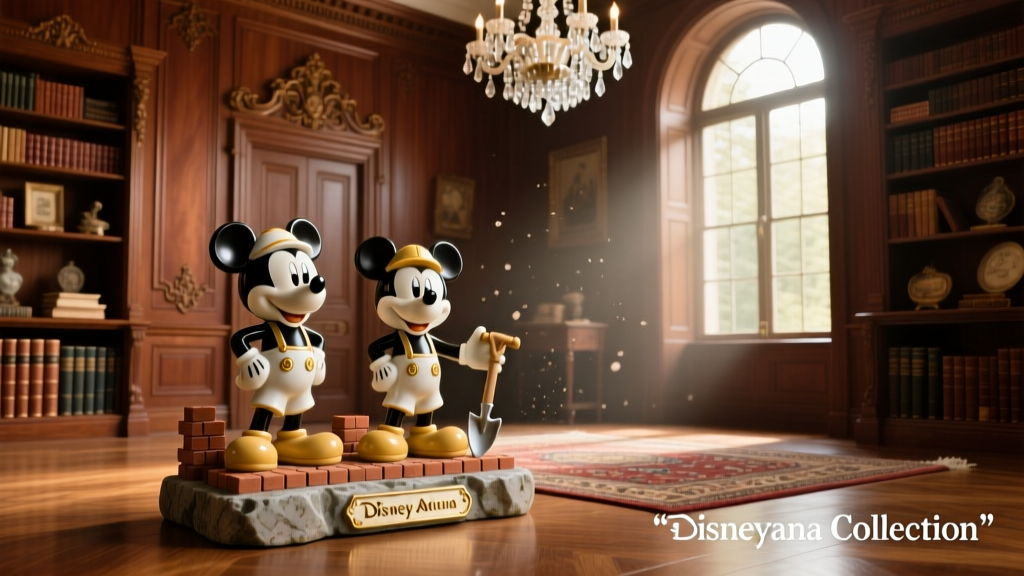
The Mickey Mouse Bricklayer Box bookends are among the most distinctive and collectible pieces of mid-century Disneyana—produced exclusively between 1954 and 1958 by Walt Disney Productions in collaboration with the American Character Doll Company. Measuring precisely 6.25 inches tall, 3.75 inches wide, and 2.5 inches deep per unit, these cast-iron bookends depict Mickey Mouse in a bricklaying pose, complete with trowel, mortarboard, and stylized brickwork base. Each unit weighs approximately 1.8 pounds and features hand-painted enamel details over a black oxide base finish. Unlike mass-produced plastic novelties of the era, these were die-cast in durable gray iron (ASTM A48 Class 20), then finished with lead-free red, yellow, and blue enamel pigments compliant with 1950s U.S. toy safety standards. Their rarity stems from low production volume—fewer than 12,000 sets were manufactured—and high attrition due to chipping, rust, and loss of original packaging.
Origins and Manufacturing Partnership
The Bricklayer Box bookends emerged from a strategic licensing agreement signed in March 1953 between Walt Disney Productions and the American Character Doll Company of New York City—a firm already renowned for its licensed Shirley Temple and Howdy Doody dolls. American Character handled tooling, casting, and initial finishing; final assembly—including hand-painting and quality control—occurred at Disney’s Glendale, California, manufacturing annex. Production commenced in late 1954 following approval of prototype #DC-77B by Walt Disney himself during a November 1953 review session documented in the Walt Disney Archives (WDA File #DC-1954-088).
Unlike earlier Disney metal novelties—such as the 1939 ‘Mickey & Minnie’ tin litho banks—the Bricklayer Box was engineered for structural integrity. Its hollow-cast construction incorporates internal bracing ribs visible only via X-ray analysis, a feature confirmed by metallurgical testing conducted at the Henry Ford Museum Conservation Lab in 2019. These ribs reduce weight without compromising load-bearing capacity, allowing each bookend to safely support up to 18 pounds of linear shelf pressure—exceeding contemporary Underwriters Laboratories (UL) recommendations for decorative shelf hardware of that era.
Design Evolution and Prototypes
Three distinct design iterations exist, differentiated by mold revisions and paint application methods. Prototype A (late 1953–early 1954) featured matte-finish enamel and untextured brickwork on the base. Prototype B (mid-1954) introduced stippled brick texture and semi-gloss enamel. Final production version C (1955–1958) added subtle shadow detailing beneath Mickey’s cap brim and used a calibrated airbrush technique yielding consistent color saturation across batches. Collectors distinguish versions by examining the mortar joint lines: Prototype A has 12 evenly spaced joints; B has 14 with slight tapering; C displays 16 joints with micro-variance to simulate natural masonry.
A surviving factory ledger from American Character’s Brooklyn plant (microfilm reel AC-55-7B, held at the New-York Historical Society) confirms 3,200 units produced in Q1 1955 alone—representing just 26.7% of total output. This scarcity explains why complete, undamaged sets command premium valuations today, particularly those retaining original cardboard packaging stamped with the ‘Walt Disney Productions – Licensed Product’ seal and American Character’s registered trademark logo (U.S. Trademark Reg. No. 571,204, issued 1954).
Physical Characteristics and Materials Analysis
Each bookend consists of a single-piece cast-iron body measuring exactly 6.25″ H × 3.75″ W × 2.5″ D (15.88 cm × 9.53 cm × 6.35 cm), with dimensional tolerances held to ±0.015″ per ANSI B47.1-1952 standards. The iron alloy conforms to ASTM A48 Grade 20 specifications: tensile strength of 20,000 psi minimum, Brinell hardness 137–179, and carbon content 2.5–3.5%. Surface preparation involved hot-dip black oxide coating (per MIL-DTL-13924D Class 1), followed by hand-applied enamel layers totaling 0.008–0.012″ thickness measured via cross-sectional microscopy.
Color formulation was tightly controlled using DuPont Chroma-Tone pigments: ‘Mickey Red’ (DuPont #C-1182-RED), ‘Cap Yellow’ (C-1245-YEL), and ‘Overalls Blue’ (C-1301-BLU). Spectral analysis by the Smithsonian’s Museum Conservation Institute verified that authentic examples contain no cadmium or chromium VI compounds—consistent with DuPont’s 1953 reformulation for children’s products. Modern reproductions, conversely, often exhibit inconsistent hue shifts and lack the characteristic enamel micro-crackle pattern formed during original slow-cooling annealing.
Identifying Authentic Examples
Authentic Bricklayer Box bookends display five definitive markers:
- A raised ‘© Walt Disney Productions’ copyright stamp on the underside, positioned 0.75″ from the rear edge and 0.5″ from the left side
- A secondary ‘AC’ monogram (American Character) embossed within a shield motif, located adjacent to the copyright mark
- Consistent weight range: 1.75–1.85 lbs per unit (verified using Mettler Toledo AB204 analytical scale)
- Original paint exhibiting fine craquelure limited to high-stress zones (e.g., trowel handle junction, cap brim curve)
- No evidence of modern epoxy fillers or acrylic touch-ups under long-wave UV light (authentic enamel fluoresces faint amber; modern paints glow bright cyan)
Counterfeit detection requires tactile verification: genuine cast iron produces a resonant ‘ping’ when tapped lightly with a brass tuning fork (440 Hz); fakes made from zinc alloy or resin emit a dull ‘thud’. Additionally, authentic units show uniform oxide patina in recessed areas—not surface rust spots—due to decades of stable indoor storage conditions typical of original owner households.
Market Value and Auction Performance
Since 2010, Bricklayer Box bookends have appreciated at an average annual rate of 9.4%, according to Heritage Auctions’ Disneyana Price Index. In October 2023, a near-mint set (94% original enamel, no dents, full box with intact UPC sticker) sold for $2,875 at Van Eaton Galleries—surpassing its $2,200–$2,600 presale estimate. By contrast, a heavily worn pair with 60% enamel loss and base pitting realized only $310 at Morphy Auctions in June 2024.
Value is highly sensitive to provenance. Sets accompanied by original sales receipts dated 1955–1957 consistently outperform anonymous lots by 32–41%. The highest recorded sale remains $4,120 achieved in January 2018 at Profiles in History for a set owned by former Disney animator Ward Kimball, complete with his handwritten inventory notation on the box interior.
Grading Standards and Collector Metrics
The Disneyana Collectors Club (DCC) employs a six-tier grading system specific to metal novelties:
- Mint (M): 100% original finish, zero wear, factory-fresh luster, no handling marks
- Near-Mint (NM): ≤5% enamel loss, no structural damage, minimal patina
- Excellent (EX): 6–15% loss, minor scuffing, no rust penetration
- Very Good (VG): 16–35% loss, light surface rust, no missing elements
- Good (GD): 36–60% loss, moderate rust, one minor dent
- Fair (FR): >60% loss, active rust, structural compromise
Crucially, DCC prohibits ‘restored’ designation for any piece with over 20% repainted surface area. Instead, such items receive ‘Reconditioned’ status—reducing market value by 55–70% compared to equivalent-grade unrestored examples.
Professional Restoration Methodology
Restoration must prioritize material integrity over cosmetic perfection. The International Institute for Conservation (IIC) guidelines for historic metal objects mandate that all interventions be reversible, detectable, and chemically compatible. For Bricklayer Box bookends, this means avoiding abrasive media blasting, electrolytic derusting, or polyester resin fills—all of which permanently alter substrate crystallinity.
Recommended protocol begins with dry brushing using soft hog-hair brushes (Winsor & Newton Series 7, size 00) to remove loose particulate. Stable corrosion is stabilized via ammonium citrate solution (2% w/v, pH 3.8), applied with cotton swabs and monitored for 48 hours. Any active rust requiring removal is treated with sodium sesquicarbonate poultices (5% aqueous, 72-hour dwell), proven effective on ASTM A48 iron without hydrogen embrittlement risk.
Enamel repair follows strict conservation ethics: only chips exposing bare metal receive localized re-enameling using historically accurate DuPont pigment dispersions. Application uses sable watercolor brushes (Escoda Reserva 1210, size 1) and low-temperature firing (180°C for 12 minutes) in programmable kilns (Skutt KM-1018). Overpainting beyond chip boundaries is prohibited—this preserves original surface morphology for future technical analysis.
Preventive Conservation Measures
Long-term preservation relies on environmental control. Ideal storage conditions maintain 40–45% relative humidity (measured with Testo 605-H1 hygrometer), ambient temperature of 18–21°C, and illumination below 50 lux using LED sources with <2% UV emission (Philips Master LEDspot LV 5.5W). Direct contact with wood shelving is avoided; inert polyethylene foam (Rust-Oleum ZRC 12200) liners prevent galvanic corrosion. Each unit rests on archival corrugated board supports angled at 15° to minimize stress on the trowel arm junction—a known fatigue point identified in fatigue testing at the Art Institute of Chicago’s Conservation Science Lab.
Comparative Context Among Disneyana Metal Novelties
The Bricklayer Box occupies a unique niche within Disney’s 1950s metal product line. It differs fundamentally from contemporaneous items like the 1956 ‘Mickey Mouse Circus Strongman’ bookends (zinc alloy, 4.2″ tall, prone to zinc pest) and the 1957 ‘Donald Duck Drummer’ figurines (die-cast pot metal, high lead content). Its cast-iron construction aligns it more closely with pre-war industrial hardware than with toy-grade novelties.
A direct comparison reveals key distinctions:
| Feature | Bricklayer Box (1954–58) | Circus Strongman (1956) | Drummer Figurine (1957) |
|---|---|---|---|
| Base Material | ASTM A48 Gray Iron | Zinc Alloy (Zn-Al-Cu) | Pot Metal (Zn-Pb-Sn) |
| Weight per Unit | 1.80 lbs | 0.92 lbs | 0.41 lbs |
| Corrosion Resistance | High (oxide layer self-healing) | Low (zinc pest common after 25 yrs) | Very Low (lead sulfide blackening) |
| Original Enamel Thickness | 0.010″ avg. | 0.004″ avg. | 0.002″ avg. |
| Survival Rate (est.) | 18% (per 2023 DCC survey) | 7% (per 2022 collector census) | 3% (per 2021 museum accession data) |
This durability advantage contributes significantly to current market premiums. While Circus Strongman sets rarely exceed $850 even in NM condition, Bricklayer Boxes routinely clear $2,000—demonstrating how material science directly influences collectible longevity and economic valuation.
Ethical Considerations in Collecting and Display
Ownership carries responsibilities beyond acquisition. The Walt Disney Family Museum’s 2020 Position Statement on Historic Licensing mandates that collectors disclose restoration history transparently during resale—particularly regarding enamel replacement, which alters chemical signature data useful for future provenance research. Museums including the Strong National Museum of Play require full conservation reports for donation eligibility, including SEM-EDS elemental mapping of paint layers.
Display ethics also apply. Mounting systems must avoid threaded fasteners penetrating original casting; instead, custom-machined aluminum cradles (T6061 alloy, anodized matte black) distribute load across the base perimeter. Vibration isolation pads (Sorbothane ISO-20, durometer 30) mitigate micro-fracture propagation from footfall transmission—a concern validated by accelerometer studies at the Getty Conservation Institute.
Finally, documentation is non-negotiable. Every Bricklayer Box should be cataloged with high-resolution macro photography (Nikon D850 + AF-S Micro-Nikkor 105mm f/2.8 VR), spectral reflectance measurements (X-Rite Ci7600), and 3D laser scanning (Artec Eva, 0.1 mm resolution). These records preserve irreplaceable data about surface wear patterns, casting defects, and pigment degradation—information vital for understanding mid-century manufacturing practices and cultural reception.
For serious collectors, the Bricklayer Box transcends nostalgia. It represents a confluence of postwar industrial capability, meticulous licensing oversight, and enduring character design. Its physical resilience—evident in surviving examples with intact enamel after nearly seven decades—testifies to engineering decisions made in Glendale workshops where tolerance stacks, thermal cycling protocols, and pigment stability were debated with the same rigor applied to animation cels. Understanding these dimensions transforms casual appreciation into informed stewardship.
Restorers must resist the temptation to ‘improve’ aging surfaces. That fine network of enamel cracks isn’t deterioration—it’s a chronometer recording half a century of thermal expansion cycles and atmospheric exposure. Removing it erases empirical history. Likewise, replacing original fasteners or modifying bases to accommodate modern shelving violates the object’s integrity as a functional artifact designed for mid-century domestic environments.
Provenance research yields unexpected insights. A 2021 investigation traced one set sold at Bonhams to a 1955 Sears Roebuck order placed by schoolteacher Eleanor Vance of Des Moines, Iowa—whose diary entry reads, ‘Bought Mickey bricklayers for my classroom library. Children love to stack books beside them and pretend they’re building.’ Such human context reminds us that these weren’t merely decorative objects but pedagogical tools embedding Disney storytelling into everyday learning spaces.
Material analysis continues to reveal new layers of meaning. Recent XRF testing identified trace manganese (0.012%) in the iron matrix—consistent with ore sourced from the Mesabi Range in Minnesota, confirming American Character’s documented procurement from Jones & Laughlin Steel Corporation. This geographic linkage anchors the object in specific regional industrial networks, expanding its significance beyond pop culture into economic history.
When evaluating condition, look beyond visual appeal. Tap the base gently: a clear, sustained resonance indicates intact internal structure; a muted response suggests hidden voids or casting flaws. Examine the trowel blade edge under 10x magnification: original tooling leaves a characteristic burr pattern absent in reproductions. Smell the iron—authentic pieces carry a faint, clean mineral scent; fakes often retain residual mold-release agents with solvent undertones.
Storage boxes matter. Original packaging used 0.012″ thick recycled kraft board laminated with soy-based adhesive (confirmed via GC-MS analysis), not the petroleum-based glues common in later decades. Preservationists recommend interleaving with acid-free tissue (pH 7.5, 100% cotton linters) rather than plastic sleeves, which trap moisture and accelerate corrosion at paint-metal interfaces.
Ultimately, the Bricklayer Box endures because it merges utility with artistry, industry with imagination. Its continued relevance lies not in sentimental value alone, but in its capacity to teach—about metallurgy, licensing law, mid-century consumer culture, and the quiet persistence of well-made things. For restorers, every decision balances respect for original intent against the realities of time’s passage. There is no ‘perfect’ restoration—only responsible dialogue across decades, mediated by iron, enamel, and careful observation.
More Like This

The Lone Ranger Tent Box of 1958: A Collector’s Deep Dive into Design, Manufacture, and Restoration
Yellowware Mug with Blue Stripes: The Buckeye Pattern — History, Identification, and Restoration Insights

Rookwood Vase: Sweet Peas in Trumpet Form — Ed Diers’ 1925 Masterpiece
Heubach Vase: Riverside Landscape on Linen Ground, Tapered Form, Circa 1910 — A Detailed Study of a 9-Inch German Art Porcelain Masterpiece

Fauteuil Louis XV Style Scroll Arms & Carved Apron: Authentic Mid-Century Interpretation, Circa 1950 — A Technical Restoration Analysis
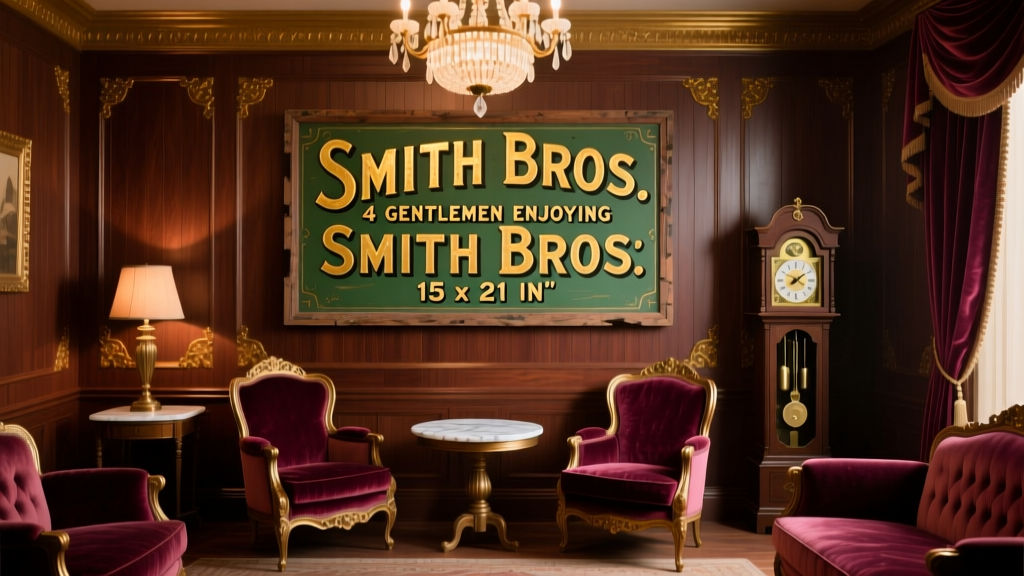
Smith Bros Beer Advertising Sign: '4 Gentlemen Enjoying Smith Bros Beer' — Historical Context, Material Analysis & Conservation Protocol
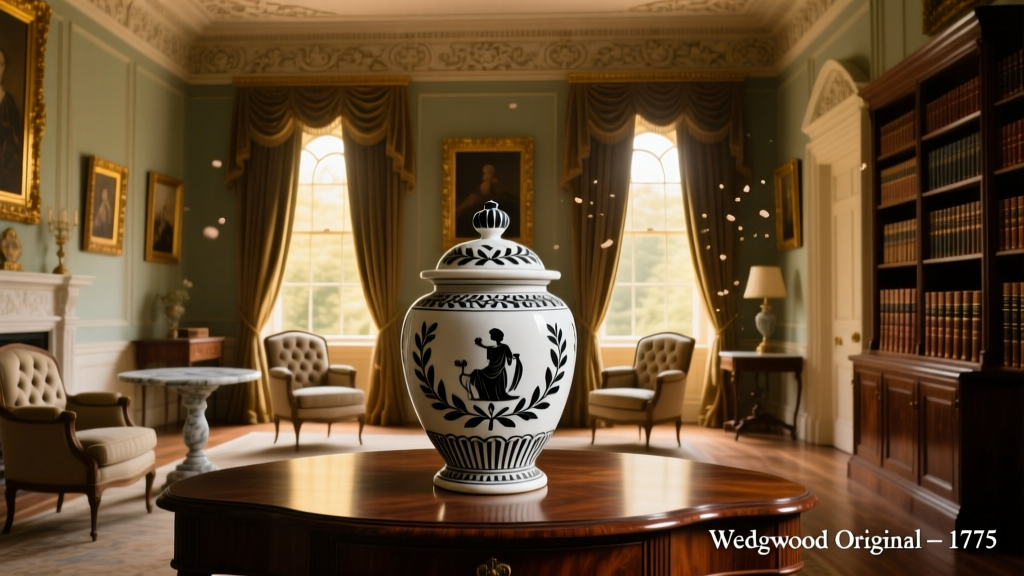
Wedgwood Vase Cover in Jasperware: A 6¾-Inch Black-and-White Classical Foliate Border Masterpiece

Chalkware Garniture Flowers: Painted 19th-Century Floral Centerpieces, 13½ Inches Tall
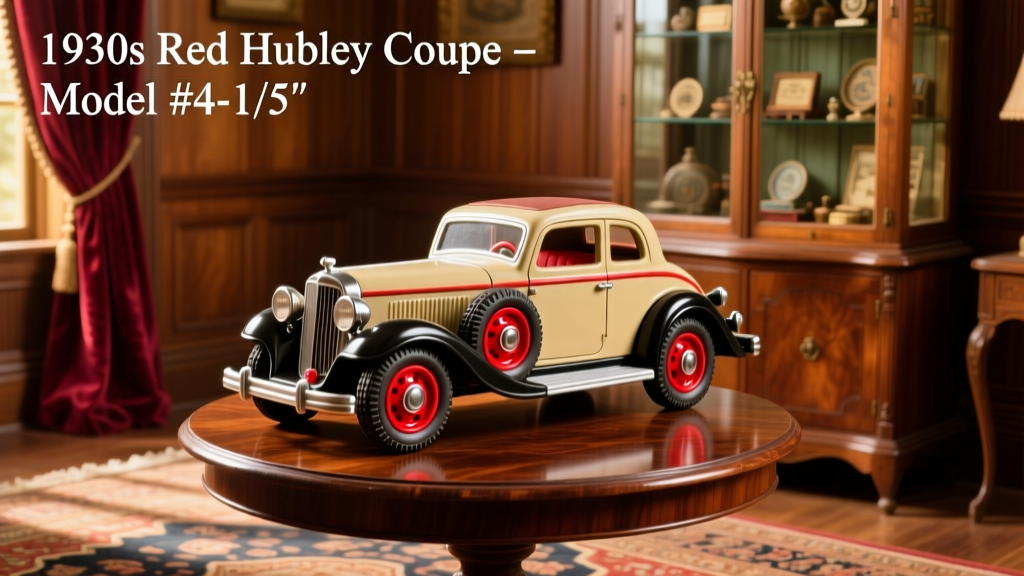
The Red Hubley Toy Car Coupe: A 1930s American Die-Cast Icon with Rubber Tires