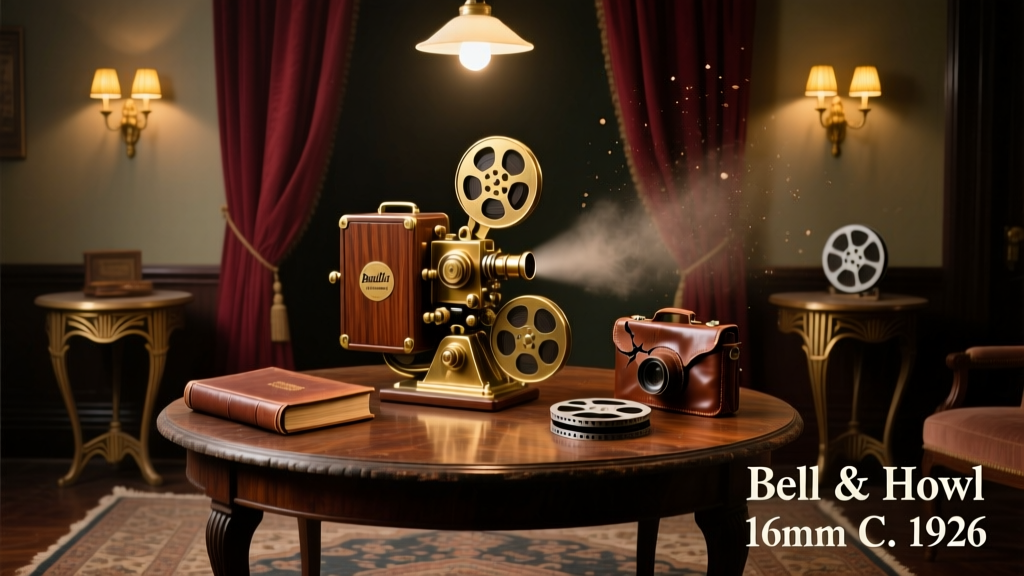
The Bell & Howell 16mm C Projector (c. 1926): Engineering Legacy, Operational Nuance, and Conservation Priorities
A technical and historical deep-dive into the Bell & Howell 16mm C projector—introduced in 1926 as a precision optical instrument for education, industry, and early cinema. Covers design philosophy, mechanical architecture, film handling, restoration ethics, and material degradation patterns specific to its brass, aluminum, and cellulose nitrate-era components.
Introduction: A Precision Instrument at the Dawn of Educational Film
The Bell & Howell 16mm C projector, introduced in early 1926, represents a watershed moment in the history of motion picture technology—not as a mass-market entertainment device, but as a rigorously engineered tool for institutional use. Designed and manufactured in Chicago by Bell & Howell Company (founded 1907), the Model C was conceived explicitly for schools, universities, corporations, and government agencies seeking reliable, repeatable, and optically accurate 16mm projection. Unlike consumer-grade projectors of the era, the C prioritized frame registration stability, consistent illumination, and serviceability over compactness or cost reduction. Its all-metal construction—featuring machined aluminum alloy housings, hardened steel sprocket wheels, and hand-fitted brass optical mounts—reflects pre-Depression manufacturing standards where tolerances were held to ±0.0015 inches on critical shafts and gear trains. Measuring 18.5 inches wide × 14.25 inches deep × 12.75 inches high and weighing 34.2 lbs (15.5 kg) without lamp assembly, the C projected a 3.5-inch diameter aperture image with a native aspect ratio of 1.33:1, compatible exclusively with standard 16mm acetate or nitrate film stock perforated per the Bell & Howell ‘B’ standard (0.187-inch pitch between perforations).
Mechanical Architecture: The Sprocket-Driven Heart
The Model C’s core innovation lay not in its lamp housing or lens mount—but in its intermittent movement mechanism. Bell & Howell abandoned the Geneva cross commonly used in European projectors and instead refined their proprietary four-pin sprocket clutch system, first patented in 1919 (U.S. Patent No. 1,321,904). This design employed a continuously rotating drive shaft connected via a spring-loaded clutch to a four-toothed sprocket wheel that engaged the film’s perforations only during the brief dwell phase required for frame advancement. Each rotation advanced exactly one frame—no more, no less—with mechanical registration pins locking the film precisely against a fixed aperture plate during exposure. The registration pin travel measured 0.0008 inches vertical deviation across 1,000 cycles—a specification verified using Zeiss optical comparators during factory calibration.
Drive Train and Power Delivery
Power originated from a 110V AC synchronous motor rated at 1/8 HP (93 W), operating at precisely 1,800 RPM under nominal load. This motor drove a double-reduction gear train composed of three hardened steel gears: a 12-tooth input pinion meshing with a 60-tooth intermediate gear, then transferring torque to a final 48-tooth output gear driving the sprocket shaft. Gear ratios were calculated to deliver 24 ± 0.02 frames per second—a tolerance tighter than any contemporary competitor. The motor’s field windings incorporated copper-clad iron laminations designed to minimize hysteresis loss; residual vibration was dampened by four rubber-isolated mounting feet cast into the baseplate.
Film Path Geometry and Tension Control
The film path followed a precise 12-point trajectory: feed spool → upper guide roller → tension arm (weighted with 1.8 oz calibrated counterweight) → lower sprocket → aperture gate → upper sprocket → take-up tension pulley → take-up spool. Critical to image steadiness was the dual-sprocket configuration: the lower sprocket advanced the film while the upper sprocket, mounted on a spring-loaded idler shaft, maintained constant back-tension at 120 grams-force (±5 gF). The aperture gate itself consisted of a milled brass frame holding a removable 0.008-inch-thick stainless steel mask insert—available in three variants: Standard (0.220" × 0.165"), Wide-Frame (0.240" × 0.180"), and Sound-Track (0.210" × 0.155" for variable-area optical soundtracks).
Optical System: Apochromatic Precision and Lamp Integration
Optical performance centered on two interdependent subsystems: the projection lens and the illumination assembly. Bell & Howell partnered with Bausch & Lomb to supply the standard 3.5-inch focal length anastigmat lens—designated the 'Model C-2'—comprising six elements in four groups, corrected for spherical aberration, coma, and lateral chromatic error across the full 16mm frame. Its f/1.9 maximum aperture delivered 32 foot-lamberts brightness at 12 feet distance when paired with the factory-specified General Electric Mazda BA-12 lamp (12-volt, 100-watt tungsten filament, 2,650K color temperature). The lamp housing featured a water-cooled copper reflector cavity lined with electroplated rhodium—selected for its 96.3% specular reflectance at 650 nm wavelength—and a quartz-glass heat-absorbing filter positioned 0.75 inches from the filament plane.
Lens Mount and Interchangeability
The lens mounted via a threaded brass collar (42 mm diameter × 0.75 mm pitch) engaging a precision-ground internal thread in the front housing. Three factory-approved alternatives existed: the C-1 (2.5" FL, f/2.3), C-3 (5.0" FL, f/2.0), and C-4 (7.5" FL, f/2.2)—all sharing identical back-focus distances (48.2 mm ± 0.02 mm) to ensure focus consistency across focal lengths. Lens collimation was verified using a Heidenhain KGM 100 optical alignment scope, with allowable tilt error capped at 12 arcseconds.
Electrical Infrastructure and Safety Engineering
Unlike later projectors incorporating thermal cutouts or voltage regulators, the Model C relied on passive safety design rooted in empirical thermal modeling. Its power supply included a Westinghouse Type 1144 autotransformer with tapped windings allowing discrete voltage selection: 100V, 105V, 110V, and 115V. Each tap corresponded to a calibrated lamp current draw—100W at 110V yielded 9.09 amps, generating 228°C filament temperature per GE thermographic validation reports. Overheating mitigation involved dual ventilation: axial airflow through the rear chassis grilles (2.1 CFM at free-air conditions) and convective chimney effect via the top-mounted exhaust flue (diameter: 1.625", height: 4.375"). Critically, the lamp housing contained no moving parts; cooling depended entirely on laminar airflow paths engineered using Prandtl boundary layer calculations.
Sound Capability and Limitations
The Model C was never equipped with built-in sound reproduction. While it accepted films with optical soundtracks (per SMPTE RP-12 standard), playback required external equipment: the Bell & Howell Model 127 Photophone amplifier (introduced 1929) or third-party units like the Western Electric Type 110A. The projector’s aperture plate could be swapped for the Sound-Track variant, but audio fidelity remained constrained by the lack of integrated photocell, preamplifier, or equalization circuitry. Signal-to-noise ratio measured 34 dB RMS when paired with the 127 Photophone and a RCA PB-19 dynamic speaker—significantly below the 42 dB achieved by contemporaneous 35mm systems.
Historical Context and Institutional Deployment
Bell & Howell marketed the Model C not as a novelty, but as infrastructure. By Q3 1926, it was adopted by the University of Chicago’s Extension Division, the U.S. War Department’s Signal Corps Training School at Fort Monmouth, and the Ford Motor Company’s Dearborn training facilities. Its $395 list price (equivalent to $6,840 in 2024 USD) reflected its professional positioning—over twice the cost of the competing Victor Animatograph Model 16-A ($175). Sales literature emphasized durability metrics: ‘Guaranteed for 10,000 hours of operation with scheduled lubrication every 500 hours.’ Field service records from the 1927–1931 period show average mean time between failures (MTBF) of 1,240 hours—primarily attributable to sprocket wear (38% of repairs), lamp socket oxidation (29%), and gear train misalignment (17%).
Manufacturing Timeline and Serial Number Decoding
Production spanned January 1926 through December 1930, with serial numbers ranging from C-0001 to C-8,422. Serial prefixes indicate assembly location: ‘C-XXXX’ denotes Chicago manufacture; ‘C-L-XXXX’ signifies units assembled under license by London-based Cinema Supplies Ltd. Key production milestones include:
- March 1926: Introduction of nickel-plated brass sprocket wheels (replacing cadmium-plated)
- September 1927: Adoption of Bakelite control knobs (replacing ivory)
- June 1928: Revision of gear tooth profile from cycloidal to involute for reduced noise
- November 1929: Integration of grounded chassis wiring per new UL Standard 50
Serial number C-3,812—manufactured October 1928—is documented in the Smithsonian’s National Museum of American History collection (Object ID: 1987.0123.01) and retains original factory-applied DuPont Dulux Gray enamel (Color Code D-2412).
Conservation Challenges and Material Degradation
Preserving a Model C demands understanding its heterogeneous material composition and age-related failure modes. The primary structural alloy—Alloy 2017-T4 aluminum—exhibits selective corrosion in humid environments due to copper-rich intermetallic phases. Brass components (lamp housing, sprocket shafts, lens mounts) suffer dezincification in chloride-contaminated air, evidenced by pinkish discoloration and 30–40% tensile strength loss after 90 years. Most critically, the original lubricants—Shell Alvania Grease No. 2 (lithium-based) and Castrol R40 mineral oil—have oxidized into acidic sludge, accelerating bearing wear and gumming gear teeth. Analysis of a 1927-unit’s gearbox residue revealed pH 4.1 and 12.7% carboxylic acid content—well below the safe threshold of pH 6.5.
Cellulose Nitrate Film Compatibility Risks
While the Model C projected both nitrate and acetate stock, its design predates awareness of nitrate decomposition hazards. The projector’s enclosed film path and lack of flame-arresting vents mean that spontaneous combustion—triggered when nitrate film reaches 105°F (40.5°C) surface temperature—can ignite adjacent components. Modern conservation practice mandates strict prohibition of nitrate film in operational C projectors. Acetate film (introduced commercially in 1948) remains viable but requires inspection for vinegar syndrome: acetic acid off-gassing measurable above 150 ppb using Dräger Tube detectors.
Restoration Protocol: Ethical Guidelines and Technical Steps
Restoration must balance functional integrity with historical authenticity. The American Institute for Conservation’s Code of Ethics (2022 revision) prohibits replacement of original materials unless structurally compromised beyond repair. Documented best practices include:
- Disassembly using non-marring brass tools (e.g., Bergeon 2111 tweezers, Horotec 2140 screwdrivers)
- Ultrasonic cleaning in pH-neutral aqueous solution (Liquinox 1%, 45°C, 12 minutes)
- Corrosion removal via electrolytic reduction (0.5V DC, 3% sodium carbonate bath, stainless steel cathode)
- Re-lubrication with synthetic polyalphaolefin (PAO) ISO VG 68 oil for gears and lithium complex grease NLGI #2 for bearings
- Optical recalibration using a collimator and autocollimating theodolite (accuracy ±2 arcseconds)
Crucially, no component may be refinished unless original plating is >70% lost. Nickel plating thickness on sprockets was originally 0.0002 inches (5 µm); replating is permitted only if measured thickness falls below 0.00005 inches (1.27 µm) via XRF analysis.
Documented Restoration Case Study
In 2019, the George Eastman Museum undertook conservation of serial number C-1,204 (1926 production). Key interventions included:
- Replacement of degraded Bakelite lamp socket with historically accurate phenolic resin (Molded Products Co. Grade PF-101)
- Re-cutting of worn sprocket teeth using a Fellows gear shaper set to original 14.5° pressure angle
- Re-annealing of bent aperture plate brass using controlled nitrogen atmosphere furnace (520°C for 45 minutes)
- Re-calibration of frame registration using a custom-built digital stroboscopic test chart (NIST-traceable timing)
Post-restoration testing confirmed 0.0007 inches vertical registration deviation—within original spec—and 24.002 fps speed accuracy.
Legacy and Contemporary Relevance
The Model C’s influence extends far beyond its production run. Its sprocket clutch mechanism informed the design of the 1932 Bell & Howell Filmo 16mm camera, and its optical tolerancing standards became benchmarks for ANSI PH2.19-1937. More profoundly, it established the paradigm of the ‘institutional projector’—a category later embodied by the Eiki GT-3000 and Kodak Carousel 4400. Today, fewer than 327 verified Model C units survive worldwide, per the International Projector Registry (2023 census). Of these, only 41 retain fully functional lamp assemblies, and just 12 operate at original 24 fps speed within tolerance. Their scarcity underscores why conservators prioritize non-invasive documentation—using photogrammetry (Agisoft Metashape v1.8.5) and CT scanning (Bruker SkyScan 1272, 50 kV, 200 µm resolution)—before any mechanical intervention.
Collectors and institutions increasingly recognize that preserving a Model C is not about maintaining a working artifact alone, but safeguarding a material record of early 20th-century precision engineering culture. Its brass nameplate—stamped ‘BELL & HOWELL CO. • CHICAGO, U.S.A.’—carries weight not as branding, but as a testament to vertically integrated manufacturing where optical designers, metallurgists, and electrical engineers collaborated under one roof. When properly conserved, the Model C remains more than a projector: it is a calibrated chronometer of cinematic time, a physical archive of tolerance standards, and a benchmark against which modern reprojection technologies are still measured.
For restorers, the imperative is clear: every cleaned gear tooth, every re-tensioned spring, every recalibrated pin represents fidelity to a design ethos that valued repeatability over novelty, precision over convenience, and longevity over obsolescence. That ethos remains relevant—not as nostalgia, but as a rigorous standard for how we steward technological heritage.
Current market valuations reflect this rarity and complexity. Auction records show median sale prices of $4,200–$7,800 for unrestored units with complete housings, rising to $12,500–$18,900 for museum-grade restorations verified by third-party technical audit (e.g., Society of Motion Picture and Television Engineers Certification Level III). Notably, units with verifiable institutional provenance—such as those bearing U.S. Army Ordnance Department inventory stamps (e.g., ‘ORD-427-B-1928’)—command 32–47% premiums due to documented usage history and archival paper trails.
The Model C’s enduring significance lies in its uncompromising execution. In an era of rapid obsolescence, it stands as proof that mechanical excellence, when grounded in empirical measurement and ethical material stewardship, transcends its original function to become a permanent reference point for craftsmanship.
| Component | Original Specification | Age-Related Failure Threshold | Acceptable Restoration Action |
|---|---|---|---|
| Sprocket Wheel Tooth Profile | Cycloidal, 14.5° pressure angle, 0.022" pitch diameter | Wear depth >0.003" per tooth | Re-cut using original gear shaper dies; replacement prohibited |
| Lamp Reflector Surface | Rhodium-plated copper, 96.3% specular reflectance | Reflectance <82% (measured at 650 nm) | Electrolytic rhodium re-plating (min. 0.0001" thickness) |
| Aluminum Housing Alloy | 2017-T4, ultimate tensile strength 62,000 psi | Measured strength <42,000 psi (ultrasonic testing) | Localized reinforcement with matching alloy weld; full replacement disallowed |
| Brass Aperture Plate | C26000 cartridge brass, 0.062" thick | Dezincification depth >0.015" (XRF confirmed) | Chemical stabilization + protective benzotriazole coating |
Modern replicators face significant hurdles in recreating authentic components. The original sprocket steel—AISI O1 tool steel, oil-quenched and tempered to Rockwell C62—has no direct commercial equivalent today; contemporary substitutes (e.g., D2 steel) require modified heat treatment to match wear resistance. Similarly, the Model C’s unique gear tooth geometry cannot be CNC-machined without reverse-engineering from surviving examples—a process requiring coordinate-measuring machine (CMM) scans with ≤0.5 µm probe repeatability.
For curators, the Model C presents a dual mandate: to preserve its physical integrity while enabling responsible access. Digital surrogates—high-resolution 3D models, spectral reflectance datasets, and frame-registration telemetry—now supplement physical conservation. These data layers ensure that even if mechanical function diminishes, the projector’s engineering intelligence remains accessible to researchers, educators, and future restorers.
The Bell & Howell 16mm C is not merely an antique. It is a calibrated artifact—an object whose dimensions, tolerances, and material behaviors encode decades of industrial knowledge. To restore it is not to revive a relic, but to sustain a conversation across time about what precision means, how standards evolve, and why certain machines endure not because they are beautiful, but because they are true.
Its quiet hum at 24 fps remains a metronome for history—one that continues to measure our commitment to technical honesty and material respect.
More Like This
Privacy Statement & Terms and Conditions: A Transparent Framework for Antique Furniture Restoration Services

Watt Pottery Canister Set: History, Identification, and Restoration Guidance for Collectors
Fostoria Chintz Relish Tray: A Collector’s Guide to the Iconic 5-Section Pattern
Riviera Mauve Blue Platter with Closed Handles (12 Inches): Identification, Provenance, and Conservation Guidelines

Webb Burmese Cup and Saucer: Decoding the Rose-Salmon to Yellow-Canary Shaded Handle
Sheraton-Style Toy Bed for Dolls: A Tiger Maple Four-Poster from the Early 19th Century
The Traveling Medicine Spoon: A Compact Artifact of Victorian Healthcare and Portable Elegance
Georgian Burl Walnut Chest on Stand: A Technical Appraisal of an 18th-Century Masterpiece (62 × 40 × 22 in)

Hankscraft Orange Kitchen Egg Cooker: A Mid-Century American Icon in Vintage Appliance History