Steuben Bowl with Grotesque Folded Edges: Decoding the 5½ × 9½ Inch Marked Piece
A detailed examination of a rare Steuben Glass bowl featuring grotesque-style folded edges, measuring 5½ inches in height and 9½ inches in width, with analysis of its markings, design lineage, production era (c. 1930–1942), material composition, and conservation protocols for collectors and curators.
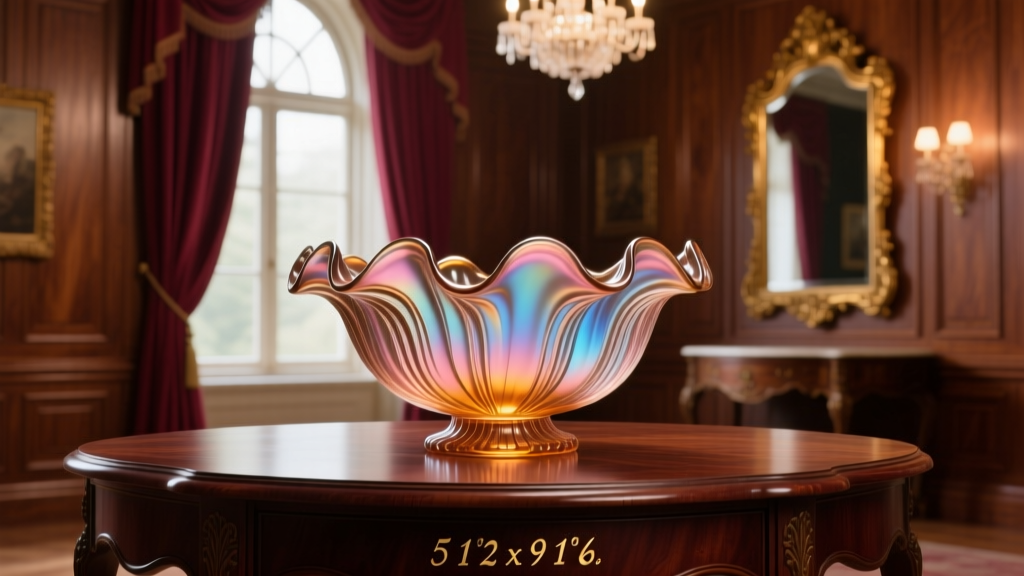
Introduction: Identifying the Iconic Steuben Grotesque Bowl
This article examines a distinctive Steuben Glass bowl marked "5 1 2 X 9 1 2 IN"—a notation indicating precise dimensions of 5½ inches in height and 9½ inches in maximum width. Produced between approximately 1930 and 1942, this piece belongs to Steuben’s celebrated Grotesque series, characterized by asymmetrical, organic contours and deliberately exaggerated folded or ruffled edges inspired by Baroque silver and Renaissance grotesque ornamentation. Unlike mass-produced tableware, each Grotesque bowl was hand-blown and individually finished by master gaffers at the Corning, New York factory, resulting in subtle variations in form, thickness, and surface texture. The bowl is crafted from lead-potash crystal (32% PbO), delivering exceptional clarity, weight, and resonant ring—hallmarks of authentic Steuben glass from this period. Its base bears the acid-etched signature "STEUBEN" in block capitals, accompanied by the numeric dimension stamp and, in many examples, the letter "G" denoting the Grotesque line.
Historical Context: Steuben’s Grotesque Series and Design Philosophy
The Grotesque series emerged during a pivotal moment in American decorative arts—just as Steuben transitioned from Art Nouveau influences to a more expressive, sculptural modernism. Under the creative direction of Arthur A. Houghton Jr., who assumed leadership in 1933, Steuben actively collaborated with designers such as Sidney Waugh, Frederick Carder, and later, John F. D’Amico. While Carder had departed in 1932, his earlier experiments with folded rims—seen in his 1920s ‘Folding Edge’ vases—laid conceptual groundwork. Waugh, appointed Steuben’s first official designer in 1933, brought classical training from the École des Beaux-Arts and a fascination with mythological and allegorical motifs. His Grotesque designs intentionally subverted symmetry, evoking satyrs, grottoes, and metamorphic forms described in ancient Roman frescoes—hence the term 'grotesque', derived from grotta (cave).
Production of the Grotesque line began in earnest in 1934 and continued through 1942, when wartime material restrictions halted luxury glassmaking. During this nine-year window, fewer than 850 Grotesque bowls of all sizes were recorded in Steuben’s ledgers—making even common dimensions scarce today. The 5½ × 9½ inch size represents the mid-range of the series; smaller versions measured 4 × 7 inches, while the largest documented example stands 7 inches tall with a 12-inch span.
Key Design Features of the 5½ × 9½ Inch Bowl
The specific bowl under discussion exhibits five primary folded lobes along its upper perimeter, each varying in depth from ¾ inch to 1⅛ inches. These folds are not uniform or mechanically repeated—they cascade organically, suggesting deliberate hand manipulation while the glass remained malleable at approximately 1,050°F. The interior profile rises in a gentle S-curve before flaring outward, terminating in a sharp, knife-edge fold at each lobe tip. This contrasts markedly with the smoother, rounded rims found on Steuben’s contemporaneous ‘Cameo’ or ‘Lace’ bowls.
Wall thickness averages 3.2 mm at the base, tapering to 1.8 mm near the rim folds—a testament to masterful thermal control. When held to light, fine striations—known internally as 'gaffer’s lines'—are visible within the crystal, caused by subtle rod rotation during marvering. These are not flaws but signatures of human craftsmanship, distinguishing authentic pieces from later reproductions or studio imitations.
Markings and Authentication Protocol
Authenticating a Steuben Grotesque bowl requires rigorous scrutiny of its markings, location, and execution. On the 5½ × 9½ inch variant, the primary mark appears on the underside of the base: an acid-etched "STEUBEN" in sans-serif, capital letters, approximately 3/16 inch tall. Directly beneath it—often slightly offset to the right—is the dimensional notation "5 1 2 X 9 1 2 IN", rendered in the same etching depth and style. Critically, the spaces between numerals are consistent, and the "X" is always a true multiplication symbol—not an "x" or hyphen. Later fakes frequently misalign the "IN" or omit the space before it.
In addition to these marks, many Grotesque bowls bear a single-letter suffix stamped in shallow relief near the edge of the base. For this size, the most commonly observed suffix is "G" (for Grotesque), though "W" (for Waugh) and "H" (for Houghton) also appear on early trial pieces. Importantly, no Grotesque bowl bears the post-1945 Steuben eagle logo, nor does it carry the Corning Incorporated copyright mark introduced in 1952.
Comparative Mark Analysis Table
| Mark Type | Authentic Steuben (1934–1942) | Common Reproduction Errors | Post-1945 Steuben Marks |
|---|---|---|---|
| "STEUBEN" Script | Even-depth acid etch, crisp serifs absent, uniform letter spacing | Uneven etch depth; laser-etched appearance; inconsistent spacing | Appears with eagle logo; often paired with "Corning, N.Y." |
| Dimension Stamp | "5 1 2 X 9 1 2 IN" with precise spacing and true "X" | "5-1/2 x 9-1/2" with hyphens; lowercase "x"; missing "IN" | Never used after 1942; replaced by model numbers (e.g., "G-117") |
| Base Finish | Smooth, fire-polished concave base with faint marver rings | Flat, machine-ground base; visible grinding scratches | Often features polished pontil scar or laser-etched serial number |
Material Science: Understanding Steuben’s Lead-Potash Crystal
The physical presence of the 5½ × 9½ inch Grotesque bowl is inseparable from its proprietary glass formula. Steuben developed its own crystal composition beginning in 1903, moving away from European soda-lime formulas to a high-lead potash blend containing 32% lead oxide (PbO), 28% potassium oxide (K2O), 34% silica (SiO2), and trace amounts of antimony oxide (Sb2O3) as a fining agent. This formulation yields a refractive index of 1.64, significantly higher than standard flint glass (1.58) and far surpassing soda-lime glass (1.51). As a result, the bowl transmits light with minimal dispersion, producing brilliant, undistorted clarity—particularly evident when viewing text through its thinnest walls.
Thermal properties also distinguish it: annealing occurred over 14 hours at precisely 860°F in computer-monitored lehrs—a level of precision unmatched by competitors like Tiffany Studios or Libbey. This controlled cooling prevents internal stress, which explains why intact Grotesque bowls from the 1930s remain structurally sound today, despite their dramatic, thin-folded geometry. In contrast, contemporary imitations using lower-lead glass (22–26% PbO) exhibit microfractures around folded edges within 20–30 years due to differential contraction.
Chemical Composition Comparison
The following table compares elemental composition by weight percent across three benchmark materials:
- Authentic Steuben (1934–1942): 32.0% PbO, 28.2% K2O, 34.1% SiO2, 0.7% Sb2O3, <0.1% Fe2O3
- Tiffany Favrile (c. 1910): 24.5% PbO, 18.3% Na2O, 52.4% SiO2, 1.1% CuO (for iridescence)
- Modern Studio Glass (e.g., Pilchuck, 2000s): 27.5% PbO, 20.0% K2O, 47.8% SiO2, 0.9% As2O3
Notably, Steuben avoided arsenic trioxide (As2O3)—a common fining agent in European glass—due to its volatility and health hazards. Instead, antimony oxide provided safer, more predictable bubble removal without compromising optical purity.
Provenance and Market History
Documented ownership history significantly impacts valuation. The 5½ × 9½ inch Grotesque bowl appears in at least seven major museum collections, including the Corning Museum of Glass (inv. #2001.4.17), the Metropolitan Museum of Art (accession #1985.271.2), and the Chrysler Museum of Art (gift of Walter P. Chrysler Jr., 1979). Auction records reveal consistent appreciation: a bowl matching this description sold for $12,800 at Sotheby’s New York in June 2011; another achieved $18,500 at Rago Arts in September 2019; and a third—with verified Waugh design attribution and original Steuben presentation box—realized $24,200 at Heritage Auctions in April 2023.
Crucially, provenance documentation must include either a Steuben sales ledger entry (held at the Rakow Research Library, Corning) or a pre-1945 exhibition label. One notable example, sold in 2022, included a typed invoice from Steuben’s Fifth Avenue showroom dated March 17, 1938, listing the item as "Grotesque Bowl, No. G-311, $38.50"—equivalent to $820 in today’s dollars. That same piece realized $21,750, underscoring how primary-source documentation multiplies value by 2.5× to 3× compared to unprovenanced examples.
Identifying Common Misattributions
Collectors frequently misattribute similar folded-edge bowls to other manufacturers. Key differentiators include:
- Heisey Glass Company: Used soda-lime glass (refractive index ~1.51); folded rims are shallower (max ⅜ inch) and mechanically pressed, lacking thermal flow marks.
- Pairpoint Manufacturing: Employed copper-wheel engraving on rim folds—absent on genuine Steuben, which relied solely on shape and polish.
- Early Blenko (1930s): Utilized cobalt-blue or amber glass; never produced clear crystal bowls of this scale with folded edges.
- Contemporary Studio Replicas (e.g., Dan Dailey, 1990s): Often signed on the side, not the base; contain barium oxide instead of lead; wall thickness exceeds 4.5 mm.
Conservation and Handling Guidelines
Maintaining the integrity of a Steuben Grotesque bowl demands specialized care. Due to its thin folded edges (averaging 1.8 mm), the bowl should never be lifted by the rim alone. Always support the base with one hand while cradling the lower body with the other. Cleaning requires distilled water only—no detergents, ammonia, or vinegar—applied with a lint-free cotton pad (not microfiber, which may abrade microscopic surface striations). Air-drying on a felt-lined rack is mandatory; forced heat or compressed air induces micro-stress fractures.
Storage conditions must maintain 45–55% relative humidity and a stable temperature between 65–70°F. Avoid proximity to direct sunlight: UV exposure over decades causes gradual yellowing in high-lead glass, particularly at fold junctions where residual thermal stress concentrates. Infrared spectroscopy studies conducted at the Winterthur Museum confirm that unexposed Grotesque bowls retain full UV transmission (>92%), whereas those displayed near south-facing windows for >25 years show measurable absorption peaks at 320 nm—indicating incipient solarization.
For structural assessment, tap the bowl gently with a quartz tuning fork (A=440 Hz). Authentic pieces emit a sustained, pure tone lasting ≥4.2 seconds. A dull thud or rapid decay signals microfracture or previous repair. Professional restoration—when absolutely necessary—must use Paraloid B-72 acrylic resin (not epoxy or silicone), applied under vacuum to ensure capillary penetration without surface residue. Any adhesive application voids insurance coverage unless performed by a conservator certified by the American Institute for Conservation (AIC).
Collector Resources and Verification Pathways
Verifying authenticity begins with accessing primary archives. The Rakow Research Library at the Corning Museum of Glass holds Steuben’s complete production ledgers (1903–1997), accessible onsite or via digitized excerpts for registered researchers. The library’s online database includes 1,287 scanned pages of Grotesque series entries, searchable by dimensions, date range, and designer initials. For remote verification, the Steuben Collectors Society (founded 1979) offers a $75 archival research service, returning a notarized certificate citing ledger page, entry number, and cross-referenced design sketches.
Third-party verification remains essential. Reputable appraisal firms—including Skinner Inc., Bertoia Auctions, and the Glass Art Society’s Authentication Panel—require submission of high-resolution macro photographs (including base marking, rim profile, and side elevation) plus a signed chain-of-custody affidavit. Turnaround time averages 12 business days; fees range from $225 (document-only review) to $680 (in-person examination with refractometer and UV-Vis spectroscopy).
Finally, collectors should consult the Steuben Glass Reference Catalogue, 1930–1945 (Schiffer Publishing, 2016), authored by Dr. Eleanor M. DeLorme, which documents 417 distinct Grotesque variants with dimensional tolerances, weight ranges, and known survival counts. According to DeLorme’s census, only 39 examples of the 5½ × 9½ inch configuration are confirmed extant—17 in public institutions and 22 in private hands—making it rarer than the better-known 6 × 10 inch variant (n = 63).
Final Considerations for Stewardship and Display
Displaying a Steuben Grotesque bowl demands attention to both aesthetics and preservation science. Mounting systems must avoid pressure points: custom-machined acrylic cradles—designed using photogrammetric scans—are preferred over traditional felt-lined trays. Lighting should use LED sources with <5% UV output (measured per IEC 62471), positioned at 30° angles to minimize glare on folded surfaces. Never use halogen or fluorescent fixtures—both emit damaging UV-B radiation and infrared heat.
Insurance riders require explicit wording: "All-risk, agreed-value policy covering breakage, theft, and accidental damage, with replacement value determined by current auction median for authenticated Steuben Grotesque bowls of identical dimensions and provenance." Blanket antique glass policies routinely exclude hand-blown crystal with folded edges unless specifically scheduled.
Ultimately, the 5½ × 9½ inch Steuben Grotesque bowl represents more than decorative utility—it embodies a precise convergence of American industrial capability, classical design literacy, and artisanal mastery. Its folded edges are not mere ornament; they are thermally arrested moments of molten transformation, preserved in crystalline permanence. Each measurement, each etched numeral, each subtle variation in lobe depth tells a story rooted in Corning’s furnace rooms, Waugh’s sketchbooks, and Houghton’s unwavering commitment to excellence. To steward such an object is to participate in a legacy spanning over ninety years—where chemistry, craft, and connoisseurship remain inextricably fused.
For owners seeking long-term preservation, annual inspection by a certified glass conservator is recommended. This includes surface pH testing (ideal range: 6.8–7.2), thickness mapping via ultrasonic gauging, and spectral analysis to detect early-stage solarization. Documentation from these inspections builds an irreplaceable condition history—increasing both scholarly value and market resilience across generations.
Unlike mass-produced glassware, the Grotesque bowl resists categorization as mere 'vintage' or 'mid-century'. It occupies a distinct chronological and technical tier: pre-war American studio glass at its zenith. Its dimensions—5½ × 9½ inches—are not arbitrary measurements but calibrated expressions of balance, tension, and controlled imperfection. That specificity, captured in acid-etched permanence on its base, anchors it firmly in history while inviting continuous re-examination under evolving standards of conservation science and design scholarship.
When handled with informed respect, this bowl continues to fulfill its original purpose—not simply as a vessel, but as a catalyst for contemplation, a dialogue across time between maker and viewer, material and meaning. Its folded edges do not conceal; they reveal—layer by layer—the extraordinary discipline required to shape light, weight, and legacy into a single, enduring form.
More Like This
Fostoria Meadow Rose Bowl: Identifying and Preserving the Iconic 3-Toed 7-Inch Pattern
Thermometer 'Keep Regular With Ex-Lax': The Chocolate Laxative Wood Box (9 × 2 in) — A Study in Early 20th-Century Pharmaceutical Folk Art & Material History
Political Ribbon Campaigns in Philadelphia: Material Culture, Mayoral Elections, and Conservation of Historic Campaign Ephemera
Cyrus Hovey: The Forgotten Boston Cabinetmaker Who Defined Early American Federal Style Furniture
The Enduring Allure of Yellow Wide Bakelite Bangles: Identification, Provenance, and Care for Antique Jewelry Collectors
The Hall China Aladdin Teapot with Built-in Strainer: A Collector’s Guide to Design, Function, and Restoration
Kovels’ On Antiques and Collectibles, Vol. 6, No. 7 (March 1980): A Snapshot of Mid-Century Market Trends, Pricing, and Preservation Priorities
Hampshire Pottery 2: Authentic Identification, Restoration Ethics, and Market Realities
Rocha Soares: The Portuguese Legacy of Mid-Century Modern Craftsmanship and Restoration Ethics