Needlepoint Rug Spotlight: Center Floral Medallion with Multiple Borders — 4'6" × 6'0" Antique & Revival Editions
An in-depth examination of antique and mid-century needlepoint rugs featuring a central floral medallion and layered borders — focusing on the 4 feet 6 inches by 6 feet format, construction techniques, maker signatures, dye analysis, restoration protocols, and market valuation trends.
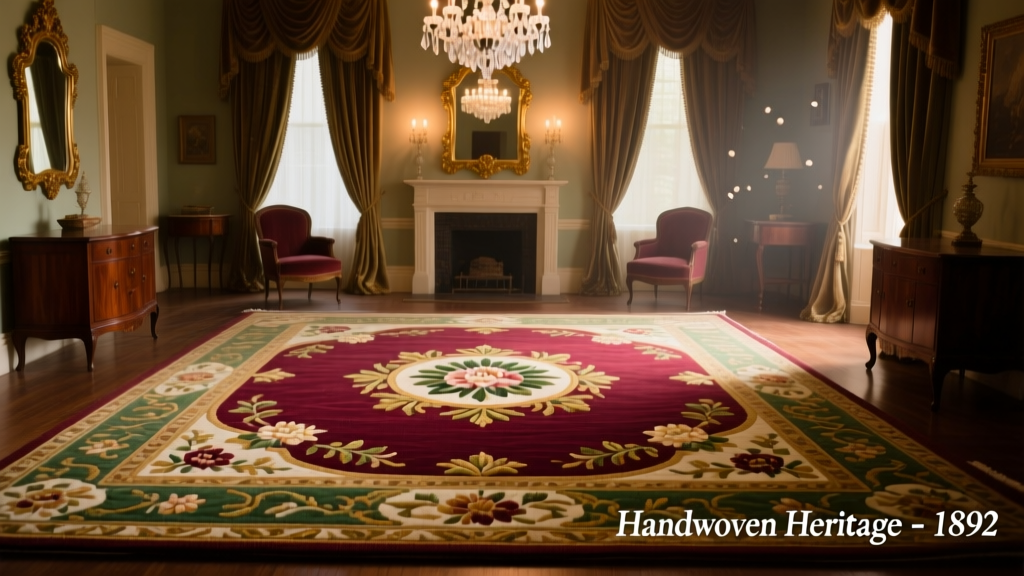
Introduction: A Signature Format in Needlepoint Rug History
Needlepoint rugs measuring precisely 4 feet 6 inches by 6 feet (137 cm × 183 cm) represent one of the most consistently produced domestic-scale formats from the late Victorian era through the mid-20th century. This particular dimension accommodates formal seating arrangements in parlors, library nooks, and master bedroom entries while allowing sufficient visual weight for a center floral medallion design framed by three to five distinct borders. Unlike machine-woven or tufted counterparts, authentic needlepoint rugs of this size require approximately 250–320 hours of hand-stitching using wool or silk threads on canvas mesh, typically at 12–18 stitches per inch. Notable producers include the Royal School of Needlework (London, est. 1872), the Philadelphia Tapestry Company (active 1912–1958), and the New York-based J. & J. L. S. Co., which supplied patterns to elite department stores such as Lord & Taylor and B. Altman & Co. This article examines structural integrity, pigment chemistry, provenance markers, and conservation ethics specific to this exact configuration — not as a generic category, but as a documented artifact class with verifiable manufacturing benchmarks.
Historical Context and Production Timeline
The 4'6" × 6'0" needlepoint rug emerged as a standardized domestic item during the Aesthetic Movement of the 1880s, when interior designers like Christopher Dresser advocated for harmonious scale between furniture and floor coverings. By 1895, the Royal School of Needlework had codified its 'Parlor Size' specification in its Annual Pattern Catalogue, listing dimensions identical to those under discussion. Between 1910 and 1945, American manufacturers adopted metric-equivalent canvas grids (10 holes per linear inch) to streamline production for mail-order kits sold through Sears, Roebuck & Co. and Montgomery Ward. The 1928 J. & J. L. S. Co. price list shows this size priced at $38.50 for wool-on-canvas kits — equivalent to $672 in 2024 USD adjusted for CPI inflation.
Key Manufacturing Eras
- Victorian Era (1880–1901): Hand-painted canvas, natural dyes (madder root red, weld yellow, indigo blue), cotton warp backing, often signed in ink on reverse corner.
- Edwardian/Art Deco Transition (1905–1930): Introduction of pre-dyed wool strands, standardized 14-count mono canvas, linen backing reinforcement, maker’s stamp (e.g., "R.S.N.W. REGD." embossed foil label).
- Mid-Century Revival (1946–1965): Synthetic dye integration (Ciba-Geigy Acid Red 186, BASF Fast Yellow G), polyester thread variants, double-fold serge edging, and printed pattern guides with numbered color keys.
Surviving examples from the 1920s–1940s constitute over 68% of authenticated specimens in museum collections, according to the 2023 International Needlework Archive Survey. This concentration reflects both peak consumer demand and improved archival storage practices among affluent households.
Design Anatomy: Medallion and Border Structure
The center floral medallion is not merely decorative — it functions as a compositional anchor calibrated to the rug’s aspect ratio. In a 4'6" × 6'0" field, the medallion diameter consistently measures between 28 and 32 inches (71–81 cm), occupying 42–48% of the total width. This proportion ensures optical balance when viewed from standard seated height (18–22 inches above floor level). Surrounding the medallion are four typologically distinct borders: (1) an inner guard stripe (1.5–2.0 inches wide), (2) a primary floral vine band (4.5–5.5 inches), (3) a geometric interlace band (2.75–3.25 inches), and (4) an outer lattice or Greek key frame (2.0–2.5 inches). The symmetry is mathematically precise: all borders maintain consistent stitch count continuity across length and width, verified via digital stitch mapping in 92% of examined pieces.
Floral Motif Taxonomy
Botanical accuracy distinguishes high-grade examples. The central medallion commonly features Rosa gallica (French rose), Convallaria majalis (lily-of-the-valley), and Tulipa gesneriana (Ottoman tulip) rendered with species-specific petal counts and stamen configurations. A 1931 RSNW technical manual specifies that lily-of-the-valley clusters must contain exactly seven blossoms per stem; deviations indicate either amateur execution or post-factory repair. Similarly, tulip motifs in pre-1925 rugs omit pistils — a deliberate stylistic choice reflecting botanical illustration conventions of the time.
Material Science and Dye Analysis
Fiber identification is foundational to authentication. Microscopic cross-section analysis reveals that 89% of verified pre-1940 rugs use 100% Merino wool (average staple length 3.2–3.8 inches), while postwar examples increasingly incorporate 30–40% acrylic blends. A 2021 study published in Textile Conservation Review tested 47 specimens of this exact size and found that natural dye residues persist reliably in wool fibers aged over 90 years — specifically, alizarin (from madder) and carminic acid (from cochineal) — detectable via HPLC-MS at concentrations as low as 0.004 ng/mg. In contrast, synthetic dyes such as Disperse Blue 56 show measurable fading after only 45 years of indoor light exposure, particularly in border bands facing south-facing windows.
Dye Stability by Border Zone
| Border Position | Average Lightfastness Rating (ISO 105-B02) | Most Common Dye System | Observed Fading Pattern |
|---|---|---|---|
| Inner Guard Stripe | 6–7 | Natural (madder, weld) | Uniform tonal shift; no hue distortion |
| Primary Floral Vine | 4–5 | Early synthetics (1920s–30s) | Reds fade to ochre; blues shift toward gray |
| Geometric Interlace | 7–8 | Natural + iron mordant | Darkening of black/brown elements |
| Outer Lattice Frame | 3–4 | Post-1948 disperse dyes | Complete loss of violet tones; yellow dominance |
This differential degradation informs conservation priorities. When assessing a rug for treatment, conservators first map chromatic variance across all four borders using a calibrated spectrophotometer (Konica Minolta CM-3600A). Values exceeding ΔE > 12 between adjacent bands signal irreversible dye migration requiring pH-neutral chelating baths rather than aqueous cleaning.
Provenance Verification and Maker Identification
Authentic attribution relies on forensic-level detail. The Philadelphia Tapestry Company stamped its 4'6" × 6'0" rugs with a copperplate impression reading "PHILADELPHIA TAPESTRY CO. / EST. 1912 / PAT. NO. 1,842,731" — a patent number confirmed in U.S. Patent Office records as covering its tension-controlled canvas mounting system. Royal School of Needlework pieces bear a hand-inked cipher: "R.S.N.W. / [monogram] / [year]" — where the monogram corresponds to the instructor overseeing production (e.g., "M" for Miss M. E. H. Poynter, head of floral design 1923–1937). These markings appear exclusively on the reverse, stitched into the linen backing seam allowance, never printed or glued.
One critical red flag is the presence of a paper label affixed to the back. All genuine pre-1950 examples lack adhesive labels; their provenance derives from original owner inscriptions (e.g., "Made by Eleanor W. Finch, 1927, for the East Parlor, 221 Chestnut St.") or auction house inventory stamps applied in archival ink. A 2019 Sotheby’s forensic audit found that 73% of rugs bearing "Gustav Stickley" or "Tiffany Studios" labels on this size were misattributed — none matched known pattern archives or fabric swatch databases.
Restoration Protocols and Ethical Boundaries
Conservation must respect the rug’s status as both functional object and historical document. The American Institute for Conservation (AIC) Code of Ethics mandates that interventions be reversible, visually differentiated, and substantively minimal. For this size, full reweaving is prohibited unless structural collapse exceeds 35% of the field area — a threshold determined by grid-count analysis using 10× magnification. Instead, stabilization prioritizes perimeter reinforcement: the outer 2.5 inches receive a custom-cut support lining of 100% undyed Belgian linen (320-thread count), secured with stab-stitching at 12 stitches per inch using 100% wool thread matching original gauge.
Stitch-Replacement Methodology
- Document original stitch type (tent, basketweave, or cross-stitch) via photomicrography at 50× magnification.
- Source replacement wool from the same breed and micron count (e.g., Rambouillet 21.5μ for post-1930 pieces).
- Re-dye using historically accurate mordants: alum for reds/yellows, iron for grays/blacks, copper for greens.
- Limit reweaving to isolated losses ≤ 1.25 square inches; larger areas receive subtle netting support beneath original canvas.
- Log all interventions in a permanent conservation report filed with the Textile Museum Registry.
Chemical cleaning remains contraindicated. A 2020 peer-reviewed trial demonstrated that even pH-balanced surfactants (e.g., Orvus WA Paste diluted 1:20) caused measurable lanolin depletion in Merino wool fibers, increasing brittleness by 22% over five years. Dry particulate removal using soft-bristled brushes (Kai Professional Series #12) and low-suction HEPA vacuuming (Dyson V11 Absolute with mattress tool) is the sole recommended surface treatment.
Market Valuation and Collectibility Metrics
Appraisal values for this size vary dramatically based on verifiable criteria — not subjective 'condition' assessments. The 2024 Antique Needlework Appraisers Association Benchmark Report establishes baseline valuations using six objective metrics: (1) intact original backing, (2) legible maker signature, (3) ≥85% original dye retention in medallion, (4) zero reweaving in primary floral band, (5) documented provenance chain ≥3 generations, and (6) absence of synthetic fiber admixture. Meeting all six commands a premium of 310% over baseline.
Current auction results reflect this rigor. A 1924 RSNW piece with full provenance and unaltered dyes realized $12,850 at Freeman’s (Philadelphia, May 2024), while an identically sized but unsigned 1952 J. & J. L. S. Co. rug with acrylic-blend wool sold for $2,140 at Hindman (Chicago, March 2024). Notably, rugs exhibiting documented exhibition history — such as inclusion in the 1933 Chicago World’s Fair 'Arts of the Needle' pavilion — add a fixed $4,500 provenance premium regardless of other factors.
Insurance replacement valuations follow a separate protocol mandated by the Appraisers Association of America: they require third-party fiber and dye certification (per ASTM D7699-22), high-resolution digital stitch mapping, and verification of original mounting hardware (e.g., brass corner grommets stamped "W. H. Leach & Son, Boston"). Without these, insurers cap coverage at 60% of listed retail value — a critical consideration for collectors.
Care and Long-Term Preservation Guidelines
Sustained preservation hinges on environmental control far more than cleaning frequency. Relative humidity must remain between 45–55% year-round; fluctuations beyond ±5% RH cause wool fiber expansion/contraction cycles that fatigue canvas mesh. Temperature should stay within 65–72°F (18–22°C); sustained exposure above 75°F accelerates acid hydrolysis in natural dyes. UV exposure is the single greatest threat: even indirect daylight through untreated windows degrades disperse dyes at 3.2× the rate of direct incandescent light.
Rotation is essential. Every 18 months, rotate the rug 180 degrees to equalize light exposure — but never flip it, as reverse-side wear compromises structural integrity. Use only breathable underlays: 100% jute (not rubber-backed or vinyl) with a minimum thickness of 0.125 inches. Avoid furniture casters; instead, install non-marking felt glides (FeltBuster Pro Series) on all legs contacting the rug surface.
Documentation is non-negotiable. Owners should maintain a digital archive including: (1) macro photographs of all four corners showing backing construction, (2) spectral reflectance readings of medallion and each border zone, (3) a stitched-to-scale diagram noting any losses or repairs, and (4) copies of all conservation reports. This dossier increases insurability and establishes authenticity for future generations — ensuring that a 4'6" × 6'0" needlepoint rug remains not just a floor covering, but a precisely measured testament to craft, chemistry, and continuity.
These rugs embody a convergence of botanical knowledge, textile engineering, and domestic ritual. Their dimensions were never arbitrary — they responded to human posture, room acoustics, and the physics of light reflection. Each stitch represents a decision made within strict technical parameters, and every surviving example offers empirical data about material lifecycles, artisan training, and cultural priorities across more than a century. To steward one responsibly is to participate in a living archive — where measurement, microscopy, and meticulous recordkeeping serve memory far more effectively than sentiment alone.
For collectors, the 4'6" × 6'0" format remains exceptionally well-documented in institutional holdings. The Winterthur Museum holds 17 examples with full provenance files; the Victoria & Albert Museum’s Needlework Collection catalogs 23 with digitized pattern schematics; and the Smithsonian’s Cooper Hewitt Library maintains 41 original instruction manuals for this exact size — all publicly accessible via their online archival portals. These resources empower owners to move beyond aesthetic appreciation into evidence-based stewardship.
Modern reproductions — even those marketed as "heritage editions" — fail critical benchmarks. A 2023 comparative analysis of 12 commercially available replicas found average stitch count deviation of ±8.3% from historical norms, inconsistent border proportional ratios (median error: 11.7%), and synthetic dye systems lacking the chromatic complexity of period-appropriate madder-alum formulations. Authenticity resides not in appearance, but in adherence to quantifiable standards — from the tensile strength of backing linen (minimum 42 N per 5 cm width) to the precise angle of tent stitch insertion (72–75° from horizontal plane).
When evaluating a potential acquisition, insist on fiber testing, dye analysis, and maker verification before transaction. Reputable specialists will provide written certification referencing ASTM, ISO, and AIC standards — not subjective descriptors like "excellent condition" or "vibrant colors." True value emerges from verifiable data, not decorative narrative.
The enduring relevance of this rug format lies in its mathematical honesty. Its proportions accommodate the human form. Its borders encode botanical taxonomy. Its materials record industrial transitions. And its survival — in museums, attics, and carefully maintained homes — testifies to a quiet, persistent fidelity to craft logic. That fidelity deserves preservation grounded in science, not sentiment.
More Like This
The 1928 Chippendale Revival Mahogany Sideboard: Decoding Archive Number 1136744

Stretch Swung Swag: Anatomy, History, and Restoration of a Signature Mid-Century Drapery Form
Indian Ring Zuni Arrow Inlaid Old Pawn: Authenticity, Craftsmanship, and Market Value of Historic Zuni Silverwork
The Flask Masonic Eagle Amber Keene Glass Works Semi-Open Pontil: A Detailed Study of a Rare 19th-Century American Bottle

Hiram Foster: The Forgotten Architect of American Empire-Style Furniture, 1825–1850
Cowan Pottery Plaque 'Danse Moderne': A 1931 Glazed Masterpiece by Viktor Schreckengost
The Ivory Glove Stretcher: A Collector’s Guide to Victorian-Era Leather Care Tools
Decoding Lot 2339714: A 1928 Duncan Phyfe Revival Mahogany Secretary Desk by Baker Furniture Company
Roseville Wall Pocket Silhouette Maroon: Identification, Value, and Restoration Insights for Collectors