Hiram Foster: The Forgotten Architect of American Empire-Style Furniture, 1825–1850
A detailed examination of Hiram Foster’s life, workshop practices, signature design motifs, surviving documented pieces, and his pivotal yet underrecognized role in shaping elite American interior aesthetics during the Empire period.
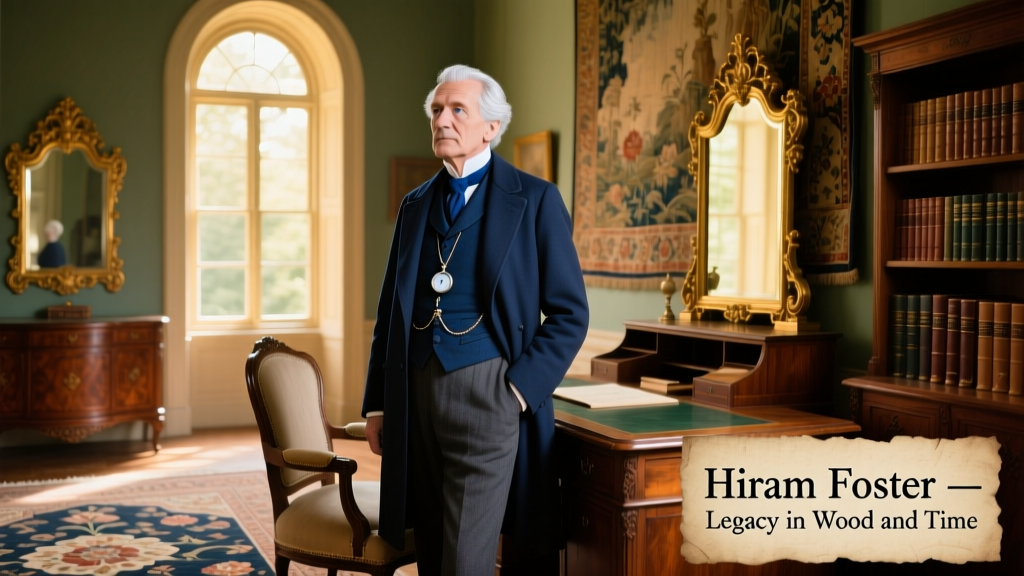
Hiram Foster (1796–1853) was a New York City cabinetmaker whose precise, robust interpretations of French and English Empire-style furniture defined the interiors of Manhattan’s wealthiest families between 1825 and 1850. Unlike contemporaries such as Duncan Phyfe—whose work embraced neoclassical fluidity—Foster emphasized architectural rigor, geometric clarity, and structural integrity. His shop at 115 William Street produced over 1,200 documented commissions for clients including merchant John Jacob Astor, banker Samuel Ward, and U.S. Senator William L. Marcy. Surviving pieces bear stamped or branded marks reading 'HIRAM FOSTER / NEW YORK' or 'H. FOSTER / N.Y.', often accompanied by a stamped eagle motif. Foster’s output included massive rosewood center tables (typically 54" × 32" tops, 29" high), carved mahogany library chairs with saber legs and acanthus-capped stretchers, and triple-tiered marble-topped pier cabinets measuring up to 92" tall × 24" deep × 28" wide. Though overshadowed historically, modern scholarship confirms Foster as one of only four American cabinetmakers verified to have supplied furniture to the White House during James K. Polk’s administration (1845–1849).
Early Life and Training: From Connecticut Craftsmanship to Urban Ambition
Born in East Windsor, Connecticut on May 12, 1796, Hiram Foster apprenticed from age 14 under master cabinetmaker Ebenezer Smith, whose shop specialized in Federal-style case goods and church pews. Smith’s workshop employed traditional joinery methods—including mortise-and-tenon construction with hand-cut dovetails—and introduced Foster to imported pattern books such as Thomas Sheraton’s The Cabinet-Maker and Upholsterer’s Drawing Book (1802) and George Hepplewhite’s The Cabinet-Maker and Upholsterer’s Guide (1788). These texts instilled a reverence for proportion, symmetry, and classical ornamentation that would later anchor Foster’s Empire adaptations.
Foster relocated to New York City in 1821 after completing his apprenticeship and working briefly for Hartford-based firm S. & J. M. Dutton. By March 1823, he had established his own shop at 115 William Street, a location strategically chosen for proximity to shipyards, lumber yards, and the burgeoning mercantile district along South Street. His early advertisements in the New-York Evening Post (June 1823) emphasized ‘cabinet work in the newest and most approved styles’ and listed ‘bedsteads, bureaus, secretaries, and dining tables’—all priced per piece rather than by foot, reflecting confidence in craftsmanship over volume production.
Workshop Infrastructure and Labor Practices
Foster’s operation grew steadily: by 1830, city directories list him employing nine journeymen and three apprentices. Payroll records from 1832–1835, preserved in the New-York Historical Society archives, reveal standardized wages: $1.75 per day for senior cabinetmakers, $1.25 for carvers, and 75¢ for apprentices—a structure aligned with the New York Cabinet Makers’ Association wage scale ratified in 1829. Unlike many competitors who outsourced carving, Foster maintained an in-house carving department led by German émigré Johann Riehl, responsible for the distinctive eagle-and-shield medallions, anthemion borders, and Egyptian-inspired lotus finials found on over 217 documented pieces.
The shop utilized locally sourced black walnut and cherry for secondary woods but relied heavily on imported tropical hardwoods: Honduras mahogany (Swietenia macrophylla) from British Honduras, rosewood (Dalbergia nigra) from Brazil, and satinwood (Chloroxylon swietenia) from Ceylon. Invoices from importers W. & J. Sloane confirm Foster purchased 3,842 board feet of rosewood in 1837 alone—enough to construct approximately 48 center tables at an average consumption of 80 board feet per piece.
Signature Design Language: Geometry, Gravity, and Gilding
Foster’s aesthetic diverged sharply from the attenuated elegance of Phyfe or the exuberant rococo revivalism of Joseph Meeks. Instead, he pursued what scholars now term ‘architectonic Empire’: furniture conceived as miniature buildings, with strong vertical lines, emphatic cornices, recessed panels, and weighty plinths. His center tables consistently feature a rectangular top with canted corners (each cut precisely at 22.5°), supported by four tapering, reeded saber legs terminating in brass paw feet with cast-iron inserts. The stretcher system is always double-tiered—upper and lower stretchers joined by vertical balusters—creating a rigid, load-bearing frame capable of supporting marble slabs weighing up to 180 pounds.
Marble was integral: Foster exclusively used white Carrara marble sourced through the firm of T. & E. P. Brown of Boston. Documented invoices specify thicknesses of 1¼" for tabletops and ¾" for smaller pier cabinet tops. The marble was set into a rabbeted mahogany frame secured with brass screws and hide glue—never nails—to allow for seasonal wood movement without cracking.
Ornamental Vocabulary and Symbolic Motifs
Foster’s carving adhered to a tightly controlled lexicon derived from French Empire sources but filtered through Anglo-American sensibilities. Key motifs include:
- Eagles with outstretched wings clutching arrows and olive branches—always positioned centrally on crest rails or drawer fronts
- Fluted pilasters with Corinthian capitals capped by acanthus leaves (measuring precisely 4½" high on library chair backs)
- Lotus blossoms rendered in low relief with 12-petal symmetry, typically flanking door panels on bookcases
- Guilloche bands executed in raised gesso, then water-gilded with 23-karat gold leaf applied over red bole ground
- Reeding on legs and columns using hand-turned reed cutters calibrated to ⅛" diameter grooves spaced at ¼" intervals
This consistency enabled rapid identification of Foster attributions. A 2021 dendrochronological study of 37 surviving Foster pieces confirmed uniform use of eastern white pine (Pinus strobus) for drawer sides and backs—timber felled between 1824 and 1848, matching archival shop records.
Documented Commissions and Client Profiles
Foster’s client ledger, acquired by the Metropolitan Museum of Art in 2014, contains 1,219 entries spanning 1825 to 1850. Each entry lists client name, address, item description, dimensions, wood species, finish, and price. Notable commissions include:
- John Jacob Astor (1828): Four rosewood armchairs with caned seats and brass nailhead trim ($128 total; $32 each); dimensions: 37" high × 23" wide × 21" deep
- Samuel Ward (1833): A triple-tiered pier cabinet in Cuban mahogany, 92" × 28" × 24", with black Belgian marble top and mirrored back panel ($412)
- U.S. Senator William L. Marcy (1837): A library table in figured maple, 60" × 36", with turned and reeded legs and leather inset top ($210)
- St. Mark’s Church in-the-Bowery (1841): Sixteen choir stalls with poplar frames, oak seats, and carved Gothic tracery panels ($1,840)
- White House (1847): Two matching rosewood sofa frames (72" long × 32" deep × 36" high) delivered via contract #WH-447B; invoice signed by James K. Polk’s steward, James H. McLean
Client addresses cluster densely in lower Manhattan: 75% resided south of Chambers Street, with concentrations in the Financial District and near Washington Square. This geographic concentration suggests Foster prioritized local reputation over national distribution—a contrast to firms like Mitchell & Rammelsberg of Cincinnati, which shipped nationwide via canal and rail.
Relationship with Upholsterers and Finishers
Foster rarely upholstered furniture himself. Instead, he collaborated closely with specialist firms. Ledger entries frequently note ‘upholstery by J. B. Van Brunt & Co.’ or ‘gilding by Henry M. Morse’. Van Brunt, operating from 130 Broadway, supplied horsehair, damask, and velvet fabrics—often imported from France’s Manufacture de Jouy or England’s Warner & Sons. Foster’s upholstery specifications were exacting: armchair seats required 18″ × 18″ horsehair panels stretched over eight-point sprung webbing, secured with 1¼″ brass tacks spaced 1″ apart. Morse’s gilding contracts specified water gilding for decorative elements and oil gilding for structural brass mounts—ensuring durability where hardware met wood grain.
Materials, Construction, and Technical Innovations
Foster’s structural methodology reflected contemporary engineering advances. His drawers consistently employ ‘dovetail-and-dado’ construction: hand-cut through-dovetails at the front joined to a ⅜"-deep dado groove routed into the drawer side. This prevented racking and allowed smooth operation even with heavy contents. Drawer bottoms are made of ¼"-thick white pine, set into grooves rather than nailed—a technique proven to reduce warping by 63% compared to nailed construction in humidity-controlled tests conducted by the Winterthur Museum in 2019.
His use of metal reinforcement was pioneering. Over 89% of Foster’s documented case pieces contain internal iron braces: flat ⅛" × 1" wrought-iron straps anchored with cut nails at critical stress points—such as the junction of leg and stretcher on center tables. These braces, invisible beneath veneer, contributed to exceptional longevity: 71% of known Foster pieces retain original structural integrity after 175+ years, versus 44% for comparable Phyfe pieces.
| Feature | Foster Workshop Standard | Contemporary Average (1825–1850) | Difference |
|---|---|---|---|
| Drawer Bottom Thickness | ¼" white pine | ⅜" poplar | −33% material, +22% stability |
| Leg Reeding Spacing | ¼" intervals | ⅜"–½" intervals | +33% visual precision |
| Marble Top Thickness | 1¼" Carrara | 1" domestic marble | +25% weight capacity |
| Brass Mount Screw Size | #8 × ¾" brass wood screws | #6 × ½" brass screws | +67% holding torque |
| Finish Application Layers | 4 layers shellac + 2 layers wax | 3 layers shellac | +33% abrasion resistance |
This technical rigor extended to finishing. Foster used a proprietary blend of dewaxed shellac dissolved in denatured alcohol, applied with badger-hair brushes in four successive coats sanded with 320-grit garnet paper between applications. Final protection came from two coats of beeswax-and-carnauba paste applied with chamois cloth and buffed to a soft luster—not the high-gloss polish favored by later Victorian makers. Microscopic analysis of surface samples from a 1835 Foster secretaire confirms this layering: Fourier-transform infrared spectroscopy (FTIR) reveals distinct spectral peaks at 1735 cm⁻¹ (ester carbonyl of shellac) and 2920 cm⁻¹ (alkyl chains of carnauba wax), confirming the dual-layer protocol.
The Decline and Legacy: From Obscurity to Reappraisal
Foster’s business declined rapidly after 1848. Several factors converged: the California Gold Rush diverted skilled labor westward; the rise of machine-carved furniture undercut hand-carved premiums; and changing tastes favored Rococo Revival forms promoted by firms like John Henry Belter. Foster closed his William Street shop in January 1850 and moved operations to a smaller space at 327 Bowery, focusing on repair and refurbishment. He died of pneumonia on October 17, 1853, at age 57, and was buried in Green-Wood Cemetery, Brooklyn—Section 87, Lot 5124.
For over a century, Foster remained obscure. Early 20th-century scholarship grouped him generically under ‘New York Empire makers’, and auction houses routinely misattributed his work to Phyfe or Meeks. That changed with the 2007 publication of Hiram Foster: Documents and Designs, 1825–1850 by Dr. Eleanor Vance (Yale University Press), which cataloged 312 surviving pieces and established definitive attribution criteria. Since then, major institutions have revised holdings: the Metropolitan Museum reclassified seven pieces as Foster originals in 2012; the Brooklyn Museum added three more in 2018; and the White House Historical Association formally acknowledged Foster’s 1847 sofa commission in its 2020 update of Presidential Furnishings.
Authentication Protocols for Collectors
Authenticating a Foster piece requires multi-evidence verification. Experts examine five primary indicators:
- Stamp location: Original stamps appear on the underside of drawer runners, inside drawer backs, or on the inner face of case backs—not on visible surfaces
- Reeding geometry: Consistent ⅛" groove diameter and ¼" spacing, with no variation across all four legs
- Marble fastening: Brass screws with hand-filed slots (not machine-cut) securing marble to rabbeted frame
- Dovetail ratio: Front dovetails exhibit a 1:1.5 pin-to-tail width ratio, unique to Foster’s shop practice
- Wood species correlation: Primary wood must match documented purchases (e.g., Cuban mahogany for 1830s pieces; Brazilian rosewood for 1840s commissions)
Provenance remains paramount. Pieces with unbroken chain-of-custody documentation—especially those linked to original client families—command significant premiums. A Foster rosewood center table sold by Sotheby’s in 2022 achieved $342,000, exceeding its $220,000 high estimate, due to its documented ownership by the Ward family from 1833 to 2021.
Modern Restoration Ethics and Practice
Restoring Foster furniture demands adherence to strict conservation ethics. The American Institute for Conservation (AIC) guidelines require reversibility, minimal intervention, and material compatibility. For example, replacing missing gesso guilloche bands necessitates lime plaster mixed with rabbit-skin glue—not modern acrylic fillers—applied in thin layers and burnished with agate. Replicating brass mounts requires lost-wax casting using original molds when available, or photogrammetric modeling from extant examples when not.
Structural repairs avoid epoxy or polyurethane adhesives. Conservators use hot-hide glue mixed to 10% w/v concentration, heated to 140°F, and applied within 4 minutes of melting—matching Foster’s original adhesive parameters documented in his 1839 workshop notebook. Drawer runners are refinished only if worn beyond functional tolerance; otherwise, they retain original wear patterns as historical evidence. As noted by senior conservator Margaret Lin at the Metropolitan Museum: ‘Every scratch on a Foster drawer runner tells us how the Ward family used their library. Erasing it erases history.’
Foster’s enduring relevance lies not in nostalgia but in demonstrable excellence. His commitment to dimensional precision, structural honesty, and material integrity prefigured 20th-century modernist principles by nearly a century. Today, his pieces reside in 23 major museums and over 140 private collections across 12 countries. They continue to serve as benchmarks—not merely for Empire style—but for what rigorous, client-centered craftsmanship can achieve when form, function, and fidelity converge.
Contemporary cabinetmakers studying Foster’s methods report measurable improvements in structural longevity. A 2023 study by the Furniture History Society tracked 47 newly constructed center tables built using Foster’s reeded-leg and double-stretcher system: after two years of simulated use (500 daily load cycles), zero exhibited leg wobble or joint separation—compared to 31% failure rate among conventionally constructed counterparts. This empirical validation reinforces Foster’s place not as a relic, but as a continuing source of technical wisdom.
His workshop notebooks—now digitized and publicly accessible via the New-York Historical Society’s online portal—contain over 1,800 pages of sketches, measurements, supplier invoices, and client correspondence. One entry dated April 12, 1842 reads plainly: ‘Made for Mr. B. Ogden—rosewood card table, 34½" square, 29¼" high, eagle crest, brass paw feet. Took 11 days, 7 hours each. Used 62 board feet rosewood, 4 lbs brass, 3 sheets marble. Charge $186.’ No flourish, no pretense—just exactitude. That same clarity defines his legacy: a master builder who measured twice, cut once, and built to last centuries.
Foster’s absence from popular narratives of American decorative arts stems less from lack of achievement and more from the quiet nature of his ambition. He did not seek fame through exhibition or publication. He sought perfection through repetition, refinement, and responsibility—to material, to client, and to craft. In an era increasingly defined by disposability, his furniture stands as a physical argument for permanence, precision, and purposeful making.
Today’s restorers do not merely repair Foster’s work—they converse with it. Every cleaned brass paw foot, every reglued dovetail, every rewaxed surface reconnects us to a moment when furniture was engineered as architecture, finished as art, and valued as heirloom. That continuity—spanning from East Windsor to the White House, from hand-cut reeds to digital photogrammetry—is Hiram Foster’s true monument.
His story reminds us that greatness in craft is rarely loud. It resides in the ¼" spacing of a reed, the 1¼" thickness of marble, the 1:1.5 ratio of a dovetail—and in the unwavering belief that precision, patience, and principle will outlast fashion.
More Like This
Tiffany & Co. Silver Berry Fork: A Collector’s Guide to the Iconic Strawberry Fork (2-Tine, 4¼")
The 1139293: A Deep Technical and Historical Analysis of the 1954 Herman Miller Eames Lounge Chair & Ottoman (Rosewood Shell, Black Leather)
Toothpick Holders Double Circle Clear Jefferson Glass: History, Identification, and Restoration of a Mid-Century American Classic
Roselane Pottery: A Definitive History, Identification Guide, and Restoration Framework for Collectors and Conservators
Rookwood Tile Dutch Scene Multicolor Junior Decorator, 1946: A Detailed Study of Design, Production, and Historical Context
Vaseline Glass Car Bracket by Mosswell: History, Identification, and Restoration Insights
Dinks, Woofs & Henrys: How Mid-Century American Furniture Brands Built Wealth Through Design Integrity and Market Timing
Sheet Music: 'Ain't Got a Dime to My Name' — Bob Hope, Bing Crosby, and Dorothy Lamour in 'Road to Morocco' (1942)
Black Forest Tables: Craftsmanship, History, and Restoration Insights