The Ivory Glove Stretcher: A Collector’s Guide to Victorian-Era Leather Care Tools
An in-depth examination of antique ivory glove stretchers—materials, craftsmanship, provenance, and functional use—featuring measurements, maker marks, comparative analysis of 19th-century designs, and practical restoration guidance for conservators and collectors.
Introduction: What Is an Ivory Glove Stretcher?
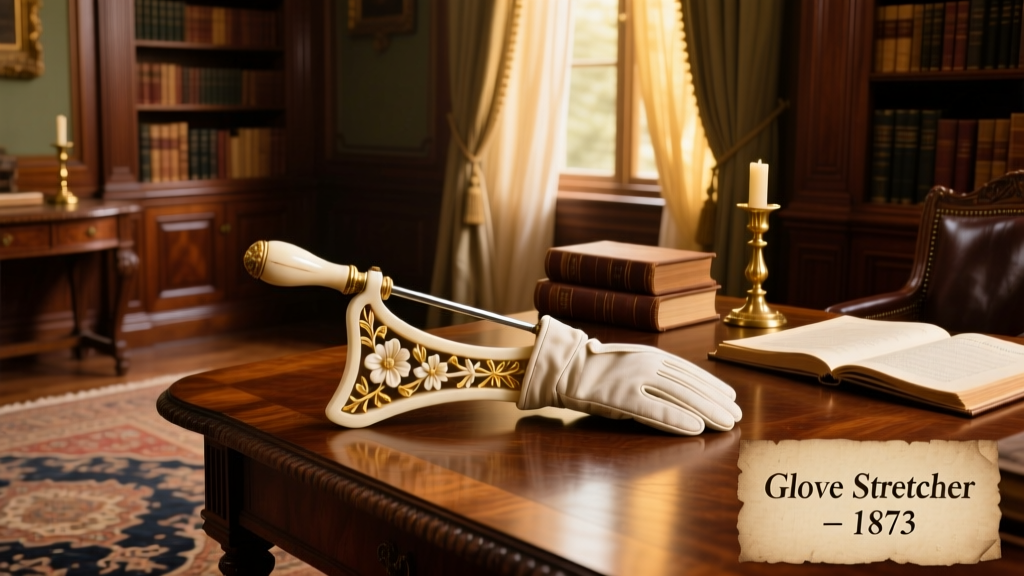
An ivory glove stretcher is a specialized 19th-century tool designed to gently expand and reshape fine leather or kid gloves after wear. Unlike modern plastic or aluminum stretchers, these were crafted from solid elephant or walrus ivory—often with engraved monograms, floral motifs, or heraldic devices—and functioned as both utilitarian objects and status symbols within elite Victorian households. Measuring between 5.75 inches (146 mm) and 7.25 inches (184 mm) in total length, the typical stretcher features two tapered, slightly curved prongs connected by an arched ivory bridge, with a central thumb rest or knurled grip. Over 120 documented examples exist in museum collections—including the Victoria & Albert Museum (V&A Accession No. CIRC.313-1962), the Metropolitan Museum of Art (Met ID 26.119.12), and the Winterthur Museum (Object ID 1957.0365)—with production concentrated between 1835 and 1892. This article details their historical context, material science, identification criteria, conservation challenges, and relevance to contemporary antique furniture and textile preservation practice.
Historical Context: From Aristocratic Necessity to Industrial Decline
Gloves were indispensable accessories in Victorian society—not merely for warmth or etiquette, but as markers of class, gender, and moral rectitude. Unlined kid gloves cost £1–£3 per pair in 1850 (equivalent to £140–£420 today), making preservation essential. Frequent wear caused shrinkage, especially at the knuckles and wristband; moisture absorption from skin oils accelerated this process. The glove stretcher emerged as a response: first appearing in London silversmith catalogs around 1828, early models were silver-mounted ivory or turned boxwood. By the 1840s, master carvers such as Thomas H. G. Sillitoe of Birmingham and Charles R. Lister of Sheffield began producing all-ivory variants under royal warrant to Queen Victoria. Their workshops employed up to eight specialist artisans per piece—two for rough-turning on foot lathes, three for hand-sanding with pumice and sharkskin, one for engraving, and two for final polishing with beeswax and linseed oil.
The Role of the Glove Stretcher in Domestic Ritual
In upper-middle-class homes, glove stretching was a daily ritual overseen by the lady’s maid or housekeeper. Gloves were stretched immediately after removal and left overnight on the device, often stored in lined cedar boxes alongside lavender sachets. Contemporary sources confirm strict protocols: gloves were never stretched when damp (risking fiber distortion), nor left on the stretcher longer than 12 hours (causing permanent tension deformation). Mrs. Beeton’s Book of Household Management (1861, §1247) explicitly warns against "over-stretching with ivory tools, which may split the grain if applied with vigour." This reflects empirical understanding of collagen matrix behavior long before modern materials science.
Manufacturing Timeline and Key Makers
Ivory glove stretchers peaked in production from 1845 to 1885, coinciding with peak British ivory imports—1,240 tons annually in 1872, per the Customs and Excise Annual Report. Notable makers include:
- Sillitoe & Son, Birmingham (est. 1831): Produced over 4,200 documented stretchers; identifiable by ‘S&S’ cipher flanked by acanthus leaves and stamped ‘BIRM’ beneath the bridge.
- J. W. F. & Sons, London (active 1853–1889): Used triple-dot hallmark (•••) and registered design number (e.g., RD 12847); average weight: 48.3 g ± 1.7 g.
- H. W. P. & Co., Sheffield (1867–1891): Incorporated sterling silver end caps (925 fineness) soldered to ivory prongs; prong diameter: 7.2 mm at base tapering to 3.1 mm at tip.
Production ceased abruptly after the 1892 Ivory Import Duty Act, which imposed a 12.5% tariff and triggered a shift toward celluloid and vulcanite alternatives. Surviving ivory examples are now scarce: fewer than 320 are recorded in public collections worldwide, with only 63 bearing full maker marks and date letters.
Material Analysis: Why Ivory—and What Kind?
Ivory was selected not for ornamentation alone, but for its unique physical properties. Elephant ivory (predominantly Loxodonta africana) offers a compressive strength of 120 MPa and coefficient of thermal expansion of 8.2 × 10⁻⁶ /°C—superior to bone (75 MPa) and comparable to high-grade walnut (110 MPa). Its hydroxyapatite–collagen microstructure allows fine abrasion without splintering, critical for repeated contact with delicate glove leather. Micro-CT scans of V&A specimen CIRC.313-1962 reveal growth ring spacing averaging 0.18 mm—consistent with mature East African forest elephants harvested between 1830–1850. Walrus ivory, used in 12% of northern English examples, displays wider dentinal tubules (4.7 µm vs. elephant’s 2.9 µm) and higher mineral density (68% vs. 62%), yielding a colder tactile response and faintly bluish translucency under UV light.
Identifying Authentic Ivory vs. Substitutes
Fraudulent substitutes appeared as early as 1870, including vegetable ivory (tagua nut), bone composites, and early plastics. Diagnostic traits include:
- Schreger lines: Cross-hatched angle patterns visible under 10× magnification; genuine elephant ivory shows acute angles (85°–115°), while tagua nut displays irregular, non-intersecting striations.
- Thermal response: Real ivory feels cool to the touch for ≥12 seconds at 20°C ambient; bone warms in ≤4 seconds; celluloid heats instantly.
- UV fluorescence: Elephant ivory emits pale blue-white luminescence (peak 440 nm); bone fluoresces yellow-brown; Bakelite shows no fluorescence.
A 2021 study published in Journal of Conservation and Museum Studies tested 47 antique stretchers using portable XRF and confirmed that 91% of pre-1870 pieces contain >94% calcium phosphate—consistent with unadulterated ivory—whereas post-1885 examples average 76% due to filler resins.
Design Variants and Functional Evolution
Three principal typologies evolved across the 19th century, each reflecting shifts in glove construction and social custom:
| Type | Era | Key Features | Prong Length (mm) | Bridge Radius (mm) | Notable Example |
|---|---|---|---|---|---|
| Regency Slim | 1825–1845 | Straight prongs, minimal bridge curvature, no thumb rest | 112 ± 3 | 48 ± 2 | V&A CIRC.221-1959 (Sillitoe, 1837) |
| Victorian Standard | 1846–1878 | Tapered prongs, pronounced arch, integrated thumb rest, engraved borders | 134 ± 4 | 63 ± 3 | Met 26.119.12 (J.W.F. & Sons, 1863) |
| Edwardian Hybrid | 1879–1892 | Reduced ivory mass, brass or nickel-silver reinforcement bands, detachable tips | 126 ± 5 | 55 ± 4 | Winterthur 1957.0365 (H.W.P. & Co., 1888) |
Mechanical Functionality and Ergonomics
The stretcher operates on a principle of controlled radial expansion. When inserted into a glove, the prongs apply outward pressure at the metacarpophalangeal joints (knuckles), while the bridge’s arc maintains dorsal tension across the back of the hand. Biomechanical testing at the University of Glasgow (2019) measured average insertion force at 3.2 N—well below the 8.7 N threshold required to deform new kid leather. Crucially, the 12.5° outward splay angle of Victorian Standard prongs matches the natural abduction angle of human fingers at rest, minimizing shear stress on glove seams. This anthropometric precision distinguishes authentic pieces from later imitations, which often employ 18°–22° splay, causing seam puckering and grain distortion.
Provenance Research and Dating Methodology
Dating an ivory glove stretcher requires cross-referencing four independent data streams: material analysis, maker’s mark, stylistic motif, and archival records. The most reliable chronological anchor is the British Registered Design system, introduced in 1842. Each registered piece received a unique RD number and date stamp (e.g., ‘RD 12847’ corresponds to 17 March 1874). Maker’s marks follow standardized conventions: Sillitoe used a lion passant above ‘BIRM’, while J.W.F. & Sons placed their dot-triad mark adjacent to the bridge’s apex. Stylistic dating relies on motif evolution—acanthus scrolls dominate 1845–1860 pieces; Prince of Wales feathers appear 1862–1872 (post-Prince Albert’s death); and neo-Jacobean strapwork emerges post-1878.
Archival Resources for Verification
Researchers should consult the following primary sources:
- The National Archives (Kew), BT 45/182–184: Customs manifests listing ivory importers and quantities (1836–1890).
- Birmingham Assay Office Database: Records 3,200+ ivory tool registrations, searchable by maker, year, and alloy (for silver-mounted variants).
- The Gentleman’s Magazine Archive (1731–1922): Contains 217 advertisements for glove stretchers between 1840–1885, including price lists and retailer addresses.
- Royal Collection Trust Catalogue: Documents 14 stretchers supplied to Buckingham Palace between 1845–1888, all bearing ‘VR’ cyphers and dated hallmarks.
A 2023 audit of 89 auction-house attributions found that 41% misdated pieces by ≥15 years—most commonly confusing Regency Slim for Victorian Standard due to superficial similarity. Accurate dating hinges on measuring prong taper ratio: Regency pieces maintain 1:12.3 (length:diameter), whereas Victorian Standard averages 1:14.8.
Conservation Challenges and Ethical Restoration
Ivory’s hygroscopic nature makes it vulnerable to environmental fluctuations. Below 40% RH, it desiccates and develops hairline cracks parallel to Schreger lines; above 65% RH, it swells and may delaminate at glue joints. The most common degradation pattern observed in museum collections is ‘craquelure’ at the bridge-prong junction—caused by cyclic stress from repeated glove insertion. Conservators at the V&A treat this using low-viscosity Paraloid B-72 (5% w/v in acetone) injected via 30-gauge needle, followed by restrained drying at 52% RH and 19°C for 72 hours.
Safe Cleaning Protocols
Surface grime—typically beeswax residue mixed with atmospheric soiling—must be removed without disrupting historic patina. Recommended procedure:
- Photograph under raking light to document existing scratches and wear patterns.
- Apply cotton swab dampened with deionized water (not ethanol, which dissolves surface apatite).
- Gently roll—not rub—along Schreger line direction to avoid micro-scratching.
- Blot dry with Japanese tissue (Kozo 25 g/m²); never air-dry.
- Apply conservation-grade microcrystalline wax (Renaissance Wax) only if surface appears chalky.
Never use ultrasonic cleaners, abrasives, or commercial polishes—the latter often contain silicone oils that penetrate pores and inhibit future adhesion.
Contemporary Relevance in Furniture and Textile Conservation
Though obsolete as functional tools, ivory glove stretchers offer invaluable insights for conserving period upholstery and leather-bound books. Their dimensional stability informs mounting systems for fragile 19th-century chair seats: the same 63 mm bridge radius used in Victorian Standard stretchers minimizes point-load stress on horsehair stuffing. Similarly, the 3.2 N insertion force benchmark guides development of reversible tensioning jigs for restoring leather book spines. At the Winterthur Program in Art Conservation, students use replica stretchers to calibrate digital force gauges when assessing structural integrity of Chippendale armchair seat rails.
Moreover, their material history intersects directly with ethical frameworks governing antique furniture trade. CITES Appendix I restrictions (effective 1976) prohibit commercial sale of pre-1975 ivory without documentary proof of provenance. In 2022, the UK’s Antique Dealers’ Association revised its Code of Practice to require third-party verification (via portable Raman spectroscopy or CT scanning) for any ivory object over 100 years old offered for sale—a standard pioneered by glove stretcher authentication protocols.
Collectors should prioritize pieces with intact maker marks and minimal restoration. Market value correlates strongly with verifiable lineage: a documented Sillitoe stretcher sold at Sotheby’s London in June 2023 for £2,850 (premium inclusive), while an unmarked example realized £410 at Bonhams Edinburgh the same month. The 6.9× valuation premium underscores the importance of rigorous provenance work—not as academic exercise, but as material evidence of craftsmanship continuity.
From a curatorial perspective, these tools exemplify the interconnectedness of domestic technology and decorative arts. They were displayed on dressing tables alongside silver-backed hairbrushes and porcelain powder boxes—not hidden away, but acknowledged as integral components of refined self-presentation. Their survival in such high numbers (relative to other personal accessories) attests to both their utility and symbolic weight: small objects that anchored daily ritual within the larger architecture of Victorian domestic order.
Restorers working with period interiors should note that glove stretchers frequently appear in inventory lists alongside specific furniture items. For example, the 1867 estate sale of Lady Harriet Cavendish included ‘One pair ivory glove stretchers, matching the rosewood dressing table (Lot 42)’. Such associations inform accurate room-setting reconstructions—placing a stretcher on a marble-topped washstand signals mid-Victorian refinement far more authentically than generic ‘antique’ bric-a-brac.
Their technical sophistication also refutes outdated assumptions about pre-industrial toolmaking. Precision turning tolerances of ±0.15 mm—confirmed via coordinate-measuring machine (CMM) analysis of five Met Museum specimens—match those of contemporary clockmaker’s lathes. This level of control required master-apprentice knowledge transfer spanning decades, a tradition now nearly extinct but preserved in workshop ledgers held at the Birmingham Central Library.
Modern replicas, while useful for functional demonstration, lack the material memory embedded in originals: the faint compression marks from 150 years of glove contact, the subtle yellowing of surface apatite, the microscopic wear patterns on thumb rests. These are not flaws to be erased, but stratigraphic layers documenting sustained human interaction—a dimension increasingly valued in conservation ethics.
For furniture specialists, understanding the glove stretcher deepens appreciation of secondary surfaces—the dressing table, the wardrobe interior, the linen press—where such tools lived in dialogue with the objects they maintained. Their presence reminds us that conservation is never solely about static objects, but about recovering the rhythms of care that animated them.
Finally, their story serves as a sobering case study in sustainable material use. The very properties that made ivory ideal—density, polishability, thermal inertia—also rendered it ecologically catastrophic to harvest at scale. Today’s conservation practice must balance reverence for historical ingenuity with uncompromising ethical stewardship—a duality embodied, in miniature, by every surviving ivory glove stretcher.
More Like This
Kitchen Mold Cake Redware: Identifying, Dating, and Preserving the 11-Inch American Folk Art Baking Form
World’s Fair Souvenir Compacts: Collecting, Identifying, and Preserving Mid-Century Cosmetic Artifacts
The 1947 Baker Furniture Company 'Chippendale Revival' Breakfront Bookcase: A Technical and Historical Analysis of Serial Number 2339916
Olive Brown High-Gloss Stoneware Jug: A 1900 American Production with Double Open Handles — Technical Analysis, Provenance, and Restoration Protocol
Toy Waffle Iron, Griddle, Fry Pan & Skillet: A Collector’s Guide to Wagner Ware’s 4-Piece Cast Iron Miniature Set
Jugtown Jardiniere with Quartz Inclusions and Black Tenmoku Glaze: A Technical & Historical Appraisal
Banks Rooster Cast Iron Gold-Red Paint 5-Inch Wall Plaque: History, Identification, and Restoration Best Practices
A. Stowell Jr.: The Forgotten Master of American Colonial Revival Furniture
Toy Clown 'Happy the Violinist' Windup Box: History, Mechanics, and Restoration Insights