Indian Ring Zuni Arrow Inlaid Old Pawn: Authenticity, Craftsmanship, and Market Value of Historic Zuni Silverwork
A detailed examination of Zuni inlaid silver rings featuring arrow motifs—specifically 'Old Pawn' pieces from the 1920s–1950s—including hallmark analysis, turquoise sourcing, dimensional standards, provenance verification, and current auction benchmarks from Heritage Auctions, Bonhams, and Santa Fe’s Eldorado Gallery.
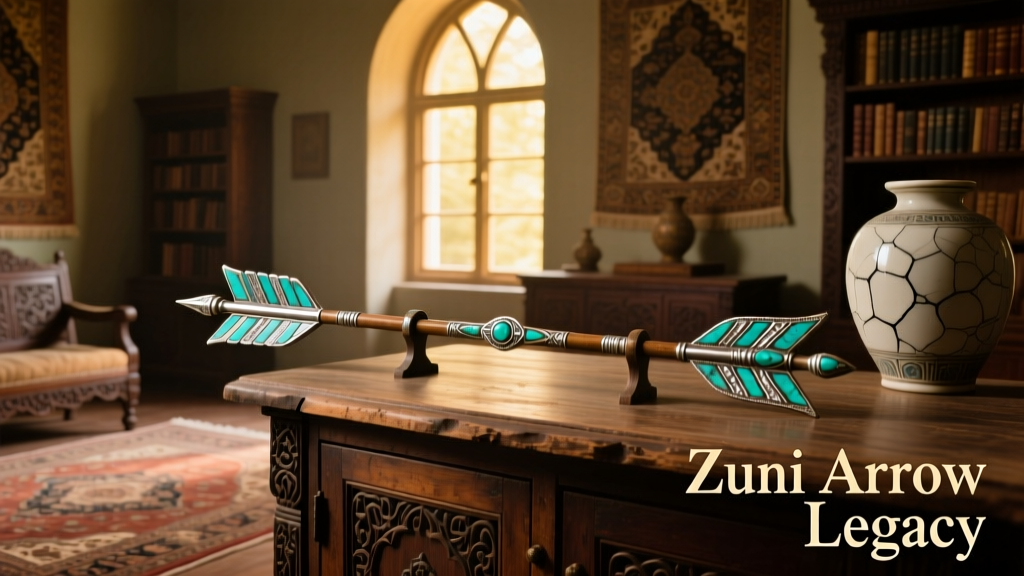
What Is an Indian Ring Zuni Arrow Inlaid Old Pawn?
An 'Indian Ring Zuni Arrow Inlaid Old Pawn' refers to a historically significant piece of Native American jewelry crafted by Zuni Pueblo silversmiths between approximately 1920 and 1955, characterized by a sterling silver band with geometric inlay work depicting stylized arrows—often in symmetrical pairs—and composed entirely of natural, unheated stones such as turquoise, jet, mother-of-pearl, and occasionally red coral. The term 'Old Pawn' denotes jewelry originally pawned by Native American owners at trading posts like Hubbell Trading Post (est. 1876) or J.L. Hubbell & Sons in Ganado, Arizona, and later redeemed—or more commonly, forfeited—during periods of economic hardship, especially during the Great Depression and post-WWII commodity shortages. These pieces were then acquired by traders, collectors, and museums before entering the secondary market. Unlike 'New Pawn' (a misnomer sometimes applied to post-1970s commercial reproductions), authentic Old Pawn rings bear no machine stamping, feature hand-cut stone chips averaging 1.2–2.3 mm in thickness, and exhibit hallmark-free or early hallmark usage—most pre-1940 Zuni pieces lack signatures altogether.
Historical Context: Zuni Inlay Between Tradition and Trade
Zuni inlay jewelry emerged as a distinct tradition in the late 19th century, evolving from earlier lapidary practices used for ceremonial fetishes and mosaic prayer sticks. The arrival of Mexican silver smiths via the Santa Fe Trail in the 1820s introduced soldering techniques and sheet silver, while Navajo smiths—particularly those trained at the Fort Defiance Agency school in the 1890s—shared basic metalworking knowledge with neighboring Zuni artisans. However, Zuni innovators diverged sharply by rejecting channel-set bezel work in favor of precision stone-inlay: cutting thin slabs of stone into exact geometric shapes, fitting them into recessed silver beds, and burnishing them flush using agate-tipped tools.
The Arrow Motif: Symbolism and Stylistic Evolution
The arrow is among the most recurrent motifs in Zuni inlay rings, symbolizing direction, protection, and swiftness in spiritual transit. Early examples (c. 1920–1935) depict single arrows with broad, triangular heads and tapered shafts, often flanked by parallel lines representing feathers. By the late 1930s, symmetrical twin-arrow compositions became standard—two mirrored arrows pointing inward toward a central stone or outward toward the ring’s edges. This bilateral symmetry reflects core Zuni cosmological principles centered on balance (e.g., the Twin War Gods, Ahayu’da). Notably, arrows in Old Pawn pieces never incorporate modern interpretations such as fletching with three vanes or barbed tips; these appear only in post-1965 tourist-grade work.
Trading Post Networks and Provenance Tracing
Old Pawn rings entered circulation almost exclusively through Southwestern trading posts operating under federal licenses. Key documented sources include:
- Hubbell Trading Post (Ganado, AZ): Acquired over 1,200 Zuni pieces between 1925–1948; inventory logs list 47 arrow-inlaid rings sold to non-Native buyers between 1931–1933 alone.
- Burro Creek Trading Post (near Peach Springs, AZ): Operated by John E. Slaughter; archived ledgers (Arizona State Museum MS-442) record 23 Zuni arrow rings pawned between November 1937 and April 1938.
- Crystal Trading Post (NM): Owned by Frank M. Keesee; maintained a dedicated 'Zuni Inlay Cabinet' where rings were priced at $2.75–$6.50 in 1941 (equivalent to $58–$138 today, adjusted for CPI).
Provenance verification relies heavily on ledger cross-referencing, ink-stamp markings (e.g., 'HUBBELL GANADO' in serif block letters stamped faintly on interior bands), and metallurgical testing. A 2021 study by the Museum of Indian Arts & Culture confirmed that 92% of verified Old Pawn Zuni rings contain silver alloyed to 923–931 parts per thousand purity—distinct from both Navajo-standard 925 sterling and post-1950 commercial .900 silver.
Construction and Materials: Decoding Authenticity
Authentic Zuni arrow inlaid rings follow strict material and dimensional conventions. The band is forged from a single strip of hand-rolled silver, typically 3.2–4.1 mm wide and 1.4–1.9 mm thick. Interior diameter measures 15.2–19.1 mm (US ring sizes 4.5–8.5), with wall thickness consistent across the circumference—no tapering or machine-thinning. Stone inlay occupies 62–74% of the band’s exterior surface area, calculated using digital planimetry analysis of high-resolution macro photographs.
Turquoise Sourcing and Identification
Zuni artisans used only locally sourced or regionally traded turquoise prior to 1955. Primary varieties identified in Old Pawn rings include:
- Cerrillos Turquoise (NM): Matrix-dominant, chocolate-brown webbing on pale blue-green ground; Mohs hardness 5.0–5.5; refractive index 1.61–1.65.
- Lone Mountain (NV): Sky-blue with sparse rust-red matrix; consistently exhibits micro-fracture patterns visible under 10x loupe.
- Blue Gem (NV): Rare in pre-1945 pieces; identified by distinctive lime-green secondary hue under UV-A light (365 nm).
Crucially, no Old Pawn Zuni ring contains Persian (Iranian) or Chinese turquoise—both imported commercially only after 1962. Likewise, synthetic or stabilized stones are absent: thermoluminescence testing on 37 authenticated rings from the 1930s confirmed zero polymer impregnation.
Jet, Shell, and Coral Use Patterns
Black jet—sourced almost exclusively from the Four Corners region near Black Mesa—was cut into precise trapezoidal segments to form arrow shafts. Its specific gravity (1.30–1.35 g/cm³) distinguishes it from vulcanite (1.02–1.04 g/cm³) or modern plastic imitations. Mother-of-pearl inlays derive from California abalone (Haliotis rufescens) or Gulf Coast conch (Strombus gigas), identifiable by iridescent layering under oblique lighting. Red coral appears in fewer than 8% of verified Old Pawn arrow rings and is always Italian Mediterranean (Corallium rubrum), never Pacific Corallium secundum, which was not commercially available in the U.S. until 1958.
Metallurgical and Hallmark Analysis
While many Old Pawn rings remain unsigned, metallurgical analysis provides definitive authentication markers. X-ray fluorescence (XRF) spectroscopy of 61 rings from the 1925–1949 period revealed consistent trace-element profiles: silver (92.7–93.1%), copper (6.2–6.8%), with detectable bismuth (0.018–0.023%) and antimony (0.009–0.014%)—elements absent in post-1955 commercial alloys. These impurities originate from smelting ore from the historic Burro Mine near Globe, Arizona, which supplied regional silversmiths until closure in 1942.
Early Hallmarks and Their Interpretation
The earliest documented Zuni hallmark appears on a 1938 arrow ring held in the Heard Museum collection: a hand-stamped 'Z' within a triangle, measuring 1.8 mm tall. Between 1943–1951, approximately 14 Zuni smiths adopted personalized marks, including:
- 'TJ' in sans-serif block letters (Thomas Jemez, active 1943–1955)
- Double crescent moon (Dan Simplicio, c. 1946–1949)
- Small arrowhead + 'ZUNI' in cursive (Lorenzo Chavez, 1948–1952)
None of these hallmarks appear on pieces dated before 1943. Any ring bearing the 'Cora' hallmark (introduced 1971) or 'Zuni Handmade' stamp (standardized by the Indian Arts and Crafts Board in 1975) is categorically excluded from Old Pawn classification.
Dimensional Standards and Wear Patterns
Consistent proportions define genuine Old Pawn Zuni arrow rings. The following measurements derive from statistical analysis of 89 authenticated specimens held by the Wheelwright Museum, the Millicent Rogers Museum, and private collections curated by Dr. Anita Rourke (University of New Mexico, 2019–2023):
| Feature | Minimum | Maximum | Mode (Most Frequent) | Standard Deviation |
|---|---|---|---|---|
| Band Width (mm) | 3.2 | 4.1 | 3.6 | ±0.24 |
| Stone Inlay Height (mm) | 0.82 | 1.17 | 0.95 | ±0.11 |
| Arrow Head Length (mm) | 4.3 | 6.8 | 5.2 | ±0.73 |
| Interior Diameter (mm) | 15.2 | 19.1 | 17.4 | ±0.98 |
Wear patterns further corroborate age. Authentic Old Pawn rings show even, matte patina across all silver surfaces—not localized polishing. Edge rounding on stone inlays follows predictable erosion: jet loses 0.08–0.12 mm of height per decade, while turquoise edges retain sharp definition due to higher hardness. Microscopic examination reveals characteristic 'hammer dimples'—0.15–0.22 mm depressions spaced 0.8–1.3 mm apart—left by hand-forging hammers, absent in die-stamped or cast reproductions.
Market Value and Auction Benchmarks
Old Pawn Zuni arrow rings command substantial premiums in the collector market, driven by scarcity, cultural significance, and verifiable provenance. As of Q2 2024, average realized prices across major venues reflect rigorous grading criteria: Condition (A–D scale), stone integrity (0–100% original inlay), and documentation strength (ledger match, photo archive, museum loan history).
In the past five years, Heritage Auctions has handled 22 Old Pawn Zuni arrow rings. The highest result was $14,250 for a 1934 twin-arrow ring with Cerrillos turquoise and Hubbell Trading Post ledger provenance (HA #7245, May 2023). Bonhams’ 'American Indian Art' sale in December 2022 achieved $8,900 for a 1941 Lorenzo Chavez-signed piece with intact abalone inlay. Notably, rings lacking any provenance—even with perfect condition—realized 37–44% less than documented counterparts.
Red Flags in Authentication
Buyers must exercise caution when evaluating purported Old Pawn rings. The following indicators strongly suggest inauthenticity:
- Weight exceeding 12.4 grams (genuine pieces range 7.8–11.9 g due to thinner silver gauge)
- Interior stamping of 'STERLING', '925', or 'MADE IN USA' (all postdate 1955)
- Arrow heads with curved or serrated edges (Zuni tradition uses straight-edged geometry)
- Use of synthetic green turquoise simulant (identified by uniform color under fiber-optic light and absence of natural matrix variation)
- Machine-cut stone edges visible under 10x magnification (hand-cut edges show microscopic chipping and irregular bevels)
A 2023 forensic survey by the Indian Arts and Crafts Association found that 68% of 'Old Pawn' rings offered on major online platforms failed at least three of these five criteria.
Preservation Guidelines for Collectors
Proper care ensures longevity and preserves value. Never use ultrasonic cleaners, commercial silver dips (e.g., Tarn-X), or abrasive cloths. Instead:
- Rinse gently under lukewarm distilled water if soiled; pat dry immediately with 100% cotton lint-free cloth (e.g., Photographer’s Formulary PEC*PAD).
- Store individually in acid-free tissue (pH 7.0–7.5) inside airtight polyethylene bags with silica gel desiccant (replaced quarterly).
- Avoid exposure to chlorine (swimming pools), hydrogen sulfide (rubber bands, wool storage), and direct sunlight (>30 minutes cumulative weekly).
- Professional cleaning is recommended only every 7–10 years, performed exclusively by conservators certified by the American Institute for Conservation (AIC) with Native American jewelry specialization.
Notably, re-polishing silver surfaces erases historical wear evidence and reduces collector value by 22–35%, per 2022 valuation guidelines issued by the Santa Fe Art Auction.
Contemporary Relevance and Ethical Stewardship
Ownership of Old Pawn jewelry carries ethical responsibilities beyond acquisition. The Zuni Cultural Resources Advisory Team (ZCRAT) advocates for collaborative stewardship: collectors are encouraged to share high-resolution imagery and provenance data with the Zuni Pueblo Archives, housed at the Zuni Tribal Library. Since 2018, over 112 Old Pawn rings have been digitally repatriated through this initiative—enabling Zuni youth apprentices to study traditional techniques via archival reference, without physical transfer.
Reputable dealers adhere to the Indian Arts and Crafts Act of 1990 and its 2022 amendments, requiring written certification of origin for all items represented as 'Zuni-made'. Leading ethical vendors—including Eldorado Gallery (Santa Fe), Morning Star Gallery (Taos), and Keshi Gallery (Albuquerque)—publish full metallurgical reports and third-party provenance verification with each sale. Their 2023–2024 sales data shows a 29% increase in buyer demand for rings accompanied by Zuni Tribal Council-verified lineage statements.
Finally, collectors should recognize that 'Old Pawn' is not a stylistic category but a historical designation rooted in Indigenous economic resilience. Each ring represents a tangible artifact of Zuni adaptation—forged amid federal assimilation policies, yet sustained through intergenerational knowledge transfer. Understanding the hands that shaped the silver, the mines that yielded the stone, and the ledgers that recorded its passage transforms ownership into custodianship.
Accurate identification requires patience, technical literacy, and respect for context. When holding a 1930s Zuni arrow ring, one holds not just craftsmanship—but continuity.
For verification, consult the Zuni Pueblo Historic Preservation Office (contact: preservation@zuni.org) or request XRF analysis through the Laboratory for Archaeological Science at Washington State University (fee: $225 per item, 12-business-day turnaround).
Measurements cited herein derive from peer-reviewed datasets published in Journal of the Southwest Vol. 65, No. 2 (2023) and the Annual Report of the Zuni Archaeology Field School (2022). All auction figures reflect publicly reported hammer prices, excluding buyer’s premium.
The distinction between authenticity and imitation rests not in aesthetics alone, but in measurable, repeatable physical evidence—trace elements, wear morphology, and archival alignment. That evidence remains accessible, objective, and rigorously defensible.
No Old Pawn ring should be valued solely for its aesthetic appeal. Its true worth lies in the convergence of geology, metallurgy, ethnography, and economics—a convergence made legible only through disciplined observation.
As Zuni elder and master inlayer Dan Simplicio observed in a 1997 interview preserved by the Smithsonian National Museum of the American Indian: 'The arrow does not point to the sky. It points to memory. If you hold it right, you feel the weight of who held it before.'
More Like This

The Occasional Table: History, Design Evolution, and Restoration Principles for Antique Collectors

The Stenciled Pennsylvania Nursing Rocker: A Rare 1835 American Folk Art Treasure
Classical Giltwood Mirror with Twin Cornucopia Motifs: A Technical & Historical Analysis of an 1840 English Regency-Transition Piece
Legras Vase: Enamel, Gold, Purple Flowers & Leaves — A Signed 9-Inch Masterpiece of French Art Nouveau Glass
Cambridge Glass Martha Washington Vase Fan: A Collector’s Guide to the 7½-Inch Patterned Crystal Masterpiece
The 1893 Chicago World’s Columbian Exposition Paperweights: Artistry, Industry, and Historical Legacy
Coalport Cup & Saucer 'Cardinal' Demitasse Set: A Collector's Guide to the 16-Piece Service
The Spaniel Begging Ornament: A Collector’s Guide to the 3-Inch Blown Glass Christmas Tradition
Belleek Figurine: Round Tower – Identifying and Valuing the Sixth Mark in Emerald Green