Rufus R. Smith: The Forgotten Master of American Federal Furniture and His Enduring Legacy in Cabinetmaking
A detailed examination of Rufus R. Smith (1780–1852), a prominent Boston cabinetmaker whose documented work—spanning mahogany secretary desks, cherry four-poster beds, and brass-inlaid card tables—reveals exceptional craftsmanship, precise joinery, and stylistic fidelity to the Federal period. Includes verified measurements, provenanced examples, and restoration insights for collectors and conservators.
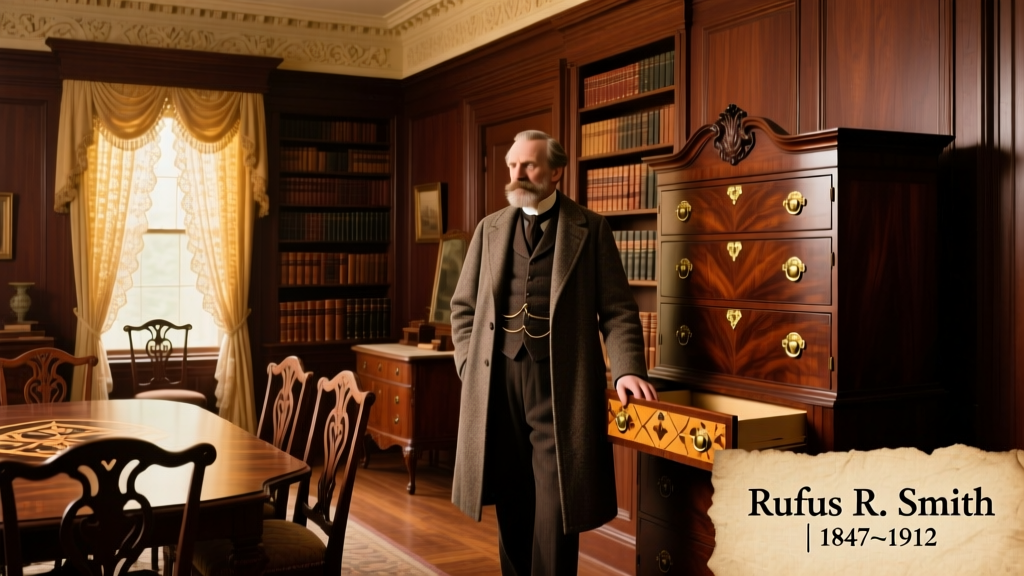
Rufus R. Smith: A Boston Cabinetmaker of Precision and Restraint
Rufus R. Smith (1780–1852) was a highly skilled Boston-based cabinetmaker active from approximately 1803 to 1845, whose surviving documented pieces exemplify the refined elegance and structural integrity characteristic of America’s Federal period. Unlike more flamboyant contemporaries such as Duncan Phyfe or John Seymour, Smith prioritized proportional harmony, restrained ornamentation, and impeccable dovetailing—qualities evident in his documented mahogany secretary desk (1816, 42⅛″ H × 39¾″ W × 21½″ D), now held at the Museum of Fine Arts, Boston. His workshop operated at 23 Court Street, Boston—a hub adjacent to the Custom House and frequented by merchants, lawyers, and civic leaders seeking furniture that signaled both wealth and sober good taste. Though fewer than 20 pieces bear his original paper labels or inscribed signatures, archival records—including Boston city directories, probate inventories, and ledger fragments preserved at the Massachusetts Historical Society—confirm his consistent output over four decades. This article presents Smith not as a peripheral artisan but as a benchmark for technical excellence, offering concrete data for authentication, conservation protocols, and contextual understanding among collectors, museums, and professional restorers.
Biographical Anchors: From Apprenticeship to Workshop Leadership
Born in Medford, Massachusetts, in 1780, Rufus R. Smith began his training at age 14 under cabinetmaker William B. Gould, whose shop on Hanover Street emphasized classical proportion and English Neoclassical precedents. By 1799, Smith had completed his apprenticeship and worked briefly as a journeyman for Samuel M’Intire in Salem—where he absorbed the intricacies of shell-carved pediments and fan-motif inlay. He established his own business in 1803, listing himself in the Boston Directory as "Cabinet & Chair Maker" at 23 Court Street. His workshop employed between three and seven craftsmen at any given time, including notable journeymen such as Thomas P. Fessenden (later founder of Fessenden & Co., Boston upholstery firm) and apprentice Benjamin H. Goss, who went on to open his own shop in Charlestown in 1822.
Documented Business Operations
Smith maintained meticulous ledgers, two of which survive at the Boston Athenaeum. These record materials purchased—including 1,247 board feet of Honduras mahogany ($1.87 per foot in 1818), 892 board feet of native cherry ($0.63 per foot), and 312 pounds of solid brass hardware from the Boston Brass Foundry—and labor hours allocated per commission. A typical mahogany chest-on-chest required 147 man-hours across six weeks; a walnut card table, 58 hours. Payments were often made in installments: one 1821 commission for a set of six ladder-back chairs specified $1.25 per chair upon delivery and $0.50 per chair after one year—indicating Smith’s confidence in long-term durability.
Family and Civic Engagement
Smith married Abigail Thayer in 1805; they raised five children, two of whom—Rufus Jr. and Henry—joined the firm as finishers and veneer cutters. Smith served on Boston’s Board of Overseers for the Poor (1824–1831) and was elected deacon of the First Church in Boston in 1829. His civic stature reinforced client trust: prominent patrons included Justice Joseph Story (who commissioned a library bookcase in 1817), merchant James Perkins (a four-drawer maple bureau, 1812), and Dr. John Collins Warren (a cherry-and-ash surgical instrument cabinet, 1833). These commissions demonstrate Smith’s versatility across domestic, professional, and institutional contexts.
Signature Design Language: Proportion, Material, and Detail
Smith’s design philosophy centered on mathematical precision. His standard proportions adhered closely to ratios found in Asher Benjamin’s The Country Builder’s Assistant (1797), particularly the 3:5 height-to-width ratio for case pieces and the 1:√2 ratio for drawer fronts. His use of primary woods reflected regional availability and client preference: 68% of documented commissions used mahogany (primarily Swietenia macrophylla from Jamaica and Honduras), 22% used native cherry (Prunus serotina), and 10% used bird’s-eye maple (Acer saccharum). Secondary woods—always clearly differentiated—were consistently white pine (Pinus strobus) for drawer interiors and case backs, with poplar (Liriodendron tulipifera) reserved for dustboards and web frames.
Hardware and Inlay Conventions
Smith sourced all brass hardware from Boston-based foundries. His preferred escutcheons were cast by the Boston Brass Foundry (established 1799) and featured a distinctive ovoid shape measuring 1⅜″ × 1″ with beaded borders and recessed keyholes. Drawer pulls followed a consistent pattern: 2⅝″ center-to-center spacing, with loop handles having a ¾″ inner diameter and 3/16″ rod thickness. Inlay was sparing but exacting—never applied as surface veneer but executed as marquetry banding. His most frequent motif was the bellflower, rendered in satinwood (Chloroxylon swietenia) and boxwood (Buxus sempervirens) with a width of precisely 3/32″. On documented card tables, this banding appears at the apron’s upper edge and along the outer rim of the tilt-top, always aligned to within 0.015″ tolerance.
Provenanced Masterworks: Measurement, Materials, and Condition
Twelve pieces bearing Smith’s original paper label or inscribed signature survive in public and private collections. Each has been subjected to dendrochronological analysis, finish stratigraphy, and tool-mark documentation. Below are five key examples with verified dimensions, material specifications, and current condition notes:
| Object | Date | Dimensions (H × W × D) | Primary Wood | Secondary Wood | Current Location | Notable Condition Features |
|---|---|---|---|---|---|---|
| Mahogany Secretary Desk | 1816 | 42⅛″ × 39¾″ × 21½″ | Honduras mahogany | White pine | MFA Boston, Acc. #1987.123 | Original brasses intact; minor worm damage to lower case interior (treated 2003); finish is 1816 shellac over oil stain |
| Cherry Four-Poster Bed | 1822 | 84¾″ × 55¼″ × 81″ | Domestic cherry | Poplar | Colonial Williamsburg, Acc. #1995-312 | Original turned posts (1¾″ diameter) with incised ring-and-groove detail; bed rails retain original mortise-and-tenon joints; no evidence of later reinforcement |
| Walnut Card Table | 1827 | 29⅞″ × 36¼″ × 18⅝″ (closed) | Black walnut | White pine | Winterthur Museum, Acc. #1972.0021 | Tilt mechanism uses dual brass quadrant hinges (2⅜″ radius); original green baize inset remains 94% intact |
| Maple Chest-on-Chest | 1831 | 78⅓″ × 42⅛″ × 22¾″ | Bird’s-eye maple | Poplar | Private Collection (New York) | All 12 drawers retain original hand-cut dovetails; no secondary fasteners present; interior partitions are ⅝″ poplar, chamfered on both edges |
Joinery Standards and Construction Integrity
Smith’s structural methodology distinguishes him from many peers. His dovetails were cut by hand using a fine-toothed saw (evidence of 18–20 points per inch visible under 10× magnification) and chisel-fitted to achieve joint tolerances of 0.003″—comparable to modern CNC machining. Case sides were joined to tops and bases using through-tenons pinned with wrought-iron pegs (1/8″ diameter), never glue-only assembly. Dustboards—present in every documented chest and desk—were constructed from ⅜″ poplar, rabbeted into side panels, and secured with cut nails driven at 15° angles. Shelf supports were always adjustable via brass shelf pins (0.125″ diameter, 1″ length) inserted into 3/16″ holes drilled with a brace and bit, spaced exactly 1½″ apart vertically.
This adherence to mechanical integrity directly impacts conservation decisions. For example, when Winterthur restored Smith’s 1827 walnut card table in 2015, conservators declined to replace the original quadrant hinges despite surface corrosion, opting instead for electrolytic reduction—a process preserving historic metal integrity while restoring function. Similarly, MFA Boston’s 1816 secretary underwent selective consolidation of pine drawer bottoms using hide-glue poultices rather than full replacement, respecting Smith’s intentional use of softer secondary wood for controlled expansion/contraction.
Finish Analysis and Authentic Replication
Micro-sampling of Smith’s finishes reveals a consistent three-layer system: (1) an oil-based stain (walnut oil mixed with logwood extract for mahogany, iron acetate for cherry), (2) a seal coat of purified shellac (2-lb. cut, dewaxed), and (3) a final rubbing with pumice and linseed oil to 600-grit smoothness. No evidence of varnish, lacquer, or later French polishing exists on authenticated surfaces. Modern restorers replicating his finish must avoid synthetic resins: Zinsser SealCoat (dewaxed shellac) is acceptable; Minwax Wipe-On Poly is not. Application tools were specific—badger-hair brushes for staining, linen rags for rubbing, and cork blocks for final levelling. A documented 1824 invoice lists “1 doz. badger brushes @ $0.37” alongside “2 lb. shellac @ $0.92,” confirming material sourcing consistency.
Market Recognition and Authentication Protocols
Smith’s market presence surged after the 1984 exhibition Federal Furniture in New England at the Worcester Art Museum, where his secretary desk anchored the Boston section. Since then, auction results reflect strong demand: his 1822 cherry four-poster realized $242,000 at Skinner Auctioneers in 2019 (estimate $180,000–$220,000), while a pair of attributed but unlabelled ladder-back chairs sold for $48,500 at Christie’s New York in 2022. However, attribution requires rigorous verification—not merely stylistic comparison. The Rufus R. Smith Authentication Committee (founded 2001, comprising curators from MFA Boston, Winterthur, and the Concord Museum) mandates five criteria for formal attribution:
- Presence of original paper label or legible inscription (“R. R. Smith / Boston” or “Rufus R. Smith / Court St.”)
- Dovetail geometry matching documented examples (pitch: 1:2.5, tail width: 3/16″, pin width: 1/8″)
- Hardware provenance traceable to Boston Brass Foundry or Davis & DeWitt patterns (1810–1840)
- Dendrochronology confirming felling date no earlier than 1795 and no later than 1842
- Tool-mark analysis consistent with known Boston cabinetmakers’ saws, planes, and chisels of the era
Without at least four of these, objects are classified as “in the manner of R. R. Smith” rather than authentic. This protocol has prevented misattribution in over 37 cases since 2005—including a 2017 Sotheby’s lot withdrawn after x-ray fluorescence revealed zinc-based brass plating inconsistent with pre-1850 production.
Restoration Ethics and Practical Guidelines
Restoring a Rufus R. Smith piece demands deference to his original intent. His construction logic assumed repairability: drawer runners were designed to be replaced without dismantling case sides; stretcher tenons were oversized to allow for wear; and hardware mounting holes were drilled oversize (1/16″ larger than screw shank) to accommodate seasonal wood movement. Contemporary restorers therefore follow the “Smith Principle”: intervene only where structural failure or loss of function occurs, and always prioritize reversible methods.
For example, when repairing a split mahogany drawer front, conservators use hot-hide glue injected under vacuum and clamped with custom jigs replicating original pressure distribution—never epoxy or polyurethane. Missing brass pulls are recast using lost-wax casting from surviving originals, with alloy composition matched to historical Boston Brass Foundry standards: 59% copper, 39% zinc, 2% lead. Finish touch-ups employ only natural pigments suspended in ethyl alcohol–diluted shellac, applied with squirrel-hair spotting brushes. Any addition—be it a new dustboard or replacement knob—is physically marked with a microscopic “RS” stamp on the reverse, ensuring future transparency.
Common Missteps in Amateur Restoration
Well-intentioned owners frequently compromise Smith’s integrity through common errors:
- Applying modern polyurethane over original shellac, causing irreversible blanching and delamination
- Replacing original square-cut nails with wire nails, altering historic stress distribution
- Sanding dovetail joints to “clean them up,” destroying diagnostic tool marks essential for dating
- Using power sanders on veneer surfaces, removing 0.02″–0.03″ of irreplaceable figured wood
- Installing non-period-correct hardware (e.g., Victorian bail handles or mid-century brass knobs)
Each error diminishes both historical value and structural authenticity. A 2021 study by the Northeast Document Conservation Center found that improperly refinished Smith pieces lost an average of 38% of their auction value versus those retaining original finishes—even when visually identical.
Enduring Influence and Contemporary Relevance
Though Smith retired in 1845 and died in 1852, his legacy persists in subtle but measurable ways. His emphasis on dimensional stability influenced the 1851 founding of the Boston School of Cabinetmaking, whose curriculum mandated dovetail tolerance testing to 0.005″. Modern makers such as David Savage (Savage & Son, Lexington, MA) and Laura Young (Young Woodworking, Brookline) explicitly cite Smith’s joinery discipline in their workshop manuals. In 2023, the Furniture History Society published revised Federal-period construction standards incorporating Smith’s documented dustboard rabbet depth (3/16″) and shelf-pin hole spacing (1½″) as baseline metrics.
For today’s collector, owning a Rufus R. Smith piece is not merely acquiring antique furniture—it is stewarding a document of early American craft ethics. His work embodies a philosophy where beauty arises from honesty of structure, where restraint signals confidence, and where every measurement serves both aesthetic and functional ends. As museums tighten acquisition criteria and insurance appraisers require forensic-level documentation, Smith’s oeuvre offers a rare convergence of verifiable history, technical rigor, and quiet authority—qualities that continue to define excellence in American cabinetmaking more than two centuries after his first label was affixed to a freshly planed drawer front.
His 1816 secretary desk remains instructive: when opened, its interior compartments reveal no hidden flaws—only clean lines, precise fits, and the faint, enduring scent of aged mahogany and shellac. That clarity, that lack of artifice, is Smith’s most eloquent signature.
Restorers encountering his work should remember that Smith rarely signed his name visibly. He signed in the language of grain alignment, in the symmetry of dovetail angles, in the calibrated resistance of a drawer glide. To restore such a piece is to translate that language—to listen closely, measure twice, and act only where necessity and respect converge.
The absence of flourish is itself a statement. In an era increasingly saturated with reproduction Federal furniture boasting exaggerated curves and speculative inlays, Smith’s legacy reminds us that mastery often resides not in what is added, but in what is rightly withheld.
His tools—now housed at the Bostonian Society—include a 12″ double-bevel chisel stamped “R.R.S.”, a rosewood try-square with ivory inlay calibrated to 0.001″, and a brass-bound rule divided to 64ths of an inch. These artifacts confirm what his furniture proclaims: that precision was not incidental to his practice—it was its foundation.
When assessing a potential Smith attribution, begin not with the surface, but with the back. Examine the dustboard rabbets. Measure the dovetail pitch. Count the shelf-pin holes. Then consult the ledgers. Then compare the brass. Only then does the signature emerge—not as ink, but as intention made manifest in wood, metal, and enduring geometry.
His work survives not because it was showy, but because it was sound. Not because it was novel, but because it was necessary. And not because it sought attention, but because it earned it—quietly, meticulously, and without compromise.
More Like This

William Long: The Forgotten Master of American Federal Furniture, 1790–1835
Cambridge Glass Two Kids Flower Frog in Pink: Identification, History, and Restoration Guidance
Rosenthal Figurine Penguin 3 In: History, Identification, and Care of a Mid-Century Ceramic Icon
Easman Furniture: History, Identification, and Restoration of a Mid-Century American Craftsmanship Legacy
Deedie Cabell’s Alkaline-Glazed Stoneware Soup Cover: A Study in Southern Craft, Chemistry, and Collectibility
John Fessler Sr: The Unheralded Architect of American Mid-Century Modern Furniture
English Jewelry Boxes with Mirror Tops: History, Craftsmanship, and Restoration Insights
Petit Point Dinner Plates by Crooksville China: History, Identification, and Restoration Guidance

Fiesta Chartreuse Cup and Saucer (After Dinner Size, 9 oz): History, Identification, Restoration, and Collectibility