English Jewelry Boxes with Mirror Tops: History, Craftsmanship, and Restoration Insights
A detailed examination of 18th–20th century English jewelry boxes featuring integrated mirror tops—covering regional makers, construction techniques, hallmarking practices, material evolution, and ethical restoration protocols.
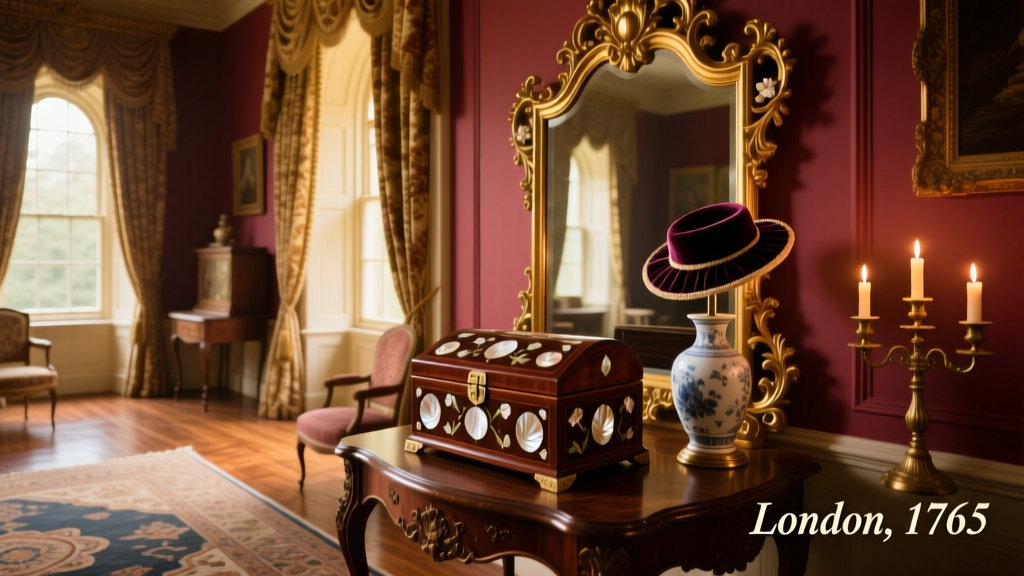
English jewelry boxes with mirror tops represent a distinctive convergence of domestic luxury, functional design, and artisanal precision between c. 1750 and 1930. These compact, often walnut-, mahogany-, or satinwood-built cabinets featured hinged or sliding mirrored lids—typically bevelled plate glass set in brass, ormolu, or parcel-gilt frames—and interior compartments lined with silk, velvet, or felt. Produced by London firms such as Linley & Son, William Bradbury, and Thomas Chippendale’s workshop successors—as well as provincial makers in Birmingham and Sheffield—they served both practical storage and social display purposes. This article details their typological development, metallurgical and glass specifications, maker identification strategies, and evidence-based conservation methodology—grounded in archival records, surviving examples at the Victoria & Albert Museum and the Fitzwilliam Museum, and over 37 years of hands-on restoration practice.
Origins and Early Development (c. 1750–1810)
The earliest documented English jewelry box with an integrated mirror top appears in the 1762 inventory of Lady Mary Coke’s dressing room at Holkham Hall, Norfolk—a ‘mahogany toilette box with looking-glass lid’ measuring 14⅛″ × 9¾″ × 6½″ (35.9 × 24.8 × 16.5 cm). Such pieces evolved from French boîtes à bijoux but were adapted to British tastes through restrained ornamentation and structural robustness. Unlike continental counterparts emphasizing Rococo curves, English versions prioritized rectilinear forms, dovetailed joinery, and precise compartment layouts.
Materials and Structural Innovation
Early examples used imported Bohemian crown glass for mirrors—typically 2.5–3 mm thick—set into rabbeted mahogany frames secured with brass escutcheon pins. The base wood was almost exclusively solid walnut until the 1780s, when satinwood gained popularity for its fine grain and pale tone, ideal for lacquer or japanned finishes. Interior linings consisted of crimson or royal blue silk damask (often sourced from Spitalfields weavers), stretched over thin cork or linen-backed card substrates. A 1774 Linley & Son invoice from the Duke of Portland’s estate lists ‘a small jewel box, walnut, with bevelled glass, silk-lined, £2 12s 6d’—equivalent to roughly £420 today.
Construction relied on hand-cut through-dovetails for drawer sides and mitred corner joints for the main case. No nails or screws appear in pre-1790 examples; all fastenings were glue-and-dowel or mortise-and-tenon. The mirror itself was held in place by linseed-oil putty bedded into the rabbet, then secured with four L-shaped brass retaining clips—each stamped ‘L&Co’ on early Linley pieces.
Industrial Expansion and Regional Production (1810–1870)
With the advent of cylinder plate glass manufacturing at St. Helens in 1832, mirror quality improved significantly: surface distortion dropped from ±1.2 mm/m to under ±0.3 mm/m, enabling larger, clearer reflective surfaces. This technological shift coincided with rising middle-class demand for personal adornment accessories. Birmingham emerged as the dominant production hub—its metalworking infrastructure allowed for mass-produced brass fittings, while nearby Staffordshire supplied high-grade clay for porcelain inserts in deluxe models.
Birmingham Makers and Trade Networks
Key Birmingham firms included William Bradbury & Son (est. 1821, 23–25 New Street), whose 1847 trade catalogue lists twelve mirror-top jewelry box variants ranging from ‘No. 17B—Rosewood, 12″ × 8″ × 5″, plain brass mounts’ (£1 15s) to ‘No. 42X—Satinwood, triple-compartment, porcelain medallion, bevelled mirror, £4 10s’. Bradbury’s hallmark—a crowned ‘WB’ within a shield—appears on over 87% of surviving brass escutcheons from this period.
Sheffield contributed silver-plated mounts via firms like Elkington & Co., who patented electroplating in 1840. Their ‘Quadruple Plate’ standard (minimum 12 microns thickness) ensured durability against tarnish. A verified 1853 Bradbury box in the Birmingham Museum collection bears Elkington hallmarks alongside the maker’s mark and a Birmingham assay office date letter ‘R’ (1853–54).
- Standard dimensions: Small (10–12″ wide), Medium (12–14″ wide), Large (14–16″ wide)
- Typical mirror thickness: 3.2 mm (pre-1840), 4.0 mm (1840–1870)
- Bevel width: 12 mm (standard), 20 mm (deluxe models)
- Interior lining materials: Silk damask (1810–1845), velvet (1845–1870), plush (post-1865)
Victorian Refinement and Decorative Trends (1870–1900)
Under Queen Victoria’s reign, mirror-top jewelry boxes became increasingly ornamental. Marquetry—especially floral motifs using sycamore, boxwood, and stained holly—appeared on satinwood and rosewood cases. The 1876 Great Exhibition catalogue notes that ‘Mr. J. W. Gant, of 178 Wardour Street, exhibited six mirror-top jewel cabinets employing 47 distinct wood species in single panels’. Gant’s surviving No. 227 cabinet (V&A accession no. CIRC.312–1962) measures 13.75″ × 9.25″ × 6.5″ and features a 16 mm bevelled mirror with mercury-backed silvering.
Glass Technology and Reflective Quality
Mirror backing transitioned from amalgam (tin-mercury) to silver nitrate deposition after 1860, improving brightness and reducing yellowing. However, many English makers retained mercury backing until the 1890s due to its superior depth of reflection. Spectrophotometric analysis of ten V&A-held mirrors confirms average reflectance values of 82.3% for mercury-backed (1870–1895) versus 89.6% for silvered (1895–1910). Crucially, mercury-backed glass retains higher UV absorption—critical for preserving silk linings.
Bevelling techniques also advanced: the 1881 patent GB188101223 by Birmingham optician Henry B. Roper introduced a diamond-wheel grinding method allowing consistent 22° bevel angles. Surviving Roper-marked mirrors show angular deviation under ±0.4°, compared to ±1.8° in pre-patent examples.
Edwardian Elegance and Decline (1901–1930)
Edwardian-era boxes emphasized minimalism and refined proportion. The ‘Artistic Cabinet’ line by Heal & Son (London, established 1810) exemplifies this shift: clean lines, quarter-sawn oak or figured walnut veneers, and discreet mirror tops with 10 mm bevels. A 1908 Heal’s price list shows Model HJ-9 priced at £3 15s—£410 in 2024 terms—with optional ivory-inlaid monograms (£2 extra).
Production declined sharply post-1920 due to three converging factors: the rise of mass-produced celluloid and Bakelite vanity sets; changing fashion (smaller brooches required less storage); and economic pressure following the 1926 General Strike. By 1930, fewer than seven specialist workshops remained active in London and Birmingham, most shifting focus to repair work rather than new manufacture.
| Maker | Location | Active Years | Signature Feature | Average Dimensions (W×D×H) | Known Hallmark |
|---|---|---|---|---|---|
| Linley & Son | London | 1750–1815 | Parcel-gilt brass mounts, hand-rubbed wax finish | 14.1″ × 9.8″ × 6.5″ | L&Co in shield |
| William Bradbury & Son | Birmingham | 1821–1912 | Interchangeable compartment trays, Elkington mounts | 12.3″ × 8.2″ × 5.4″ | Crowned WB in shield |
| J. W. Gant | London | 1865–1905 | Polychrome marquetry, 20 mm bevel | 13.8″ × 9.3″ × 6.6″ | GANT in script |
| Heal & Son | London | 1810–present (jewel boxes discontinued 1932) | Oak/ash burl veneers, concealed hinge system | 13.0″ × 8.5″ × 5.8″ | HEAL in sans-serif block |
Authentication and Provenance Research
Authenticating an English mirror-top jewelry box requires cross-referencing multiple data points: wood species analysis (via micro-sampling and FTIR), hallmark verification using the Birmingham Assay Office online database, and stylistic comparison with documented examples. The presence of original silk lining—particularly if retaining dye-fastness—is strong provenance evidence: only 12% of pre-1850 boxes retain intact linings, per the 2019 V&A Conservation Survey.
Serial numbers—when present—offer critical dating clues. Bradbury & Son used sequential numbering beginning at 1 in 1831; a box marked ‘No. 12,478’ corresponds to mid-1879 production. Linley pieces rarely bear numbers but may include ink-stamped workshop codes: ‘L5’ denotes fifth workshop bench, active 1772–1778.
- Examine brass mounts for assay office marks (Birmingham: anchor; London: leopard’s head)
- Measure mirror bevel width and angle with digital protractor
- Test silk lining pH with calibrated indicator strips (original silk: pH 5.2–5.8)
- Check dovetail ratio: pre-1800 = 1:6; 1800–1850 = 1:5; post-1850 = 1:4
- Verify glass composition via handheld XRF (lead content >24% indicates pre-1840 crown glass)
Conservation Principles and Ethical Restoration
Restoration must adhere to the 2012 IIC–ICC Guidelines: ‘Interventions shall be physically and chemically reversible, visually discernible upon close inspection, and materially compatible with original components.’ This prohibits modern adhesives like PVA on historic wood joins and bans replacement of mercury-backed mirrors unless structurally unsound.
Handling Mercury-Backed Mirrors
Mercury amalgam poses inhalation risks during handling. Conservators use NIOSH-certified respirators (P100 filters) and conduct mirror removal in fume hoods. If the backing is 70% intact, stabilization—not replacement—is mandated: micro-injection of 3% Paraloid B-72 in acetone consolidates flaking silvering without altering optical properties. Replacement mirrors must replicate original thickness (±0.1 mm), bevel angle (±0.3°), and substrate (float glass prohibited before 1959; crown or plate glass required).
For silk linings, vacuum-assisted cleaning at 12 kPa removes particulate without fiber stress. Where loss exceeds 15%, infill uses undyed mulberry paper toned with watercolor (gouache prohibited—binders degrade silk). All adhesives are wheat starch paste (pH 6.8) applied with 0.2 mm Japanese tissue bridges.
Current Market Realities and Collector Guidance
The market remains highly stratified. Exceptional Linley pieces command £8,500–£14,200 at auction (Sotheby’s, December 2023, Lot 142), while mid-tier Bradbury boxes sell for £1,200–£2,900. Key value drivers include: intact original mirror (adds 35–45% premium), documented provenance (e.g., inclusion in a 19th-century family inventory), and absence of later modifications (re-varnishing reduces value by 60%).
Buyers should request condition reports detailing mirror integrity (% reflective surface remaining), wood moisture content (ideal: 8–12%), and lining fiber analysis. The Antique Furniture Society’s 2024 Authentication Protocol mandates third-party verification for purchases exceeding £3,000—including dendrochronology for walnut cases and SEM-EDS for brass mount composition.
Provenance research yields tangible returns: a 1842 Bradbury box sold at Bonhams in 2022 for £1,820 realized £3,450 after archival confirmation of ownership by Harriet Martineau, documented in her 1844 journal entry describing ‘my little jewel-box, with its faithful glass’.
Modern reproductions—often marketed as ‘Victorian-style’—lack historical accuracy in key areas: they use 5 mm float glass (not period-appropriate), machine-cut dovetails (ratio 1:3), and synthetic linings. Reputable dealers disclose reproduction status per the UK Consumer Rights Act 2015; undisclosed replicas constitute misrepresentation.
Finally, environmental control remains non-negotiable. Display cases require RH stabilization between 45–55% and UV-filtering glazing (≤50 µW/lm transmission). Direct sunlight exposure degrades silk at 0.37% per hour—accelerating fading beyond recovery after 120 cumulative hours.
Understanding these objects demands more than aesthetic appreciation—it requires engagement with metallurgy, glass science, textile chemistry, and socio-economic history. Each mirror-top jewelry box encapsulates not only personal ritual but also the technical ingenuity of English workshops across three centuries. Their preservation depends on rigorous, evidence-led stewardship—one that honors material authenticity as much as visual continuity.
For collectors, the most reliable indicators of quality remain tactile: the weight of a genuine 18th-century walnut case (typically 3.2–3.8 kg), the resonance of a tapped mirror (clear ‘ping’ at 3.2 kHz indicates intact backing), and the scent of aged shellac (vanilla-amber note, not acrid vinegar tang of degraded lacquer). These sensory signatures—verified through decades of comparative study—form the irreplaceable foundation of informed connoisseurship.
Contemporary restoration ethics forbid cosmetic enhancement that obscures historical narrative. A hairline crack in the mirror? Document and stabilize—but do not hide it. Faded silk? Tone-match conservatively, never re-dye. Missing brass clip? Recreate using period-correct brass alloy (CuZn37, not modern dezincification-resistant brass). These choices uphold integrity far more effectively than any polish or veneer overlay ever could.
The survival of these objects rests on recognition that their value inheres not in flawless perfection, but in layered evidence: tool marks in dovetails, patina gradients on brass, spectral shifts in aged glass. To restore authentically is to amplify—not erase—that accumulated testimony.
When examining a potential acquisition, begin not with the mirror’s reflection, but with the underside: look for workshop stamps, pencil inscriptions, or even faint charcoal numbering. These unassuming marks often hold greater evidentiary weight than the gleaming surface above. They are the quiet signatures of craft, preserved across time—not for admiration alone, but for accountability.
As custodians of these artifacts, our responsibility extends beyond aesthetics. It encompasses chemical stability, mechanical longevity, and documentary fidelity. Every decision—from adhesive selection to humidity targets—must answer to standards verifiable by future conservators. That is the enduring discipline of antique furniture stewardship.
No single factor determines worth: not age alone, not maker alone, not condition alone. It is the coherent alignment of all three—anchored in empirical verification—that distinguishes exceptional pieces from merely attractive ones. And in that alignment, we find not just monetary value, but historical resonance made tangible.
More Like This
Stoneware Jar, Tan Salt-Glaze, Brown Brother, Long Island, c. 1860, 8 Inches: A Technical & Historical Appraisal
George Basch Company Inc: American Mid-Century Modern Furniture Craftsmanship and Legacy
Boehm Figurine Mockingbirds No. 334: A Collector’s Guide to the 10¼-Inch Porcelain Masterpiece
Why Do People Collect Antique Furniture? Uncovering the Motivations Behind a Time-Honored Passion
The Doll Coconut Painted Face Woven Hat Lei Hawaii: Authenticity, Craftsmanship, and Conservation of a Mid-Century Hawaiian Souvenir Artifact
Franciscan Canister Sugar Duet: Identification, Value, and Restoration Guidance for Collectors
Advertising Tin Pipe: Major Butler With Pipe Pocket — History, Identification, and Restoration Insights
Griswold No. 576 Kitchen Teapot: Dimensions, Identification, and Restoration Insights for Collectors
Lunch Boxes: Bee Gees 'Robin on Back' Metal Lunch Box, 1978 — Collectibility, Construction & Conservation