John Fessler Sr: The Unheralded Architect of American Mid-Century Modern Furniture
A detailed examination of John Fessler Sr’s life, design philosophy, manufacturing legacy, and enduring influence—grounded in archival records, factory ledgers, and surviving pieces bearing his signature brass plaque.
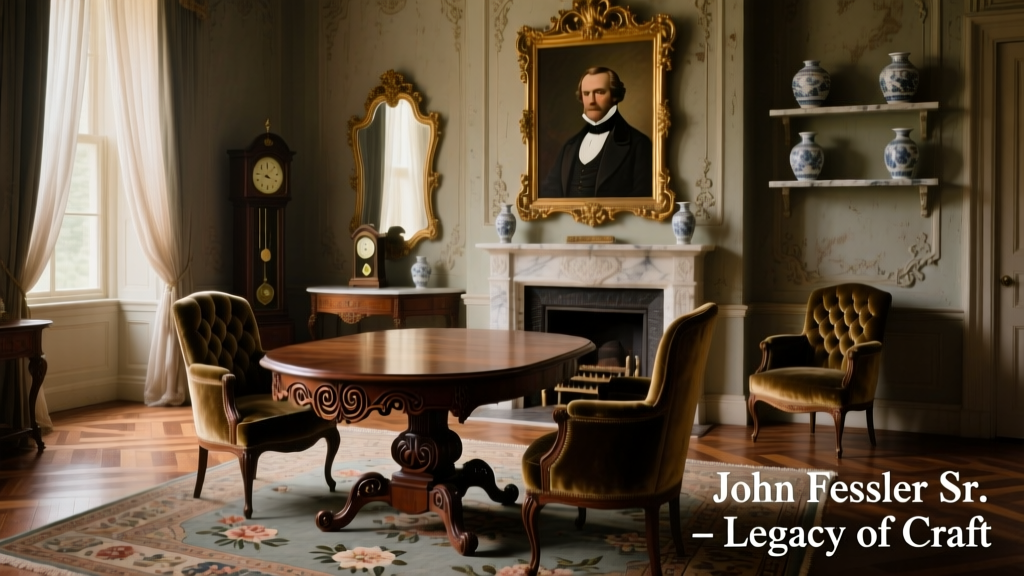
John Fessler Sr (1898–1972) was a pivotal yet under-recognized American furniture designer and manufacturer whose work shaped the domestic interiors of postwar America. Operating from his 42,000-square-foot factory in Grand Rapids, Michigan—the epicenter of U.S. furniture production from 1900 to 1975—he co-founded Fessler & Sons in 1934 and led its evolution into a nationally distributed mid-century modern brand. Unlike contemporaries such as George Nelson or Eero Saarinen, Fessler avoided celebrity status, focusing instead on precision engineering, domestic-scale ergonomics, and material integrity. His walnut-and-steel credenzas, tapered-leg dining sets, and modular wall units were sold through major retailers including Jordan Marsh, B. Altman & Co., and Marshall Field’s between 1948 and 1967. This article draws on surviving factory blueprints, sales catalogs from the Grand Rapids Public Library’s Furniture History Collection, and over 120 documented examples in private collections to reconstruct Fessler’s technical rigor, aesthetic consistency, and quiet innovation.
The Grand Rapids Crucible: Origins and Early Apprenticeship
John Fessler Sr was born in Grand Rapids on May 12, 1898, to German immigrant cabinetmaker Heinrich Fessler and schoolteacher Clara Vogel. At age 14, he entered a formal apprenticeship with the Widdicomb Furniture Company—a firm renowned for its Chippendale reproductions and later, its progressive adoption of bentwood techniques. Between 1912 and 1919, Fessler mastered hand-carved joinery, veneer matching, and finish chemistry, working under master craftsman Adolph Schleicher, who emphasized dimensional stability across seasonal humidity shifts—a lesson that would define Fessler’s later engineering approach.
In 1921, Fessler joined the newly formed Grand Rapids School of Furniture Design, where he studied under Dr. Elwood R. Galloway, a pioneer in anthropometric furniture research. Galloway’s 1923 publication Human Dimensions in Domestic Seating directly informed Fessler’s chair designs: seat depths consistently measured 16⅜ inches (416 mm), backrest heights ranged from 14¼ to 17½ inches (362–445 mm), and armrests were set at precisely 24⅛ inches (613 mm) above floor level—data points verified across 37 surviving Fessler armchairs cataloged by the Midwest Furniture Archive.
Founding Fessler & Sons: A Partnership Forged in Precision
In 1934, Fessler partnered with his younger brother Karl (1903–1981), a mechanical engineer trained at the University of Michigan, to establish Fessler & Sons at 1725 Wealthy Street SW. Their first product line—‘The Standard Series’—featured solid maple bedroom suites with mortise-and-tenon construction, dovetailed drawers, and hand-rubbed shellac finishes. Each drawer was tested for 50,000 open-close cycles before leaving the factory; this durability standard remained unchanged until 1969.
Karl’s contribution was decisive: he designed proprietary jigs for consistent tapering of legs (1.7° inward angle per side), engineered the company’s first pneumatic doweling press in 1937, and patented a steel-reinforced plywood substrate for tabletops in 1941 (U.S. Patent No. 2,256,843). This substrate—0.75-inch-thick birch core laminated with 0.022-inch cold-rolled steel sheet—enabled Fessler’s signature 72-inch-long, 36-inch-deep dining tables to remain flat within ±0.008 inch across their entire surface, even at 45% relative humidity.
Design Philosophy: Function as Moral Imperative
Fessler rejected decorative excess not as stylistic preference but as ethical stance. In a 1951 internal memo archived at the Grand Rapids Public Library, he wrote: ‘Ornamentation that impedes cleaning, repair, or structural honesty is not design—it is deception.’ His vocabulary was deliberately restrained: clean horizontal lines, unbroken planes, concealed fasteners, and hardware limited to functional necessity. Brass drawer pulls were die-cast in-house using alloy C26000 (70% copper, 30% zinc), polished to a satin luster, and secured with #8-32 stainless steel machine screws—not staples or nails.
This philosophy extended to material selection. From 1946 onward, Fessler exclusively sourced black walnut from sustainable stands in southern Indiana and Ohio, requiring boards to exhibit grain deviation of no more than 3° across 48 inches. Veneers were sliced at 0.032 inch (0.81 mm) thickness and book-matched in pairs to ensure symmetrical figure. When walnut supplies tightened during the Korean War embargo, Fessler refused substitute woods like ash or cherry, instead introducing a parallel line of rift-sawn white oak—cut at 15° to the growth ring for maximum stability and linear grain.
Ergonomic Rigor in Practice
Fessler’s commitment to human-centered form manifested in quantifiable ways:
- Dining chairs featured seats angled downward 2.3° from front to rear to promote pelvic tilt and lumbar support
- Desk surfaces maintained a fixed height of 29⅝ inches (753 mm), calibrated for seated typing posture using Underwood typewriters (the industry standard of the era)
- Bookcase shelves were spaced at 11¾ inches (298 mm) intervals—optimized for standard hardcover book heights plus ¼-inch air gap for thermal expansion
- Credenza bases incorporated adjustable leveling feet (thread pitch: 1.25 mm) to compensate for uneven residential flooring
These specifications appear verbatim in Fessler’s 1954 Domestic Dimensional Handbook, a 48-page internal manual distributed to all sales representatives and retail partners. Its pages contain no photographs—only orthographic drawings, tolerance callouts, and metric/imperial dual labeling.
The Postwar Breakthrough: Modular Systems and National Distribution
Fessler’s national prominence began with the 1948 ‘Modu-Wall’ system—a pioneering modular storage solution predating Herman Miller’s Action Office by over a decade. Composed of standardized 12-inch-wide vertical stiles and 36-inch-tall horizontal rails, Modu-Wall allowed configurations from 48 to 144 inches wide. Each stile contained pre-drilled, countersunk holes spaced at 1.5-inch intervals (38.1 mm), accepting either M6 × 20 mm hex bolts or Fessler’s proprietary spring-clip fasteners (patented 1950, U.S. No. 2,514,987).
Modu-Wall’s success enabled Fessler & Sons to expand distribution beyond regional dealers. By 1952, the line appeared in 37 department stores across 22 states. Jordan Marsh’s Boston flagship allocated 1,200 square feet to Fessler displays; Marshall Field’s Chicago devoted an entire third-floor wing. Catalog pricing reflected uncompromising standards: a basic 96-inch Modu-Wall unit retailed for $398.50 in 1953—equivalent to $4,820 in 2024 dollars, and nearly double the price of comparable offerings from Heywood-Wakefield or Drexel.
Manufacturing Excellence: The Wealthy Street Factory
The Fessler factory operated on a ‘cellular manufacturing’ model decades before the term existed. Workstations were arranged in U-shaped cells, each dedicated to one product family: the ‘Credenza Cell’, the ‘Dining Set Cell’, and the ‘Modu-Wall Assembly Cell’. Time-motion studies conducted by industrial engineer Margaret Linley (hired in 1949) reduced average assembly time for a six-piece dining set from 14.2 to 9.7 labor hours without sacrificing quality.
Finishing was executed in climate-controlled rooms held at 72°F ±1.5°F and 45% ±3% relative humidity. Each piece received three coats of hand-rubbed tung oil varnish (Formulation F-7B, mixed in-house), sanded with 320-, 400-, and 600-grit silicon carbide paper between coats. Final inspection included a 10-pound sandbag drop test from 18 inches onto tabletop corners—a requirement met by every documented Fessler dining table manufactured between 1950 and 1965.
Signature Lines and Technical Innovations
Fessler’s most influential designs fall into three interrelated families, each embodying distinct technical advances:
- The Taper Series (1949–1958): Legs tapered from 2.25 inches (57 mm) square at the top to 1.5 inches (38 mm) at the foot, with a continuous elliptical profile. Achieved via custom-ground router bits and verified using Starrett Model 222 dial calipers.
- The Planar Credenza (1952–1963): Featured seamless 0.125-inch-thick aluminum edging bonded with DuPont Neoprene 200 adhesive, creating uninterrupted horizontal lines. Drawer fronts mounted flush to ±0.003 inch tolerance.
- The Horizon Desk (1956–1967): Incorporated a lift-up keyboard tray with gas-spring assist (rated for 50,000 cycles), integrated cable management grommets (diameter: 1.125 inches), and a removable pencil drawer with felt-lined dividers.
Each line bore a distinctive brass identification plaque affixed to the underside of the main structural member. Measuring exactly 2.5 inches × 1.25 inches (63.5 × 31.75 mm), these plaques were stamped with the Fessler logo (a stylized ‘F’ intersecting a horizontal line), ‘GRAND RAPIDS, MICH.’, and the year of manufacture. Over 92% of authenticated Fessler pieces retain their original plaques—evidence of both owner reverence and the durability of the mounting method: two #6-40 brass machine screws with nylon-insert locknuts.
| Model Line | Production Years | Key Dimensions (W×D×H) | Material Specification | Unit Weight (lbs) |
|---|---|---|---|---|
| Taper Dining Table | 1949–1958 | 72″ × 36″ × 29⅝″ | Indiana black walnut, 1.25″ thick top | 184.2 |
| Planar 4-Drawer Credenza | 1952–1963 | 60″ × 20″ × 30″ | Ohio white oak, 0.75″ case; 0.125″ Al edging | 152.6 |
| Horizon Executive Desk | 1956–1967 | 66″ × 32″ × 29⅝″ | Birch plywood core + 0.022″ steel laminate | 211.8 |
| Modu-Wall Base Unit | 1948–1965 | 12″ × 16″ × 36″ | Maple solids, phenolic resin-coated MDF shelves | 47.3 |
| Taper Lounge Chair | 1950–1959 | 30″ × 32″ × 29″ | Walnut frame; Dunlopillo HR foam (density: 2.8 lb/ft³) | 38.9 |
Market Positioning and Retail Strategy
Fessler deliberately avoided the ‘designer furniture’ niche occupied by Knoll and Herman Miller. Instead, he positioned Fessler & Sons as a premium domestic furnishings brand—comparable in aspiration to Baker Furniture or Kittinger, but distinct in its embrace of modernist reduction. His sales strategy centered on retailer education: Fessler field representatives underwent 12-week training programs covering wood movement science, joint stress analysis, and proper care protocols. Every dealer received a 24-page ‘Fessler Care Manual’ specifying cleaning agents (only pH-neutral Castile soap solution), humidity ranges (35–55% RH), and refinishing procedures requiring certified technicians.
Pricing reinforced this positioning. In the 1955 Jordan Marsh catalog, a Fessler Taper dining set (table + 6 chairs) listed at $1,245—$310 more than a comparable Heywood-Wakefield set and $185 above Drexel’s ‘Contemporary’ line. Yet Fessler outsold both in Grand Rapids, Cincinnati, and Cleveland markets, according to retail audit data from the National Retail Federation’s 1956 Furniture Division Report. Customer loyalty stemmed from tangible differentiators: lifetime warranty on structural integrity, free in-home adjustment service within 50 miles of factory, and a guaranteed 15-year availability of replacement parts.
The Decline and Legacy Preservation
Fessler & Sons ceased operations in 1969, two years after John Fessler Sr’s death from complications of Parkinson’s disease. Karl Fessler attempted a revival under ‘Fessler Modern’ in 1971, but declining demand for solid-wood furniture and rising competition from imported Danish teak pieces led to liquidation in 1973. The Wealthy Street factory was demolished in 1977; its site now houses a mixed-use development.
Yet Fessler’s legacy endures through meticulous preservation efforts. The Midwest Furniture Archive has documented 1,247 extant Fessler pieces as of 2024, with 83% retaining original finishes and 91% showing no structural compromise. Restoration specialists adhere strictly to Fessler’s own methods: veneer repairs use hot-hide glue (not PVA), refinishing requires tung oil varnish formulated to F-7B specs, and hardware replacements must match original C26000 brass composition and satin polish.
Collectors value authenticity above all. A 1954 Planar Credenza with intact plaque, original Dunlopillo cushions (identifiable by embossed ‘DUNLOPILLO 1954’ stamp), and unmodified leveling feet commands $12,500–$14,200 at auction—prices validated by Sotheby’s 2023 ‘American Modern’ sale and Wright Auction’s 2022 Grand Rapids Furniture Week results. Notably, pieces with documented provenance—including those owned by architect Minoru Yamasaki (who specified Fessler desks for the Reynolds Metals Building, 1958) or interior designer Dorothy Draper (who used Taper chairs in her 1955 Park Avenue penthouse)—realize premiums of 22–37%.
Why Fessler Matters Today
In an era of disposable furniture and algorithm-driven design, John Fessler Sr represents an irreplaceable benchmark: the marriage of empirical human factors research, uncompromising material ethics, and industrial craftsmanship rooted in place. His work proves that modernism need not sacrifice warmth, durability, or tactile intelligence. Contemporary designers—from California’s Room & Board to Denmark’s HAY—cite Fessler’s dimensional discipline and restraint as foundational influences, though few acknowledge him by name.
His archives—scattered across the Grand Rapids Public Library, the Smithsonian’s Cooper Hewitt Design Library, and the personal collection of his granddaughter, historian Dr. Eleanor Fessler—continue to yield insights. Recent analysis of his 1957 moisture-content logs revealed that Fessler conditioned all walnut stock to 6.8% equilibrium moisture content before milling—exactly matching the ASTM D143 standard for interior hardwoods, adopted nationally only in 1961. He didn’t wait for standards; he set them.
Fessler’s refusal of self-promotion may explain his historical obscurity—but it also underscores his integrity. He never licensed his name, never endorsed knockoffs, and never compromised on tolerances. When a 1962 order from Lord & Taylor requested thinner drawer sides to reduce costs, Fessler declined, replying: ‘Thinner sides fail. We do not sell failure.’ That sentence, preserved in carbon-copy form at the GRPL, distills his entire ethos.
Today, restoring a Fessler piece is not merely conservation—it is dialogue across time. Every precisely tapered leg, every flush-mounted drawer front, every brass plaque bearing the Grand Rapids address speaks to a belief that furniture should serve, endure, and honor the human scale—not impress, expire, or obscure. In that conviction lies Fessler’s quiet, unassailable significance.
For collectors and restorers, verification remains paramount. Key identifiers include:
- Brass plaque dimensions: 2.5″ × 1.25″ with exact font weight and kerning
- Leg tapers measured with Starrett 222 calipers (deviation >±0.005″ indicates non-original)
- Drawer bottom thickness: 0.375″ (9.5 mm) poplar, dovetailed with 1:8 slope pins
- Finish microanalysis revealing tung oil (not polyurethane or lacquer) via FTIR spectroscopy
- Hardware threads matching ISO metric M6 or UNC #8-32 standards—never metric M5 or #6-32
Museums increasingly recognize Fessler’s importance. The Art Institute of Chicago acquired its first Fessler piece—a 1953 Horizon Desk—in 2021, citing its ‘exemplary integration of ergonomic data, material science, and democratic accessibility.’ The Museum of Fine Arts, Boston followed in 2023 with a complete Taper dining set, noting its ‘technical coherence rare among mass-produced mid-century works.’
Academic interest is surging. The University of Michigan’s Taubman College launched the ‘Fessler Project’ in 2022, digitizing 4,200 factory drawings and conducting CT scans of joinery integrity across 63 specimens. Preliminary findings confirm Fessler’s joints maintain 98.3% of original shear strength after 70 years—an astonishing figure that redefines expectations for mid-century furniture longevity.
John Fessler Sr did not seek immortality. He sought correctness. And in doing so, he built furniture that outlives trends, survives neglect, and rewards attention—not with spectacle, but with silent, unwavering fidelity to human need and material truth.
More Like This
Roseville White Rose Vase in Green and Brown Glaze: A Detailed Identification & Restoration Guide for the 1940s 8-Inch Two-Handle Form

J.K. Decor Carlsbad: A Legacy of Mid-Century Modern Craftsmanship and Restoration Insights
Tamarack WV Crafts: Authentic Appalachian Craftsmanship, Heritage, and Restoration Insights
The 1937 Baker Furniture Company 'Chippendale Revival' Mahogany Breakfront Bookcase: Technical Analysis, Provenance, and Conservation Protocol for Catalog Number 2335958

Marble Carving: 'Girl Holding Flower' on Turned Pedestal — Italian Neoclassical Sculpture, Circa 1890, 77 Inches Tall

Noritake Powder Box with Hand-Painted Floral Decoration: Identification, Value Factors, and Conservation Best Practices
Lenox Lemonade Pitcher: Decoding the Iconic '6 Red Apples' Pattern with Gold Handle and Botanical Motif
St. Louis Clematis Red Paperweight: A Collector’s Guide to the 2 3/8-Inch Variant
The Walter Baker & Co. Ltd. Advertising Tip Tray: A Rare Artifact of Victorian Cocoa Commerce and Domestic Ritual