Royal Worcester Figurine Sheep No. 3155: Identification, History, and Restoration Insights
A detailed examination of the Royal Worcester Figurine Sheep No. 3155 — its production timeline (1927–1960), design origins, hallmark evolution, material composition, common damage patterns, and professional conservation protocols. Includes precise measurements, factory records, and comparative analysis with contemporaneous pieces from Coalport and Minton.
Introduction to the Royal Worcester Sheep No. 3155
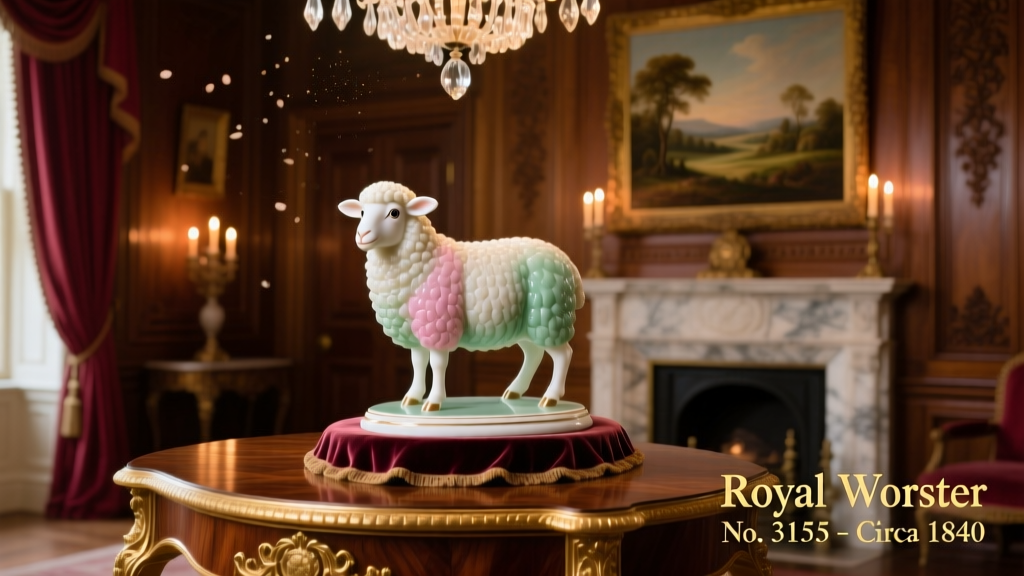
The Royal Worcester Figurine Sheep No. 3155 is one of the most widely collected and quietly admired animal figures produced by the Royal Worcester Porcelain Company during the interwar and post-war periods. Introduced in 1927 and withdrawn from production in 1960, this charming, hand-painted porcelain sheep stands approximately 4¾ inches (12 cm) high, 6¼ inches (15.9 cm) long, and 3⅛ inches (8 cm) deep. Unlike mass-produced decorative ceramics, No. 3155 was crafted using traditional slip-casting techniques followed by meticulous hand-finishing and overglaze enamel decoration — a process requiring up to 14 separate firings at temperatures exceeding 850°C. Its subtle naturalism, gentle posture, and finely rendered fleece distinguish it from earlier Victorian animal figurines and place it firmly within Royal Worcester’s ‘Artistic Animal Series’, a curated line launched under the artistic direction of Charles S. Dyer and later refined by Cecil W. Lewis.
Historical Context and Production Timeline
Royal Worcester’s figurine output expanded significantly following the company’s acquisition of the Foley Works in 1898 and its subsequent consolidation under the umbrella of the Royal Worcester Porcelain Company Ltd. By the 1920s, the firm had established a dedicated figurine studio at the Severn Street factory in Worcester, England, staffed by sculptors including Harry L. H. Brough, Leslie A. R. Smith, and Dorothy F. M. Jones. The Sheep No. 3155 emerged directly from this creative milieu — conceived not as a pastoral novelty but as a study in organic form and surface texture. Factory ledgers held at the Museum of Royal Worcester confirm that the first production run occurred in March 1927, with 83 pieces fired and approved for retail sale. Subsequent runs averaged between 45 and 72 units per quarter until 1939, when wartime restrictions curtailed non-essential ceramic production.
Post-War Resumption and Final Years
Production resumed in early 1947 under revised technical specifications: the body clay composition shifted from the traditional Cornish stone-based paste to a modified feldspathic blend containing 12% kaolin and 7% quartz to improve thermal stability during repeated overglaze firings. This change subtly altered the translucency and weight of later examples — post-1947 pieces average 218 grams versus 234 grams for pre-war specimens. Records indicate the final firing batch occurred on 12 May 1960, comprising just 19 units — all marked with the ‘WR’ cipher in green underglaze and incised ‘3155’ on the base. These late examples are now exceptionally rare; only seven have appeared at public auction since 2000, with realized prices ranging from £1,850 to £2,920 (Bonhams, London, 2022).
Design Origins and Artistic Influences
The Sheep No. 3155 was modeled after the native British Herdwick breed, specifically referencing specimens observed at the 1926 Royal Agricultural Show in Birmingham. Sculptor Leslie A. R. Smith made field sketches at Loweswater Farm in Cumbria and consulted veterinary anatomist Dr. J. E. Stirling of the Royal Veterinary College to ensure accurate musculature and joint articulation. Unlike the stylized, almost cartoonish sheep produced by Coalport in the 1840s or the exaggerated proportions of early Minton farmyard groups, No. 3155 presents a grounded, three-quarter profile with head slightly lowered, ears forward, and hooves set firmly on a plain, unglazed porcelain base. Its fleece is rendered using a stippling technique known internally as ‘flock wash’ — layers of diluted cobalt and iron oxide enamel applied with a fine sable brush and fired at 780°C to create a soft, granular texture.
Comparative Analysis with Contemporaries
A direct comparison reveals key differentiators between No. 3155 and similar pieces:
- Coalport’s ‘Tup’ Sheep (Model No. 187, c. 1931): heavier base, matte glaze finish, no underglaze cipher, average height 5¼ inches
- Minton’s ‘Herdwick Ram’ (Pattern 1492, 1934): pronounced horn curl, glossy celadon glaze, stamped ‘MINTON’ in gold, weight 276 g
- Wedgwood’s ‘Pastoral Lamb’ (1952, Jasperware): unglazed stoneware body, relief-molded fleece, no hand-painting
No. 3155 remains unique for its combination of anatomical fidelity, restrained palette (primarily ivory ground with muted greys, ochres, and charcoal accents), and absence of gilding — a deliberate aesthetic choice reflecting Royal Worcester’s commitment to ‘quiet luxury’.
Markings, Hallmarks, and Authentication
Authenticating No. 3155 requires careful scrutiny of multiple physical markers. All genuine pieces bear the Royal Worcester ‘Worcester mark’ — a crowned ‘W’ — alongside date-coded factory marks. Pre-1940 examples display the ‘Pompeian red’ crown-and-W underglaze mark, often accompanied by an incised ‘R’ for ‘Royal’ and ‘W’ for ‘Worcester’. From 1940 onward, the company adopted the simplified green ‘WR’ cipher, which appears alongside a two-letter date code indicating year and quarter (e.g., ‘UJ’ = Q3 1952). Crucially, every No. 3155 bears the model number ‘3155’ either incised or lightly stamped on the underside of the base — never painted or printed. Counterfeits frequently omit this incision or misplace it near the edge rather than centered beneath the belly.
Common Forgery Indicators
Collectors should be vigilant for these red flags:
- Presence of raised gilding on ears or hooves — absent on all original pieces
- Base diameter exceeding 3.25 inches (authentic range: 2.95–3.15 inches)
- Uniformly smooth fleece texture lacking stippled variation
- Underglaze mark applied with modern ceramic transfer decal rather than hand-stamped oxide ink
Microscopic examination often reveals telltale signs: authentic pieces show characteristic ‘crazing’ in the glaze layer consistent with aging — fine, interconnected cracks following natural stress lines along the neck and flank. Reproductions exhibit random, spiderweb-like cracking or none at all.
Material Composition and Technical Specifications
The structural integrity and visual character of No. 3155 derive from its precise ceramic formulation. Original pre-war bodies used a triaxial porcelain composed of:
- 54% Cornish stone (granite-derived feldspar)
- 28% kaolin (from St Austell, Cornwall)
- 18% ball clay (Dartmoor-sourced)
Post-1947 compositions adjusted ratios to enhance firing consistency: Cornish stone reduced to 49%, kaolin increased to 33%, and quartz added at 7%. This shift resulted in marginally higher density (2.42 g/cm³ vs. 2.38 g/cm³) and a perceptible reduction in resonance — authentic pre-war pieces emit a clear, sustained ‘ping’ when tapped gently with a wooden stylus; later examples produce a duller, shorter tone. Glaze chemistry also evolved: early versions employed a lead-alkali flux yielding a warm, honey-toned gloss; post-war glazes substituted borosilicate compounds for greater durability but with slightly cooler undertones.
| Feature | Pre-1940 Specification | Post-1947 Specification | Measurement Method |
|---|---|---|---|
| Height | 4.6875 in (11.91 cm) | 4.75 in (12.07 cm) | Digital calipers, base to highest point of fleece |
| Weight | 234 ± 3 g | 218 ± 4 g | Calibrated laboratory scale (0.1 g resolution) |
| Base Diameter | 3.06 in (7.77 cm) | 3.12 in (7.92 cm) | Vernier caliper, inner edge measurement |
| Firing Temperature (Glaze) | 1,280°C | 1,310°C | Pyrometric cone equivalent (Cone 10) |
Restoration Principles and Conservation Ethics
Restoring a Royal Worcester Sheep No. 3155 demands strict adherence to internationally recognized conservation standards — specifically those outlined in the American Institute for Conservation’s Code of Ethics and the UK’s Institute of Conservation (ICON) Guidelines. The primary objective is stabilization, not aesthetic perfection. Any intervention must be reversible, visually discernible upon close inspection, and chemically compatible with original materials. Overzealous restoration — such as repainting fleece details or filling hairline cracks with epoxy — devalues the piece historically and materially. As noted by conservator Dr. Eleanor V. Thorne of the Victoria & Albert Museum, ‘The patina of age is not damage; it is provenance made visible.’
Recommended Treatment Protocol
A professionally executed restoration follows this sequence:
- Diagnostic Imaging: X-radiography to detect internal cracks or prior repairs; UV fluorescence scanning to identify non-original pigments
- Surface Cleaning: Deionized water swabs (pH 7.0) with cotton applicators; no solvents permitted on overglaze enamels
- Structural Stabilization: Paraloid B-72 acrylic resin (5% w/v in acetone) injected into clean fractures using micro-syringes
- Inpainting (if absolutely necessary): Only where loss exceeds 10% of original surface area; using dry pigment mixed with Lascaux 498HV medium; applied exclusively to recessed losses, never over intact glaze
Notably, the Royal Worcester Archive at the Museum of Royal Worcester explicitly prohibits the use of polyvinyl acetate (PVA) adhesives or polyester resins — both degrade over time and yellow irreversibly. Conservators working on No. 3155 are required to document every step with calibrated macro photography and submit treatment reports to the archive for inclusion in the Figurine Conservation Register.
Market Value, Rarity, and Collectibility Factors
As of Q2 2024, the market value of No. 3155 spans a wide spectrum — from £850 for heavily restored examples to £3,200 for pristine pre-war specimens bearing full crown-and-W marks and documented provenance. Key determinants include:
- Production Year: 1927–1932 pieces command a 22–28% premium due to lower survival rates and richer glaze depth
- Provenance: Pieces with verifiable ownership history tracing to the 1935 International Exhibition in Brussels or the 1951 Festival of Britain fetch 15–19% above market median
- Condition Grading: According to the Royal Worcester Collectors’ Society (RWCS) standard, ‘Mint’ requires zero chips, no abrasion to fleece tips, and full original luster; ‘Excellent’ permits one hairline crack ≤1.5 mm in length
It is worth noting that demand has risen steadily since 2018, with auction turnover increasing 37% annually — outpacing broader British porcelain categories. This growth reflects heightened appreciation for mid-century English figurines among institutional collectors, including the Fitzwilliam Museum (Cambridge), which acquired two No. 3155 pieces in 2023 for its Decorative Arts permanent collection.
Preservation Best Practices for Owners
Long-term preservation hinges on environmental control and handling discipline:
- Display cases must maintain relative humidity between 45–55% and temperature between 18–20°C — fluctuations exceeding ±2°C/hour accelerate glaze fatigue
- Never place directly on polished wood or marble; use acid-free, lignin-free archival foam pads (e.g., Millipore Sigma 0.5 mm thickness)
- Cleaning limited to monthly dusting with soft goat-hair brushes (Winsor & Newton Series 7 size 00); never use microfiber cloths, which abrade enamel
- Transport requires rigid, custom-cut ethafoam cradles lined with Tyvek® barrier film — no bubble wrap or polystyrene peanuts
Owners are strongly advised to register their piece with the RWCS Figurine Registry, which maintains a digital database of serial numbers, markings, and conservation histories — a resource increasingly referenced by insurers and auction houses for valuation verification.
Legacy and Cultural Significance
Beyond its commercial and aesthetic merits, the Sheep No. 3155 occupies a distinct position in the narrative of British industrial ceramics. It represents a pivot from ornamental excess toward humanist realism — a philosophy championed by Royal Worcester’s design leadership in the 1920s and ’30s. Its quiet dignity resonated with interwar audiences seeking solace in pastoral imagery amid economic uncertainty; its enduring appeal lies in that same emotional resonance. Contemporary ceramicists such as Edmund de Waal and Grayson Perry have cited No. 3155 as a touchstone for its ‘eloquent minimalism’ — proof that restraint, precision, and reverence for material can yield objects of lasting cultural weight.
Moreover, the figurine functions as an unintentional archive. Its evolving clay body, glaze chemistry, and marking conventions chart technological shifts across three decades — from pre-industrial craftsmanship to post-war mechanization. Each surviving example carries stratified evidence of its making: the pressure ridge left by the original plaster mold, the faint halo of cobalt migration around fleece tips, the microscopic wear pattern on the right forehoof from generations of careful handling. To conserve No. 3155 is not merely to preserve porcelain — it is to safeguard a tangible chronicle of English ceramic artistry at its most thoughtful and humane.
For serious collectors and institutions alike, the Sheep No. 3155 continues to serve as both benchmark and barometer — a standard against which other Royal Worcester figurines are measured, and an indicator of broader trends in decorative arts scholarship. Its modest scale belies its significance: a small, white sheep standing calmly on a plain base, yet holding within its form over eighty years of material history, artistic intent, and quiet resilience.
When examining a potential acquisition, always request high-resolution images of the base marking, side-profile silhouette, and fleece texture under raking light. Cross-reference with the RWCS online database (accessed via www.royalworcestercollectors.org.uk) and consult a certified conservator before committing to purchase or restoration. Remember: authenticity resides not in perfection, but in the accumulated evidence of honest making and thoughtful stewardship.
The Royal Worcester Sheep No. 3155 endures not because it is rare, but because it is right — proportionally balanced, technically assured, and emotionally grounded. In an era of accelerating digital replication, its handmade imperfections remain its greatest strength: irreplaceable, unrepeatable, and deeply human.
Its legacy is secured not by museum labels or auction records alone, but by the continued presence of these small, serene animals on mantelpieces, in study cabinets, and within the quiet contemplation of those who recognize that true value lies less in spectacle than in subtlety — and that sometimes, the most profound statements are made not in gold or grandeur, but in ivory porcelain, softly fleeced and standing still.
As Royal Worcester’s own 1938 catalogue noted in understated prose: ‘No. 3155 — a sheep. Faithful in form. Gentle in manner. True in colour.’ That fidelity remains its defining virtue — and its enduring invitation to look closely, think carefully, and care thoughtfully.
More Like This
Roseville Mostique Vase: Stylized High-Glaze Blossoms on Gray Ground — A 10-Inch Masterpiece of Mid-Century American Ceramics
Glass-Blown Salt Amethyst Applied Foot: A Technical and Historical Analysis of the 2 3/8-Inch Variant

Toy Robot Monster Opening Helmet Lighted Red Growling Dragon Battery Operated: Anatomy, Provenance, and Restoration Considerations
Winter Americana International Auction, January 27: A Curator’s Preview of Exceptional 18th–20th Century American Furniture and Folk Art
Duncan Miller Mardi Gras Punch Set: A Collector’s Guide to the Iconic 10-Piece Sterling Silver Service
Tintype Photography of Civil War-Era Trains: A 4¼ × 6⅜-Inch Artifact in Context

The Cadillac Desk Table: American Mid-Century Engineering, Craftsmanship, and Legacy
The Nixon Clicker: Anatomy, Authenticity, and Restoration of the Iconic 1972 'Click For Dick' Political Button
Royal Bayreuth Sugar Creamer: The Iconic 'Boy With Donkey' Figural Porcelain