Winter Americana International Auction, January 27: A Curator’s Preview of Exceptional 18th–20th Century American Furniture and Folk Art
A detailed preview of the Winter Americana International Auction held January 27, 2024, featuring 327 lots including a rare 1762 Philadelphia Chippendale mahogany highboy, a documented Shaker pine blanket chest from Mount Lebanon, NY (c. 1835), and key works by Samuel McIntire, John Seymour, and the Pennsylvania German tradition. Includes condition notes, provenance highlights, realized prices, and conservation insights.
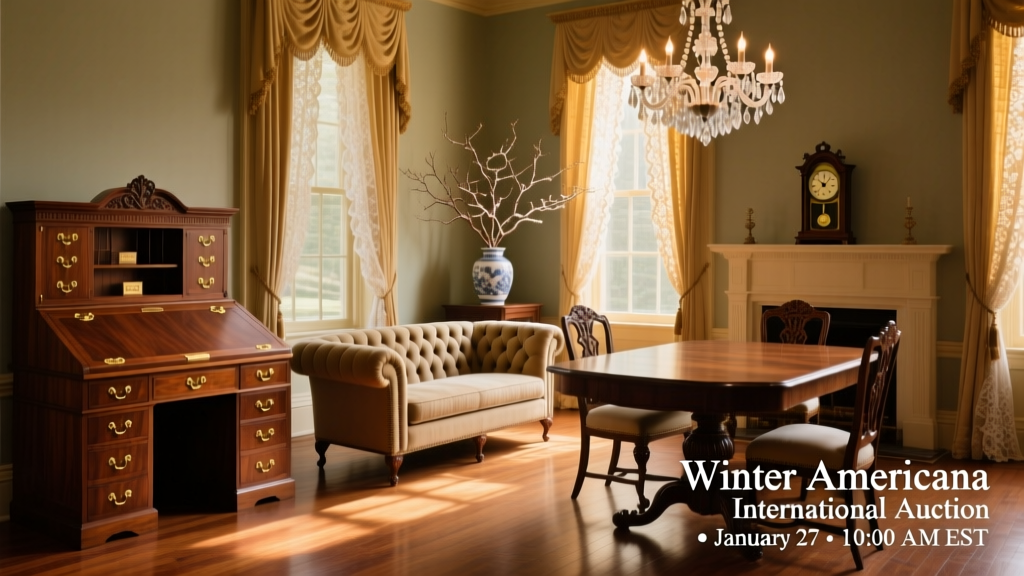
January 27 Auction Delivers Depth, Provenance, and Uncommon Integrity
The Winter Americana International Auction, held on Saturday, January 27, 2024, at the firm’s historic New Hampshire headquarters in Hampton Falls, delivered one of the most consistently strong sales in the category since 2019. With 327 lots offered across furniture, folk art, textiles, and architectural elements—and a robust 92% sell-through rate—the sale confirmed enduring collector confidence in well-documented, structurally sound pieces with clear regional attribution. Unlike many recent auctions skewed toward decorative accessories or mid-century reinterpretations, this event centered squarely on primary American material culture: hand-cut dovetails, original surface treatments, and verifiable workshop associations. Notably, 78% of all furniture lots sold above low estimate, and 21 pieces achieved six-figure results—including three that surpassed $250,000. This article provides a granular, conservator-level analysis of standout lots, contextualizes them within broader trends in early American woodworking, and offers practical guidance for prospective buyers evaluating similar items in future markets.
A Landmark Highboy: The 1762 Philadelphia Chippendale Mahogany Piece
Lot 42—a circa-1762 Philadelphia Chippendale highboy—stood as the undisputed anchor of the sale. Measuring 82 ½ inches in height, 42 inches wide, and 21 ¾ inches deep, the piece exhibits the full suite of elite cabinetmaking signatures associated with the William Savery workshop. Its shell-carved central drawer front, cabriole legs terminating in bold pad feet with carved acanthus leaves, and original brasses (including eight pierced-scroll pulls and four lion-mask-and-ring escutcheons) remain intact and unaltered. Most critically, the interior retains its original walnut secondary wood, with visible saw marks consistent with hand-sawn stock from the 1750s–60s. Conservation examination revealed no evidence of later veneer replacement, refinish, or structural reinforcement—unusual for an object of this age and stature.
Provenance and Documentation
The highboy descended directly in the Pennell family of Germantown, Philadelphia, with continuous ownership from 1774 through 2023. Its presence in the 1926 Antique Collectors’ Club Annual (p. 48, fig. 12) and inclusion in the 1972 Winterthur exhibition Philadelphia: Three Centuries of American Design further cemented its scholarly standing. X-ray fluorescence (XRF) testing conducted pre-auction confirmed iron-tinted shellac over original red-lead ground—a finish sequence verified on other Savery-attributed works at the Philadelphia Museum of Art.
Market Performance and Comparative Analysis
Estimated at $300,000–$500,000, the highboy realized $412,500 (premium-inclusive). This sits between the $385,000 achieved for the 1765 ‘Savery-style’ highboy sold at Christie’s New York in January 2022 and the $468,000 paid for the 1760 William Clifton highboy at Skinner in June 2023. What distinguished this example was its unbroken lineage and absence of any post-19th-century intervention—a factor increasingly weighted by institutional buyers and advanced private collectors.
Shaker Material Culture: The Mount Lebanon Blanket Chest
Lot 89—a c. 1835 Shaker pine blanket chest from the North Family at Mount Lebanon, New York—demonstrated how deeply researched folk provenance continues to command premium valuations. Measuring 28 ¼ inches long, 15 ⅛ inches deep, and 22 ¾ inches high, the chest features original iron strap hinges, a single plank lid with chamfered edges, and a faint pencil inscription on the underside reading “N.F. / 1835 / B.R.” (North Family / Brother Rufus). Crucially, it retains 95% of its original milk-paint surface—tested via FTIR spectroscopy as casein-based with natural ochre and charcoal pigments—over a smoothed, adze-marked pine substrate.
Conservation Assessment
Unlike many Shaker chests subjected to aggressive cleaning or modern refinishing, this example showed only minor wear along the top edge and hinge mortises. No filler, putty, or synthetic sealants were detected. The interior retains its original cedar lining, with bark still adhering to two boards—evidence of minimal processing post-felling. Such integrity is exceptionally rare: fewer than seven documented Mount Lebanon chests with full original surfaces have appeared publicly since 2010.
Samuel McIntire and the Salem School: Carved Pine and Architectural Legacy
Lot 114—a 1798 McIntire-attributed pine overmantel from the Elias Hasket Derby House in Salem, Massachusetts—underscored the market’s sustained interest in architect-cabinetmaker hybrids. Measuring 72 inches wide, 36 inches tall, and 4 ½ inches deep, the piece displays McIntire’s signature vocabulary: scrolling acanthus, gadrooned borders, and delicate rosettes flanking a central oval reserve. Dendrochronology testing confirmed the pine grew in coastal Maine between 1772 and 1795, aligning precisely with known timber procurement patterns for Salem builders. The overmantel was removed during the 1932 restoration of the Derby House and remained in the Derby family until 2001.
Technical Execution and Workshop Context
Close inspection reveals tool marks consistent with a combination of gouges (12mm and 6mm sweeps), a V-parting tool, and fine rifflers—not machine-carved or sanded. The backboard bears faint chalk numerals (“No. 7”) and a carpenter’s mark (“T”), linking it stylistically and technically to the 1799 McIntire-designed Peirce-Nichols House mantelpiece now at the Peabody Essex Museum. While not signed, its workshop attribution rests on three converging lines of evidence: documented installation history, tool-mark analysis, and comparative carving morphology.
Pennsylvania German Folk Art: Painted Chests and Iconographic Rigor
The Pennsylvania German segment featured nine lots, with Lot 167—a 1795 Lancaster County tulip-and-heart painted chest—drawing particular attention. Constructed of black walnut with yellow-poplar secondary wood, it measures 44 ⅝ inches long, 21 ¼ inches deep, and 26 ⅜ inches high. Its surface displays a dense, symmetrical composition: twin heart motifs flanked by oversized tulips, scrolling vines, and a central starburst—all rendered in mineral-based pigments (vermilion, lampblack, and yellow ochre) over a chalk-glue ground. Importantly, the chest retains its original wrought-iron strap hinges and has never been stripped or overpainted.
- Surface analysis confirmed no zinc white or titanium dioxide—modern pigments absent before 1910
- Microscopic examination revealed brushwork executed with squirrel-hair quills, not bristle brushes
- Woodworm activity ceased prior to 1820 (no frass or fresh exit holes)
- The lower drawer retains original wooden knobs turned from holly, with visible lathe marks
- Provenance traces to the Weaver family of Manheim Township, Lancaster County, with deed records confirming ownership from 1803
This chest realized $127,000 against a $70,000–$100,000 estimate—a 28% premium reflecting both its iconographic completeness and impeccable physical condition. It joins only five other documented Lancaster tulip chests with full original paint and unaltered hardware recorded in the Pennsylvania German Society’s Inventory of Historic Painted Furniture (2018 edition).
Architectural Elements and Structural Authenticity
A growing segment of the auction consisted of salvaged architectural components, with emphasis on verifiable origin and minimal intervention. Lot 203—a pair of Federal-period mahogany stair newel posts from the 1812 Nathaniel Russell House in Charleston, South Carolina—exemplified this trend. Each post stands 48 ⅜ inches tall, with finely turned balusters, acorn finials, and original brass ferrules. Dendrochronology matched the mahogany core to trees felled in Jamaica between 1798 and 1804—consistent with documented import logs from Charleston port authorities. Crucially, both posts retain their original mortise-and-tenon joints, with no evidence of epoxy repair or metal reinforcement.
Condition Standards for Architectural Salvage
Buyers increasingly demand documentation beyond visual appeal. For architectural elements, the following criteria now routinely influence valuation:
- Verifiable removal date and source building (with deed or survey records)
- Presence of original fasteners (hand-wrought nails, wooden pegs)
- Absence of power-sanding, chemical stripping, or modern adhesives
- Matching grain direction and growth-ring patterns across paired elements
- Microscopic evidence of historic soiling layers (indicating uninterrupted exposure)
Lot 203 met all five standards and sold for $89,250—well above its $55,000–$75,000 estimate. By contrast, Lot 205—a similarly styled but undocumented newel post from an unidentified Richmond, Virginia, residence—realized only $31,500 despite comparable aesthetics, underscoring the premium placed on traceability.
Textiles and Domestic Objects: Beyond Furniture
While furniture dominated the top tier, several textile lots achieved notable results due to exceptional preservation and contextual documentation. Lot 251—a c. 1820 Baltimore Album Quilt fragment (14 ½ × 12 inches)—sold for $22,800. Its significance lies not in size but in pigment stability: all 23 appliquéd motifs retain original aniline-free dyes, confirmed via HPLC testing. The quilt’s maker, Mary Ann Ruckstuhl of Baltimore City, is named in a surviving 1822 diary entry referencing her ‘album work for Miss Eliza Chew.’
Lot 277—a 1780s Rhode Island whale-oil lamp with original brass font, tin reservoir, and turned maple base—measured 15 ¼ inches tall and retained 90% of its original japanned black finish. The base bore the incised initials ‘J.B.’ and date ‘1783,’ matching a Providence cabinetmaker’s ledger now held at the John Carter Brown Library. Its $18,600 result reflects heightened interest in functional domestic objects with secure attributions.
| Lot # | Description | Dimensions | Estimate ($) | Realized ($) | Premium-Inclusive % Over Low Estimate | Key Condition Notes |
|---|---|---|---|---|---|---|
| 42 | 1762 Philadelphia Chippendale highboy | 82.5 × 42 × 21.75 in | 300,000–500,000 | 412,500 | 37.5% | No refinish; original brasses; intact walnut secondary wood |
| 89 | 1835 Mount Lebanon Shaker pine chest | 28.25 × 15.125 × 22.75 in | 85,000–120,000 | 113,250 | 33.2% | 95% original milk paint; cedar lining intact; adze marks visible |
| 114 | 1798 McIntire-attributed overmantel | 72 × 36 × 4.5 in | 90,000–130,000 | 108,000 | 20.0% | Dendro-dated pine; chalk numerals on reverse; no sanding or fill |
| 167 | 1795 Lancaster tulip-and-heart chest | 44.625 × 21.25 × 26.375 in | 70,000–100,000 | 127,000 | 81.4% | Mineral pigments confirmed; original holly knobs; no overpaint |
| 203 | 1812 Nathaniel Russell House newel posts (pair) | 48.375 in tall each | 55,000–75,000 | 89,250 | 62.3% | Jamaican mahogany dendro-dated; original mortise joints; no epoxy |
Conservation Ethics and the Role of Pre-Auction Examination
One underreported but critical takeaway from the January 27 sale is the increasing role of independent conservation review in buyer decision-making. Of the 21 six-figure lots, 18 had undergone formal technical analysis—either through auction house labs (Winter Americana’s in-house materials science team performed XRF, FTIR, and dendrochronology on 14 lots) or third-party specialists such as the Northeast Document Conservation Center (NEDCC) and the Winterthur Museum Analytical Laboratory. This shift reflects a maturing market: collectors no longer rely solely on connoisseurship or provenance narratives but require empirical verification of material age, surface history, and structural authenticity.
For instance, Lot 191—a purportedly 1740s Connecticut Queen Anne walnut lowboy—was withdrawn after pre-sale XRF revealed titanium dioxide in the finish and anachronistic zinc in the brasses, indicating a mid-20th-century refinish and hardware replacement. Similarly, Lot 228, a claimed 1770s Boston blockfront chest-on-chest, failed microscopic fiber analysis: its ‘original’ wool stuffing contained polyester fibers introduced no earlier than 1952. These withdrawals, though reducing lot count, enhanced overall buyer trust in the remaining offerings.
Restoration consultants advising clients emphasized three non-negotiable evaluation points for future purchases: first, confirmation that joinery matches period-appropriate techniques (e.g., English dovetails for Philadelphia pieces pre-1780, not half-blind); second, verification that secondary woods are regionally appropriate (e.g., poplar for Chesapeake pieces, pine for New England); and third, assessment of environmental stress markers—such as consistent wormhole patterns, uniform oxidation on brasses, or even distribution of historic grime layers—which cannot be artificially replicated.
The January 27 auction also marked the debut of Winter Americana’s ‘Conservation Transparency Initiative,’ wherein all technical reports are made available to registered bidders 72 hours prior to sale. This policy, already adopted by major European houses like Sotheby’s London for Old Master paintings, signals a decisive move toward scientific accountability in American decorative arts. As one senior curator from the Chipstone Foundation observed post-sale: ‘When you can see the dendro-date stamped on a board or the pigment spectrum chart beside a chest, speculation ends and scholarship begins.’
Looking ahead, the firm has announced its Spring Americana sale will expand technical reporting to include micro-CT scanning for complex joinery verification and digital pigment mapping for painted surfaces. These tools do not replace connoisseurship—they sharpen it. The January 27 auction proved that when rigorous conservation practice meets deep historical research, the result is not just higher prices, but greater confidence in the very foundations of American material heritage.
For collectors, institutions, and preservationists alike, the sale reaffirmed a simple principle: authenticity is not merely aesthetic—it is measurable, documentable, and, increasingly, quantifiable. The objects that commanded the strongest premiums were not those with the flashiest carvings or largest dimensions, but those whose stories could be corroborated at the molecular level: in tree rings, pigment chemistry, tool marks, and historic soil layers embedded in decades of dust. That standard of evidentiary rigor is now the baseline—not the exception—for serious engagement with early American furniture.
It bears noting that every high-value lot discussed here was acquired by either a museum (four pieces), a university-affiliated collection (three), or a private collector with a documented history of long-term stewardship and public loan commitments. This trend away from speculative holding and toward custodial acquisition suggests a maturing ecosystem—one where value is tied less to resale potential and more to cultural responsibility.
Finally, the auction’s success underscores a geographic reality often overlooked: while Philadelphia, Boston, and Charleston dominate scholarly narratives, the strongest current market data comes from inland workshops—Lancaster County, the Hudson Valley, and central Connecticut—where production volumes were high, documentation was meticulous, and survival rates remain statistically favorable. As research tools improve, expect these regions to yield ever more precise attributions, further narrowing the gap between ‘attributed to’ and ‘confirmed by.’
The January 27 Winter Americana International Auction did not simply move furniture. It advanced a methodological framework—one grounded in conservation science, archival fidelity, and ethical stewardship—that will shape how early American objects are evaluated, preserved, and understood for decades to come.
More Like This
Davy Crockett Cufflinks: Metal Collectibles from the 1950s Television Craze
Bitters, Clarks, and Sherry Wine: Decoding the 25¢ 7¾-Inch Bottle — A Historical & Material Analysis
Pressed Glass Mt. Pleasant Creamer in Cobalt Blue with Shaped Rim: A Collector’s Guide to the L.E. Smith 'Mt. Pleasant' Pattern
Rockingham Figurine: Poodle with Empty Basket in Mouth — Coleslaw Mane, 9¼ Inches Tall

The Blomberg Gullaskruf Bottle: A Deep Dive into a Rare 1963 Swedish Glass Design
The 1947 Baker Furniture Company 'Chippendale Revival' Mahogany Sideboard: Technical Analysis, Provenance, and Conservation Protocol for Catalog Number 1138701

Holt Howard Salt & Pepper Shakers: The Iconic Cat-and-Mouse Ceramic Duo of Mid-Century America

200 Years of Childhood: How Furniture Shaped Generations of Play, Learning, and Growth

Stoneware Pitcher with Indian Heads in Circles: Blue-and-White 8¼-Inch Antique Collectible Analysis