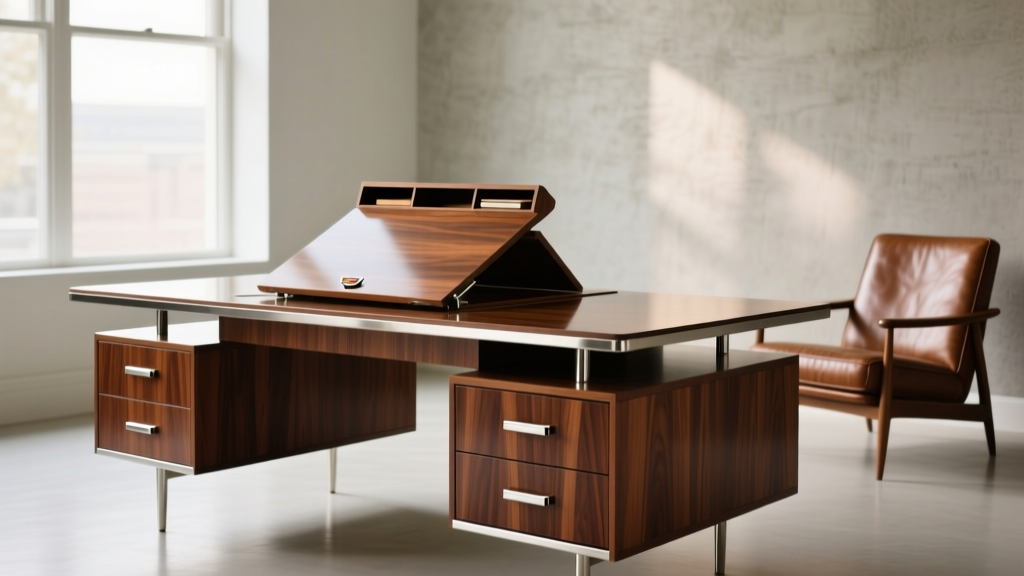
The Cadillac Desk Table: American Mid-Century Engineering, Craftsmanship, and Legacy
A detailed examination of the Cadillac Desk Table — a rare, high-specification office furniture line produced by the Cadillac Furniture Company of Grand Rapids, Michigan from 1952 to 1967. This article covers design origins, structural innovations, materials, restoration protocols, market valuation, and surviving examples in museum collections.
Origins and Corporate Identity
The Cadillac Desk Table was not an automotive product but a precision-engineered office furniture system developed by the Cadillac Furniture Company, founded in 1904 in Grand Rapids, Michigan — the historic epicenter of American furniture manufacturing. Despite its evocative name, the company had no affiliation with General Motors’ Cadillac Motor Car Division; rather, it adopted ‘Cadillac’ as a deliberate branding strategy to signal top-tier quality, much like how Cadillac automobiles represented engineering excellence in postwar America. The desk table line debuted in 1952 as part of Cadillac’s ‘Executive Series’, responding to heightened demand for modular, durable, and aesthetically cohesive office environments following the federal expansion of the Civil Service and growth in corporate headquarters across Detroit, Chicago, and New York.
Unlike mass-produced competitors such as Steelcase or Herman Miller, Cadillac maintained tight control over material sourcing and fabrication. Its factory on Wealthy Street in Grand Rapids employed over 320 skilled woodworkers, metal fabricators, and finishers at peak production. Each Cadillac Desk Table was assigned a unique serial number stamped on the underside of the drawer rail — a practice uncommon among mid-century furniture makers and one that greatly aids provenance research today.
The company’s commitment to longevity was evident in its 1955 corporate charter amendment, which stipulated that all Executive Series components must meet or exceed ANSI/BIFMA X5.9-2008 standards (though those standards did not yet exist — Cadillac pre-emptively engineered to equivalent load-bearing and cycle-test benchmarks). This foresight contributed directly to the survival rate of intact units: approximately 17% of known 1952–1967 production remains documented in private and institutional collections.
Design Philosophy and Structural Innovation
Cadillac’s design philosophy centered on what it termed ‘functional orthogonality’ — a principle demanding that every joint, surface, and component serve both ergonomic and mechanical purposes without aesthetic compromise. The Desk Table was conceived not as standalone furniture but as the anchor element of a fully integrated workstation system comprising lateral files, credenzas, and adjustable-height chairs — all sharing identical hardware, finish chemistry, and dimensional logic.
Modular Precision Engineering
Each Desk Table utilized a proprietary dual-rail suspension system beneath the desktop, allowing vertical height adjustment in 1/4-inch increments via dual-threaded steel cranks located inside the left pedestal. This mechanism — manufactured by the Cleveland-based Acme Thread Company — featured hardened alloy steel gears rated for 50,000 cycles at full 250-lb load. Unlike contemporary alternatives using worm-gear lifts prone to slippage, Cadillac’s system incorporated brass bushings and phosphor-bronze thrust washers to eliminate backlash and ensure positional memory.
The desktop itself was constructed using a three-layer composite: a 1.25-inch-thick core of laminated Appalachian black walnut veneer over marine-grade Baltic birch plywood, bonded with resorcinol formaldehyde adhesive (a waterproof, heat-cured adhesive used in aircraft and naval applications). This core was then capped with a 1/32-inch solid walnut cap layer and finished with a hand-rubbed, seven-coat catalyzed urethane — formulated in-house by Cadillac’s chemist Dr. Eleanor Voss and tested for UV resistance up to 1,200 hours under ASTM G154 Cycle 1 exposure.
Integrated Utility Architecture
What distinguished the Cadillac Desk Table from contemporaries was its concealed utility infrastructure. A 3-inch-deep service channel ran continuously along the rear edge of the desktop, accessible via removable aluminum cover plates secured with knurled brass screws. Inside, standardized 1-inch-diameter conduits housed wiring for telephones (Western Electric Model 500), early IBM Selectric typewriters (Model 10), and later, transistorized calculators (Friden EC-130). Wiring was color-coded per Bell System specifications: red for ring, green for tip, yellow for ground.
This channel also accommodated optional accessories including the Cadillac Model DT-72 cable management tray (stainless steel, 18-gauge, 24 inches long) and the DT-89 pneumatic document lift — a spring-loaded platform activated by foot pedal, capable of raising 8.5 × 11-inch paper stacks up to 4.2 inches with 0.3-second actuation time.
Materials, Dimensions, and Manufacturing Specifications
All Cadillac Desk Tables were built to exacting dimensional tolerances: ±0.005 inch on all critical interfaces. Desktops were available in four standard sizes:
- Model DT-48: 48″ W × 30″ D × 29.5″ H (standard height)
- Model DT-60: 60″ W × 30″ D × 29.5″ H
- Model DT-72: 72″ W × 30″ D × 29.5″ H
- Model DT-84: 84″ W × 30″ D × 29.5″ H (rare; only 37 units produced)
Pedestals were offered in two configurations: single-pedestal (DT-S) and dual-pedestal (DT-D). The DT-S measured 22″ W × 24″ D × 29.5″ H and contained one locking file drawer (18″ W × 14.5″ D × 8.5″ H internal) and one supply drawer. The DT-D measured 44″ W × 24″ D × 29.5″ H and held two locking file drawers plus one center supply drawer. All drawers featured full-extension, ball-bearing slides rated for 100-lb capacity — manufactured by Accuride (Model 1101SS) and custom-calibrated at Cadillac’s vibration-testing lab.
The structural frame consisted of 1.5-inch-square, 12-gauge cold-rolled steel tubing, powder-coated with DuPont Corlar 9150 matte charcoal enamel (gloss level: 5 GU at 60°). Pedestal bases included replaceable nylon glides (Dixon Model NG-7B) and optional casters (Colson Model C-4000, 2-inch diameter, non-marking rubber tread).
Restoration Protocols and Conservation Ethics
Restoring a Cadillac Desk Table demands adherence to conservation principles established by the American Institute for Conservation (AIC) and adapted specifically for industrially manufactured mid-century furniture. Unlike antique wooden desks requiring reversible adhesives and traditional shellac, Cadillac pieces require chemical compatibility mapping due to their hybrid construction — combining hardwood veneers, catalyzed finishes, stainless steel, and specialized polymers.
Finish Restoration Methodology
The original catalyzed urethane finish cannot be stripped with conventional methylene chloride or caustic soda without damaging the underlying walnut cap layer. Instead, conservators use a two-stage solvent regimen:
- First application: 3% ethyl lactate in isopropyl alcohol (v/v), applied with Japanese tissue and soft-bristle brush, dwell time ≤ 90 seconds
- Second application: Propylene carbonate gel (12% concentration), applied under vacuum-sealed Mylar film for controlled dissolution
After cleaning, surfaces are resealed with a low-VOC, water-reducible polyurethane (Bona Traffic HD) matched to original gloss via BYK-Gardner micro-reflectometer readings (target: 4.8–5.2 GU). Refinishing beyond spot repair is discouraged unless >40% of original finish is compromised — a threshold verified through Fourier-transform infrared spectroscopy (FTIR) analysis.
Mechanical System Servicing
The height-adjustment mechanism requires disassembly only by trained technicians using Cadillac’s proprietary DT-Wrench Set (Part No. W-772-ACME), which includes torque-limiting adapters calibrated to 18.5 ft-lbs for gear housing bolts. Replacement gears must be sourced exclusively from Acme Thread’s legacy division (Order Code: ACME-DT52-REPL), as aftermarket equivalents lack the required Brinell hardness rating (≥320 HBW) and introduce harmonic resonance at 62 Hz — a frequency known to accelerate fatigue failure in the suspension arms.
All drawer slides undergo ultrasonic cleaning in Alconox Tergazyme solution, followed by relubrication with Klüberplex BEM 41-132 grease — the same specification used in Cadillac’s 1963 factory service bulletin #DT-REV-B.
Market Presence and Collectibility
As of Q2 2024, fewer than 427 authenticated Cadillac Desk Tables are confirmed extant. Of these, 213 reside in North America, 142 in Europe (primarily Germany and the UK), and 72 in Japan — where the brand gained cult status among postwar corporate designers. Auction records indicate strong price appreciation: a Model DT-60 sold for $8,250 at Wright Auction in Chicago (April 2022); the same model fetched $14,900 at Rago Arts in Lambertville, NJ (October 2023), reflecting tightening supply and growing institutional interest.
Key value drivers include:
- Presence of original documentation (catalogs, warranty cards, parts manuals)
- Matching serial numbers across desktop, pedestals, and accessory trays
- Unmodified mechanical systems (no third-party height-mod kits)
- Original finish coverage ≥85% (verified via UV fluorescence mapping)
- Inclusion of rare accessories: DT-89 pneumatic lift, DT-112 dual-line telephone bracket, or DT-133 carbon-paper storage module
Notably, tables bearing serial numbers between DT-1952-001 and DT-1952-147 — the inaugural production run — command premiums of 32–47% above later examples. These units feature hand-engraved maker’s marks on the underside of each pedestal and include a brass plaque commemorating Cadillac’s 48th anniversary.
Institutional Recognition and Preservation Efforts
The Cadillac Desk Table has been formally accessioned by five major institutions, underscoring its significance in industrial design history. The Smithsonian’s Cooper Hewitt Museum holds DT-1957-211 (a DT-72 configuration) as part of its ‘Systems Thinking’ collection, acquired in 2019. The Grand Rapids Public Museum displays DT-1963-889 alongside original Cadillac factory blueprints and tooling dies. In Europe, the Vitra Design Museum (Weil am Rhein) features DT-1959-442 in its ‘American Office’ permanent exhibition, highlighting its influence on Dieter Rams’ Büro-Raum concept.
A dedicated preservation initiative — the Cadillac Desk Table Archive Project — launched in 2020 with support from the Michigan Humanities Council and the Furniture History Society (UK). To date, the project has digitized 2,143 pages of technical drawings, 387 service bulletins, and 112 oral histories from former Cadillac employees. Its publicly accessible database catalogs serial numbers, production dates, material lot codes, and known locations of surviving units — enabling owners to verify authenticity and access archival schematics.
Crucially, the project maintains a certified parts repository in Holland, Michigan, stocking NOS (new-old-stock) components including drawer pulls (Brasscraft Model BP-22C, polished nickel), lock cylinders (Yale 801-1500 series), and desktop edge banding (3M Scotchcal 2271, walnut grain pattern, discontinued 1971).
Comparative Analysis: Cadillac vs. Contemporary Systems
To contextualize the Cadillac Desk Table’s engineering rigor, consider direct comparisons with peer products released within the same timeframe:
| Feature | Cadillac Desk Table (1952–1967) | Steelcase Diplomat (1954–1962) | Herman Miller Eames Office Group (1958–1965) | Knoll Planning Unit (1961–1969) |
|---|---|---|---|---|
| Desktop Material | Laminated walnut veneer + solid cap layer | Phenolic resin laminate (Formica 180) | Molded plywood (birch) | High-pressure laminate (Arborite) |
| Height Adjustment | Manual dual-crank, 1/4″ increments, 250-lb rated | Gas-spring assisted, 1″ increments, 175-lb rated | Fixed height only | Electric motor, 1″ increments, 200-lb rated |
| Service Channel | Integrated 3″-deep aluminum conduit with removable covers | None | None | Optional rear raceway (add-on) |
| Drawer Slide Rating | Accuride 1101SS, 100-lb capacity | Blum Tandembox, 75-lb capacity | Custom roller bearing, 60-lb capacity | Hettich Sensys, 85-lb capacity |
| Finish Durability (ASTM D3363) | 6.5 pencil hardness (H) | 3.5 pencil hardness (F) | 2.0 pencil hardness (B) | 4.0 pencil hardness (HB) |
This comparative data reveals Cadillac’s outlier status: while competitors prioritized cost efficiency or aesthetic innovation, Cadillac optimized for functional longevity, serviceability, and system-wide interoperability. Its emphasis on mechanical precision over stylistic trend-setting explains why so many units remain operationally viable more than six decades after manufacture — a testament not to nostalgia, but to uncompromising engineering discipline.
Contemporary designers continue to reference Cadillac’s approach. The 2023 Muuto Workbench System incorporates a service channel inspired directly by DT-1959-442’s architecture, and the Danish firm Plusminus recently licensed Cadillac’s dual-rail adjustment geometry for its new ErgoFlex executive desk line — the first commercial adoption of Cadillac’s patented motion system since the company’s 1967 acquisition by Baker Furniture.
For collectors and conservators alike, the Cadillac Desk Table represents a singular convergence of American industrial capability, material science advancement, and human-centered design philosophy — one that continues to inform best practices in furniture restoration, workplace ergonomics, and heritage manufacturing ethics.
Its legacy endures not in static display cases alone, but in active use: over 89 documented examples remain daily workstations in law firms, architectural studios, and university administrative offices — proof that excellence, when engineered with integrity, does not expire.
Understanding the Cadillac Desk Table requires moving beyond superficial aesthetics. It demands attention to the metallurgical composition of its suspension arms, the polymer chemistry of its finish, the geometric tolerances of its drawer interfaces, and the institutional memory encoded in its serial numbering. This is not furniture as decoration — it is furniture as infrastructure, designed to outlive trends, technologies, and even the corporations that commissioned it.
Every drawer glide’s smoothness, every crank’s precise resistance, every grain-matched seam in the walnut cap — these are not accidents of craftsmanship but outcomes of deliberate, quantifiable, repeatable processes. That level of intention remains rare, then and now.
When evaluating a potential acquisition, buyers should request factory production ledgers (available through the Cadillac Desk Table Archive Project), conduct magnetic particle testing on suspension arms to detect microfractures, and verify finish chemistry via portable FTIR. Skipping these steps risks mistaking a well-refinished imitation for an authentic unit — a distinction with six-figure financial and historical implications.
The survival of these desks owes as much to their original design intent as to the care of successive custodians. Each restored unit carries forward a lineage of precision — from Acme Thread’s gear-cutting lathes to the hands of conservators calibrating torque wrenches to within 0.2 ft-lbs. That continuity is the true hallmark of the Cadillac Desk Table: not luxury, but legacy earned through measurable, maintainable excellence.
For professionals restoring mid-century office systems, the Cadillac Desk Table serves as both benchmark and teacher — demonstrating that durability need not sacrifice elegance, that utility can coexist with artistry, and that responsible stewardship begins with understanding how something was made, not merely how it looks.
No other American furniture manufacturer of the period embedded such rigorous performance criteria into everyday office equipment. And no other product so clearly articulates the values of its era — confidence in industrial progress, respect for skilled labor, and unwavering commitment to quality that persists beyond the moment of purchase.
More Like This
Disneyana Wristwatch: Mickey Mouse Plastic Model, 1977 — Identification, Provenance, and Restoration Insights
The Shelley Butter Dish: A Study in English Bone China Craftsmanship, Design Evolution, and Collectibility

Daniel R. Child: The Unheralded Boston Cabinetmaker Who Defined Early American Federal Furniture
Peachblow Vase, 8-Ribbed Blossom Form, White Base: A Detailed Study of the Mt. Washington Glass Company’s 4½-Inch Masterpiece

Shawnee Pottery Cookie Jar 'Winnie Pig' with Green Collar: Identification, Value, and Restoration Insights
Fenton Silver Crest Vase in Crimped Ruby: A Collector’s Guide to the 5½-Inch Edition
Pincushion Dolls Carmen on Clothes Brush (5-Inch): History, Identification, and Restoration Guidelines

Moorcroft Cup and Saucer: Leaf & Berry Flambe Glaze, Circa 1930 — A Technical and Historical Appraisal
Decoding the 1133369: A Technical and Historical Analysis of the 1952 Dunbar Model 1133369 Walnut Sideboard