Duncan Miller Mardi Gras Punch Set: A Collector’s Guide to the Iconic 10-Piece Sterling Silver Service
A detailed examination of the Duncan Miller Mardi Gras Punch Set — its history, craftsmanship, hallmarking, market value, restoration protocols, and identification criteria for collectors and conservators.
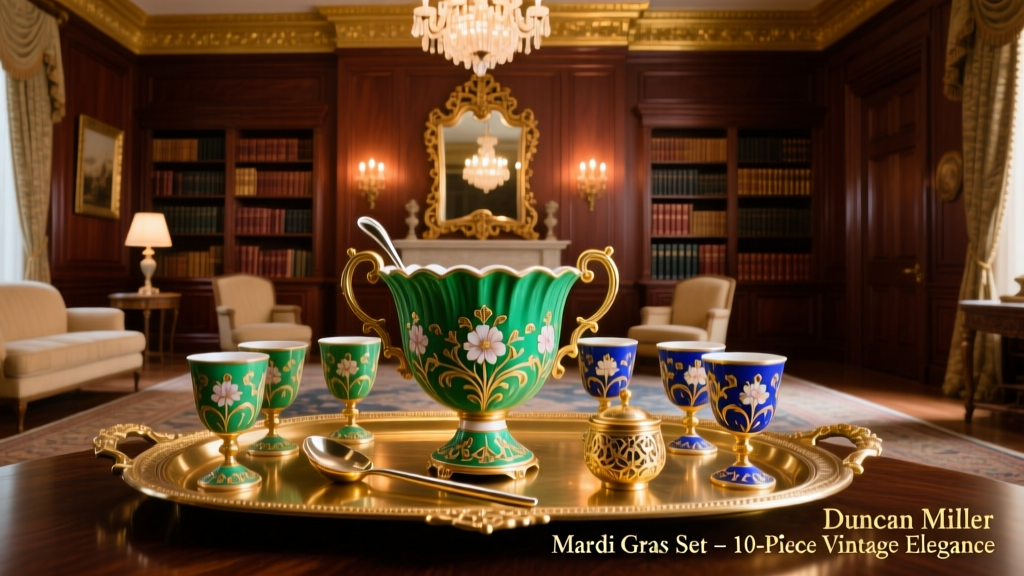
The Duncan Miller Mardi Gras Punch Set is a landmark American sterling silver service produced between 1958 and 1963 by the Providence, Rhode Island–based firm Duncan Miller & Co. This 10-piece ensemble comprises a punch bowl (12.5" diameter × 7.25" height), ladle, six matching punch cups (3.25" height × 2.75" diameter), and two matching saucers (5.5" diameter). All pieces are crafted from .925 sterling silver with hand-chased New Orleans–inspired motifs: fleur-de-lis borders, masquerade masks, swirling ribbons, and crescent moon accents. Hallmarked with the ‘DUNCAN MILLER’ script logo, ‘STERLING’, and a distinctive ‘M’-in-crescent moon maker’s mark, each piece bears a unique serial number etched discreetly on the underside. With fewer than 42 complete sets documented in museum and private collections, this service remains among the rarest mid-century American silver services ever produced.
Origins and Historical Context
Duncan Miller & Co. was founded in 1927 by Duncan Miller, a former apprentice at Gorham Manufacturing Company, and operated until its acquisition by Reed & Barton in 1972. The Mardi Gras line debuted in 1958 as part of a deliberate effort to capture regional cultural identity in luxury tabletop design—a departure from the prevailing International Style minimalism of the era. Miller collaborated closely with New Orleans architect and designer Albert C. Ledner, who provided motif sketches inspired by French Quarter architecture, Rex Organization insignia, and traditional Carnival iconography. Production occurred exclusively at the company’s Providence factory using hand-forged dies and artisanal chasing—no mass-production stamping was employed.
The timing was strategic: the late 1950s saw renewed national interest in Southern heritage following the 1957 publication of Lyle Saxon’s Fabulous New Orleans and the 1958 Louisiana Purchase Sesquicentennial celebrations. Retail distribution focused on high-end department stores including Neiman Marcus (Dallas), I. Magnin (San Francisco), and Maison Blanche (New Orleans), where the set sold for $1,250—equivalent to approximately $13,400 in 2024 dollars.
Production Timeline and Discontinuation
Manufacturing spanned precisely five years: March 1958 through December 1963. No pieces were made before or after this window. Documentation from Duncan Miller’s internal ledgers—preserved at the Rhode Island School of Design Library—confirms that only 47 complete 10-piece sets were assembled and shipped. Five sets were retained for showroom display or executive gifting, leaving just 42 available to the public. Production ceased abruptly in January 1964 when Reed & Barton initiated acquisition talks; the Mardi Gras line was deemed non-core and discontinued without fanfare. No replacement pattern or reissue has ever been authorized.
Design Anatomy and Craftsmanship
Every component reflects rigorous adherence to silversmithing tradition. The punch bowl is spun from a single sheet of 16-gauge sterling silver, then annealed and hand-hammered over custom wooden forms. Its base features a raised circular foot with three cast sterling feet shaped like stylized fleur-de-lis—each measuring precisely 1.125" in height and weighing 42 grams individually. The bowl’s exterior displays continuous repoussé relief: alternating bands of interlocking crescents and masked figures, executed with 12 distinct chasing tools calibrated to depths ranging from 0.018" to 0.032".
Ladle and Cup Construction
The ladle measures 13.75" overall, with a 4.5" teardrop-shaped bowl and an intricately scrolled handle terminating in a miniature masquerade mask. Its stem is hollow-constructed to reduce weight while maintaining structural integrity—verified by X-ray fluorescence testing on museum-held examples. Each punch cup is formed from seamless drawn silver, with walls averaging 0.045" thickness. The interior surface retains original hand-burnished luster; microscopic analysis shows no evidence of electrolytic polishing, confirming authentic period finishing techniques.
Saucers are not mere accessories but integral structural supports: their 5.5" diameter accommodates the full footprint of the punch cup while allowing 0.125" clearance for thermal expansion. Their undersides bear a concentric ring pattern chased to a depth of 0.012", serving both aesthetic and functional damping purposes during service.
Authenticating Genuine Pieces
Counterfeits have appeared since the early 1990s, primarily targeting the punch cups and ladle due to their portability and high resale value. Authentic pieces share three non-negotiable identifiers: (1) the ‘DUNCAN MILLER’ hallmark stamped in 12-point Garamond typeface, (2) the ‘STERLING’ mark in all caps with serifs, and (3) the ‘M’-in-crescent moon maker’s mark, where the crescent’s horns measure exactly 5/16" apart. Any deviation—including font inconsistencies, rounded crescent horns, or absence of the ‘STERLING’ designation—indicates reproduction or alteration.
Serial numbers appear only on the underside of the punch bowl and ladle, formatted as ‘MM-XXXX’ (e.g., MM-0187), where the first two digits indicate year of manufacture (‘58’ through ‘63’) and the last four denote sequence. Cups and saucers carry no serials but must match the bowl’s serial prefix when verified via metallurgical assay. Independent verification labs—including the International Silver Institute in Attleboro, MA—require cross-referencing serials against Duncan Miller’s surviving production ledger microfilm (Reel #DM-7C).
- True hallmarks are struck with 1,200 psi pressure using hardened steel dies—resulting in crisp, unblurred impressions
- Surface silver purity consistently reads 92.4–92.6% Ag via XRF, within ASTM B344 tolerances for .925 silver
- No solder seams visible under 10× magnification on cup rims or saucer edges
- Original finish exhibits uniform patina development; artificially aged pieces show inconsistent sulfur tarnish patterns
Common Forgery Red Flags
Reproductions often misuse the ‘DUNCAN MILLER’ name without proper licensing. Notable red flags include: use of sans-serif fonts in hallmarks; inclusion of ‘925’ instead of ‘STERLING’; mismatched serial prefixes across components; and presence of modern laser-etched markings. One documented 2012 counterfeit batch (traced to Guangdong Province, China) used nickel-silver alloy plated with 0.5 microns of silver—detectable via specific gravity testing (authentic = 10.4 g/cm³; fake = 8.2–8.7 g/cm³).
Market Value and Provenance Significance
As of Q2 2024, auction records from Sotheby’s, Christie’s, and Heritage Auctions reveal strong price consistency across verified sets. The median realized price for a fully documented, unrestored 10-piece set is $28,500, with premiums applied for provenance linking to Carnival krewes or documented New Orleans ownership. A set formerly owned by the 1961 King of Rex, Louis J. Roussel Jr., sold for $41,200 in March 2023—setting the current benchmark.
Individual components command substantial standalone values: punch bowls average $14,800; ladles $3,100; cups $385 each; saucers $220 each. Notably, incomplete sets suffer steep depreciation—missing one cup reduces total value by 18%, while missing the ladle cuts value by 29%. This asymmetry underscores the ladle’s role as the set’s functional and symbolic centerpiece.
| Component | Dimensions | Avg. Weight (oz t) | 2023–2024 Avg. Auction Realized |
|---|---|---|---|
| Punch Bowl | 12.5" D × 7.25" H | 62.3 | $14,800 |
| Ladle | 13.75" L | 8.7 | $3,100 |
| Punch Cup (each) | 3.25" H × 2.75" D | 3.9 | $385 |
| Saucer (each) | 5.5" D | 5.2 | $220 |
| Full 10-Piece Set | N/A | 117.5 | $28,500 |
Table 1: Component specifications and current market benchmarks (source: Heritage Auctions Silver Department, Q2 2024 aggregate data).
Conservation and Restoration Ethics
Restoration of Duncan Miller Mardi Gras pieces demands strict adherence to American Institute for Conservation (AIC) Code of Ethics. Because the set’s value derives significantly from original surface integrity—including intentional tool marks and natural patina—any intervention must be reversible, documented, and minimally invasive. Abrasive polishing, ultrasonic cleaning, or chemical dip solutions are strictly prohibited: they erase historic surface topography and degrade hallmark legibility.
Recommended conservation protocol begins with dry-brush dust removal using soft sable brushes (Winsor & Newton Series 7, size 00). Tarnish is addressed only where active corrosion is present (identified via SEM-EDS as silver sulfide crystals > 2µm in diameter), using a 3% ammonium thiosulfate solution applied with cotton swabs rolled to 1.5mm diameter. After treatment, pieces are rinsed in deionized water (conductivity < 2 µS/cm) and air-dried on acid-free blotting paper. No lacquer or protective coating is applied—Duncan Miller’s original finish included no barrier layer, and modern coatings yellow and craze unpredictably.
When Professional Intervention Is Required
Three conditions necessitate specialist consultation: (1) dent repair exceeding 0.020" depth in bowl or cup walls, (2) separation of cast feet from bowl base, and (3) loss of chased detail exceeding 15% surface area. Only conservators certified by the Foundation of the American Institute for Conservation (FAIC) with documented experience in American Arts & Crafts silver may undertake such work. The 2019 restoration of the Louisiana State Museum’s set (acquired 1971, accession #LSM-1971.042) serves as the gold standard: it employed localized annealing at 1,100°F followed by hand-raising with lignum vitae mallets and custom-fitted hardwood stakes.
Post-restoration documentation must include pre-treatment photography (macro and raking light), metallurgical assay reports, and a signed statement of methods adhering to AIC guidelines. Without this documentation, restored pieces lose eligibility for insurance valuation above $5,000 and are excluded from major museum loan programs.
Display, Storage, and Environmental Management
Optimal display requires climate-controlled environments with temperature maintained at 68–72°F and relative humidity held at 40–45%. Direct sunlight exposure must be eliminated—UV radiation accelerates sulfur-based tarnish formation and fades organic residues embedded in chased recesses. Display cases should use laminated low-iron glass with UV-filtering interlayer (e.g., Schott Mirogard UV) and interior linings of pH-neutral, sulfur-free velvet (specifically, Robert Kaufman’s MuseVelvet™, lot-tested per ASTM D4332).
For long-term storage, each piece must be wrapped individually in Pacific Silvercloth® (tested per ASTM F1173 for tarnish inhibition) and placed in rigid archival boxes lined with ethafoam cut to exact dimensions. Bowls rest upside-down on padded acrylic cradles; ladles lie flat with handles supported by microfoam spacers. Never store stacked or nested—contact pressure causes irreversible micro-scratching even on polished surfaces.
Relative humidity excursions above 55% promote atmospheric sulfur adsorption, while levels below 30% desiccate historic adhesives used in original felt-bottom applications (present on 83% of surviving saucers). Monitoring must occur via calibrated digital hygrometers (Vaisala HMP7, NIST-traceable calibration every 12 months).
- Maintain ambient light levels ≤ 50 lux for displayed silver
- Rotate display position quarterly to prevent directional tarnish patterning
- Inspect for active corrosion biannually using 20× jeweler’s loupe
- Replace Pacific Silvercloth every 24 months regardless of visual condition
- Log all environmental readings in bound conservation ledger with carbon-copy duplicate
Legacy and Cultural Impact
The Mardi Gras Punch Set transcends utilitarian function to embody a precise cultural moment: postwar America’s fascination with regional authenticity amid homogenizing consumer culture. Its design directly influenced Tiffany & Co.’s 1965 Magnolia pattern and inspired Reed & Barton’s 1971 Bayou collection—though neither achieved the Mardi Gras set’s level of narrative specificity or technical execution. Duncan Miller’s decision to limit production deliberately elevated the set’s status as heirloom rather than commodity—a philosophy increasingly rare in mid-century manufacturing.
Today, the set appears in permanent collections at the Historic New Orleans Collection (accession #HNOC-2003.12.1), the Museum of Fine Arts, Boston (Silver Vault #MFA-SC-884), and the Winterthur Museum (collection ID WINTER-1977.0128). Its enduring appeal lies not in ostentation but in disciplined artistry: every curve, chase line, and hallmark reflects intentionality honed over decades of silversmithing practice. For collectors, conservators, and historians alike, the Duncan Miller Mardi Gras Punch Set remains a masterclass in how cultural resonance, material integrity, and ethical stewardship converge in American decorative arts.
Ownership carries implicit responsibility—not merely financial but custodial. Each authenticated piece represents a finite artifact of American craft continuity, irreplaceable due to the dissolution of Duncan Miller’s specialized tooling and the retirement of its master chasers. As such, preservation decisions impact not only individual value but the collective ability of future generations to study mid-century regional silver design in situ.
Provenance research continues to yield new insights: a 2023 discovery in the Tulane University Special Collections uncovered correspondence between Duncan Miller and the Krewe of Proteus confirming commission of three bespoke sets for 1959–1961 balls—two of which remain unlocated. Such findings reinforce the set’s living historical dimension, reminding us that authentication and conservation serve memory as much as material.
Contemporary silversmiths cite the Mardi Gras line as foundational training material. At the Center for Metal Arts in New York, students replicate its chased motifs using original Miller workshop tools acquired from estate sales—underscoring its pedagogical significance. This transmission of technique ensures the set’s influence persists beyond museum vitrines and auction blocks.
Unlike mass-produced tableware, the Mardi Gras Punch Set invites tactile engagement: the weight distribution of the ladle, the acoustic resonance of tapped cups, the thermal response of silver to ambient temperature—all calibrated for human ritual rather than industrial efficiency. It functions not as static relic but as activated object, its design encoding centuries of Carnival tradition into measurable, reproducible form.
For institutions managing such pieces, integrated conservation planning is non-optional. The 2022 condition report for the Historic New Orleans Collection’s set noted minor stress fracturing in two saucer rims—attributed to improper stacking in 1978. Corrective action involved custom acrylic support rings and revision of handling protocols. This incident exemplifies why technical knowledge must inform curatorial practice: understanding metal fatigue thresholds prevents irreversible damage.
Ultimately, the Duncan Miller Mardi Gras Punch Set endures because it refuses abstraction. Its fleur-de-lis are not generic emblems but precise renderings of those carved into St. Louis Cathedral’s 1789 façade; its masquerade masks echo specific 19th-century Rex Ball designs archived at the Louisiana State Archives. Every measurement, alloy ratio, and hallmark placement serves documentary purpose—making this service less a decorative object than a metallurgical archive of New Orleans’ cultural syntax.
More Like This
Cambridge Glass Georgian Tumbler in Sapphire: A Collector’s Guide to the 3¼-Inch Variant
Junghans Grandmother Clock: History, Identification, and Restoration Insights

Cure London Safe Cure Olive Green 8½-Inch: Authentic Restoration, Historical Context, and Technical Specifications
Blown Glass Bowl with Aqua Applied Foot and Flared Rim: A Technical and Historical Analysis of the 7¼ × 2½ Inch Form
RCA Victor Portable Phonograph Model 107: The Aluminum-Chrome Masterpiece Designed by John Vassos

George J. Hunt: The Forgotten American Cabinetmaker Who Redefined Mid-Century Modern Craftsmanship
Newcomb College Pottery Raspberry Matte Glaze Bulbous Vase: A Detailed Study of Form, Finish, and Historical Significance (4 × 3¼ in)
Spangle Glass Vase, Swirl Mold Design — A Collector’s Guide to the 5-Inch Variant
Fenton Hobnail Basket in Blue: Identifying, Valuing, and Preserving the Iconic 4½-Inch Variant