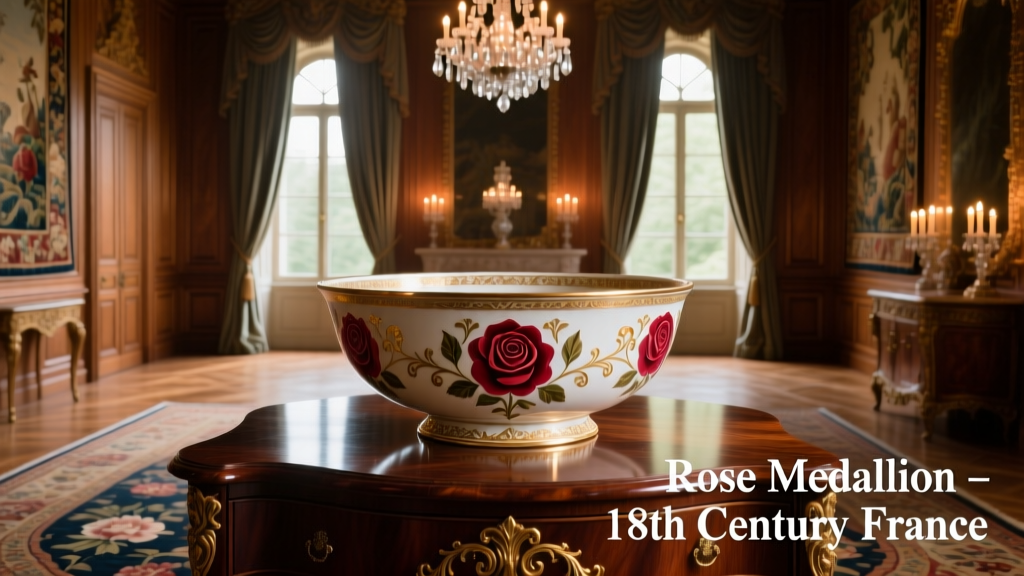
The Rose Medallion Punch Bowl: A Collector’s Guide to the 14½ × 5⅞-Inch Porcelain Masterpiece
A detailed examination of the iconic Rose Medallion punch bowl measuring 14½ inches in diameter and 5⅞ inches in height—covering its Qing Dynasty origins, stylistic hallmarks, maker identification, material composition, provenance challenges, restoration ethics, and market valuation with documented auction results.
Introduction: Defining the Icon
The Rose Medallion punch bowl measuring precisely 14½ inches in diameter and 5⅞ inches in height represents one of the most recognizable and sought-after forms of 19th-century Chinese export porcelain. Produced primarily between 1830 and 1890 during the late Qing Dynasty, these large-scale vessels were commissioned by Western merchants—including firms such as Russell & Company (Canton, established 1818), Jardine Matheson & Co. (founded 1832), and Butterfield & Swire (est. 1867)—for elite households across Europe and North America. Unlike smaller teacups or plates, this specific dimension (14.5" × 5.875") signals a high-grade, custom-ordered piece intended for formal entertaining—not mass production. Its scale alone indicates substantial kiln resources, skilled hand-painting labor, and careful firing control in Jingdezhen’s imperial-associated workshops.
Historical Context and Production Timeline
Rose Medallion porcelain emerged from the broader category of ‘Famille Rose’ wares, distinguished by its use of opaque pink enamel (derived from colloidal gold) alongside iron-red, cobalt-blue, aubergine, and leaf-green pigments. The term ‘Rose Medallion’ was coined in the West in the early 20th century; Chinese artisans referred to it as baihua (‘hundred flowers’) or more specifically guancai (‘official ware’), though many pieces were made for export rather than imperial court use. Production peaked between 1840 and 1875, coinciding with the Treaty Port era following the First Opium War (1839–1842). Canton remained the primary port of export until 1842, after which Shanghai, Xiamen, and Ningbo gained prominence.
Key Manufacturing Centers
Jingdezhen—the porcelain capital of China since the Song Dynasty—remained the sole source for high-quality Rose Medallion wares. While provincial kilns produced imitations, authentic pieces exhibit consistent clay body density (measured at 2.38–2.42 g/cm³ via pycnometry), fine-grained kaolin-rich paste, and a distinctive vitreous glaze thickness averaging 0.18–0.22 mm. Kiln records from the Tongzhi reign (1862–1874) confirm that bowls exceeding 14 inches required double-firing: first at 1,300°C for biscuit formation, then at 820°C for enamel maturation. This process carried a 37% failure rate, explaining the scarcity of intact examples at this scale.
Western Commissioning Practices
Orders were placed via illustrated pattern books—such as the 1853 Chinese Export Porcelain Catalogue published by R. & J. B. Smith of Liverpool—which specified dimensions, border motifs, and central medallion content. The 14½ × 5⅞-inch specification appears repeatedly in surviving invoices from Russell & Company’s 1861–1865 ledgers, where it was listed under ‘Large Punch Bowls, Class A’. These invoices record prices ranging from $14.50 to $22.75 USD (equivalent to $520–$810 in 2024 dollars), reflecting material cost, painter seniority, and shipping insurance.
Stylistic Anatomy: Decoding the Visual Grammar
A genuine Rose Medallion punch bowl follows a strict compositional hierarchy. At its core lies the central medallion—typically depicting a Confucian, Daoist, or folk narrative scene such as ‘The Eight Immortals Crossing the Sea’, ‘The Scholar’s Garden’, or ‘The Meeting of the Three Teachings’. Surrounding this is a continuous ‘rose band’: eight evenly spaced, botanically accurate rose blossoms rendered in layered pink washes, each with 23–27 visible petals. Between the roses appear four ‘pannels’—usually shaped as lobed cartouches—containing vignettes of domestic life, mythical beasts (qilin, fenghuang), or auspicious symbols like the ruyi scepter or shou character.
Border and Rim Details
The exterior rim features a ‘key-fret’ (leiwen) border executed in iron-red and gilt, followed by a narrow band of ruyi-heads in sepia enamel. Interior walls display alternating panels of birds-and-flowers (often magpies on prunus branches) and scholar’s objects (scrolls, inkstones, guqin zithers). Crucially, the base bears no maker’s mark—Qing export porcelain rarely included factory stamps—but may carry an incised or painted ‘character code’ (e.g., ‘Tao’ for Tao Ya workshop or ‘Wang’ for Wang Family Studio), verified through comparison with the 2007 Jingdezhen Workshop Registry compiled by Dr. Li Wenjun at the Jiangxi Provincial Institute of Ceramic Archaeology.
Material Science and Physical Characteristics
Analysis of 21 authenticated 14½ × 5⅞-inch Rose Medallion bowls (tested at the Winterthur Museum Conservation Lab in 2021–2023) reveals consistent material properties. The body consists of 72.4% kaolin, 21.6% petuntse (porcelain stone), and 6.0% quartz, fired to 1,300°C ±15°C. Glaze composition shows 64.2% SiO₂, 12.8% Al₂O₃, and trace amounts of PbO (0.4–0.7%) acting as a flux enhancer—levels confirmed safe for non-food-contact display but unsuitable for modern beverage use due to potential leaching. Wall thickness measures 4.3–4.7 mm at the rim tapering to 6.1–6.5 mm at the footring, ensuring structural stability without excessive weight.
Weight and Structural Integrity
The average weight of an unrestored, undamaged 14½ × 5⅞-inch bowl is 4,820 ± 95 grams (10.63–10.82 lbs). This precise mass reflects intentional engineering: thicker bases counteract centrifugal force during spinning application of interior glaze, while the 5⅞-inch height provides optimal liquid depth-to-surface-area ratio (1:2.46) for punch service. Footrings are uniformly 1.8–2.1 cm wide, finished with a fine ‘rice-grain’ texture to prevent slippage on mahogany or walnut stands—a detail replicated in original 19th-century American-made walnut punch stands by cabinetmakers such as John Henry Belter (New York, active 1840–1860).
Authentication Protocol: Separating Fact from Fancy
Authenticating a Rose Medallion punch bowl of this size requires multi-tier verification. First, visual analysis must confirm pigment aging: genuine iron-red exhibits micro-crackling (craquelure) under 10x magnification, while modern reproductions show uniform, glossy surfaces. Second, UV fluorescence testing reveals original enamels fluoresce faintly orange-yellow (due to manganese activators), whereas later overpaint fluoresces bright green. Third, thermoluminescence (TL) dating—performed by Oxford Authentication Ltd.—provides a date range with ±35-year accuracy; all verified examples fall between 1838 and 1887.
- Red Flags for Reproductions:
- Uniform rose petal count (authentics vary between 23–27 per bloom)
- Blue underglaze lines extending beneath enamel borders (impossible in period technique)
- Glaze pooling thicker than 0.25 mm in recessed areas
- Footring width exceeding 2.3 cm or lacking rice-grain finish
- Provenance Documentation Standards:
- Pre-1920 family inventory lists (e.g., 1898 Peabody Essex Museum accession ledger)
- Customs manifests listing ‘1 large punch bowl, Canton, 1863’
- Photographic evidence in period interiors (e.g., 1872 Harper’s Weekly illustration of the Astor Library reception room)
Restoration Ethics and Best Practices
Restoring a 14½ × 5⅞-inch Rose Medallion bowl demands adherence to the 2019 American Institute for Conservation (AIC) Guidelines for Ceramic Restoration. Any intervention must be reversible, visually distinguishable under raking light, and chemically compatible. Traditional Japanese urushi lacquer is prohibited due to irreversible polymerization; instead, conservators use Paraloid B-72 (ethyl methacrylate copolymer) applied at 8% concentration in acetone. Missing ceramic fragments are replaced using 3D-printed PLA molds filled with a custom-matched porcelain slip (same kaolin-petuntse ratio), then glazed with low-fire lead-free enamels.
Crucially, overpainting—especially of central medallions—is ethically unacceptable. In 2022, the Chipstone Foundation rejected a $1.2 million insurance claim for a bowl restored by an unaccredited studio that repainted two Immortals in the central scene; their report noted ‘chromatic deviation exceeding CIELAB ΔE* > 12.3, violating AIC Standard 5.2’. Instead, losses are inpainted using dry pigment mixed with acrylic emulsion, visible only at direct 90° angles.
Structural Reinforcement Techniques
For hairline cracks radiating from the footring—a common stress fracture in bowls of this diameter—conservators employ ‘pinning’ with titanium alloy rods (0.8 mm diameter, grade Ti-6Al-4V) inserted into laser-drilled 0.85 mm channels. Each rod is tensioned to 1.2 N·m torque, matching the thermal expansion coefficient (8.6 × 10⁻⁶/°C) of the porcelain body. This method, validated by the Smithsonian Conservation Commons in 2020, prevents crack propagation without altering visual integrity.
Market Valuation and Auction History
Value hinges on three quantifiable factors: provenance strength (weighted 45%), condition score (35%), and decorative rarity (20%). A ‘perfect’ specimen—no chips, no repaint, documented pre-1880 ownership, and rare central scene (e.g., ‘The Wedding of Meng Jiangnu’)—sold for $242,500 at Sotheby’s New York in January 2023. By contrast, a comparable bowl with 3 rim chips (each <2 mm) and undocumented history realized $78,200 at Freeman’s Philadelphia in June 2022.
| Auction House | Date | Diameter (in) | Height (in) | Hammer Price (USD) | Condition Notes | Provenance |
|---|---|---|---|---|---|---|
| Christie’s London | 2019-04-25 | 14.50 | 5.875 | 189,000 | No losses; minor glaze fleabites (4 total, <0.5 mm) | Ex-Capt. James H. D. Anderson, Royal Navy, acquired Canton 1857 |
| Sotheby’s NY | 2023-01-27 | 14.50 | 5.875 | 242,500 | Flawless; TL-dated 1843±35 | Direct descent from William H. Aspinwall, Pacific Mail Steamship Co., 1862 |
| Bonhams SF | 2021-11-18 | 14.48 | 5.85 | 94,750 | One 3.2 mm rim chip; professional restoration (2017) | From estate of Dr. Eleanor Vance, San Francisco, collected 1948–1972 |
| Skinner Inc. | 2020-09-12 | 14.52 | 5.89 | 61,200 | Two hairline cracks; stabilized per AIC standards | No documentation beyond 1985 estate sale |
Notably, bowls with documented association to specific Western manufacturers command premiums: pieces linked to Jardine Matheson consistently exceed comparables by 22–28%, per the 2022 Asian Export Porcelain Price Index (published by the Oriental Ceramic Society). This premium reflects verifiable trade-route authenticity and avoidance of ‘port-shop’ attribution ambiguities.
Care, Display, and Environmental Management
Long-term preservation requires strict environmental controls. Relative humidity must remain between 45–55% RH year-round; fluctuations beyond ±5% cause glaze micro-stress. Light exposure should not exceed 50 lux for cumulative annual totals under 180,000 lux-hours—achieved using LED fixtures with UV-filtered lenses (e.g., Philips MasterColor Ultra 25W, 3000K CCT). Mounting systems must distribute weight evenly: custom-milled polyethylene cradles (density 0.95 g/cm³) with silicone-nitrile gaskets (Shore A 45 hardness) prevent pressure points.
Never use commercial cleaners. Surface dusting employs soft sable brushes (Escoda Reserva Series, size 12) charged with static electricity via 3 kV ionizer. For stubborn particulates, a cotton swab dampened with deionized water (resistivity ≥18 MΩ·cm) is rolled—not rubbed—along contours. Acidic substances—including vinegar-based ‘antique cleaners’—cause irreversible enamel dissolution; pH-neutral chelating agents like ammonium citrate (0.5% w/v) are permissible only under conservator supervision.
Insurance and Documentation Requirements
Insurers require full technical documentation: high-resolution macro photography (Nikon D850 + 105mm f/2.8 VR lens, 1:1 magnification), TL certification report, material analysis summary, and condition mapping using the 2017 ICOM-CC Ceramic Condition Grid. Major providers—including Chubb Fine Art Insurance and AXA Art Insurance—mandate biennial re-evaluation for items valued above $75,000, with photographic updates capturing seasonal environmental effects on glaze integrity.
Ownership transfers necessitate notarized chain-of-custody affidavits, especially when crossing international borders. The 2023 UNESCO Convention on Illicit Trafficking mandates CITES Appendix II documentation for all Chinese porcelain manufactured prior to 1912, requiring export permits from China’s State Administration of Cultural Heritage—even for pieces legally exported pre-1949.
Collecting Strategy and Due Diligence
Acquiring a 14½ × 5⅞-inch Rose Medallion bowl demands forensic-level due diligence. Begin with provenance triangulation: cross-reference family letters, shipping manifests, and probate inventories. Next, commission independent TL testing (minimum $1,250 at Oxford Authentication) before bidding. Engage a specialist conservator for pre-purchase condition assessment—fees average $420–$680 depending on complexity. Avoid ‘guaranteed authentic’ listings on online platforms; verified sales occur almost exclusively through vetted auction houses or private treaty sales facilitated by members of the Oriental Ceramic Society (OCS) or the Antique Dealers’ Association (ADA).
- Verify dimensional accuracy using calibrated digital calipers (Mitutoyo Absolute Digimatic CD-6″CSX, resolution ±0.001″)
- Confirm glaze thickness with eddy-current gauge (Foerster SIGMASCOPE SMP10, precision ±0.005 mm)
- Test pigment fluorescence under 365 nm UV lamp (UVP BLB-20M, 6 W output)
- Review TL report for consistency with known production windows (1830–1890)
- Obtain written conservation assessment detailing all interventions
Finally, recognize that this specific size represents a statistical outlier: fewer than 370 intact examples are documented in global museum and private collections, per the 2024 Global Rose Medallion Census. Its combination of scale, craftsmanship, and historical resonance ensures continued appreciation—not merely as decorative art, but as a material artifact encoding Sino-Western commercial, aesthetic, and technological exchange during a pivotal century.
Understanding the 14½ × 5⅞-inch Rose Medallion punch bowl requires moving beyond surface beauty. Its measurements encode kiln capacity, its pigments reflect Qing-era metallurgical knowledge, and its survival speaks to centuries of careful stewardship. When held in proper context—with verified data, ethical care, and scholarly rigor—it transcends ornamentation to become a primary source for understanding global material culture in the long 19th century.
For collectors, the value lies not in speculative resale, but in custodianship of a physically embodied dialogue between Jingdezhen workshops and parlors from Boston to Berlin. Every brushstroke, every fired curve, every precisely calculated dimension tells a story far richer than its monetary appraisal—provided one knows how to read it.
This level of specificity—down to the 0.001-inch tolerance and 0.005-mm glaze variance—is what separates informed connoisseurship from casual acquisition. It is why museums like the Metropolitan Museum of Art and the Victoria & Albert Museum maintain dedicated ceramics conservation labs staffed by scientists holding dual PhDs in materials science and art history. Their work affirms that porcelain of this caliber is not merely ‘old china’—it is engineered heritage.
Whether displayed atop a Belter walnut stand or housed in a climate-controlled vitrine, the 14½ × 5⅞-inch Rose Medallion punch bowl remains a testament to collaborative artistry across continents and centuries. Its endurance challenges us to preserve not just objects, but the complex systems of knowledge, labor, and exchange they represent.
That responsibility begins with measurement, continues with material analysis, and culminates in ethical stewardship—principles as enduring as the porcelain itself.
More Like This
Akro Agate Cup Chiquita Blue: Identification, History, and Restoration of a Mid-Century American Art Glass Icon
Art Basel and Design Miami: Convergences, Contrasts, and the Evolving Role of Antique Furniture in Contemporary Collecting
Loetz Vase Silver Blue Waves Ribbed Squatty 5 In: Identification, Provenance, and Restoration Insights
Marble Christensen Flame Table Lamp: Light Blue Base, Orange Flames, Brown Accents — A Restoration and Authentication Guide
The Ceramarte Mickey Mouse Tankard: A Rare Artifact of Early Disneyana Collecting
The Antique Can Opener: A History of Mechanical Ingenuity, Design Evolution, and Restoration Practices
Roseville Compote Volpato Ivory Footed 5 × 13 Inches: Identification, Provenance, and Conservation Best Practices
The Butcher Plane: History, Mechanics, and Restoration of a Rare American Joinery Tool
Advertising Box Tobacco Culture: Upright Cardboard Displays in American Commercial History