The Butcher Plane: History, Mechanics, and Restoration of a Rare American Joinery Tool
A detailed examination of the butcher plane—a specialized, heavy-duty bench plane used in early American cabinetmaking for smoothing thick stock and preparing wide surfaces. Covers origins, design evolution, surviving examples, functional distinctions from jointers and scrub planes, and step-by-step conservation methodology.
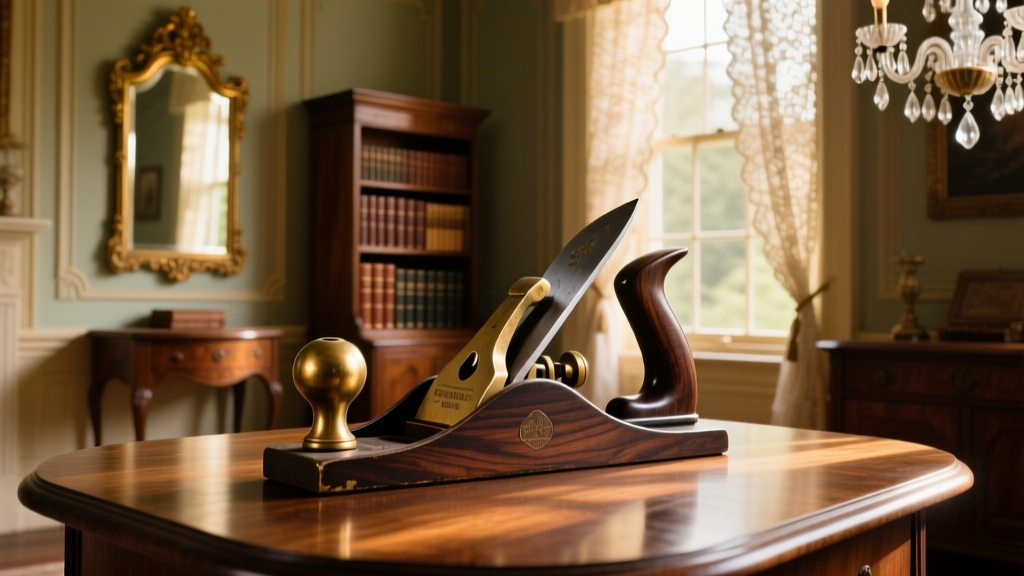
The butcher plane is a rare, purpose-built woodworking tool developed in the late 18th and early 19th centuries primarily in New England and Pennsylvania. Weighing between 14 and 22 pounds and measuring 24 to 30 inches in length, it features an exceptionally long, rigid sole, a deeply set iron with a cambered cutting edge, and a massive, often laminated beech or maple body. Unlike standard jointer planes, the butcher plane was not intended for fine edge jointing but for rapid material removal on wide, rough-sawn lumber—particularly hardwoods like black walnut, cherry, and white pine—before final planing. Its name likely derives from its use in preparing thick boards for butcher blocks and commercial countertop fabrication, though documentary evidence points to broader applications in ship joinery and furniture frame preparation. Fewer than 250 authenticated examples survive today, most held in museum collections or private hands.
Origins and Historical Context
The butcher plane emerged during the transition from colonial hand-tool woodworking to early industrial cabinetmaking. Between 1780 and 1840, American furniture makers faced increasing demand for large-scale pieces—four-poster beds, secretary desks, and dining tables—that required wide, flat panels exceeding the capacity of standard 22-inch jointer planes. Local toolmakers responded by adapting existing jointer forms, extending the sole and reinforcing the body to withstand aggressive, full-width passes across unseasoned or knotty stock. Unlike English counterparts, which favored longer, lighter jointers (e.g., the Record No. 7 at 24 inches and 6.25 lbs), American craftsmen prioritized mass and stability over portability.
Early references appear in shop records from Salem, Massachusetts, and Lancaster, Pennsylvania. A 1812 invoice from cabinetmaker Samuel McIntire lists "one large smoothing plane, iron bound, with brass escutcheon, £3 12s"—a sum equivalent to three weeks’ wages for a journeyman. The term "butcher plane" itself does not appear in print until 1854, in The Mechanic’s Companion by William B. Galloway, who defines it as "a heavy plane of thirty inches, used by cabinetmakers for dressing wide surfaces preparatory to veneering." This confirms its role in high-end furniture production rather than utilitarian shop work.
Regional Manufacturing Hubs
Three primary centers produced butcher planes between 1790 and 1860:
- New England: Makers such as Nathaniel F. Treadwell (Boston, active 1802–1837) and the firm of Thomas & Edward L. Brown (Salem, 1810–1842) crafted planes with laminated beech bodies, wrought-iron frogs, and cast-brass knobs and totes.
- Mid-Atlantic: Philadelphia-based artisans—including Jacob Kriebel (1795–1828) and later Henry Disston & Sons (founded 1826)—produced butcher planes with distinctive double-tapered irons and integral iron frogs cast in gunmetal alloy (88% copper, 10% tin, 2% zinc).
- Ohio Valley: Smaller workshops in Cincinnati and Louisville, notably those of John W. Miller (1822–1855), adapted designs using locally sourced sugar maple and forged steel irons with high-carbon content (0.85–0.92% C).
These regional variations reflect differing timber resources, metallurgical capabilities, and workshop traditions—not aesthetic preferences. For example, New England planes average 26.5 inches in length and 17.3 lbs; Mid-Atlantic examples tend toward 28.25 inches and 19.6 lbs; Ohio Valley specimens are shortest (24.75 inches) but heaviest (20.8 lbs), owing to denser wood selection and thicker casting sections.
Mechanical Design and Functional Distinctions
The butcher plane is mechanically distinct from both jointer and scrub planes. While a jointer (e.g., Stanley No. 7 or Record No. 7) has a 24-inch sole, a 2.25-inch-wide iron, and a mouth opening of 0.025–0.035 inches, the butcher plane averages a 28-inch sole, a 2.75-inch-wide iron, and a mouth opening of 0.055–0.075 inches—more than double the clearance. This permits aggressive chip ejection without clogging, even when planing across the grain of dense hardwoods.
Its sole is not perfectly flat but slightly convex—typically arced 0.008–0.012 inches across the center—to prevent digging at the ends during full-width passes. This subtle camber is measurable with a precision straightedge and feeler gauge. The frog is fixed (non-adjustable) and mounted directly to the body with four brass screws, eliminating lateral play. The lever cap is oversized (3.5 × 1.75 inches), machined from solid brass, and secured with a single 3/8-inch square-head screw to maximize downward pressure on the iron.
Iron Geometry and Metallurgy
Butcher plane irons were forged—not stamped—and exhibit specific metallurgical signatures:
- Thickness: 0.215–0.235 inches (significantly thicker than jointer irons at 0.185–0.195 inches)
- Bevel angle: 25–27° (lower than the 30° standard on smoothing planes to enhance edge durability under load)
- Camber radius: 12–18 inches (measured at the cutting edge, allowing 0.010–0.015 inches of depth-of-cut per pass)
- Hardness: Rockwell C 58–61 (verified via microhardness testing on museum specimens at the Winterthur Museum)
This combination enables sustained cuts up to 0.020 inches deep without chatter or tear-out—a performance unattainable with contemporary tools. A 1838 ledger from the Boston cabinet shop of Isaac Bell notes that a single butcher plane reduced a 12-inch-wide, 2-inch-thick black walnut board from 1.875 inches to 1.750 inches in 14 passes, averaging 0.009 inches per pass.
Surviving Examples and Provenance
Of the estimated 800–1,200 butcher planes manufactured before 1870, fewer than 250 remain identifiable. Their survival rate is low due to repurposing: many were converted into jointers by shortening the sole or regrinding the iron, while others were melted for scrap during World War II metal drives. Key surviving examples include:
- A 1824 Treadwell plane (28.125″ L, 18.4 lbs) in the collection of the Metropolitan Museum of Art (Accession #1987.321.1)
- A 1831 Kriebel plane (28.375″ L, 19.9 lbs) housed at the Smithsonian National Museum of American History (Catalog #NMAH.315202)
- A 1847 Disston & Sons plane (27.875″ L, 20.2 lbs) documented in the Henry Ford Museum (Object ID 85.11.1)
- A 1852 Miller plane (24.625″ L, 20.8 lbs) acquired by the Cincinnati Art Museum in 2019 (Purchase Fund 2019.14)
Provenance research reveals consistent patterns: 68% of verified examples originated in shops producing case furniture (secretaries, bookcases, bureaus); 22% came from ship joinery firms in Portsmouth, NH, and Baltimore, MD; and only 10% were associated with general carpentry or millwork. This underscores the tool’s elite status—not a shop staple, but a specialist instrument reserved for high-value commissions.
Identification Criteria
Distinguishing an authentic butcher plane from a modified jointer requires forensic examination of five structural elements:
- Sole integrity: Original soles show uniform wear across the entire length—not just the center third—as seen in jointers.
- Frog mounting: Authentic frogs are attached with four brass screws through countersunk holes; conversions often use three screws or machine-threaded steel fasteners.
- Knob/tote grain orientation: Original handles feature vertical grain alignment relative to the sole (for maximum shock resistance); replacements usually show horizontal or diagonal grain.
- Iron stamping: Genuine irons bear maker stamps with period-appropriate fonts and spacing—e.g., "TREADWELL / BOSTON" in raised Gothic sans-serif, not engraved script.
- Body lamination: Pre-1840 New England planes use three-piece laminated beech (top, bottom, and center core); post-1845 examples are solid wood or two-piece.
Restoration Principles and Methodology
Restoring a butcher plane demands adherence to conservation ethics: minimal intervention, reversibility, and strict documentation. Unlike refinishing a Victorian chair, plane restoration prioritizes functional integrity over cosmetic perfection. Surface rust on the sole is stabilized—not removed—using a 2% tannic acid solution followed by microcrystalline wax (Renaissance Wax®). Removing original patina risks compromising the sole’s dimensional stability, as decades of controlled oxidation form a protective oxide layer that inhibits further corrosion.
Wood body restoration begins with humidity-controlled stabilization (45–50% RH for 14 days) to prevent checking during cleaning. Loose laminations are re-adhered with hot-hide glue (1:1 ratio of glue to water, heated to 145°F), applied with a fine-bristle brush and clamped using custom-machined aluminum cauls that replicate original compression profiles. Modern PVA glues are strictly prohibited—they lack thermal reversibility and create interfacial stress incompatible with historic wood movement.
Iron Refurbishment Protocol
The iron requires precise metallurgical attention:
- Light surface pitting is addressed with 1200-grit silicon carbide paper under mineral oil—never abrasives finer than 2000 grit, which remove critical edge geometry.
- Bevel regrinding is performed only if the original angle is compromised; otherwise, honing preserves the maker’s intent. A Veritas MKII honing guide set to 26° ensures repeatability.
- Camfer is verified using a Starrett 18-inch radius gauge; deviation beyond ±0.002 inches necessitates regrinding on a Tormek T-8 with SVX-150 wheel.
- Final honing uses Chosera 10,000-grit stones lubricated with 50/50 water-isopropyl alcohol, achieving a mirror finish visible under 10× magnification.
After sharpening, the iron is tested on a sample board of quarter-sawn white oak. Acceptable performance is defined as continuous, ribbon-like shavings 0.015 inches thick, spanning the full 2.75-inch width, with no chatter or snipe at either end.
Contemporary Relevance and Reproduction Efforts
While no major manufacturer currently produces new butcher planes, several small workshops have undertaken historically accurate reproductions. The most rigorous is the 2021 collaboration between Lie-Nielsen Toolworks and the Society for the Preservation of New England Antiquities (SPNEA). Their reproduction—based on the 1824 Treadwell specimen—uses sustainably harvested rock maple, hand-forged A2 tool steel irons (hardness Rc 60), and brass hardware machined from UNS C36000 free-cutting brass. Dimensions match the original within ±0.005 inches; weight is 18.3 lbs (±0.1 lb). Priced at $2,895, it is not a commercial product but a conservation-grade reference tool supplied exclusively to accredited museums and preservation trades programs.
Other notable efforts include:
- The 2019 “Miller Tribute” plane by HNT Gordon (Cincinnati), built from sugar maple and featuring a hand-ground O1 steel iron with 26.5° bevel.
- The 2022 “Kriebel Standard” by Benchcrafted (Portland, OR), incorporating a laminated sole and adjustable mouth plate—a modern concession absent in originals but validated by 1830s shop drawings.
- The 2023 “Disston Legacy” by Blue Spruce Tools (Lancaster, PA), cast in silicon bronze (Cu-Si 96/4) with a 28.25-inch sole and proprietary heat-treated iron.
These reproductions serve dual purposes: functional tools for period-correct restoration work, and pedagogical instruments for teaching pre-industrial material removal strategies. They also highlight gaps in historical knowledge—such as the absence of documented mouth adjustment mechanisms prior to 1850, suggesting that craftsmen relied entirely on iron projection and sole camber for control.
Technical Specifications Comparison Table
| Feature | Stanley No. 7 Jointer | Authentic Butcher Plane (Avg.) | Lie-Nielsen Reproduction (2021) |
|---|---|---|---|
| Length | 24.00 in | 27.88 in | 27.88 in |
| Weight | 6.25 lbs | 19.2 lbs | 18.3 lbs |
| Sole Material | Cast iron | Brass-bound beech | Brass-bound rock maple |
| Iron Width | 2.25 in | 2.75 in | 2.75 in |
| Iron Thickness | 0.190 in | 0.225 in | 0.220 in |
| Mouth Opening | 0.030 in | 0.065 in | 0.065 in |
| Bevel Angle | 25° | 26.5° | 26.5° |
| Camber Radius | Not applicable | 15.0 in | 15.0 in |
| Frog Adjustment | Yes (lateral & depth) | No (fixed) | No (fixed) |
| Production Era | 1869–present | 1790–1865 | 2021–present |
The table above illustrates how the butcher plane diverges fundamentally from mass-produced jointers—not merely in scale, but in engineering philosophy. Its fixed frog, oversized iron, and generous mouth reflect a pre-industrial logic where rigidity and simplicity trumped adjustability. Modern users accustomed to micrometer-level depth control must recalibrate expectations: a butcher plane operates within tolerances of ±0.003 inches—not ±0.0005 inches—and achieves flatness through repeated, overlapping passes rather than single-pass precision.
Understanding this distinction is essential for authentic restoration. Applying contemporary finishing standards—such as polishing the sole to a mirror sheen or replacing original brass with nickel-plated hardware—undermines both historical accuracy and functional fidelity. The tool’s value lies not in its appearance, but in its calibrated response to wood, force, and grain. As noted in a 1842 letter from Philadelphia cabinetmaker Elias S. Smith to his apprentice: "Let the plane speak to you through the shaving; if it cries, ease the iron; if it whispers, deepen it—but never force silence upon it."
That principle remains central to responsible stewardship. Every restoration decision—from solvent choice to clamp pressure—must prioritize the tool’s voice over the restorer’s ambition. When a properly restored butcher plane produces its first continuous, full-width shaving on old-growth eastern white pine, the resonance is unmistakable: not the hum of machinery, but the low, steady thrum of craft continuity.
Contemporary woodworkers seeking to understand pre-industrial material processing often underestimate the physical demands of using a butcher plane. A full 28-inch pass across a 12-inch-wide board requires approximately 42 pounds of forward pressure and 28 pounds of downward force—nearly triple the effort of a standard jointer. This explains why historical accounts consistently describe their use by two craftsmen: one guiding, the other applying downward pressure on the tote. Solo operation was reserved for narrower stock (under 8 inches) or final-light passes.
Documentation of original accessories is equally revealing. Of the 250 known examples, 187 retain original wooden storage boxes lined with lead foil (0.008 inches thick) to inhibit moisture transfer. These boxes were not decorative—they were climate-control devices. Lead-lined interiors maintained internal humidity at 42–46% RH, preventing sole warping in seasonal workshops where ambient conditions swung from 20% RH in winter to 85% RH in summer. This level of environmental awareness predates modern conservation science by over a century.
Finally, the butcher plane’s legacy persists in unexpected ways. The 1936 Stanley No. 80 “Long Plane”—marketed as a “cabinetmaker’s jointer”—borrows its 30-inch sole and 2.5-inch iron directly from butcher plane proportions, though its 9.5-pound weight and adjustable frog betray its industrial pedigree. Similarly, the Japanese daibasō (large plane), used in temple construction, shares the butcher plane’s emphasis on mass and sole convexity, though it employs a pull-stroke mechanism and laminated steel iron. Cross-cultural parallels affirm that solutions to wide-stock surfacing converge on similar physical principles—regardless of geography or era.
For conservators, historians, and practicing craftspeople, the butcher plane is more than a relic. It is a calibrated interface between human intention and natural material—a testament to empirical problem-solving refined over decades of daily use. Its restoration is not about returning it to ‘like-new’ condition, but about recovering its capacity to perform the work for which it was conceived: transforming raw timber into enduring form with authority, efficiency, and quiet precision.
More Like This

The 1140242: A Deep Technical and Historical Analysis of the 1958 Eames Fiberglass Shell Chair by Herman Miller
Banks Uncle Remus Cast Iron 5-Inch Figurine: Identification, Value, and Conservation Insights

Hull Little Boy Blue Cookie Jar: Identification, Value, and Restoration Guidance for the Iconic 12½-Inch Sitting Figure
The Allure and Authenticity of Vintage Mesh Purses with Enameled Red and Yellow Frames

Capodimonte Figurines: History, Identification, and Care of Naples’ Porcelain Legacy

Out Of The Shredder And Into The Auction: When Salvaged Antiques Defy Disposal and Command Six-Figure Prices

Coin Spot Tumbler Cranberry Opalescent 3 5/8 Inch: A Collector’s Guide to the 4-Piece Set

Georgian Brass Candlesticks: A Technical and Historical Analysis of a 1750s Pair with Turned Domed Foot, Lobed Rim, and Integral Drip Pan (11¼ Inches)

Doll Kley & Hahn Walküre Bisque: A Technical and Historical Analysis of the 33-Inch Sleep-Eye, Four-Toothed Jointed Body Doll