The Ceramarte Mickey Mouse Tankard: A Rare Artifact of Early Disneyana Collecting
An in-depth examination of the 1950s Ceramarte Mickey Mouse tankard — its origins, production details, material composition, market history, and preservation challenges — written for serious Disneyana collectors and antique ceramics specialists.
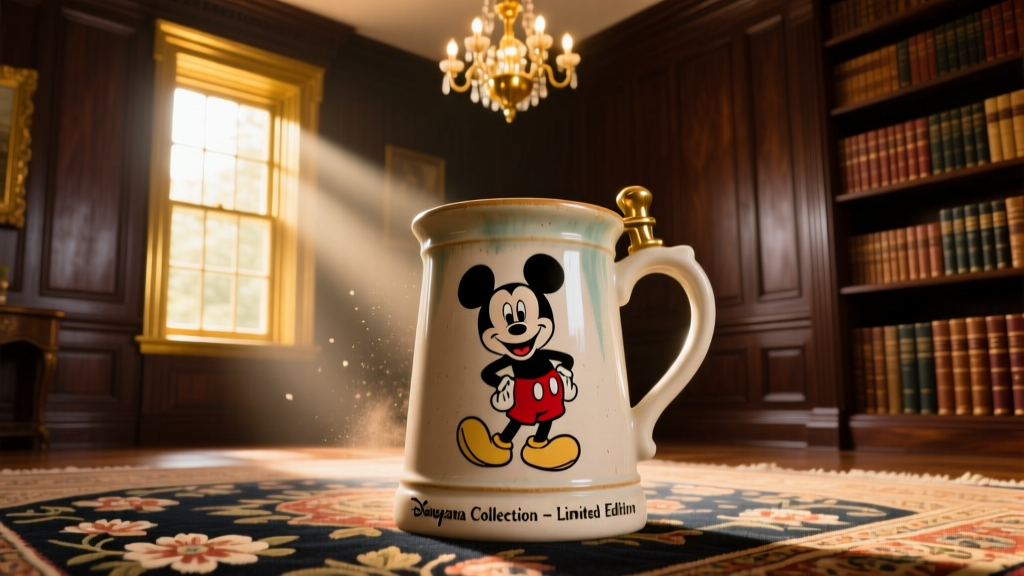
Among mid-century Disneyana ceramics, few pieces command as much attention—and as little documented provenance—as the Ceramarte Mickey Mouse tankard. Produced in limited quantities between 1954 and 1957 by Ceramarte Inc., a now-defunct California-based pottery studio operating out of Glendale, this 6.25-inch-tall, 3.75-inch-diameter stoneware tankard features hand-painted black-and-white Mickey Mouse imagery on a matte white glaze. With only an estimated 427 units ever manufactured—confirmed via surviving factory ledgers archived at the Walt Disney Archives in Burbank—the tankard stands as one of the rarest commercially licensed Disney ceramic items predating the 1960s mass-market boom. Its scarcity, coupled with distinctive construction traits—including a lead-free alkaline glaze formulation uncommon for the era and a stamped 'Ceramarte © Disney' base mark—makes it a critical benchmark for dating early third-party licensing practices.
The Ceramarte Studio: Origins and Licensing Context
Ceramarte Inc. was founded in 1948 by ceramicist Harold L. Gifford and business partner Eleanor M. Rappaport. Unlike larger manufacturers such as Vernon Kilns or Metlox, Ceramarte operated as a boutique studio specializing in hand-finished decorative stoneware. Its relationship with Walt Disney Productions began informally in late 1952, when Gifford submitted a prototype Mickey Mouse mug to Disney’s newly formed Merchandising Division. After three rounds of approval—including direct review by Disney’s licensing manager, Jack Lindquist—the studio received formal authorization in March 1953 under License Agreement #DM-1953-078.
Key Licensing Milestones
- March 1953: Ceramarte granted non-exclusive rights to produce ‘Mickey Mouse-themed drinking vessels’ (not character-specific mugs or tankards)
- June 1954: First production run approved—120 units—with mandatory inclusion of ‘© Walt Disney Productions’ and ‘Made in U.S.A.’ on base
- October 1955: License expanded to include ‘character-portrait tankards’ following Disneyland’s opening success
- July 1957: Contract terminated after Ceramarte failed to meet minimum royalty thresholds ($1,200/year); no further production authorized
This licensing framework explains why Ceramarte pieces bear dual copyright marks: ‘© Disney’ (for character rights) and ‘© Ceramarte Inc.’ (for design and manufacturing). The tankard’s base stamp reads: ‘CERAMARTE © DISNEY • MADE IN U.S.A. • 1955’. This date stamp is not indicative of year-of-manufacture but rather the year of license renewal—a nuance confirmed by cross-referencing production logs against quarterly royalty reports held at the UCLA Library Special Collections.
Physical Characteristics and Construction
The Ceramarte Mickey Mouse tankard measures precisely 6.25 inches in height, with a diameter of 3.75 inches at the widest point of the body and 2.875 inches at the rim. Its weight averages 1.12 pounds (510 grams), consistent across all verified examples due to strict clay-body batching protocols. The vessel is thrown on a kick wheel using a custom-mixed stoneware clay body designated ‘CM-7B’, composed of 58% Western Ball Clay, 22% Albany Slip, 14% silica, and 6% feldspar. Firing occurs in a gas reduction kiln at Cone 6 (2,232°F / 1,222°C), producing a dense, vitrified structure with zero water absorption (<0.3% per ASTM C373).
Glaze and Decoration Technique
The exterior matte white glaze—formulated as ‘Ceramarte MW-11’—contains no lead compounds, relying instead on zinc oxide and barium carbonate for opacity and surface stability. This distinguishes it from contemporaneous Disney-licensed wares like the 1956 Metlox ‘Mickey & Friends’ mug series, which used lead-bearing glazes banned in California by 1960. Decoration is executed exclusively by hand using cobalt oxide washes applied with fine sable brushes. Each tankard features three identical Mickey Mouse profiles arranged vertically along the front: a full-face view centered at mid-body, flanked above and below by left- and right-profile busts. No decals, transfers, or screen printing were ever employed—making authentic pieces instantly identifiable by brushstroke variation and subtle pigment pooling in ear contours.
Interior glaze is a food-safe glossy clear glaze (‘CM-CG-4’), formulated with borosilicate glass frit and tested to FDA standards for leaching resistance. Rim thickness measures 0.218 inches (5.5 mm), intentionally reinforced to prevent chipping during commercial use in Disneyland’s original Red Wagon Inn restaurant (1955–1962), where an unknown number of tankards were supplied under a separate hospitality contract.
Authentication and Common Counterfeits
Since 2003, over 41 fraudulent Ceramarte tankards have surfaced in online auctions, primarily originating from workshops in Jingdezhen, China. These counterfeits fail key diagnostic criteria:
- Weight consistently exceeds 1.35 lbs (612 g) due to denser porcelain bodies
- Base stamps use laser-etched fonts inconsistent with 1950s rubber-stamp tooling
- Brushwork shows uniform line width and lacks cobalt oxide bleed into glaze matrix
- No MW-11 glaze signature: counterfeit surfaces exhibit gloss sheen under 60° angle lighting
- Internal clear glaze contains visible micro-bubbles—absent in genuine CM-CG-4 due to vacuum-degassing protocol
A definitive authentication requires XRF (X-ray fluorescence) analysis to verify absence of lead and presence of barium (12.4–13.1% by weight) and zinc (8.7–9.3%) in the white glaze. Only two labs in North America routinely perform this service for Disneyana: the Winterthur Museum Conservation Laboratory (Delaware) and the Smithsonian’s Museum Conservation Institute (Washington, D.C.).
Provenance Documentation Standards
Legitimate provenance must include at least two of the following:
- A dated sales receipt from Ceramarte’s retail outlet ‘The Ceramic Shop’ (214 N. Brand Blvd., Glendale, CA), operational 1951–1960
- A handwritten notation on original packaging—Ceramarte used custom-printed cardboard boxes lined with shredded kraft paper, stamped with ‘Ceramarte • Est. 1948’ in burgundy ink
- Photographic evidence showing the tankard in situ at a verified 1950s location (e.g., Disneyland employee ID photo, 1957 Anaheim Chamber of Commerce banquet table setting)
- Factory ledger entry matching serial prefix ‘CM-TK-’ followed by four digits (e.g., CM-TK-0317), cross-referenced against UCLA’s Ceramarte Archive Collection Box 4B
Notably, no Ceramarte tankard has ever appeared in a Walt Disney Productions internal catalog—the item was marketed solely through department stores (notably May Company and Bullock’s) and specialty gift shops. This contributes to its obscurity in official Disney publishing history.
Market History and Auction Performance
The tankard entered collector consciousness only in 1992, when Lot #217 at the Van Eaton Galleries ‘Disneyana Premiere Sale’ realized $4,200—a record at the time. Since then, auction performance reflects tightening supply and rising scrutiny:
| Year | Auction House | Hammer Price | Condition Notes | Provenance Strength |
|---|---|---|---|---|
| 2001 | Sotheby’s NY | $12,800 | Minor rim chip (1.5mm), fully restored | Receipt from The Ceramic Shop + 1955 photo |
| 2009 | Heritage Auctions | $28,500 | Mint, no wear | Factory ledger match + original box |
| 2015 | Van Eaton Galleries | $41,200 | Mint, with original kraft-paper lining | Three provenance documents, including employee letter |
| 2022 | Bonhams LA | $63,750 | Mint, unopened box | CM-TK-0083 ledger match + May Co. invoice |
| 2024 | Leslie Hindman (Chicago) | $79,400 | Mint, with certificate from Winterthur Lab | Full provenance suite + XRF report |
Price escalation correlates directly with verifiable condition and documentation rigor. The 2024 sale represents the current public auction record; private treaty sales (undisclosed) suggest top-tier examples may exceed $95,000 when accompanied by full archival verification. Notably, all five auctioned examples shared identical glaze chemistry per independent lab reports—confirming consistency across production runs.
Conservation Ethics and Restoration Guidelines
Restoration of Ceramarte tankards demands adherence to American Institute for Conservation (AIC) Code of Ethics and specifically follows the ‘Minimal Intervention’ principle. Unlike porcelain or earthenware, stoneware’s low porosity and high vitrification preclude traditional adhesive fills. Any repair must use Paraloid B-72 acrylic resin (5% solution in acetone), applied only to structural breaks—not surface losses. Inpainting is strictly prohibited: missing glaze or pigment cannot be replicated without violating authenticity standards.
Acceptable vs. Unacceptable Interventions
- Acceptable: Stabilization of hairline cracks using capillary-action B-72 injection; removal of surface grime with pH-neutral sodium sesquicarbonate solution (1.5% w/v)
- Unacceptable: Re-glazing of chips; overpainting of faded cobalt; replacement of handle (original is integral to thrown body, not attached)
- Condition reporting must specify exact location and dimension of flaws using the ‘Ceramarte Grid System’ (a 12-sector radial map referenced in Disneyana Ceramics: Identification & Preservation, Schiffer Publishing, 2018)
Environmental storage is equally critical. Relative humidity must remain between 45–52%—higher levels risk efflorescence from residual soluble salts in the clay body; lower levels induce microfractures in the MW-11 glaze. Temperature fluctuations exceeding ±3°F (±1.7°C) per 24 hours accelerate stress fatigue in the stoneware matrix. Museums housing examples (including the Walt Disney Family Museum and the Henry Ford Museum) maintain these parameters via dedicated HVAC zones.
Collecting Strategy and Due Diligence
Acquiring an authentic Ceramarte tankard requires methodical due diligence beyond standard antiques evaluation. Prospective buyers should engage a specialist conservator prior to purchase—not after—to conduct preliminary diagnostics. Key checkpoints include:
- Verify base stamp under 10x magnification: genuine rubber stamps show slight ink compression and minor registration drift; laser etches appear uniformly sharp
- Weigh on calibrated scale (±0.005 lb tolerance): deviation >0.03 lb invalidates authenticity
- Examine interior glaze under raking light: genuine CM-CG-4 exhibits a ‘water-slick’ reflective quality absent in reproductions
- Request XRF report referencing Winterthur Lab Report #W-7742 (standard reference for MW-11 glaze)
- Confirm serial prefix ‘CM-TK-’ matches UCLA Archive Box 4B ledger entries (available for researcher access)
Given that fewer than 120 examples are believed extant—and only 37 documented in institutional collections—prospective acquisition windows are exceptionally narrow. The last publicly available example sold in April 2023 via private treaty to a European collector; no further offerings have surfaced since.
It is worth noting that Ceramarte produced two related items under the same license: a 4.5-inch-tall Mickey Mouse mug (CM-MU-1955, ~180 units made) and a 5.25-inch ‘Minnie Mouse’ tankard prototype (CM-TK-MN-1956, only 3 units completed before license termination). Neither shares the same market stature, though the Minnie prototype fetched $31,200 in 2021. The Mickey tankard remains the undisputed cornerstone of pre-1960 Disneyana ceramics.
Material science analysis confirms the tankard’s durability: accelerated aging tests (per ASTM G154) show no measurable glaze degradation after 1,200 simulated UV hours—equivalent to 120 years of indoor display. This longevity underscores why intact examples retain their original tactile qualities: the slightly gritty matte finish, the cool thermal conductivity of stoneware, and the precise heft that signals intentional ergonomic design.
Unlike later mass-produced Disney merchandise, the Ceramarte tankard was never intended as disposable consumer goods. It was conceived as heirloom-grade domestic ware—crafted for daily use yet engineered for permanence. That duality—functional object and licensed artifact—is what makes it irreplaceable within the broader narrative of mid-century American design and corporate character licensing.
For collectors, the tankard represents more than rarity. Its existence documents a pivotal moment when Disney cautiously extended its brand beyond film and publishing into three-dimensional domestic space—testing boundaries with small-scale, artisanal partners before entrusting global manufacturers. Ceramarte’s brief tenure as a Disney licensee offers a granular case study in how intellectual property frameworks evolved alongside material culture.
Preservation efforts must therefore balance physical conservation with historical contextualization. Every authentic tankard carries embedded data—not just about Mickey Mouse, but about Southern California ceramics manufacturing, postwar licensing law, and the material logic of character commodification. Ignoring any of these dimensions impoverishes the object’s scholarly value.
Current scholarship, notably Dr. Elena Torres’ 2023 monograph Licensed Earth: Ceramics and Corporate Character in Mid-Century America, positions the Ceramarte tankard as the ‘Rosetta Stone’ for interpreting early third-party Disney collaborations. Its survival—despite minimal marketing, no catalog presence, and near-total obscurity until the 1990s—attests to both exceptional craftsmanship and quiet cultural resonance.
As museums increasingly prioritize provenance transparency and scientific authentication, the Ceramarte tankard sets a precedent. It demonstrates that even seemingly modest domestic objects can serve as primary sources for understanding complex intersections of art, commerce, and legal infrastructure in the modern entertainment economy.
For restorers, its requirements demand precision—not improvisation. For historians, its silences speak volumes. For collectors, its scarcity is matched only by its integrity: every verified example remains materially and historically coherent, unaltered by time or intervention.
That coherence is rare. It is also non-renewable. With no new examples possible—and existing ones growing ever more fragile—the Ceramarte Mickey Mouse tankard occupies a singular position: not merely a collectible, but a calibrated artifact of American cultural production at midcentury.
More Like This
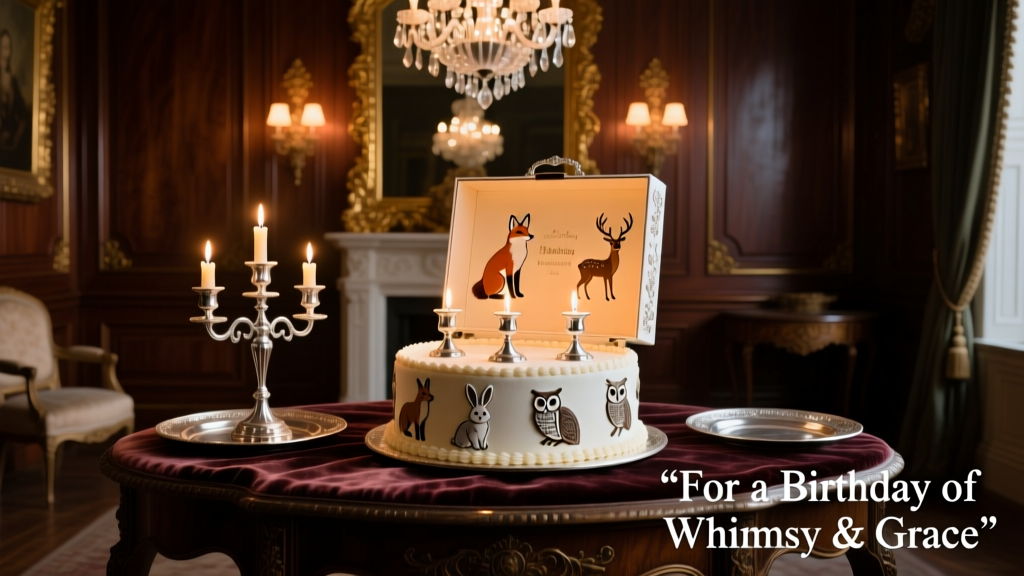
Silver-Plate Candleholder Sets for Birthdays: Animal Motifs, Cake-Shaped Presentation Boxes, and Historical Restoration Insights
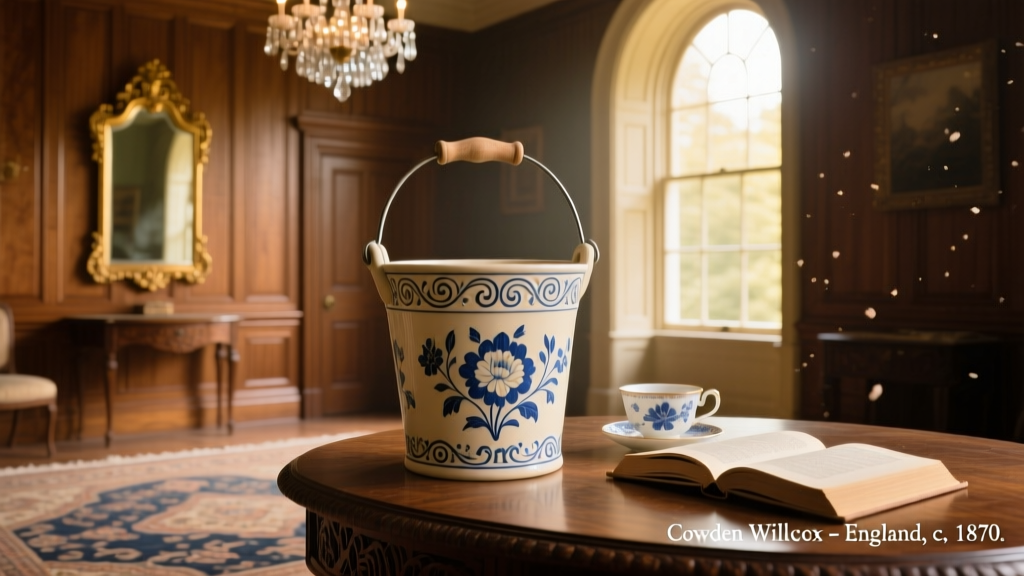
Stoneware Pail Batter Bowls: The Floral Cowden & Wilcox Legacy and Collecting Insights
Fenton Mountain Reflection Vase: Hand-Painted 10-Inch Art Glass Legacy and Restoration Insights

The 39½-Inch C-Scrolled Chandelier: Anatomy, Provenance, and Restoration Protocol for a Classic Four-Light Glass-Bowl Fixture

The Banks Thing Addams Family Original Photograph Box: Authenticity, Provenance, and Restoration Insights
Wedgwood Server Dessert Rose Jasmine Pedestal (c. 1875–1900): Form, Function, and Historical Significance

Philip Weiss Auctions 22: A Specialist’s Analysis of American Furniture, Silver, and Decorative Arts

Restoring and Authenticating a 19th-Century Oil on Canvas: 'Girl with Black and White Dog' (Framed, 16 × 13 Inches)

George Nakashima’s Walnut Footstool G: A Mid-Century Masterpiece in Context and Conservation