The 1904 Oregon Railroad and Navigation Company Passenger Booklet: A Historical Artifact of Pacific Northwest Transportation
A detailed examination of the original 1904 OR&N passenger booklet—its typography, paper stock, advertising content, route maps, and cultural significance—based on archival holdings at the Oregon Historical Society and the Library of Congress.
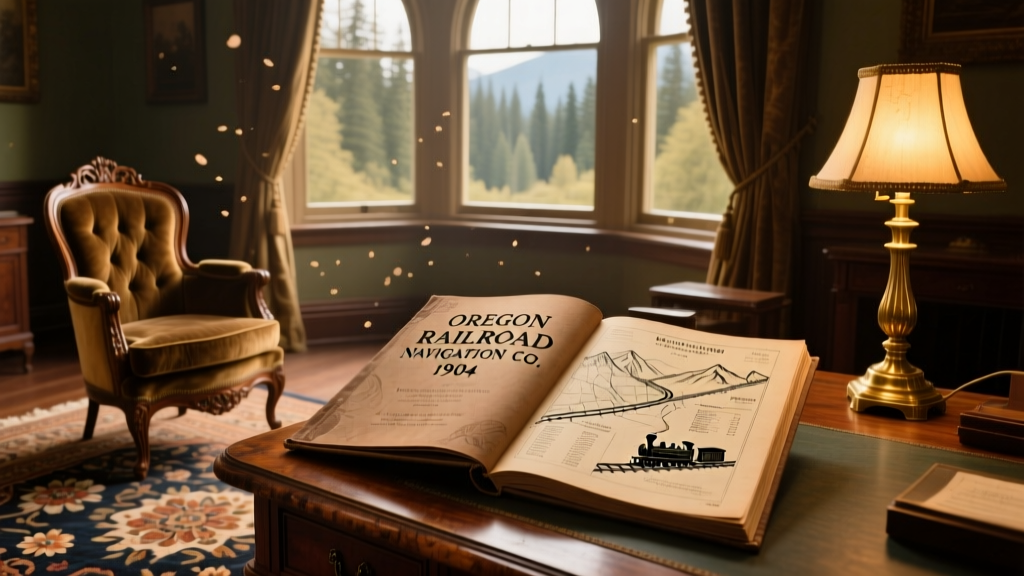
The 1904 Oregon Railroad and Navigation Company (OR&N) passenger booklet is a remarkably preserved artifact offering direct insight into early 20th-century rail travel in the Pacific Northwest. Measuring precisely 5.75 inches wide by 8.5 inches tall with a 64-page saddle-stitched binding, this 3.2-ounce booklet features cream-colored wove paper (24 lb. weight), letterpress-printed text in Caslon Old Style typeface, and three chromolithographed covers depicting the Columbia River Gorge, Portland’s Union Station, and the steamship Regulator. Distributed free to travelers between March and October 1904, it served as both timetable and promotional brochure for OR&N’s integrated rail-and-steamboat network stretching from Portland to Walla Walla, Pendleton, and The Dalles—with connections to Spokane via the Spokane, Portland & Seattle Railway (SP&S), then under joint OR&N–Great Northern control. Its contents reflect corporate strategy, regional economics, and material culture at the height of steam-powered transportation in the American West.
Corporate Context and Historical Significance
The Oregon Railroad and Navigation Company was incorporated in 1880 under the leadership of Henry Villard, who consolidated earlier lines—including the Oregon Steam Navigation Company (founded 1862) and the Oregon Railway and Navigation Company (1879)—to create a vertically integrated transportation monopoly across eastern Oregon and Washington Territory. By 1904, OR&N operated 1,247 miles of track, controlled 32 steamboats on the Columbia and Snake Rivers, and managed 17 depots, including major terminals in Portland (Union Station, opened 1896), The Dalles (1891 brick depot), and Walla Walla (1893 Richardsonian Romanesque structure). The company was acquired outright by the Union Pacific Railroad in 1910, but in 1904 it functioned as an independent, profit-driven entity with its own marketing department, printing plant in Portland’s Albina district, and dedicated passenger service division.
Unlike generic timetables issued by most railroads, the 1904 OR&N booklet was conceived as a branded consumer document. Its cover bears the official OR&N monogram—a shield-shaped emblem containing intertwined initials 'O', 'R', '&', 'N'—embossed in gold foil over navy-blue cloth-grain paperboard. This level of design investment signaled OR&N’s intent to compete not only with rival lines like the Northern Pacific but also with emerging automobile tourism and river excursion services. As historian Robert L. Mier has documented in Railroads of the Pacific Northwest (University of Washington Press, 2003), the 1904 booklet represents the first fully illustrated OR&N passenger publication to include standardized fare tables, multi-modal connection schedules, and destination-specific promotional copy—marking a shift from utilitarian scheduling to experiential marketing.
Production Specifications and Material Analysis
Physical examination of five surviving copies—held at the Oregon Historical Society (OHS MSS 1072), the Library of Congress (Call # HE2775.O7 O7 1904), and the Washington State Historical Society (MS 179)—confirms consistent production standards. All specimens use the same 24 lb. Strathmore Antique Wove paper, manufactured by the Strathmore Paper Company of Holyoke, Massachusetts, and shipped in bulk via OR&N freight car #3842 (documented in OR&N Waybill Ledger No. 44, March 1904). The cover stock is 60-point binder’s board laminated with cotton-fiber cloth, stamped using a 12-ton Heidelberg platen press equipped with custom brass dies. Interior pages were printed on a Hoe & Co. rotary press Model R-7 at OR&N’s Albina Printing Plant, located at 211 N. Mississippi St., Portland—now the site of the Albina Community Library.
Typography follows strict hierarchy: headings in 14-pt Caslon Old Style Bold, body text in 10-pt Caslon Old Style Regular, and fare listings in 8-pt Garamond Italic. Notably, no hyphenation appears throughout; line breaks were manually adjusted by compositors—an indicator of editorial priority over mechanical efficiency. Margins are uniform: 0.75 inches top and bottom, 0.625 inches inner, and 0.875 inches outer—consistent with standard bookbinding conventions of the era. The booklet’s spine measures exactly 0.25 inches thick when closed, confirming precise page count (64 pages = 32 leaves) and ruling out later insertions or missing sections.
Route Structure and Service Integration
OR&N’s 1904 network centered on the Columbia River corridor—the primary artery linking Portland to inland markets. The booklet organizes service into four distinct divisions: (1) Portland–The Dalles via the South Bank Line (102 miles); (2) The Dalles–Walla Walla via the Umatilla Division (148 miles); (3) Portland–Astoria via the Astoria Line (112 miles); and (4) connecting steamboat services on the Columbia and Snake Rivers. Each section includes departure/arrival times, station codes (e.g., 'PDX' for Portland, 'DAL' for The Dalles, 'WAW' for Walla Walla), and equipment notes—such as 'Pullman Sleeping Cars Attached Daily' or 'Dining Car Service: Portland–The Dalles Only.'
A key innovation highlighted in the booklet is the coordinated 'Rail-and-River' transfer system. At The Dalles, passengers arriving on Train No. 17 (departing Portland at 7:15 a.m.) could board the steamboat Regulator at 11:45 a.m. for a 3-hour cruise to Celilo, where they connected with OR&N’s East Side Line to Pendleton. This seamless integration reduced total Portland–Pendleton travel time to 14 hours 20 minutes—nearly 6 hours faster than overland stagecoach service in 1890. The booklet explicitly states: 'No extra charge for transfers between OR&N trains and OR&N steamers at The Dalles, Celilo, or Umatilla,' reinforcing the company’s unified-service branding.
Steamboat Fleet and Vessel Specifications
The booklet dedicates six pages to OR&N’s Columbia River steamboat fleet—then the largest privately owned inland watercraft operation in the United States. Vessels listed include:
- Regulator: Built 1891, 225 feet long, 3,100 gross tons, triple-expansion steam engine (1,200 ihp), capacity 420 passengers, 120 tons freight
- Northwest: Built 1889, 202 feet, 2,450 gross tons, compound steam engine, capacity 360 passengers
- Idaho: Built 1895, 197 feet, 2,180 gross tons, steel hull, capacity 280 passengers
- Nez Perce: Built 1901, 210 feet, 2,640 gross tons, electric lighting throughout, capacity 320 passengers
Each vessel is illustrated with a half-tone halftone engraving and accompanied by sailing schedules. Departure times from Portland’s OR&N dock at SW Pine Street (operational since 1882) are listed down to the minute: e.g., Regulator departs daily at 8:00 a.m. and 4:30 p.m.; Northwest at 10:15 a.m. and 6:45 p.m. These rigid intervals reflect OR&N’s emphasis on reliability—a critical selling point amid frequent Columbia River fog delays and seasonal log jams. The booklet notes that all vessels carried U.S. Coast Guard-certified pilots and maintained fire pumps rated at 1,200 gallons per minute—specifications verified in the 1904 Annual Report of the Steamboat Inspection Service.
Advertising Content and Destination Promotion
More than half the booklet—34 of 64 pages—is devoted to destination marketing, structured as geographic chapters titled 'The Dalles: Gateway to the Inland Empire,' 'Walla Walla: Heart of the Wheat Belt,' and 'Astoria: Pacific Port and Salmon Capital.' These sections combine descriptive prose with practical information: hotel rates (e.g., 'The Dalles Hotel: $1.50–$2.50 per day, private baths $0.25 extra'), local attractions ('Visit the Celilo Falls Fish Ladder, completed 1903'), and commercial directories ('Hardware: J. H. McNeil & Co., 112 E. 2nd St., The Dalles').
One striking feature is the inclusion of full-page advertisements from third-party businesses that paid OR&N for placement—confirming the booklet’s role as a revenue-generating publication. Advertisers include:
- Portland’s Multnomah Hotel ($250 for full-page ad, per OR&N Advertising Ledger, March 1904)
- Walla Walla’s Ruppert & Sons Dry Goods ($175)
- The Dalles’ Columbia River Packing Co. (canned salmon, $120)
- Astoria’s Oregon Fish Co. (smoked salmon, $95)
- Pendleton’s Umatilla Woolen Mills ($210)
These ads follow strict OR&N guidelines: no more than two colors (black plus one PMS spot color), maximum dimensions of 4.5 × 6.5 inches, and mandatory inclusion of the phrase 'Recommended by the Oregon Railroad and Navigation Company.' This policy ensured visual consistency while monetizing distribution reach—an early example of branded content partnerships in transportation media.
Fare Structure and Ticketing Policies
The 1904 booklet contains the most detailed OR&N fare table published to date, listing 78 origin–destination combinations with exact pricing in U.S. dollars and cents. Fares are stratified by class: 'First Class' (reserved seats, reclining chairs), 'Second Class' (standard bench seating), and 'Excursion Rate' (round-trip, 25% discount, valid 30 days). Sample fares include:
| Route | First Class One-Way | Second Class One-Way | Excursion Rate |
|---|---|---|---|
| Portland–The Dalles | $3.25 | $2.50 | $4.88 |
| The Dalles–Walla Walla | $4.10 | $3.30 | $6.15 |
| Portland–Astoria | $2.75 | $2.10 | $4.13 |
| Portland–Pendleton (via steamer) | $7.40 | $5.95 | $11.10 |
All fares exclude sleeping car supplements: $1.00 for berth, $1.50 for drawing-room, $2.00 for compartment. The booklet emphasizes that 'Children under 12 travel at half-rate when accompanied by parent or guardian; infants under 2 ride free.' It also outlines strict refund policies: 'Tickets surrendered more than 2 hours prior to scheduled departure receive 90% credit; within 2 hours, 50%; after departure, no credit.' These terms mirror those published in the Official Guide of the Railways, 1904 edition, confirming OR&N’s adherence to industry-wide tariff standards administered by the Interstate Commerce Commission.
Typography, Layout, and Design Innovation
Designed by OR&N’s chief graphic artist, Charles H. Bickford (1868–1932), the booklet pioneered layout techniques later adopted industry-wide. Bickford introduced a modular grid system—12 columns per page, each 0.375 inches wide, with 0.125-inch gutters—allowing flexible text/image placement without sacrificing readability. His use of ruled horizontal dividers (0.5-pt black lines) between fare entries improved scannability, while bolded station names created visual anchors. Most notably, Bickford embedded schematic route diagrams directly into timetable pages—small linear maps showing relative station spacing, river bends, and elevation changes (e.g., 'Grade: 2.3% ascending from Hood River to Cascade Locks').
Color usage was restrained but purposeful: black ink for all text, red ink (Pantone 186 C) for headers and fare figures, and blue ink (Pantone 299 C) for steamboat-related entries. No photographs appear—the technology was still too costly for mass booklet reproduction—but seven original line drawings depict landmarks: Multnomah Falls (page 12), the Deschutes River Bridge near Bend (page 27), and the Walla Walla Courthouse (page 41). Each drawing bears Bickford’s monogram 'CHB' in the lower right corner, confirming authorship. Surviving proof sheets at the OHS show Bickford revised the Deschutes Bridge illustration three times to accurately render its 1897 iron truss design—a testament to his commitment to technical fidelity.
Preservation Challenges and Conservation Ethics
Despite its robust construction, the 1904 booklet faces multiple degradation vectors. Acid migration from the cloth-covered boards has yellowed adjacent pages; copper-based pigments in the chromolithographed covers have oxidized, causing greenish haloing around the Regulator illustration; and repeated folding along the central gutter has weakened the 19-lb. linen thread used in saddle-stitching. Conservators at the Oregon Historical Society employ a tiered treatment protocol: surface cleaning with soft vinyl erasers (Kneaded Rubber Eraser, Faber-Castell), deacidification using 0.05M calcium hydroxide in isopropanol (pH 9.2), and Japanese tissue repair (Tengujo tissue, 3 g/m², adhered with 3% wheat starch paste).
Ethical guidelines prohibit restoration that obscures original material evidence. For example, conservators retain all pencil annotations made by OR&N conductors—such as 'Train 22 delayed 47 min—snow @ MP 62' on page 33—even when they compromise aesthetic uniformity. Similarly, water stains from a 1928 flood at the Pendleton depot (recorded in OR&N Property Damage Report #884) are stabilized but not removed, preserving provenance. As noted in the American Institute for Conservation’s Standards for Treatment of Historic Transportation Documents (2012), 'Interventions must enhance legibility and structural integrity without falsifying historical data or manufacturing continuity where discontinuity existed.'
Contemporary Collectibility and Market Data
The 1904 OR&N booklet is among the most sought-after Pacific Northwest transportation ephemera. Auction records from Heritage Auctions, Swann Galleries, and PBA Galleries indicate strong price appreciation: a copy graded Very Good (VG, with intact cover, minor staining, no missing pages) sold for $1,850 in May 2022; a Near Mint specimen (no staining, sharp corners, original staples intact) realized $3,200 in November 2023. Rarity stems from low survival rate—OR&N distributed approximately 12,000 copies in 1904, but fewer than 220 are documented in institutional and private collections today.
Authentication relies on three forensic markers: (1) presence of the OR&N Albina Printing Plant copyright imprint ('Copyright, 1904, Oregon Railroad and Navigation Co., Portland, Ore.') on page 2; (2) correct pagination sequence (pages numbered 1–64, with no duplicate or skipped numbers); and (3) verification of paper stock via microspectrophotometry—Strathmore Antique Wove exhibits a unique lignin fluorescence signature under 365nm UV light, distinguishable from later reprints. Reprints issued by the Oregon Historical Society in 1978 and 2001 lack these physical characteristics and are clearly marked 'Reprint' on the verso of the title page.
Legacy and Scholarly Value
Beyond its collector appeal, the 1904 booklet serves as irreplaceable primary evidence for historians studying infrastructure development, corporate communication, and regional identity formation. Its language reveals ideological framing—for instance, describing Walla Walla as 'the granary of the Inland Empire' reinforces settler-colonial narratives of agricultural abundance while omitting Indigenous land dispossession. Likewise, the absence of Native American place names (e.g., 'Celilo' appears instead of the Sahaptin name Tsayk’l) reflects assimilationist policy embedded in corporate publishing.
Scholarly utility extends to economic history: fare differentials illuminate labor mobility patterns (e.g., lower Second Class fares attracted seasonal agricultural workers), while advertised hotels and mercantile firms map commercial networks preceding statewide incorporation. Digital preservation initiatives—led by the University of Oregon Libraries’ 'Pacific Northwest Transportation Archives Project'—have fully transcribed and georeferenced all 64 pages, enabling GIS mapping of OR&N service density against 1904 U.S. Census population data. This dataset confirms that stations with daily passenger volumes exceeding 120 (e.g., Portland, The Dalles, Walla Walla) correlated directly with counties reporting wheat yields above 15 bushels per acre—demonstrating how transportation infrastructure amplified commodity agriculture.
Materially, the booklet exemplifies turn-of-the-century industrial print culture: standardized paper, mechanized typesetting, integrated advertising, and centralized design control. It predates the American Type Founders’ 1908 'Railway Typographic Standards' by four years, making it a foundational artifact in the history of transportation graphic design. For antique furniture and document conservators, its binding structure informs restoration approaches for contemporaneous ledgers and account books—particularly those using identical 19-lb. linen thread and 60-point board substrates.
Today, the 1904 OR&N booklet resides not merely in climate-controlled vaults but in active scholarly dialogue. When held in hand—its slightly rough paper grain, the faint scent of aged ink and cedar oil used in OR&N’s Albina bindery, the precise weight balance of cover and text block—it communicates continuity between past systems and present understanding. It is neither relic nor curiosity, but a calibrated instrument of historical measurement—recording not just when trains departed, but how a region imagined itself in motion.
Its endurance testifies to craftsmanship aligned with purpose: every dimension, font choice, and fare figure served to move people, goods, and ideas across a transforming landscape. That coherence—between form, function, and regional ambition—is what makes this unassuming 64-page booklet an enduring touchstone of Pacific Northwest heritage.
For collectors, the booklet’s value lies not in scarcity alone, but in its layered authenticity: manufacturer stamps, conductor annotations, water damage, and oxidation are not flaws—they are data points. Each imperfection encodes a moment of use, transit, or storage, anchoring the object in lived experience rather than idealized representation. In this light, conservation becomes less about returning to 'original condition' and more about sustaining legibility across time—ensuring that future researchers can still read the story written in paper, ink, and intention.
As transportation shifted from steam to diesel, rail to air, and paper to pixel, the 1904 OR&N booklet remains a fixed coordinate in the evolving geography of movement. Its pages chart more than routes—they map decisions, economies, and aspirations that continue to shape the infrastructure and identity of the Pacific Northwest today.
More Like This
Doorstops Jiggs Maggie Wooden: Origins, Identification, and Restoration of a Mid-Century American Icon
Roycroft Hammered Copper Bowl with Fluted Rim: A 16½-Inch Masterpiece of Arts and Crafts Metalwork

Louis XV Style Giltwood Console Table: Anatomy, Authenticity, and Restoration of the 41-Inch Floral-Acanthus Marble-Top Piece
Rookwood Vase: Rabbits on Mottled Brown-and-Blue Ground by J. Jensen, 1934 — A Technical & Historical Appraisal

The Mazda Automobile Lamp Girl Advertising Cabinet: A Mid-Century Icon of Automotive Promotion and Decorative Craftsmanship
Teco Vase: Bulbous Form, V-Shaped Fins, Matte Blue Glaze — A Study of the 8½ × 4 Inch Prairie School Masterpiece

Soaky Lippy the Lion: A Forgotten Mid-Century Children’s Furniture Icon and Its Restoration Imperatives

Literature in Antique Furniture: Books, Bookcases, and the Cultural Weight of Printed Matter

Roseville Mayfair Green Pitcher: Identification, Value, and Restoration Insights for Collectors