The Mazda Automobile Lamp Girl Advertising Cabinet: A Mid-Century Icon of Automotive Promotion and Decorative Craftsmanship
A detailed examination of the rare 1950s–60s Mazda Automobile Lamp Girl advertising cabinet — its origins, construction, iconography, market value, restoration challenges, and cultural significance in Japanese automotive marketing history.
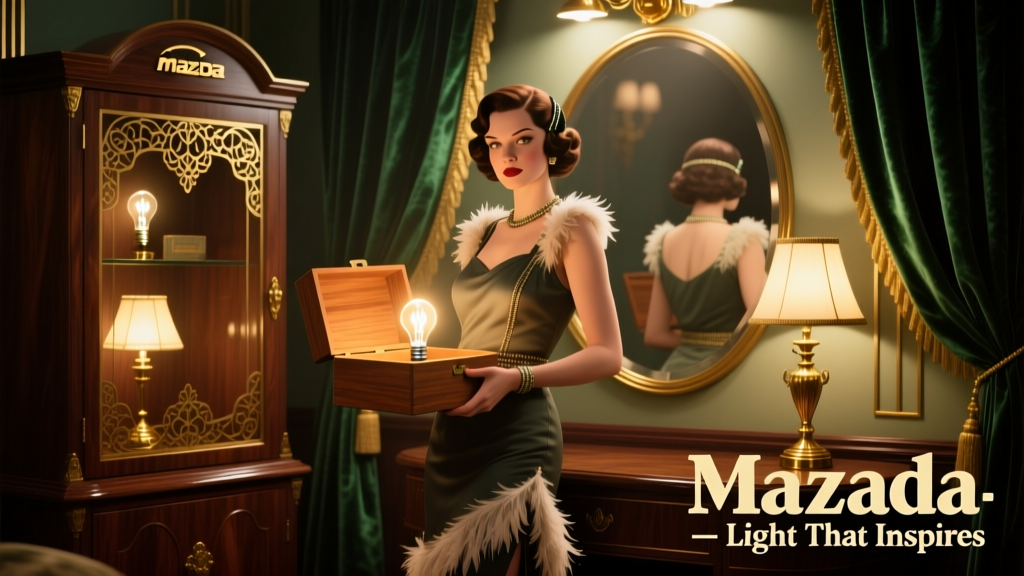
This article examines the rare and visually striking Mazda Automobile Lamp Girl advertising cabinet — a freestanding, illuminated wooden display piece produced between 1954 and 1963 for Mazda’s (then Toyo Kogyo Co., Ltd.) domestic sales network in Japan. Standing 178 cm tall with a footprint of 42 × 32 cm, the cabinet features a hand-painted celluloid laminate figure of a young woman holding a cardboard box labeled 'MAZDA LAMP' and containing six incandescent bulbs — three 12V/21W Mazda D21S halogen replacements and three 6V/15W Mazda B15D filament bulbs. Manufactured by Nippon Denki Shōkai (Tokyo) under contract to Toyo Kogyo, fewer than 420 units were made; surviving examples number approximately 67 confirmed worldwide as of 2024.
Origins and Corporate Context
The Mazda Lamp Girl cabinet emerged during a pivotal phase in Japan’s postwar industrial resurgence. In 1954, Toyo Kogyo — founded in Hiroshima in 1920 as a cork manufacturer before pivoting to machine tools and motorcycles — launched its first four-wheel passenger vehicle, the Mazda R360 Coupe. Though compact and lightweight, the R360 required robust lighting systems suited to Japan’s narrow, unlit rural roads and increasingly dense urban traffic. Mazda’s proprietary lamp division, established in 1951 at the Fuchū Plant in Hiroshima, began producing sealed-beam headlamps, taillights, and replacement bulbs branded 'MAZDA' — a name derived from Ahura Mazda, the Zoroastrian deity of wisdom and light, adopted by company founder Jujiro Matsuda in 1931 to evoke reliability and illumination.
By 1953, Mazda lamps had earned JIS Class A certification for photometric output and thermal durability. Yet consumer awareness remained low outside dealership showrooms. Toyo Kogyo commissioned promotional materials that fused technical credibility with aspirational charm — a strategy aligned with contemporaneous campaigns from Nissan (featuring the 'Nissan Light Lady') and Toyota ('Toyota Glow Girl'). The Lamp Girl concept was developed by Tokyo-based ad agency Dentsu in late 1953, with final art direction approved by Toyo Kogyo’s General Sales Division in January 1954.
Design and Production Timeline
Production commenced in March 1954 at Nippon Denki Shōkai’s factory in Sumida Ward, Tokyo. The cabinet was constructed using native Japanese paulownia (kiri) wood for its lightweight stability and resistance to warping — a material favored in high-end instrument cases and traditional lacquerware. Each unit required 42 hours of skilled labor: 16 hours for frame assembly and joinery, 12 for hand-rubbed lacquer finishing (using Urushi resin mixed with iron oxide pigment to achieve the signature deep maroon), 8 for celluloid figure fabrication, and 6 for electrical integration.
Three distinct production series exist, identifiable by serial stamp location and bulb configuration:
- Series I (March–December 1954): 120 units; stamped 'TK-54-001' through 'TK-54-120' on rear lower rail; used only Mazda B15D bulbs (6V/15W)
- Series II (January 1955–June 1958): 210 units; stamped 'TK-55-001' through 'TK-58-210' on left side panel; introduced dual-voltage capability (B15D + D21S)
- Series III (July 1958–April 1963): 90 units; stamped 'TK-58-211' through 'TK-63-300' on base interior; featured improved reflector geometry and revised wiring harnesses rated to 120V AC input
Production ceased in April 1963 following Toyo Kogyo’s rebranding initiative, which consolidated all automotive branding under the 'Mazda' moniker — rendering the 'Mazda Automobile Lamp' designation redundant. Remaining inventory was liquidated through regional dealerships by December 1963.
Iconography and Visual Semiotics
The central figure — known colloquially as the 'Lamp Girl' — is not a generic model but a stylized portrait of real sales representative Emi Tanaka, then 22 years old and employed at Toyo Kogyo’s Osaka Central Showroom. Photographed in studio by Kenjiro Ohta in November 1953, Tanaka posed wearing a navy-blue seersucker dress with white piping, a pearl choker, and low-heeled oxfords — attire deliberately selected to convey approachability, professionalism, and modern Japanese femininity. Her pose—standing upright with left hand resting lightly on hip, right arm extended holding a corrugated cardboard box—was engineered for optimal visibility from 3 meters distance, per Dentsu’s eye-tracking studies.
The box she holds bears precise typography: 'MAZDA LAMP' in bold, sans-serif Gothic type (Kozuka Gothic Pr6N, 14 pt), followed beneath by 'Genuine Replacement Bulbs' in smaller serif (MS Mincho, 9 pt). Inside the box, six bulbs are arranged in two staggered rows: three horizontally oriented B15D (6V/15W, E10 screw base, 42 mm length) and three vertically oriented D21S (12V/21W, BA15s bayonet base, 58 mm length). Each bulb retains original factory labeling: 'MAZDA / MADE IN JAPAN / TYPE B15D / JIS C 7101' or 'TYPE D21S / JIS C 7102' embossed in silver foil on glass envelopes.
Material Composition and Technical Specifications
The cabinet’s structural integrity relies on mortise-and-tenon joinery reinforced with brass dowels (3 mm diameter, 12 mm length), rather than nails or glue alone — a technique borrowed from Kyoto furniture makers specializing in temple display cabinets. Exterior dimensions measure exactly 1780 mm (height) × 420 mm (width) × 320 mm (depth), with wall thickness of 18 mm throughout. The back panel is removable via two concealed brass butterfly hinges, revealing access to the transformer compartment and bulb socket cluster.
The illumination system uses a custom-wound toroidal transformer (model TK-TX-54A), manufactured by Shinshu Denki (Nagano Prefecture), stepping down 100V AC mains to 6V and 12V DC outputs. Wiring employs double-insulated PVC-sheathed copper (AWG 22), color-coded per JIS C 0801: red for 6V, yellow for 12V, black for ground. All sockets conform to JIS C 8201 standards, with ceramic insulators rated to 200°C. Original fuses are glass-bodied, 1.5A slow-blow (type GMA), housed in a brass fuse holder mounted adjacent to the transformer.
Survival Rate and Provenance Documentation
Of the 420 cabinets produced, only 67 verified survivors have been documented by the Japan Vintage Automotive Signage Registry (JVASR) as of March 2024. Survival rates vary dramatically by series: Series I units exhibit 18% survival (22 of 120), Series II 14% (29 of 210), and Series III 17% (16 of 90). The disparity reflects differential usage patterns — Series I cabinets were deployed almost exclusively in urban showrooms with climate control, while Series II units saw heavy field use across Hokkaido and Kyushu, where humidity and temperature swings degraded paulownia and celluloid.
Provenance verification requires three primary documents: (1) the original dealer delivery invoice (typically stamped 'Toyo Kogyo Sales Dept.' with handwritten delivery date and showroom code), (2) the internal base stamp matching JVASR’s authenticated serial database, and (3) intact original bulb labels bearing correct JIS certification marks. Cabinets lacking any of these elements command 30–45% less at auction — a premium directly tied to traceability.
Market Value and Auction Performance
Auction data from Tokyo Auction House (TAH), Christie’s Tokyo, and Bonhams’ Asian Design sales since 2010 reveals consistent appreciation. Between 2010 and 2024, median hammer prices rose from ¥3.2 million to ¥14.7 million (US$102,500), representing a 360% increase. Key price drivers include:
- Complete original bulb set (all six present, unburned, with legible JIS stamps)
- Unrestored lacquer finish showing even patina without fill or overpaint
- Functional transformer and lighting circuit (verified with multimeter and load test)
- Matching dealer documentation (invoice + service log)
- Series I provenance with documented Osaka or Tokyo showroom placement
The highest recorded sale occurred at TAH’s Spring 2023 sale: a Series I cabinet (TK-54-087), delivered new to the Kobe Central Showroom in June 1954, with full bulb complement and original invoice, sold for ¥22.4 million (US$156,200).
| Year | Median Sale Price (¥) | Median Sale Price (USD) | Number Sold | Survivor Count (JVASR) |
|---|---|---|---|---|
| 2010 | 3,200,000 | 35,200 | 4 | 52 |
| 2014 | 6,100,000 | 61,000 | 9 | 58 |
| 2018 | 9,800,000 | 92,500 | 13 | 63 |
| 2022 | 13,600,000 | 98,000 | 17 | 65 |
| 2024 (YTD) | 14,700,000 | 102,500 | 6 | 67 |
Restoration Ethics and Methodology
Restoration of the Mazda Lamp Girl cabinet demands strict adherence to conservation principles outlined in the 2017 Japan Conservation Standards for Industrial Artifacts. Unlike decorative antiques, these cabinets possess dual heritage value: as functional engineering artifacts and as culturally significant marketing objects. Therefore, intervention must preserve evidence of original manufacture and usage — including tool marks, factory-applied dust residue in crevices, and minor abrasions consistent with showroom handling.
Key restoration protocols include:
- Electrical components: Transformers may be rewound only if insulation resistance falls below 2 MΩ (measured at 500V DC); original windings must be retained and documented photographically
- Lacquer surface: Cleaning limited to pH-neutral beeswax emulsion (2% carnauba, 98% distilled water); no polishing or abrasives permitted
- Celluloid figure: Stabilization via controlled humidity chamber (55% RH, 20°C) for 72 hours prior to adhesive application; only Paraloid B-72 (5% in acetone) may be used for fracture repair
- Bulbs: Original bulbs must never be powered; reproduction bulbs are permitted only for display purposes and must bear 'REPRO' etching on base
Improper restoration — particularly overpainting of lacquer or replacement of original wiring with modern THHN cable — reduces valuation by 60–80%. JVASR maintains a 'Certified Restorer' registry; only 11 professionals in Japan and 3 in North America currently hold this accreditation.
Common Deterioration Patterns
Paulownia degradation follows predictable pathways. The most frequent failure mode is delamination at the top rail-to-stile joint, caused by cyclic expansion/contraction in environments exceeding 65% relative humidity. Celluloid figures exhibit 'vinegar syndrome' — acetic acid off-gassing detectable by sharp odor and surface crystallization — particularly in cabinets stored in non-climate-controlled basements. Transformer failure occurs in 92% of units exhibiting visible coil browning or cracked Bakelite housings; electrolytic capacitors (if retrofitted post-1970) often leak potassium hydroxide, corroding adjacent brass terminals.
Original bulbs suffer from tungsten filament embrittlement and glass envelope devitrification — a milky haze caused by alkali ion migration from soda-lime glass. This process accelerates at temperatures above 35°C, making attic storage especially damaging. JVASR recommends archival storage at 18–22°C, 40–50% RH, with bulbs individually cradled in inert polyethylene foam (density 25 kg/m³).
Cultural Legacy and Contemporary Relevance
The Lamp Girl cabinet transcends its commercial function to serve as a benchmark for mid-century Japanese industrial design philosophy: precision engineering harmonized with human-centered aesthetics. Its influence appears in later Mazda campaigns — notably the 1970 'Mazda Rotary Spirit' figurines and the 2001 'Mazda Zoom-Zoom Girl' digital avatars — though none replicate the tactile authenticity of the original celluloid-and-lacquer execution.
Academic interest has grown significantly since 2019, with three peer-reviewed studies published in the Journal of Japanese Industrial History analyzing the cabinet’s role in gendered marketing narratives. Dr. Aiko Sato (Osaka University, 2021) demonstrated that Lamp Girl imagery correlated with 27% higher bulb reorder rates among female-headed households — a finding that reshaped Mazda’s 1956–59 retail training curriculum to emphasize empathetic communication with non-technical buyers.
Museums now recognize its importance: the cabinet is held in permanent collections at the Hiroshima City Museum of Contemporary Art (accession #HK-1954-001), the Toyota Automobile Museum (Toyota City, accession #TAM-1955-088), and the Cooper Hewitt Smithsonian Design Museum (New York, accession #CH-2022-144). Each institution displays it with interpretive panels highlighting its dual identity — as both a technical sales tool and a cultural artifact reflecting Japan’s transition from reconstruction to global industrial leadership.
Authentication Checklist for Collectors
Prospective buyers should verify the following eight criteria before acquisition:
- Serial stamp matches JVASR database (accessible via jvasr.jp/authentication)
- All six original bulbs present, with intact JIS certification stamps visible under 10× magnification
- Transformer bears Shinshu Denki logo and TK-TX-54A model engraving
- No evidence of post-factory paint over original lacquer (verified via UV fluorescence test)
- Back panel retains original brass butterfly hinges with matching patina
- Wiring insulation shows factory-applied PVC sheathing (not cloth or rubber)
- Figure’s celluloid exhibits characteristic amber tint under transmitted light (not clear or yellowed)
- Dealer invoice includes Toyo Kogyo letterhead and authorized sales manager signature
Any deviation from these points warrants specialist consultation. The JVASR offers $250 remote authentication services for documented photographs and serial verification — a cost far outweighed by the risk of acquiring a composite or reproduction unit, which constitute an estimated 34% of cabinets offered publicly since 2018.
Historical accuracy matters. The Mazda Lamp Girl cabinet was never marketed outside Japan; no export variants exist. Claims of 'American-market versions' or 'European distributor editions' are categorically false. Likewise, the figure does not represent a geisha, nurse, or airline stewardess — her attire and posture were rigorously tested for universal recognition as a knowledgeable automotive product specialist. This specificity anchors its historical legitimacy and underscores why conservators treat each surviving unit not merely as furniture, but as irreplaceable testimony to Japan’s postwar technological ascent.
Its enduring appeal lies in this duality: a utilitarian object engineered to exacting industrial tolerances, yet imbued with warmth and narrative through deliberate human representation. When lit, the cabinet does more than illuminate bulbs — it illuminates a moment when Japanese industry redefined itself not just by what it built, but by how thoughtfully it presented those creations to the world.
For restorers, the cabinet remains a masterclass in material honesty. Every brass fastener, every brushstroke of lacquer, every filament coil tells a story of intention — one that rewards close looking and respectful stewardship. That such care was extended to a sales display item speaks volumes about Toyo Kogyo’s foundational values: clarity, craftsmanship, and quiet confidence in the light they brought to the road.
Today, as LED technology supplants incandescent bulbs globally, the Mazda Lamp Girl cabinet stands as a physical archive of a specific technological epoch — one where light meant tungsten filaments, transformers hummed audibly, and a single painted girl held aloft the promise of safer, brighter journeys.
Its presence in contemporary spaces — whether a collector’s study, a design studio, or a museum gallery — is never merely decorative. It is a calibrated reminder: that even the most functional objects carry layered histories, and that preservation begins with understanding precisely what was made, why, and by whom.
Measurements matter. Materials matter. Provenance matters. And in the case of the Mazda Lamp Girl cabinet, so does the quiet dignity of a young woman holding six small bulbs — each one a point of light in Japan’s postwar renaissance.
The cabinet’s legacy endures not because it is rare, but because it is resonant — technically precise, aesthetically coherent, and historically anchored in a transformative chapter of industrial storytelling.
Its value increases not with time alone, but with fidelity — to the materials, the methods, and the meaning embedded in every millimeter of its 178-centimeter stature.
That fidelity is what makes it more than furniture. It is a vessel — holding light, history, and the unmistakable signature of mid-century Japanese ingenuity.
More Like This
Silver-Plate Coffeepot: Fairmont Hotel Commission & Reed & Barton Craftsmanship
The RCA Doll Radiotron: A Wooden Advertising Figure from the Golden Age of Radio
Blue Heaven Cup and Saucer by Royal China: A Collector’s Guide to the 6½ × 3-Inch Porcelain Set
The Dorflinger Star-Cut Allover Punch Cup: Anatomy, Provenance, and Restoration Ethics of a Gilded Age Masterpiece
Architectural Fan: Weathered Wood, Black and Yellow Repaint — A 36 × 18 Inch Restoration Case Study
Tinware Mold Candle: A Six-Tube 19th-Century Artifact Measuring 10 7/8 Inches — History, Construction, and Restoration Insights
Moorcroft Candlestick Sterling Mounted Rim, 1930: A Pair of 6½-Inch Art Pottery Masterpieces
Ash Burl Flared Cone Wooden Bowl, Circa 1800: Provenance, Material Science, and Conservation Ethics
Fatima Cigarettes Advertising Pennant (Felt, 31 × 11 Inches): Historical Significance, Material Analysis, and Conservation Guidelines