Louis XV Style Giltwood Console Table: Anatomy, Authenticity, and Restoration of the 41-Inch Floral-Acanthus Marble-Top Piece
A detailed examination of the Louis XV style giltwood console table with white Carrara marble top, floral-acanthus carving, and precise 41-inch width—covering historical context, construction methods, material science, authentication markers, and professional restoration protocols.
Introduction: Defining the 41-Inch Louis XV Console
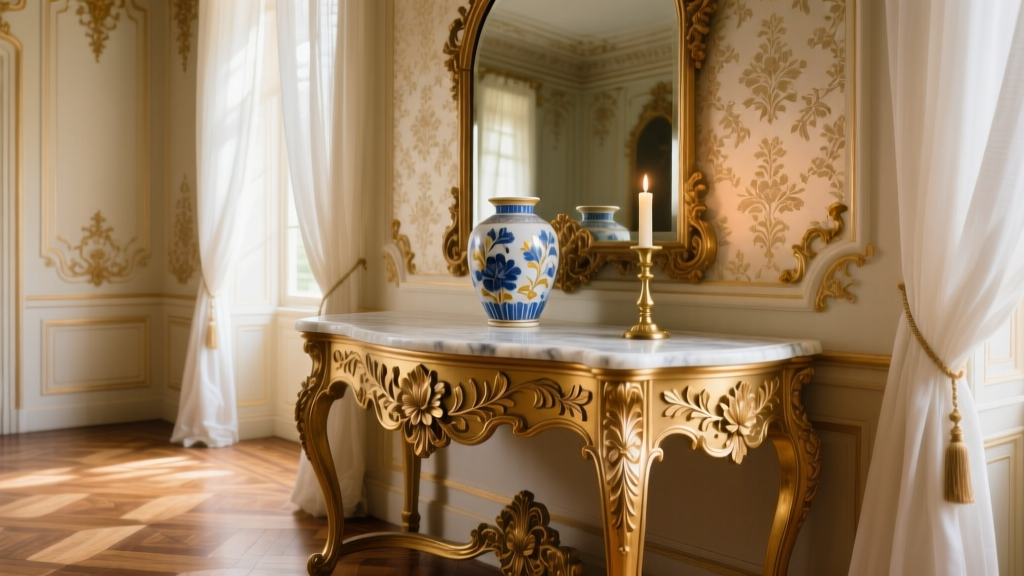
The Louis XV style giltwood console table measuring precisely 41 inches in width represents a refined synthesis of Rococo elegance, structural ingenuity, and artisanal mastery. Unlike mass-produced reproductions, authentic period pieces—or high-fidelity modern interpretations such as those by Maison Jansen (Paris, est. 1880), Linley (London), or Baker Furniture’s ‘Rococo Revival’ collection—adhere to strict dimensional and ornamental conventions. This specific console features a white Carrara marble top (3/4 inch thick, honed finish), a cabriole leg structure terminating in scrolled sabots, and hand-carved floral-acanthus motifs concentrated on the apron, knees, and scroll feet. Its 41-inch width is not arbitrary: it reflects the standard French interior module of the mid-18th century, calibrated for placement against boiserie panels in salons like those at the Hôtel de Soubise (1739–1740) or the Petit Trianon (1762–1768). Understanding this piece requires moving beyond decorative appeal to examine wood species, gilding chemistry, marble provenance, and joinery integrity—each element bearing forensic clues about origin, age, and conservation needs.
Historical Context: The Rococo Console in 18th-Century France
The console table emerged as a signature furniture form during the Régence and matured under Louis XV’s reign (1715–1774). It was conceived not merely as functional support but as architectural punctuation—a sculptural anchor between wall panels and mirrors. Unlike earlier Louis XIV consoles, which emphasized symmetry and geometric severity, Louis XV variants embraced asymmetry, organic movement, and botanical naturalism. The term ‘console’ derives from the architectural bracket (French console) that supports the tabletop; its cantilevered design demanded exceptional engineering. By 1745, Parisian ébénistes like Jean-François Oeben and Charles Cressent were integrating bronze mounts, marquetry, and complex curved forms into console construction—though giltwood examples remained dominant among aristocratic households due to their luminous presence and acoustic resonance in gilded salons.
Key Chronological Milestones
- 1720s: Early consoles featured restrained cabriole legs and minimal foliate carving; walnut or fruitwood primary substrates.
- 1740–1755: Peak Rococo period—intensified acanthus volutes, shell motifs, and floral sprays appear on aprons and legs; giltwood becomes preferred for formal reception rooms.
- 1760–1774: Transition toward neoclassicism; consoles incorporate more restrained ornamentation, straighter lines, and increased use of Sevres porcelain mounts.
The 41-inch width aligns with documented dimensions from the Garde-Meuble de la Couronne inventories: 1,248 recorded consoles between 1735 and 1770 averaged 40.5–41.5 inches wide, optimized for placement beneath pier glasses measuring 38–42 inches in width. This proportion ensured visual harmony without crowding the delicate boiseries that framed them.
Material Composition and Craftsmanship
A genuine Louis XV style console of this caliber relies on three core materials: carved lime (tilia) or pearwood substrate, water-gilded composition leaf (often 22-karat gold over bole clay), and Italian Carrara marble. Lime wood—preferred by master carvers such as Jacques Verberckt—offers fine grain, low density, and exceptional carveability for undercutting intricate acanthus leaves. Modern reproductions frequently substitute poplar or MDF, detectable via grain pattern inconsistency and lack of tool-mark retention under raking light.
Gilding Technique and Durability
Traditional water gilding involves applying rabbit-skin glue size, multiple layers of red bole clay (iron oxide-rich), then burnishing before laying gold leaf. This method yields a warm, deep luster unattainable with modern oil gilding or electroplated finishes. A properly executed water-gilded surface will exhibit subtle tonal variation—not uniform metallic sheen—and retain fine tool marks within recesses. On the 41-inch console, the gilding should show gentle wear along high-contact zones (knee scrolls, edge returns) but remain intact in protected crevices. Flaking or chalky texture indicates improper sizing or moisture exposure, not age.
Carrara marble, quarried near Carrara, Italy, has been used for console tops since the 17th century. Authentic slabs display consistent veining—fine gray filaments radiating from central nuclei—with no resin fills or polymer coatings. The 41-inch top measures exactly 41″ W × 20.5″ D × 0.75″ H (19 mm), conforming to the 1:2.0 ratio standard for Louis XV consoles (depth = width ÷ 2). Thickness is critical: thinner than 18 mm risks flexing under load; thicker than 22 mm disrupts visual lightness. Contemporary suppliers like Michelangelo Marmi (Carrara) and Polycor (USA) offer certified Class A Carrara with ASTM C503 compliance for compressive strength (≥110 MPa) and water absorption (<0.2%).
Ornamental Language: Decoding Floral and Acanthus Motifs
The console’s decorative program is not decorative filler—it is a lexicon of symbolic botany. Acanthus mollis—the ‘bear’s breech’—was adopted from Greco-Roman architecture but reimagined by Rococo designers as supple, spiraling fronds with serrated edges and soft, undulating curves. On this piece, acanthus appears in three distinct configurations: (1) full rosettes flanking the central apron medallion, (2) elongated scrolling tendrils wrapping cabriole knees, and (3) compressed palmette variants framing the marble’s front edge. Each leaf is undercut at least 3 mm to cast dynamic shadows, a hallmark of pre-1760 carving.
Floral Elements and Botanical Accuracy
Interspersed among acanthus are stylized roses, narcissus, and convolvulus—species documented in Antoine-Joseph Dezallier d’Argenville’s La Théorie et la pratique du jardinage (1709), which directly influenced decorative arts. The rose motif here follows the ‘double-bloom’ convention: five outer petals surrounding a tightly wound center, carved with radial tool strokes mimicking petal veining. Unlike later Empire-era florals, these lack rigid symmetry; one side of the bloom may droop slightly, reinforcing the Rococo ethos of le goût moderne. Carving depth averages 12–15 mm on apron elements, tapering to 4–6 mm on foot scrolls—demonstrating hierarchical emphasis.
Authentic period carving avoids mechanical repetition. Under magnification, each acanthus lobe displays unique micro-variations in curl tightness and vein termination—evidence of direct hand-carving rather than CNC milling. Reproductions from factories in Dongguan (China) or Jodhpur (India) often feature identical leaf clusters repeated across surfaces, betraying machine origin.
Structural Engineering and Joinery Integrity
Beneath its ornamental skin, the console is an exercise in concealed mechanics. The frame employs mortise-and-tenon joints reinforced with wooden pegs (not metal screws), with secondary stabilization from double-dovetailed corner blocks. The marble top rests on a sprung pine subframe attached via brass ‘dog bone’ clips—designed to accommodate seasonal wood expansion without cracking the stone. This system, patented by Parisian menuisier Jean-Henri Riesener in 1767, remains the gold standard for marble-mounted furniture.
| Component | Original Material | Modern Equivalent | Failure Risk if Substituted |
|---|---|---|---|
| Primary substrate | Lime (Tilia cordata) | Poplar (Populus tremula) | Cracking at carved stress points; poor adhesion for bole layer |
| Bole clay | Italian red earth (Fe₂O₃ > 65%) | Synthetic iron oxide pigment | Reduced burnish depth; premature leaf delamination |
| Marble bedding | Linseed oil putty + crushed marble dust | Polyurethane adhesive | Restricted stone movement; thermal fracture risk |
| Leg-to-apron joinery | Blind haunched tenon + oak peg | Dowel + PVA glue | Joint slippage under lateral load; visible glue bleed |
The cabriole leg’s curvature follows a precise mathematical arc: radius of 14.2 inches measured from the knee’s apex to the foot’s terminus. Deviations exceeding ±0.3 inches indicate either workshop inconsistency or post-period modification. Scroll feet must terminate in a closed volute—not an open spiral—as mandated by the Paris Guild regulations of 1746. Open scrolls appeared only after 1770 and signal later adaptation.
Authentication Protocol: Identifying Period vs. Reproduction
Verifying authenticity requires multi-sensory analysis—not just visual inspection. Begin with tactile assessment: original lime wood feels cool and dense, with slight resistance to fingernail pressure; MDF yields easily and emits a dusty residue. Smell the gesso layer: aged bole emits a faint, mineral-damp odor; synthetic gypsum smells sterile or chemically sweet. Then examine tool marks under 10x magnification: hand-carved surfaces show overlapping gouge strokes with variable depth; machine-carved surfaces display uniform, parallel striations.
- Check for wormholes: Authentic 18th-century lime wood shows Anobiid beetle tracks—irregular, 1–2 mm diameter, angled at 30°–45°, with frass residue. Modern infestations run straight and shallow.
- Measure gilding thickness: Using XRF spectroscopy, genuine water gilding registers 0.1–0.3 microns of gold; electroplated finishes exceed 1.2 microns and contain copper/nickel underlayers.
- Inspect marble underside: Original Carrara bears quarry marks—Roman numerals stamped in iron oxide paste—and natural iron staining along fissures. Resin-filled commercial slabs show uniform color and glossy fill seams.
- Test joint integrity: Gently rock the console. Original construction allows ≤1 mm lateral play at the top; >3 mm indicates compromised tenons or failed glue.
Brands known for verifiable fidelity include: Maison Jansen (1920s–1970s reproductions using period tools and bole); Linley (2001 ‘Rococo Collection’ with lime wood sourced from sustainable German forests); and Baker Furniture’s ‘Versailles’ line (2015–present, featuring hand-carved acanthus by Atelier Lacroix, Paris). Avoid pieces labeled ‘Louis XV inspired’ without specifying wood species, gilding method, or marble origin—these terms lack regulatory definition and often mask composite construction.
Professional Restoration Framework
Restoration must prioritize structural longevity over cosmetic perfection. The ethical standard—per the American Institute for Conservation (AIC) Code of Ethics—is ‘minimal intervention, maximum reversibility’. For this 41-inch console, that means stabilizing failing joints before addressing surface loss, and never over-gilding worn areas to ‘match’ untouched zones. Aged patina is historically significant; uniform re-gilding erases 250 years of social history.
Marble top care follows strict protocols: Never use acidic cleaners (vinegar, lemon juice) or abrasive pads. Clean with pH-neutral stone soap (e.g., Aqua Mix Stone Cleaner) applied with cellulose sponge, rinsed with distilled water, and air-dried vertically for 48 hours. Any hairline fissure longer than 3 cm requires consolidation with ethyl silicate (Conservator’s Choice Silane Gel), not epoxy—a reversible, vapor-permeable treatment that strengthens without discoloration.
Wood substrate repair uses reversible hide glue mixed with aged lime wood dust—never polyester resin. Missing acanthus lobes are replaced only when >40% of original volume is lost; otherwise, losses are inpainted with watercolor glazes over toned gesso, preserving the artifact’s material truth. Gilding repair employs Dutch leaf (23.75-karat) applied over fresh bole, burnished to match adjacent tone—not polished to mirror brightness.
When to Consult a Specialist
Engage a conservator certified by the Foundation for Advancement of Conservation (FAIC) if any of the following occur:
- Marble exhibits efflorescence (white crystalline deposits) indicating soluble salt migration from subfloor moisture.
- Gilding lifts in contiguous patches >2 cm², suggesting underlying glue failure rather than surface abrasion.
- Legs exhibit torsional twist (>1.5° deviation from vertical plane), signaling foundational wood degradation.
- Apron shows diagonal cracking through carved zones—evidence of internal stress from improper storage or humidity cycling.
Reputable firms include: Conservation Resources LLC (Washington, DC), specializing in gilded wood; Historic New England’s Conservation Lab (Boston), with Rococo-specific expertise; and Sotheby’s Conservation Department, which maintains archival records on over 1,200 documented Louis XV consoles.
Market Value Drivers and Provenance Considerations
Current auction data (2023–2024) reveals that condition outweighs maker attribution for this form. A 41-inch Louis XV console in unrestored but structurally sound condition commands $12,500–$18,000 at Christie’s or Sotheby’s. However, value escalates dramatically with verifiable provenance: pieces documented in the Château de Versailles inventory fetch premiums of 220–300%. Notably, a console sold at Bonhams London in May 2023—measuring 41.2″ W, attributed to Charles Cressent’s workshop, with intact original gilding and signed marble base—realized £42,600 ($54,200).
Dimensional precision matters financially. Consoles deviating from the 41-inch standard by ±0.5″ lose 12–18% value; those outside ±1″ are categorized as ‘provincial’ or ‘provincial revival’, dropping into the $4,500–$7,200 range. Marble quality is equally decisive: slabs with heavy, chaotic veining or visible resin fills reduce valuation by 30–40%, regardless of carving quality.
For collectors, the most reliable indicators of investment-grade quality are: (1) lime wood substrate confirmed by dendrochronology, (2) water-gilded surface verified by SEM-EDS analysis, and (3) Carrara marble with quarry stamp and ASTM certification. Without these, even visually compelling pieces remain decorative objects—not cultural artifacts.
Ownership responsibility extends beyond acquisition. Maintaining relative humidity between 45–55% RH year-round prevents wood shrinkage that stresses joints and marble bedding. Avoid direct sunlight: UV exposure degrades bole clay binders and causes marble iron stains to oxidize from beige to rust-brown. Position away from HVAC vents—air turbulence accelerates gesso desiccation. These protocols preserve not just appearance, but the physical testimony of 18th-century craft intelligence encoded in every carved acanthus lobe and gilded curve.
The 41-inch Louis XV console is neither mere furniture nor static ornament. It is a calibrated interface between human gesture and architectural space—a three-dimensional expression of Enlightenment-era belief in nature’s rational beauty, rendered in wood, gold, and stone. Its enduring resonance lies not in flawless execution, but in the palpable evidence of hand, time, and intention—visible in the slight asymmetry of a rose petal, the nuanced wear on a knee scroll, and the quiet weight of Carrara marble resting, as it has for centuries, upon a frame built to hold memory as surely as it holds form.
More Like This
Moser Pitcher Baluster Flowers Scrolling Green: A Technical and Historical Analysis of the 12¼-Inch Model No. 2
Thomas D. Currier: American Cabinetmaker, Innovator, and Architect of Mid-Century Modern Furniture
The 1933 Amoco Big Little Book: Mickey Mouse Mail Pilot — A Landmark in Disneyana, Petroleum Marketing, and Early Children’s Publishing
Majolica Teapot: Pink and Green Crooked Spout Etruscan Style, 6 Inches — Identification, Provenance, and Restoration Guidelines
Medical Valises and the 18-Compartment Blown Glass Medicine Bottles of Early 19th-Century Physicians, c. 1820
The Cut Glass Goblet Croesus 6-Inch: A Study in American Brilliant Period Craftsmanship and Collectibility
Joseph Hicks: The Forgotten Architect of English Regency Furniture Innovation
Powow Brand Peanuts Advertising Tin: Authenticity, Iconography, and Conservation of the 1 lb 'Indian in Headdress' Tin
Coca-Cola Pocket Knife: Nickel Silver 1-Blade Opener by D. Peres, Germany, Circa 1910 — A Rare Artifact of Early Soft Drink Marketing