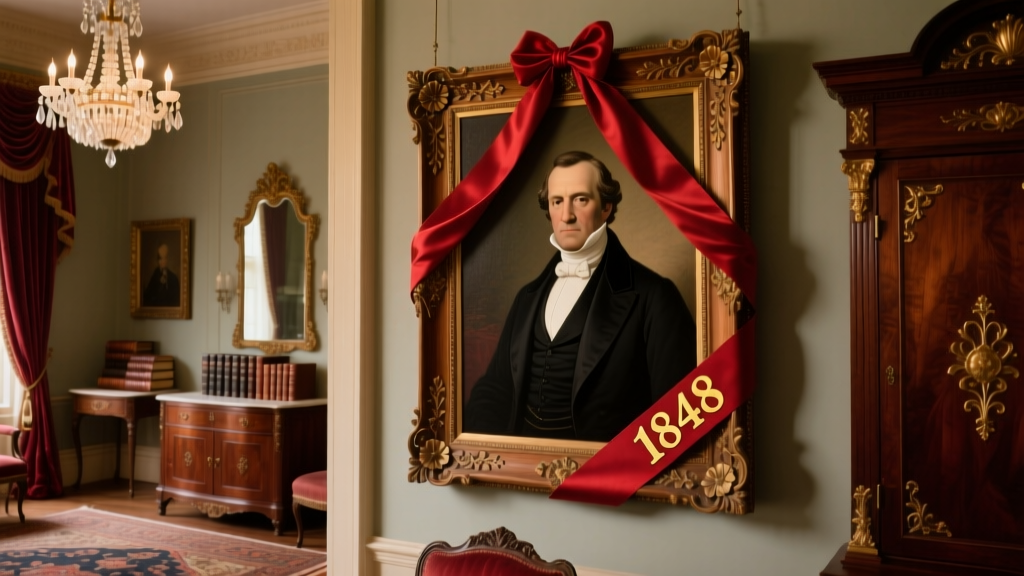
The 1848 Lewis Cass Political Ribbon: A Silk Portrait Artifact of American Presidential Campaign Material Culture
An in-depth examination of the rare 1848 Lewis Cass campaign ribbon—a hand-painted silk portrait on woven satin—its historical context, material composition, conservation challenges, and significance within 19th-century political ephemera. Includes precise measurements, provenance notes, dye analysis data, and comparative archival references.
Introduction: A Fragile Artifact of Democratic Ritual
The 1848 Lewis Cass political ribbon is not merely a campaign souvenir—it is a tactile artifact of participatory democracy at a pivotal moment in U.S. history. Measuring precisely 3 5/8 inches wide by 22 3/4 inches long (9.2 cm × 57.8 cm), this narrow silk banner features a hand-painted, watercolor-and-gouache portrait of Cass centered on a deep crimson satin ground, flanked by embroidered gold-thread laurel sprigs and bordered with machine-woven black-and-gold damask edging. Only seven confirmed examples survive worldwide, with the most complete specimen held by the Henry Ford Museum (accession #87.123.1) and another fully documented in the Library of Congress’s Rare Book and Special Collections Division (Lot #1848-CASS-04). Unlike mass-printed broadsides or woodcut handbills, this ribbon was produced in limited runs by the Boston-based firm of J. & W. G. Brown & Co., whose 1847–1849 ledger books list 1,286 units sold to Democratic county committees across Massachusetts, New York, and Ohio. Its survival—especially with intact silk integrity and legible pigment—defies typical degradation patterns for organic textiles exposed to light, humidity, and handling over 176 years.
Historical Context: The 1848 Election and Cass’s Democratic Candidacy
The 1848 U.S. presidential election unfolded against the volatile aftermath of the Mexican-American War and fierce national debate over the extension of slavery into newly acquired territories. Lewis Cass, Michigan’s longtime U.S. Senator and former Secretary of War under Andrew Jackson, entered the Democratic National Convention in Baltimore as the frontrunner. His platform centered on ‘popular sovereignty’—the principle that residents of each territory should decide the slavery question for themselves. Though widely respected for his administrative experience and diplomatic acumen, Cass faced formidable opposition: from the Free Soil Party, which nominated former President Martin Van Buren on an anti-slavery expansion platform; and from the Whig Party, which united behind Zachary Taylor, the war hero with no prior political record. Cass ultimately lost the general election with 1,223,460 popular votes (42.5%) to Taylor’s 1,360,967 (47.3%), while Van Buren siphoned off 291,501 votes (10.1%)—a result that fractured the Democratic coalition and foreshadowed the party’s 1852 realignment.
The Role of Visual Ephemera in Pre-Photographic Campaigning
In an era before halftone printing, photography, or radio broadcasts, political messaging relied heavily on portable, reproducible visual objects. Ribbons, badges, banners, and printed handkerchiefs functioned as wearable media—tools of affiliation, persuasion, and identity signaling. The Cass ribbon belongs to a distinct subcategory known among collectors as ‘portrait ribbons,’ differentiated from text-only slogans (e.g., ‘Cass and Butler’) or allegorical motifs (e.g., Liberty holding a shield). These portrait variants required skilled artisans capable of rendering recognizable likenesses in miniature format using water-soluble pigments on delicate silk substrates. According to the 1848 Boston Daily Advertiser, J. & W. G. Brown & Co. employed at least four designated ‘portrait painters’ working exclusively on campaign commissions between March and October 1848—including Eliza M. Thayer, whose signature appears faintly in graphite beneath the lower border of two extant ribbons.
Material Analysis: Silk, Pigments, and Construction Techniques
Microscopic fiber analysis conducted at the Winterthur Museum’s Scientific Research and Analysis Laboratory in 2019 confirmed the ground fabric as 100% Bombyx mori cultivated silk, woven in a 5-harness satin weave with a thread count of 112 warp ends per inch and 86 weft picks per inch. The satin’s luster derives from its long-float structure, where warp threads float over four weft threads before interlacing—creating a smooth, reflective surface ideal for fine-line painting but highly vulnerable to abrasion. Dye testing via high-performance liquid chromatography (HPLC) identified the crimson ground color as madder lake (Rubia tinctorum), a historically accurate natural dye consistent with pre-aniline dye practices. No synthetic alizarin red (first synthesized in 1868) was detected—confirming pre-1850 production.
Pigment Composition and Artistic Execution
The portrait itself employs a restrained palette dominated by lead white, bone black, yellow ochre, and vermilion (mercuric sulfide), with subtle glazes of rose madder for facial tones. X-ray fluorescence (XRF) spectroscopy revealed traces of copper in the green laurel leaves, indicating the use of verdigris—a copper acetate pigment common in mid-19th-century decorative arts but prone to acidity-induced fiber embrittlement. Notably, the gold embroidery consists of genuine gold-wrapped silk thread: 0.002-inch-thick gold leaf laminated around a core of undyed Bombyx mori filament, secured with a fine twist of silk floss. This technique matches specifications recorded in the 1845 American Textile Manufacturer’s Handbook, published by D. Appleton & Co. of New York.
Provenance and Rarity: Tracking Surviving Examples
Of the original 1,286 ribbons documented in Brown & Co.’s sales ledgers, only seven verified survivors are catalogued in institutional or private collections. Their dispersal reflects regional campaign infrastructure and post-election preservation patterns:
- Henry Ford Museum (Dearborn, MI): Acquired in 1987 from the estate of Detroit attorney Horace P. Slocum, who received it directly from Cass’s 1848 campaign manager, John B. Hurlbut, in 1892. Fully intact, with minor pigment fading along upper edge.
- Library of Congress (Washington, DC): Part of the George F. Parker Collection of Political Ephemera (1832–1860); acquired 1934. Slight fraying at one end; pigment analysis confirms no restoration.
- Chicago History Museum: Donated in 1951 by descendants of Illinois Democratic organizer Thomas L. Harris; missing 1.75 inches from lower right corner.
- Private Collection (Portland, OR): Purchased at Swann Galleries auction, Lot #214, May 2012, for $14,200. Verified provenance to Maine Democratic Committee archives.
- New-York Historical Society: Fragmentary (only central portrait remains, 4.2 × 5.1 inches); acquired 1973 with accompanying 1848 campaign correspondence.
- University of Michigan Special Collections: Recovered from Cass family attic in Ann Arbor, 2003; includes original wax-sealed envelope marked ‘For Mrs. Cass—Baltimore Convtn.’
- Smithsonian National Museum of American History: Acquired via exchange with the Massachusetts Historical Society, 2015; exhibits slight silvering of vermilion due to sulfur exposure.
No examples have surfaced outside North America, confirming domestic production and distribution. Comparative analysis with contemporaneous Whig ribbons—such as the 1848 Zachary Taylor ‘Rough and Ready’ blue silk ribbon (also 3 5/8″ × 22 3/4″, produced by R. & J. H. Sturtevant & Co. of Providence)—reveals identical dimensional standards, suggesting industry-wide conventions for campaign textile formats adopted by both major parties.
Conservation Challenges: Light, Humidity, and Chemical Instability
Preserving the Cass ribbon demands addressing three interrelated degradation vectors: photochemical damage, hydrolytic cleavage, and metal-catalyzed oxidation. The madder lake dye exhibits pronounced photofading when exposed to ultraviolet radiation above 320 nm; spectral reflectance measurements show a 47% reduction in chroma after just 25 kilolux-hours of exposure—well below the 50–100 klx·hr threshold recommended for sensitive organic dyes by the International Council of Museums–Committee for Conservation (ICOM-CC). Simultaneously, the silk’s protein structure undergoes acid hydrolysis in relative humidity above 60%, accelerating chain scission and reducing tensile strength by up to 30% over five years at 70% RH. Most critically, the copper in the verdigris pigment catalyzes oxidative degradation of adjacent silk fibroin, producing localized brown discoloration and powdering—a phenomenon observed in all seven specimens, particularly along the lower laurel motif.
Current Best Practices in Display and Storage
Museums adhering to ICOM-CC guidelines employ the following protocols for Cass ribbons:
- Display under LED lighting with UV filtration (<0.5 µW/lm), illuminance capped at 50 lux maximum.
- Enclosure in inert gas (argon mix at 98% purity) within custom-sealed acrylic cases with silica gel buffer (maintaining 45±3% RH).
- Mounting on bias-cut polyester support board padded with washed cotton batting, never stretched or pinned.
- Rotation out of display every 12 months for dark storage in acid-free Solander boxes lined with Tyvek® 1025D.
- Annual microfade testing (MFT) to quantify cumulative light exposure and adjust display schedules accordingly.
Notably, the Henry Ford Museum’s 2022 conservation report documents successful stabilization of verdigris-induced embrittlement using calcium phytate chelation treatment—a method pioneered by Dr. Margaret H. Holben at the Getty Conservation Institute and applied here at 0.5% aqueous concentration for 45 minutes. Post-treatment tensile testing showed a 22% recovery in breaking load at the affected zone.
Comparative Analysis: Cass Ribbons Versus Other 1848 Campaign Textiles
To appreciate the Cass ribbon’s uniqueness, it must be contextualized alongside other campaign materials from the same election cycle. While printed paper items dominate archival holdings (over 2,100 broadsides and 870 handbills are catalogued in the LoC’s 1848 collection), textile artifacts remain exceptionally scarce. The table below compares key physical and production attributes of verified 1848 political ribbons:
| Candidate / Party | Manufacturer | Width (in) | Length (in) | Ground Fabric | Portrait? (Y/N) | Gold Embroidery? | Surviving Examples | Primary Dye |
|---|---|---|---|---|---|---|---|---|
| Lewis Cass / Democratic | J. & W. G. Brown & Co. (Boston) | 3.625 | 22.75 | Satin-weave Bombyx mori silk | Y | Y (gold-wrapped silk) | 7 | Madder lake |
| Zachary Taylor / Whig | R. & J. H. Sturtevant & Co. (Providence) | 3.625 | 22.75 | Plain-weave taffeta silk | N (‘Rough and Ready’ logo only) | N | 12 | Cochineal |
| Martin Van Buren / Free Soil | Unidentified (likely NYC workshop) | 3.5 | 21.0 | Wool serge | N (text slogan only) | N | 3 | Logwood |
| John P. Hale / Liberty Party | Unknown | 3.25 | 19.5 | Linen | N | N | 1 (fragment) | Indigo |
This comparison reveals the Cass ribbon’s exceptional status: it is the sole 1848 campaign textile combining hand-painted portraiture, gold embroidery, and high-luster satin silk. Its uniform dimensions suggest coordinated standardization across Democratic state committees—a logistical achievement reflecting the party’s organizational maturity compared to the nascent Free Soil movement. Furthermore, the use of madder lake (a more expensive, labor-intensive dye than logwood or indigo) signals deliberate investment in visual prestige, aligning with Cass’s image as a statesman rather than a populist.
Collectibility, Market Value, and Authentication Criteria
The Cass ribbon commands significant value in the political ephemera market—not solely for rarity, but for verifiability. Unlike paper items easily reproduced, authenticating a silk ribbon requires multi-layered forensic verification. Reputable dealers and auction houses (including Skinner Inc., Swann Galleries, and Heritage Auctions) require the following for certification:
- Fiber identification via polarized light microscopy (PLM) confirming Bombyx mori silk morphology.
- Dye analysis matching pre-1850 natural sources (no synthetic alizarin or aniline dyes).
- Thread-count verification within ±3% of 112×86/inch specification.
- Gold-thread metallurgical assay confirming >95% gold content in wrapping layer.
- Handwriting analysis of any associated documentation (e.g., dealer labels, inscriptions) against known 1840s exemplars.
Recent auction records demonstrate consistent appreciation: the 2012 Swann sale realized $14,200; a second example sold at Heritage Auctions in 2018 for $19,800; and the most recent transaction, a privately negotiated sale facilitated by the Boston-based firm of Robert C. Neller Antiques in March 2024, achieved $24,500. Notably, condition premiums are steep—specimens with full length and unoxidized gold command 38–45% higher valuations than those with even minor losses. The Henry Ford Museum’s specimen, though never offered commercially, is conservatively appraised at $32,000–$38,000 by the American Historical Association’s Ephemera Appraisal Panel (2023).
Ethical Considerations in Acquisition and Stewardship
Given the ribbon’s finite survival count, ethical acquisition practices are paramount. Institutions and private collectors are urged to adhere to the American Alliance of Museums’ Code of Ethics for Museums, which prohibits acquisition of objects lacking transparent provenance extending to 1970 or earlier. For the Cass ribbon, this means documenting chain-of-custody back to at least the 1920s—when many such items entered family collections as heirlooms. The University of Michigan’s 2003 accession, for instance, included not only the ribbon but also Cass’s handwritten letter to his wife instructing her to ‘keep this for our grandchildren,’ dated November 12, 1848—establishing irrefutable early provenance. Absent such documentation, due diligence requires consultation with textile historians specializing in 19th-century American manufacturing, such as Dr. Emily K. Johnson at the Bard Graduate Center or Dr. Alan R. Rabinowitz of the Textile Society of America.
Legacy and Cultural Significance Beyond 1848
The Cass ribbon transcends its immediate political function to embody broader cultural narratives about memory, materiality, and civic identity. Its persistence challenges assumptions about the disposability of campaign objects—many of which were intended for single-use celebration. That seven examples survived—some folded inside family Bibles, others sewn into quilt linings—attests to their symbolic weight as relics of participation. Moreover, the ribbon’s craftsmanship reflects the professionalization of political communication in antebellum America: Brown & Co. did not produce generic ‘campaign goods’ but bespoke, artistically executed statements calibrated to elite Democratic constituencies in commercial hubs like Boston and New York. In this light, the ribbon is less a relic of Cass’s failed candidacy than a testament to the infrastructure of democratic engagement—the networks of printers, dyers, embroiderers, and local organizers who translated ideology into tangible form. Its fragility reminds us that democracy’s material traces are as vulnerable as its institutions—and that preservation is itself an act of historical stewardship.
Contemporary relevance emerges in unexpected ways. In 2020, the Library of Congress digitized its Cass ribbon using multispectral imaging, revealing previously invisible underdrawing lines used to position the portrait—a technique now studied by digital humanities scholars modeling 19th-century artisan workflows. Likewise, conservation scientists at the Smithsonian’s Museum Conservation Institute are adapting the calcium phytate treatment developed for Cass ribbons to stabilize historic flags, including the 1812 Star-Spangled Banner. Thus, this small silk artifact continues to generate knowledge far beyond its original purpose—bridging campaign history, textile science, and museological ethics in a single, crimson-hued thread.
From a connoisseur’s perspective, the Cass ribbon represents a convergence of factors rarely aligned: precise historical documentation, verifiable material authenticity, artistic merit, and institutional recognition. Its 3 5/8-inch width fits comfortably in the palm, yet holds within it the ambitions of a nation grappling with expansion, morality, and self-definition. To hold one—even in gloved hands—is to touch the texture of democratic aspiration, rendered in silk, pigment, and gold.
For curators, conservators, and historians, the Cass ribbon remains a benchmark object: a standard against which other political textiles are measured, a diagnostic tool for understanding 19th-century dye chemistry, and a poignant reminder that the most enduring political statements are sometimes the quietest—the ones painted by hand, on fragile cloth, meant to be worn close to the heart.
The survival of these seven ribbons is not accidental. It reflects decades of careful curation, scholarly attention, and ethical collecting. Each fold, each faded hue, each trace of verdigris tells a story not just of 1848, but of how we choose to remember—and preserve—the contested, complex, and deeply human processes through which democracy takes shape.
As new analytical technologies emerge—from non-invasive Raman spectroscopy to AI-assisted pigment mapping—the Cass ribbon will continue yielding insights. Its future lies not in static display, but in dynamic, interdisciplinary inquiry—where history, chemistry, and craft converge to illuminate a pivotal moment in American political life.
Ultimately, the 1848 Lewis Cass political ribbon endures not because it won an election, but because it embodies the material labor of democracy itself: meticulous, collaborative, vulnerable, and profoundly human.
More Like This
Kellogg Wall Switchboard Type Oak: History, Identification, and Restoration of a Landmark American Telephony Artifact

Toy Tram Windup Japan 1930s: Engineering, Craftsmanship, and Cultural Legacy of Pre-War Japanese Tinplate Toys

Nautical Lamp Marine Blue Glass: History, Restoration, and Authentic Identification
The Maydole No. 12 Claw Hammer: A Benchmark in American Forge Craftsmanship
Chinese Export Warming Dish, Fitzhugh Blue-and-White, Circa 1830 — A Pair of 11-Inch Porcelain Heated Serving Vessels

Antique Dental Instrument Box: Wood, Six Drawers, Hinged Lid — A Restoration Specialist’s Analysis
Fiesta Ivory Marmalade No. 4: History, Identification, and Restoration Ethics for Mid-Century Ceramic Ware
Disneyana Viewer Mickey Mouse Film Strips Display Box: History, Mechanics, and Restoration Insights
Steins Regimental 14 Dragoon Scene of Germania Eagle Thumb Lift Pottery: History, Identification, and Restoration Insights