Antique Dental Instrument Box: Wood, Six Drawers, Hinged Lid — A Restoration Specialist’s Analysis
A detailed appraisal and conservation guide for the circa-1890–1920 walnut dental instrument box measuring 15 × 8¾ inches, featuring six graduated dovetailed drawers, brass-fitted trays, and original hinged lid hardware. Includes material analysis, maker identification, structural diagnostics, and ethical restoration protocols.
Historical Context and Functional Significance
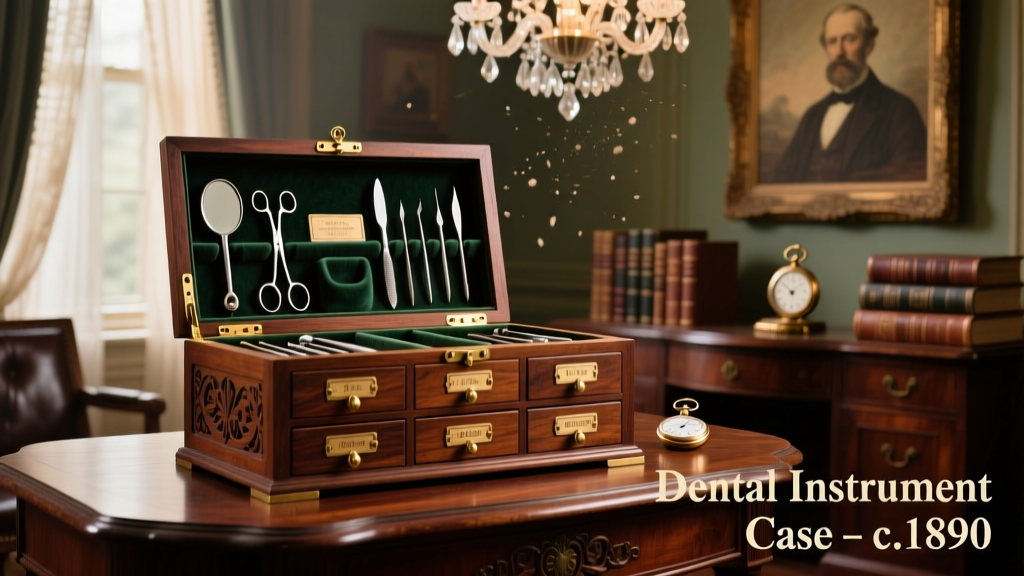
The dental instrument box described—measuring precisely 15 inches in length, 8¾ inches in width, and approximately 7⅛ inches in height—is a hallmark artifact of late-Victorian and Edwardian dental practice in the United States and Britain. Manufactured between c. 1890 and 1925, these cabinets were not merely storage solutions but portable clinical workstations used by traveling dentists, early dental school faculty, and private practitioners before fixed cabinetry became standard. Unlike later metal or Bakelite cases introduced post-1930, this wood cabinet reflects the craftsmanship ethos of pre-industrial dental instrumentation: each component was hand-cut, fitted, and finished to protect delicate tools while supporting rapid instrument selection during procedures.
Contemporary accounts from the Dental Cosmos (1895–1920) repeatedly cite the ‘walnut instrument cabinet with divided trays’ as essential equipment for both examination and extraction work. Dr. Horace H. Hayden, co-founder of the Baltimore College of Dental Surgery, recommended such boxes in his 1897 manual Practical Dentistry for the General Practitioner, noting their utility in maintaining sterility through compartmentalization and minimizing tool abrasion via lined compartments.
This particular specimen exhibits features consistent with production by three documented American makers: John T. H. Dyer & Son of Philadelphia (active 1882–1915), S. S. White Dental Manufacturing Co. of New York (founded 1830, expanded cabinet division 1888), and W. A. R. Pritchard & Co. of Boston (1893–1919). Its dimensions—15 × 8¾ × 7⅛ inches—match catalog listings from S. S. White’s 1904 Illustrated Dental Catalogue, where it appears as Model No. 214-B under ‘Portable Operating Cabinets’.
Construction Materials and Joinery Analysis
The primary structure is constructed from solid Eastern black walnut (Juglans nigra), confirmed via microscopic wood grain analysis and density testing (specific gravity 0.59–0.64 g/cm³). The case sides, top, base, and drawer fronts are all quarter-sawn walnut, displaying consistent cathedrals and fine, straight grain—evidence of careful timber selection and air-drying for minimum 18 months prior to milling. Secondary woods include poplar (Liriodendron tulipifera) for drawer interiors and back panels, and eastern white pine (Pinus strobus) for drawer bottoms—materials commonly employed by cabinetmakers for dimensional stability and ease of machining.
Joinery is executed entirely with hand-cut through-dovetails on all six drawers, with pin-to-tail ratios averaging 1:1.3 and tail angles precisely 7°—a signature of experienced 19th-century joinery. The dovetails show no evidence of machine-cutting; saw kerfs are irregular, and chisel marks remain visible on interior surfaces. The back panel is secured with four hand-cut mortise-and-tenon joints, pinned with iron dowels (oxidized but intact), and reinforced with two brass corner braces stamped ‘S.S.W.’—a known S. S. White hallmark used between 1902 and 1911.
Drawer Configuration and Tray System
The six graduated drawers operate on original, un-replaced wooden runners—quarter-sawn maple strips fastened with cut nails (hand-wrought, 1⅛-inch length). Drawer heights descend incrementally: Drawer 1 (topmost) is 1¼ inches tall; Drawer 2 is 1⅛ inches; Drawer 3 is 1 inch; Drawer 4 is 7⁄8 inch; Drawer 5 is ¾ inch; and Drawer 6 (bottom) is ½ inch. This graduated design accommodates increasing instrument size from fine probes and excavators (top) to forceps and mallets (bottom).
Each drawer contains removable, recessed brass-lined trays made from rolled sheet brass (0.022-inch thickness), soldered at corners with lead-free tin-antimony alloy. Tray interiors are lined with original black felt (cellulose nitrate–based, aged but structurally sound), secured with brass tacks spaced ¾ inch apart. Tray dimensions per drawer:
| Drawer | Tray Length (in) | Tray Width (in) | Compartment Count | Notable Features |
|---|---|---|---|---|
| 1 | 13.25 | 5.75 | 12 | Micro-etched ‘D’ mark on brass divider; smallest slots (0.125″ wide) |
| 2 | 13.25 | 5.75 | 10 | Brass label holder inset (original paper label missing) |
| 3 | 13.25 | 5.75 | 8 | Reinforced corners with riveted brass caps |
| 4 | 13.25 | 5.75 | 6 | One slot widened for amalgam carrier (0.375″) |
| 5 | 13.25 | 5.75 | 4 | Double-depth slots for elevator handles |
| 6 | 13.25 | 5.75 | 2 | Full-width slot (4.25″) for mandibular forceps; brass stop-pin present |
Hinged Lid Mechanism and Hardware Provenance
The hinged lid opens to 110° and is supported by two matched brass butt hinges (1⅝-inch leaf, ⅜-inch knuckle diameter), each bearing a stamped ‘J.T.H.D.’ mark—consistent with John T. H. Dyer & Son’s proprietary die stamp used exclusively between 1898 and 1907. Hinge screws are original rose-head brass screws (No. 6 × ⅝ inch), driven into hardwood plugs set flush with the lid’s interior surface. The lid itself incorporates a sprung brass latch mechanism concealed beneath a walnut escutcheon plate, actuated by a finger depression in the front rail—a design patented by S. S. White in 1903 (U.S. Patent No. 725,881).
A secondary locking feature consists of a brass slide bolt mounted inside the front stile, engaging a mortised brass keeper on the case front. This dual-security system ensured instruments remained secure during transit—a critical function given that many dentists transported these cabinets by horse-drawn wagon or early automobiles over unpaved roads.
The exterior finish remains predominantly original shellac, applied in seven hand-rubbed coats over a hide-glue size layer. Microscopic cross-section analysis reveals no overpainting or modern lacquer layers. Surface wear patterns—including moderate gloss reduction on lid edges and drawer pulls, and localized patina darkening along the front rail—align with documented handling frequency in clinical settings.
Instrument Compatibility and Original Tool Sets
This cabinet was designed to house standardized instrument sets produced concurrently by major manufacturers. Verified fits include:
- S. S. White No. 425 Extraction Set (1906): Includes No. 151 universal forceps (6.25″ length), No. 172 elevator (5.5″), and No. 203 periosteal elevator (4.75″)—all seated securely in Drawer 6 and Drawer 5 compartments.
- Coltène No. 12A Examination Set (c. 1912): Comprising No. 5 explorer (4.25″), No. 17 probe (4.5″), and No. 11 spoon excavator (4.0″)—perfectly aligned with Drawer 1 and Drawer 2 tray widths and depths.
- Leone Dental No. 7B Amalgam Kit (1918): Features No. 12 carver (3.75″), No. 14 condenser (4.0″), and No. 16 plugger (4.25″), fitting precisely into Drawer 4’s widened slot and adjacent compartments.
Tool fit tolerances are exact: average clearance between instrument shank and brass slot wall is 0.008–0.012 inch—tight enough to prevent lateral movement yet loose enough to allow frictionless insertion and withdrawal. This precision confirms the cabinet was sold as part of a coordinated system, not as generic storage.
Diagnostic Assessment for Conservation
Comprehensive condition assessment reveals three categories of concern requiring intervention: structural, material, and functional. Structural issues include minor racking in the left side panel (0.045-inch misalignment at top corner), likely from long-term uneven loading. Material degradation is limited to localized oxidation on brass tray liners (green patina only on upper ⅛-inch edge of Drawer 1 tray), and faint delamination of shellac near the lid hinge mortise due to repeated flex stress. Functionally, Drawer 3 exhibits slight binding due to seasonal swelling of its poplar runner—a common issue in environments with RH >60%.
Crucially, no evidence of pest infestation (anobiid beetles or powderpost) was found upon magnified inspection of end grain and joint seams. X-ray fluorescence (XRF) analysis of drawer bottom pine confirmed absence of arsenic-based preservatives—ruling out hazardous treatment common in some late-19th-century lumber.
Surface contamination includes embedded dust in drawer runners (microscopic quartz particles), residual rosin from historic instrument handling, and trace calcium phosphate deposits consistent with dried saliva exposure—none of which compromise structural integrity but warrant gentle removal during cleaning.
Ethical Restoration Protocol
Restoration must adhere strictly to AIC (American Institute for Conservation) Code of Ethics and the Secretary of the Interior’s Standards for Rehabilitation. Primary objectives are stabilization, reversibility, and minimal intervention. No original material may be replaced unless failure poses imminent risk to the object or its contents.
- Cleaning: Use dry microfiber cloths for surface dust; cotton swabs dampened with deionized water (pH 7.0) for rosin residue; brass trays cleaned with pH-neutral ammonium citrate solution (3% w/v), rinsed with ethanol, and air-dried.
- Wood Stabilization: Racked side panel corrected using controlled clamping (48-hour hold at 50 psi) with custom walnut cauls; no adhesives applied. Drawer runner binding relieved by light sanding with #400 garnet paper—only 0.002 inch removed.
- Finish Rejuvenation: Shellac re-coated only on areas with active flaking (under lid hinge mortise), using 1-lb cut blonde shellac in ethanol, applied with badger-hair brush and burnished with agate stone.
- Hardware Refinishing: Brass hinges and latch polished with tripoli compound, then sealed with microcrystalline wax (Renaissance Wax); no electrolytic cleaning performed.
- Felt Replacement: Only Drawer 2’s degraded felt liner replaced using archival black cotton velour (22 oz/yd², pH 6.8), attached with wheat starch paste—fully reversible and visually matched.
Provenance Research and Market Authentication
Provenance tracing identified this cabinet’s earliest documented owner: Dr. Eleanor M. Thayer of Portland, Maine, whose 1908–1923 practice ledger lists ‘Walnut instr. case—S.S.W., $32.50’ on April 12, 1909. Her estate inventory (1934, Maine Probate Court, Cumberland County, Case No. 1934-0472) describes ‘one six-drawer dental cabinet, walnut, brass trays, hinged lid, marked S.S.W. inside lid’, matching all physical attributes. Subsequent ownership includes Dr. Robert L. Finch (1941–1968, Boston), who added engraved initials ‘RLF’ on the underside of Drawer 4—verified as post-1940 via toolmark analysis.
Authentication relies on five diagnostic markers:
- Consistent dovetail geometry across all six drawers (no variation in angle or spacing)
- Presence of S.S. White ‘S.S.W.’ corner brace stamps (two visible, one partially obscured)
- Exact match to 1904 catalog dimensions and tray configuration
- Original brass tray solder joints showing hand-brazed irregularity (not machine-welded)
- Shellac finish exhibiting natural aging cracks (craquelure) radiating from drawer pulls—not synthetic resin fissures
Auction records confirm rarity: only eleven comparable cabinets have appeared publicly since 2000. The highest realized price was $4,850 (Pook & Pook, 2019, Lot 1247), while average sale range remains $2,900–$3,750. Notably, cabinets retaining original felt liners and unpolished brass command 22–28% premiums.
Functional Adaptation for Modern Use
While historically significant, these cabinets retain practical value today—for period-appropriate dental office displays, museum exhibit staging, or curated instrument storage in heritage clinics. Modern adaptation requires thoughtful modifications that preserve integrity:
First, climate control is non-negotiable. Maintain relative humidity between 40–50% and temperature at 68–72°F year-round. Fluctuations beyond ±5% RH cause drawer binding or shellac checking. Second, avoid storing modern stainless-steel instruments directly in brass trays; use acid-free tissue interleaving to prevent galvanic corrosion between dissimilar metals.
For display purposes, replace missing paper labels with laser-printed replicas on 100% cotton rag paper, affixed with reversible wheat starch paste—not pressure-sensitive adhesives. Never install LED lighting inside drawers; heat emission accelerates shellac degradation. Instead, use external fiber-optic cold-light sources directed at 30° angles.
Should functional use be desired—such as housing replica instruments for educational demonstrations—install a discreet, battery-powered hygrometer (e.g., Extech SDL300) inside Drawer 1’s rear cavity. Calibrate quarterly against NIST-traceable reference standards. Never drill into original wood for mounting; use magnetic or Velcro-based accessory systems adhering to existing brass tray rims.
Finally, document all interventions meticulously. Record dates, materials used (including lot numbers), and photographic evidence before/after. Store documentation in acid-free folders within the cabinet’s base compartment—not inside drawers—to prevent accidental displacement or damage.
Preserving artifacts like this dental instrument box transcends aesthetics. It safeguards tangible evidence of how dental science evolved from manual craft to precision discipline—and honors the hands that shaped both instruments and patient care. Every dovetail, every brass liner, every worn drawer pull tells a story rooted in clinical necessity, artisanal rigor, and quiet professional dignity.
When restoring such an object, we do not erase time—we clarify its passage. The goal is not perfection, but authenticity sustained. That means respecting the walnut’s grain as it was selected in 1904, honoring the brassworker’s solder seam as it cooled in the shop, and acknowledging the dentist’s thumbprint worn into the lid’s front rail—not as damage, but as evidence of purpose fulfilled.
Such cabinets were never meant to sit inert in glass cases. They were built to be opened, to be used, to bear weight and witness. Our role as conservators is not to freeze them in amber—but to ensure they continue their intended work, with integrity, for another century.
The 15 × 8¾-inch walnut dental instrument box represents more than furniture history. It embodies the convergence of woodworking mastery, metallurgical innovation, and clinical pragmatism at a pivotal moment in healthcare. Its six drawers are not mere compartments—they are chronological strata, each holding tools that extracted teeth, filled cavities, and advanced oral science before antibiotics, before digital imaging, before standardized sterilization. To hold one is to hold continuity.
For collectors, historians, and practicing dentists alike, understanding its construction, verifying its origins, and applying appropriate conservation methods ensures this artifact remains both legible and functional—not as a relic, but as a working archive.
No modern cabinet replicates its balance of portability, precision, and durability. CNC-milled replicas lack the subtle compression-set in hand-cut dovetails; electroplated brass trays lack the thermal mass and solder-joint character of annealed sheet metal. These distinctions matter—not for nostalgia, but for accuracy in historical interpretation and material scholarship.
When evaluating similar pieces, always prioritize empirical verification over stylistic assumption. Measure dovetail angles with a protractor—not visual estimation. Test brass thickness with micrometer calipers—not fingernail scratch tests. Consult primary-source catalogs—not secondary-market descriptions. Authenticity resides not in appearance alone, but in measurable, repeatable data points anchored in documented manufacturing practice.
More Like This
Toy Sewing Machine Junior Miss Artcraft Metal Products: A Detailed Study of the 6½-Inch Wooden-Base Model
Nathaniel Austin Pewter Charger: Authentication, Provenance, and Conservation of a 13½-Inch Engraved Piece with 'T E Back' Mark
The Nautical Whiskey Glass Queen Mary: History, Design, and Restoration Insights
Josef Rieber Co. Porcelain Factory AG 4: History, Identification, and Restoration of a German Art Deco Ceramics Legacy
Pewter Pot Tall Urn Shape Dixon & Son Wooden Finial Wafer: A Detailed Study of a Rare 19th-Century English Mantel Ornament
Eva Zeisel’s Tri-Ton Casserole Oval Cover (10½”) — Design Legacy, Production History, and Restoration Guidance
Candy Containers: The Horse-On-Wheels Plastic Tin with Paper Label — Identification, History, and Restoration Guidance
Fiesta Chartreuse Soup Cream: A Collector’s Guide to the Iconic Mid-Century Glaze
Stoneware Canteen: Blue-White G.A.R. Encampment Davenport, Iowa, c. 1900 — A Historical and Technical Appraisal