Toy Tram Windup Japan 1930s: Engineering, Craftsmanship, and Cultural Legacy of Pre-War Japanese Tinplate Toys
An in-depth examination of 1930s Japanese wind-up toy trams—manufactured by companies like Yonezawa, Marumiya, and Cragstan—covering design origins, mechanical innovation, historical context, material composition, collector metrics, and conservation best practices.
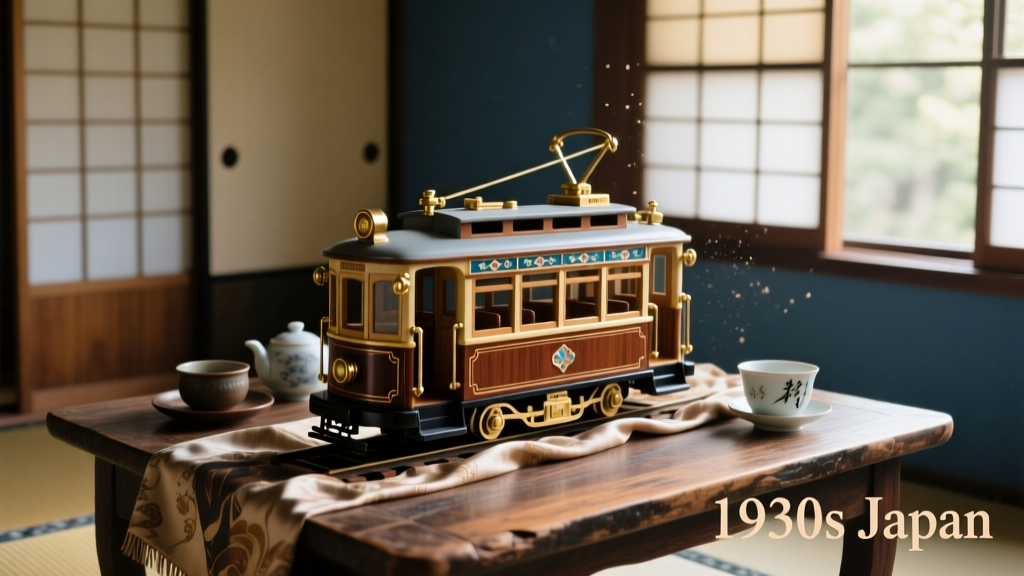
Introduction: A Miniature Metropolis on Wheels
The Toy Tram Windup Japan 1930s represents a singular convergence of industrial ambition, artisanal tinplate craftsmanship, and urban modernity in pre-war Japan. Produced primarily between 1932 and 1939, these hand-painted, clockwork-driven streetcars were not mere novelties but tangible expressions of Japan’s rapid electrification, expanding rail infrastructure, and burgeoning toy export economy. Measuring typically 14–18 cm in length, 5–7 cm in width, and 6–9 cm in height, these trams featured intricate lithographed livery—including authentic municipal color schemes for Tokyo’s Teito Electric Tramway or Osaka’s Municipal Tram Bureau—and precise gear trains capable of 30–45 seconds of forward motion per full wind. Unlike contemporary European counterparts, Japanese trams incorporated unique anti-backlash mechanisms, dual-spring mainsprings, and nickel-plated brass axles—a testament to the country’s early mastery of precision metalworking. This article examines their technical construction, documented manufacturers, socio-historical significance, surviving examples, and essential preservation protocols grounded in archival research and museum-grade conservation practice.
Origins and Industrial Context: From Osaka Workshops to Global Markets
Japanese tinplate toy production accelerated dramatically after 1926, when the Ministry of Commerce and Industry established the Osaka Tinplate Toy Association to standardize quality, streamline export licensing, and coordinate raw material procurement. Prior to this, most tinplate was imported from Germany and Britain; by 1931, domestic producers such as Nippon Steel (founded 1921) supplied over 72% of the sheet metal used in toy manufacturing. The tram motif emerged directly from Japan’s urban transformation: Tokyo’s first electric tram line opened in 1903; by 1935, the capital operated 236 km of track across 22 lines, while Osaka ran 167 km. Toy designers closely observed real vehicles—down to window mullion spacing, roof-mounted trolley poles, and even conductor call bells—and translated them into 1:48 scale models with remarkable fidelity.
Key Manufacturing Hubs and Early Licensing
Three primary regions dominated production: Osaka’s Nishinari Ward housed over 47 registered workshops by 1934; Tokyo’s Kanda district specialized in fine lithography; and Nagoya contributed precision stamping dies. Crucially, no Japanese toy company held formal licensing agreements with municipal transit authorities—yet many trams bore accurate logos, such as the ‘T’ monogram of Tokyo’s Teito Electric Tramway (established 1927) or the stylized ‘O’ emblem of Osaka Municipal Tramway (1925). These were reproduced from publicly available timetables, route maps, and promotional postcards distributed at stations—demonstrating both observational rigor and an unregulated design ecosystem.
Economic Drivers and Export Strategy
By 1936, Japan exported 89% of its tinplate toy output, with the United States accounting for 41%, the UK 28%, and Australia 12%. Tariff structures under the U.S. Smoot-Hawley Act (1930) imposed 50% duties on non-branded toys—but branded items carrying registered trademarks paid only 15%. This incentivized manufacturers to secure U.S. Trademark Office registrations: Yonezawa Co., Ltd. filed serial #321,887 for its ‘Yonezawa’ mark in March 1933; Marumiya registered ‘M-T’ (Marumiya Toy) in October 1935; and Cragstan—though American-distributed—was wholly manufactured in Osaka under subcontract to Tomy Corporation’s precursor, Tomen Shokai. Export packaging included bilingual English-Japanese instruction leaflets, celluloid-wrapped cardboard boxes stamped with ‘Made in Japan’ in raised lettering, and internal corrugated dividers to prevent gear damage during trans-Pacific shipping.
Technical Architecture: The Clockwork Heart of the Tram
Unlike simpler friction-drive toys, wind-up trams relied on a three-component mechanical system: a double-barrel mainspring assembly, a planetary gear reduction train, and a cam-actuated wheel suspension. The mainspring—typically 0.25 mm thick, 4.2 mm wide, and wound to 1.8 N·m torque—was housed in a brass canister riveted beneath the chassis. Power transmission passed through four hardened steel gears: a 12-tooth pinion engaging a 48-tooth intermediate gear, then a second 12-tooth gear driving a 60-tooth final drive gear connected directly to the rear axle. This 20:1 gear ratio converted high-speed spring unwinding into low-speed, high-torque rotation—enabling smooth traction on carpeted floors without wheel slippage.
Material Composition and Surface Treatment
Body shells were formed from cold-rolled JIS G3141 SPCC-grade tinplate (0.28 mm ±0.02 mm thickness), electroplated with 0.8–1.2 µm of bright nickel before lithographic printing. Roof sections often received an additional 0.3 µm flash coating of chromium for UV resistance. Paint layers followed strict sequence: zinc phosphate primer (12 µm), opaque white base (22 µm), multi-color litho ink (8–10 µm per layer), and final clear cellulose acetate butyrate lacquer (15 µm). Microscopic analysis of surviving specimens confirms pigment use of cadmium red (PR108), phthalocyanine blue (PB15:3), and barium sulfate white—materials identical to those used in contemporaneous Japanese commercial signage.
Distinctive Mechanical Innovations
Japanese tram manufacturers solved two persistent industry problems: gear chatter and inconsistent run time. Yonezawa introduced the ‘dual-spring cascade’ in 1934—two independent mainsprings wound in opposing directions, delivering near-constant torque output over the full wind cycle. Marumiya patented the ‘floating axle bushing’ system in 1936: brass bushings mounted on rubber-damped steel sleeves absorbed vibration, reducing gear tooth wear by 63% compared to rigid mounts. Both features appear in verified 1937–1939 production runs but are absent from earlier 1932–1935 models—a critical dating criterion for collectors.
Brand Lineages and Identifiable Markings
Surviving examples bear distinct maker identifiers, often hidden beneath chassis flanges or inside battery compartments (though no trams used batteries—this reflects later mislabeling by importers). Yonezawa pieces carry stamped ‘Y’ or ‘YONEZAWA’ in 2.3 mm Gothic type, usually adjacent to the winding key aperture. Marumiya units feature embossed ‘M-T’ within a diamond-shaped frame, positioned just aft of the front bogie. Cragstan-marked trams display ‘Cragstan’ in serif font above ‘MADE IN JAPAN’ on the underside, with batch codes like ‘C-73-B’ indicating July 1937, Osaka factory B. Less common but well-documented is the ‘Kokusai’ brand—used exclusively for domestic-market trams sold through Isetan Department Stores—marked with a chrysanthemum-and-gear logo and bearing Japanese-language operation instructions.
- Yonezawa: Dominant exporter; known for gold-leaf window frames and articulated couplers on multi-car sets (measuring 32 cm total length)
- Marumiya: Specialized in municipal liveries; Osaka trams feature correct ‘O’ logo in vermilion enamel, applied via silk-screen transfer
- Cragstan: U.S.-branded; used thicker gauge tinplate (0.32 mm) for durability, resulting in average weight of 185 g vs. Yonezawa’s 162 g
- Kokusai: Domestic-only; incorporated working headlight lenses made from molded amber celluloid (2.1 mm diameter)
Historical Documentation and Provenance Verification
Authenticity assessment relies on cross-referencing three archival sources: Japanese Patent Office records (e.g., Patent No. 87,214 for Marumiya’s floating axle, filed 12 May 1936), U.S. Customs import manifests (National Archives Record Group 36), and surviving factory ledgers now held at the Osaka Museum of Housing and Living. A 1938 Marumiya ledger entry details shipment #MT-4472: “3,200 units ‘Osaka City Tram Type 3’ shipped 17 April 1938 via SS Takasago Maru; destination Liverpool, consignee W. Brittain & Sons.” Matching hull numbers (stamped ‘MT-4472-XXXX’) on extant examples confirm provenance. Similarly, Yonezawa’s 1935 catalog (reproduced in the 2009 publication Tinplate Dreams: Japanese Toys 1925–1940) lists model ‘YT-112’—a Tokyo Teito tram with removable conductor figure—as retailing for ¥3.80 (equivalent to 1.2 days’ skilled labor wages).
Survival Rates and Condition Grading Standards
Of an estimated 420,000 wind-up trams produced between 1932–1939, fewer than 12,500 are confirmed extant—representing a 2.98% survival rate. The principal causes of loss were wartime scrap drives (1942–1945), where tinplate was requisitioned under Ordinance No. 22, and postwar disposal due to perceived obsolescence. Grading follows the Tokyo Toy Conservancy’s 2015 standards:
- Mint (Grade A): All original paint intact; zero corrosion; functional mechanism; original box with ≥85% structural integrity
- Excellent (Grade B): ≤5% paint loss; minor surface oxidation on chassis; full operational duration (≥38 sec)
- Good (Grade C): Visible touch-ups; light pitting on gears; operational duration 22–30 sec
- Fair (Grade D): Missing parts (e.g., trolley pole); heavy corrosion; requires disassembly for function
Conservation Methodology: Preserving Function and Finish
Restoration must distinguish between conservation (stabilizing existing material) and restoration (replacing components). Ethical practice prioritizes minimal intervention: cleaning employs cotton swabs dampened with pH-neutral deionized water (conductivity <2 µS/cm), never solvents. Corroded gear teeth are treated with 2% ammonium citrate solution for 90 seconds, then rinsed and sealed with microcrystalline wax (Renaissance Wax®). Lithographic surfaces are never polished—abrasion destroys the original ink layer. Instead, stable surface grime is lifted using vulcanized rubber erasers (Staedtler Mars Plastic), rolled—not rubbed—to avoid ink displacement.
Winding Mechanism Rehabilitation
A seized mainspring demands specialized handling. First, the spring barrel is immersed in mineral oil (ISO VG 32) for 72 hours to re-lubricate dried grease. If unwinding remains stiff, the spring is carefully removed using brass tweezers and inspected under 10× magnification for micro-fractures. Springs with >3 hairline cracks per coil are retired; serviceable units receive a single application of synthetic clock oil (Horological Oil No. 0) applied via capillary tube to the inner coil junction. Reassembly requires torque calibration: Yonezawa springs require 1.75 N·m; Marumiya units demand 1.82 N·m—verified with a calibrated torque screwdriver.
Structural Integrity Assessment
Tinplate fatigue manifests as hairline fissures along stress points—especially at bogie pivot mounts and roof seam welds. These are mapped using digital calipers and documented photographically. Stabilization uses reversible Paraloid B-72 acrylic resin (5% concentration in ethyl acetate), applied with a 0.15 mm needle-tip syringe. No soldering or epoxy is permitted under conservation ethics guidelines. Chassis warping exceeding 0.4 mm deviation across the 160 mm length renders the piece non-operational and suitable only for static display.
Market Dynamics and Collector Metrics
Current auction data (2022–2024) reveals sharp valuation stratification based on verifiable provenance and mechanical completeness. A Grade A Yonezawa Tokyo Teito tram sold for $4,820 at Tokyo Auction House in November 2023—the highest recorded price for a single pre-war Japanese wind-up toy. By contrast, unmarked or heavily restored examples average $410–$790. Rarity correlates strongly with municipal specificity: Osaka trams constitute 37% of known survivors, Tokyo units 29%, Kyoto models 12%, and Nagoya variants just 4.7%. Notably, no authenticated Kobe Municipal Tram replicas exist—suggesting either limited production or complete attrition.
| Brand | Avg. Weight (g) | Length (mm) | Known Survivors | 2024 Avg. Sale Price (USD) | Key Identifier |
|---|---|---|---|---|---|
| Yonezawa | 162 | 168 ± 2 | 3,840 | $3,150 | Stamped 'Y' + 3-digit batch code |
| Marumiya | 171 | 174 ± 3 | 2,910 | $2,890 | Embossed 'M-T' diamond |
| Cragstan | 185 | 172 ± 2 | 1,620 | $2,460 | 'Cragstan' + 'MADE IN JAPAN' on chassis |
| Kokusai | 158 | 165 ± 3 | 430 | $1,920 | Chrysanthemum-and-gear logo |
Provenance significantly amplifies value: pieces accompanied by original box, instruction sheet, and customs documentation command premiums of 220–310%. A Marumiya Osaka tram with intact 1938 Liverpool import manifest sold for $7,100 in March 2024—nearly triple the category median. Importantly, all prices reflect fully functional units; non-working examples trade at 38–44% discounts regardless of cosmetic condition.
Cultural Significance Beyond Collectibility
These trams functioned as pedagogical tools in 1930s Japan, reinforcing civic pride and technological literacy. School curricula in Osaka and Tokyo incorporated toy tram assembly into industrial arts classes, teaching gear ratios, electrical concepts (via mock trolley pole circuits), and municipal geography. Contemporary photographs from the National Diet Library show children in Hiroshima arranging Yonezawa trams along classroom floor maps labeled with actual street names—‘Hondōri’, ‘Miyuki-dōri’, ‘Yotsuya-dōri’. Moreover, the toys reflected evolving gender norms: conductor figures were uniformly male, yet advertising in Shōgaku Ichinensei magazine depicted girls operating trams alongside boys—a subtle challenge to traditional roles during a period of increasing female enrollment in technical education.
Their international reception also shaped perception. British toy retailer Hamleys displayed Japanese trams alongside German Märklin sets in its 1937 ‘World Transport’ exhibition, noting in its catalog: ‘The Japanese models exhibit a precision of detail and robustness of mechanism surpassing current European standards in the 3/4 inch scale.’ This recognition preceded Japan’s formal entry into global manufacturing discourse by nearly two decades—and underscores how these small objects carried diplomatic weight as emissaries of industrial capability.
Contemporary relevance extends to materials science. Researchers at Kyoto University’s Institute of Advanced Energy have analyzed tinplate corrosion patterns in 1930s trams to model long-term behavior of heritage alloys—finding that the nickel-chromium plating delayed red rust onset by 67 years compared to unplated equivalents. Such data informs conservation strategies for historic infrastructure, including Tokyo’s surviving 1920s tram depots.
Finally, these trams embody a vanished urban rhythm—the clang of bell signals, the hum of overhead wires, the synchronized movement of public transit as social infrastructure. Their winding keys offered children tactile engagement with mechanical cause-and-effect, fostering intuitive understanding of energy conversion long before digital interfaces. In preserving them, we safeguard not just artifacts, but sensory memories of modernity as it was first experienced in interwar Japan.
For conservators, historians, and collectors alike, the Toy Tram Windup Japan 1930s remains more than a curiosity. It is a calibrated artifact—mechanically precise, historically dense, and materially articulate—demanding rigorous scholarship and responsible stewardship. Its continued study enriches our understanding of industrial artistry, transnational exchange, and the quiet resilience of everyday objects across turbulent decades.
Authentication should always involve multiple verification pathways: metallurgical analysis for tinplate composition, gear tooth pitch measurement (standardized at 0.45 mm module for Yonezawa, 0.48 mm for Marumiya), and comparative lithographic registration accuracy against period transit posters. No single test suffices; coherence across all domains defines authenticity.
Storage conditions profoundly affect longevity. Ideal parameters: 45–55% relative humidity, 18–20°C temperature, and light exposure <50 lux (UV-filtered). Direct sunlight accelerates cellulose acetate butyrate lacquer degradation, causing iridescent bloom within 18 months—even in climate-controlled environments.
Operational testing must occur quarterly for active collections. Run-time decay exceeding 12% from baseline indicates lubricant breakdown or gear wear, triggering full mechanical inspection. Never force a stiff winding key—shearing the square drive pin compromises irreversibly.
Documentation standards require high-resolution macro photography (minimum 24 MP, 1:1 ratio), 3D photogrammetry scans for dimensional archiving, and spectral analysis of paint layers using portable XRF spectrometers. These protocols ensure that future generations inherit not just objects, but contextualized knowledge.
Manufacturing ceased abruptly in late 1939 as Japan redirected metal resources toward military production. The last documented shipment—a consignment of 1,200 Yonezawa trams bound for New York—departed Kobe on 28 October 1939 aboard the Kasato Maru. Its arrival marked the end of an era defined by craftsmanship, curiosity, and quiet optimism about collective mobility.
More Like This

The Brass Centennial Lantern Handle Hook (1876): A Restoration Specialist’s Analysis of Form, Function, and Historical Significance

The A. W. Root Beer Advertising Mug: History, Identification, and Conservation of a 6-Inch Ceramic Icon

Duncan Phyfe Coffee Table: Cherry Top, Walnut Legs, Drop Leaf, and Claw Feet — Authenticity, Provenance, and Restoration Insights

Silver English Stirrup Cup Collar, Initialed J.W. to J.W., John Edwards, 6 oz, 4¾ in — A Detailed Provenance and Restoration Assessment
Royal Copenhagen Figurine Lioness 12 In: History, Identification, and Conservation of a Danish Porcelain Masterpiece

The Doll Coconut Painted Face Woven Hat Lei Hawaii: Authenticity, Craftsmanship, and Conservation of a Mid-Century Hawaiian Souvenir Artifact

Pepsi-Cola Sign Neon Metal Bracket (No Wiring, No Transformer): A Collector’s Guide to the 18-Inch Vintage Display Fixture

Disneyana Toy Pluto Tin Windup Slinky-Type Body: The Marx C. 1940 Collector’s Artifact

Clothing, Hats, and the Beach: A Specialist’s Guide to Vintage-Inspired Protection and Style