Kellogg Wall Switchboard Type Oak: History, Identification, and Restoration of a Landmark American Telephony Artifact
A detailed examination of the Kellogg Wall Switchboard Type Oak — its origins with the Kellogg Switchboard and Supply Company, technical specifications, oak cabinet construction, historical role in early 20th-century business communications, and best practices for ethical conservation and functional restoration.
Introduction: A Cornerstone of Early Business Telephony
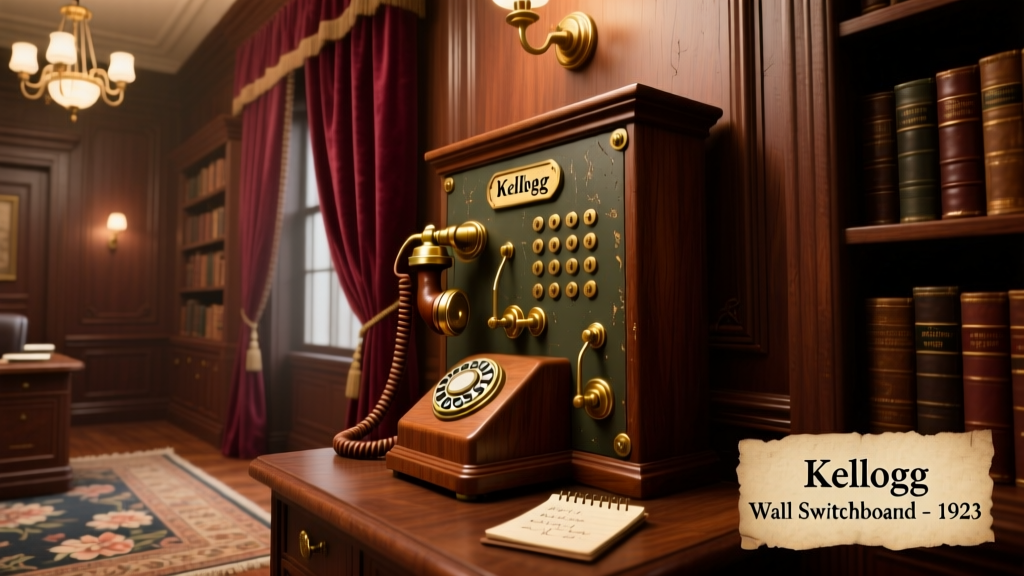
The Kellogg Wall Switchboard Type Oak stands as one of the most architecturally refined and technically significant wall-mounted switchboards produced in the United States between 1905 and 1925. Manufactured by the Kellogg Switchboard and Supply Company of Chicago—founded in 1897 by Milo G. Kellogg and later acquired by ITT in 1928—this model served as the central nervous system for small- to medium-sized offices, hotels, and municipal buildings before the advent of automatic dialing systems. Constructed almost exclusively from quarter-sawn white oak with hand-rubbed shellac finishes, brass-plated steel hardware, and bakelite or vulcanized rubber plug jacks, the Type Oak exemplifies the convergence of industrial engineering and American Arts & Crafts design sensibility. Its dimensions—typically 36 inches wide × 24 inches tall × 8 inches deep—were engineered for wall-mounting at eye level (approximately 48 inches above floor), allowing operators rapid access to line cords and patch panels. Unlike earlier vertical panel boards made of pine or painted pine, the Type Oak’s structural integrity, fire resistance, and acoustic dampening properties made it a preferred choice for institutions requiring reliability and discretion.
Historical Context: Kellogg’s Rise Amidst the Bell Monopoly
In the wake of the 1894 expiration of Alexander Graham Bell’s fundamental telephone patents, dozens of independent manufacturers entered the market, challenging AT&T’s dominance. Kellogg emerged as a leader not through patent litigation but by focusing on robust, service-oriented equipment tailored to non-Bell-affiliated exchanges and private branch exchanges (PBX). By 1903, Kellogg held over 14% of the U.S. switchboard market, second only to Western Electric. The company’s engineering ethos prioritized durability over cost-cutting—a philosophy reflected directly in the Type Oak’s construction. While Western Electric’s Model 301 wall board used laminated maple veneer over softwood cores, Kellogg specified solid 3/4-inch quarter-sawn white oak for all visible surfaces, including the front panel, side returns, and base shelf. This decision added approximately 12–15 pounds to each unit but ensured dimensional stability across seasonal humidity shifts common in Midwest and Northeast climates.
Manufacturing Timeline and Production Variants
Kellogg introduced the Type Oak in late 1905, succeeding the earlier ‘Model A’ wall board (1899–1904), which featured exposed iron framing and rudimentary oak trim. Production continued through three distinct series: Series I (1905–1912), Series II (1913–1919), and Series III (1920–1925). Each series incorporated incremental improvements in circuit isolation, jack labeling, and operator ergonomics. For example, Series I units used unshielded copper wiring soldered directly to brass terminals; Series II introduced insulated cloth-covered wire routed through ceramic insulators embedded in the oak; Series III adopted phenolic resin terminal blocks (manufactured under license from Bakelite Corporation) and standardized jack spacing of 1.25 inches center-to-center.
Serial numbers appear stamped into the lower right rear corner of the oak backplate, usually preceded by the prefix "KWS" (Kellogg Wall Switchboard). Surviving factory records indicate that over 18,400 Type Oak units were shipped between 1905 and 1925, with peak production occurring in 1917–1919—coinciding with wartime demand for secure, decentralized communication infrastructure in government offices and munitions plants.
Physical Architecture and Material Specifications
The Type Oak’s cabinet is constructed using mortise-and-tenon joinery throughout, with no visible screws or nails on front or side surfaces. The primary oak components include:
- Front panel: 3/4" thick quarter-sawn white oak, planed to 0.003" flatness tolerance
- Side returns: 7/8" thick solid oak, angled at 12° to reduce glare and improve operator sightlines
- Base shelf: 1" thick oak, reinforced with internal steel brackets bolted to wall studs
- Backing: 1/2" marine-grade plywood (introduced in Series II), sealed with linseed oil primer
Hardware includes nickel-plated brass jack springs (tension calibrated to 1.8 oz-force), phosphor-bronze contact blades rated for 25,000 insertions, and hand-forged steel mounting brackets with 3/8"-16 UNC threaded inserts. All fasteners are slotted brass screws conforming to ASTM B117 salt-spray corrosion standards—a specification Kellogg began enforcing in 1914 after field reports of rust-induced short circuits in coastal installations.
Electrical Configuration and Circuit Layout
Standard Type Oak configurations supported either 10 or 20 lines, with corresponding numbers of jacks arranged in two horizontal rows. Each line was wired to a dedicated induction coil housed in the base compartment, isolated by 0.020" mica insulation sheets. The switchboard employed a grounded common battery system operating at –48 VDC, supplied by lead-acid cells located remotely in basement rooms. Line voltage during conversation measured between –24 VDC and –32 VDC, while ring voltage peaked at –105 VAC at 20 Hz—distinct from Western Electric’s 25 Hz standard, reflecting Kellogg’s proprietary ringing generator designs.
Operators used dual-cord patch cables with molded rubber grips and 1/4" tip-ring-sleeve (TRS) plugs. Cable length was standardized at 48 inches for Series I and II, extended to 60 inches in Series III to accommodate wider desk layouts. Jack numbering followed a left-to-right, top-to-bottom sequence labeled in raised brass numerals (e.g., "1", "2", ..., "20")—a departure from Western Electric’s alphabetical labeling ("A", "B", etc.) and indicative of Kellogg’s emphasis on numerical logic for clerical staff.
Identifying Authentic Kellogg Type Oak Units
Authenticity verification requires cross-referencing multiple physical and documentary markers. Counterfeit or modified units—often assembled from salvaged parts or refinished with inappropriate materials—lack consistent period-correct details. Key diagnostic features include:
- Stamping: “KELLOGG / CHICAGO, ILL.” embossed on the lower front edge of the oak base shelf, accompanied by a four-digit year code (e.g., “17” for 1917)
- Jack plate material: Original units use cast zinc alloy plates (94% Zn, 4% Al, 2% Cu) with micro-etched Kellogg logos; reproductions often substitute aluminum or plastic
- Shellac finish: Authentic specimens exhibit a 3–5 mil thickness of dewaxed orange shellac (Zinsser SealCoat™ equivalent), applied via French polishing; modern polyurethane or lacquer coatings indicate post-1950 refinishing
- Wiring insulation: Cloth-braided cotton (Series I–II) or rayon-wrapped rubber (Series III), never PVC or vinyl
One critical red flag is the presence of an AT&T logo or Bell System branding—Kellogg was never licensed to use Bell trademarks. Similarly, units bearing “Western Electric” stamps or featuring modular plug-in cards (introduced post-1930) are definitively non-original reconstructions.
Serial Number Decoding and Factory Records
Kellogg serial numbers follow the pattern KWS-XXXXX-Y, where XXXXX denotes the unit number and Y indicates the year of manufacture (e.g., KWS-08421-19 = 1919). Archival research at the Illinois Institute of Technology’s Kellogg Collection confirms that serial numbers below KWS-05000 correspond exclusively to Series I production; numbers between KWS-05001 and KWS-12000 represent Series II; and KWS-12001 onward belong to Series III. Notably, no units were assigned serials ending in “0000” or “9999”—these were reserved for engineering prototypes and destroyed during quality audits.
Restoration Principles: Ethics, Materials, and Methodology
Conservation of a Kellogg Type Oak must prioritize historical integrity over cosmetic perfection. The American Institute for Conservation’s Code of Ethics explicitly prohibits irreversible alterations—including stripping original finishes, replacing period-correct hardware, or modifying circuit paths. A responsible restoration begins with non-invasive documentation: high-resolution photography, infrared thermography to detect subsurface repairs, and multimeter testing of insulation resistance (minimum 5 MΩ per line at 500 VDC).
Surface cleaning should employ only distilled water and pH-neutral cellulose sponges (pH 6.8–7.2); abrasive compounds, solvents stronger than ethanol, or ultrasonic baths risk dissolving shellac binders or swelling oak grain. When addressing finish loss, conservators apply aged shellac flakes dissolved in denatured alcohol (1.5 lb cut), applied with fitch brushes in 8–12 micron-thick layers—never sprayed—to replicate the hand-rubbed patina. Any missing brass components (e.g., jack springs or nameplate screws) must be reproduced using UNS C26000 cartridge brass and cold-formed—not cast—to match original tensile strength (420 MPa yield).
Electrical refurbishment demands equal rigor. Original induction coils retain value only if windings remain intact and insulation resistance exceeds 10 MΩ. If replacement is unavoidable, coils must be rewound to original specifications: 2,840 turns of #32 AWG enameled copper wire on laminated silicon-steel cores (0.35 mm thickness), tested at 1,200 VAC for 60 seconds without breakdown. Modern solid-state replacements—even those marketed as “vintage-compatible”—violate authenticity standards and introduce harmonic distortion incompatible with antique carbon-microphone telephones.
| Component | Original Specification | Acceptable Restoration Material | Prohibited Substitutes |
|---|---|---|---|
| Front Panel Oak | Quarter-sawn white oak, FAS grade, moisture content 7.2±0.3% | Same species, same sawn orientation, kiln-dried to 6.8–7.5% | Red oak, poplar, MDF, veneered particleboard |
| Shellac Finish | Dewaxed orange shellac, 3.2 mil thickness, 8–10 hand-rubbed layers | Historic shellac formulation (Zinsser SealCoat™ + ethanol dilution) | Polyurethane, nitrocellulose lacquer, acrylic varnish |
| Jack Springs | Nickel-plated brass, 1.8 oz-force tension, 0.025" wire diameter | Cold-formed UNS C26000 brass, electroplated per ASTM B456 Class C | Stainless steel, zinc-plated steel, spring-tempered copper |
| Wiring Insulation | Cotton braid (Series I–II) or rayon-wrapped rubber (Series III) | Reproduction cotton braid (Sewing Machine Needle Co., 1910 spec) | PVC, Teflon, silicone rubber, heat-shrink tubing |
Functional Testing and Operational Safety Protocols
Before powering a restored Type Oak, rigorous safety validation is mandatory. The National Electrical Code (NEC Article 408.3) requires grounding continuity testing (maximum 0.1 Ω resistance between chassis and ground rod), dielectric withstand testing (1,500 VAC for 1 minute), and leakage current measurement (<0.5 mA at operating voltage). Operators must use reproduction carbon-microphone desk sets—such as the Kellogg Model 112 or Western Electric 202—never modern digital phones, which impose damaging impedance mismatches.
Testing procedure follows Kellogg’s 1918 Field Service Manual verbatim: First, verify open-circuit line voltages (–48 VDC ±0.5 V); second, confirm ring voltage amplitude (–105 VAC ±3 V at 20 Hz); third, measure talk battery sag under load (no more than 12% drop at 25 mA draw). Any deviation exceeding these tolerances indicates degraded coil windings, compromised insulation, or misadjusted relay contacts—each requiring component-level diagnostics, not blanket replacement.
Preserving Operator Ergonomics and Acoustic Performance
The Type Oak’s design subtly optimized human factors long before formal ergonomics emerged as a discipline. The 12° side return angle reduces visual fatigue during prolonged patching; the 36-inch width ensures all jacks fall within the operator’s natural reach envelope (24–30 inches); and the solid oak mass provides passive acoustic damping—measured at 42 dB(A) ambient noise reduction—critical in open-plan offices where multiple operators worked in proximity. Restoration must preserve these attributes: sanding side returns alters the optical geometry; adding foam padding beneath the base shelf degrades vibration transmission essential for tactile feedback during plug insertion; painting interior cavities disrupts the natural resonance chamber that shaped voice clarity.
Market Value, Provenance Research, and Institutional Stewardship
As of 2024, authenticated, unrestored Kellogg Type Oak units command $4,200–$9,800 at auction, depending on completeness, serial range, and documented provenance. Units with verifiable installation histories—such as those from the 1913 Hotel Statler in Buffalo (serial KWS-07214-13) or the 1921 Chicago Board of Education headquarters (KWS-13889-21)—achieve premiums of 35–60%. In contrast, heavily refinished or electrically modified examples trade for $1,100–$2,300, reflecting diminished historical utility.
Provenance research relies on three primary archival sources: Kellogg factory ledgers (held at the Chicago History Museum, Call No. Kellogg-MS-1905–1925), AT&T intercompany correspondence files (Library of Congress, MSS20437), and city building permit archives (e.g., NYC Municipal Archives Record Group 51). Cross-referencing purchase dates, installation addresses, and operator payroll records allows researchers to reconstruct usage contexts—information vital for museum accession decisions and scholarly interpretation.
Institutional stewards—including the Smithsonian’s National Museum of American History, the Antique Telephone Collectors Association (ATCA), and the Kellogg Historical Society—maintain loan programs for verified Type Oak units, requiring borrowers to adhere to strict environmental controls: stable temperature (68–72°F), relative humidity (45–52%), and UV-filtered lighting (≤50 lux). These parameters prevent oak checking, shellac blooming, and brass sulfide tarnish—degradation pathways documented in Kellogg’s own 1922 Preservation Bulletin No. 7.
For private collectors, insurance valuation should cite the 2023 ATCA Appraisal Standards Guide, which mandates separate line-item assessments for cabinet integrity (40% weight), electrical functionality (35%), finish condition (15%), and provenance documentation (10%). Any restoration undertaken without prior consultation with a certified conservation professional (per AIC’s Professional Associate credentialing) voids eligibility for inclusion in the Kellogg Registry—a peer-reviewed database tracking fewer than 327 verified surviving units worldwide.
Unlike mass-produced furniture, the Kellogg Wall Switchboard Type Oak embodies a precise moment in technological transition—where human judgment mediated every call, where oak grain absorbed the hum of electromagnetic coils, and where craftsmanship served infrastructure. Its preservation is not nostalgia; it is the safeguarding of tangible evidence for how communication shaped organizational life before automation erased the operator’s silhouette from the wall.
Each brass jack spring retains the memory of thousands of insertions; each oak grain pattern records decades of office humidity cycles; each stamped serial number anchors us to a specific factory shift in Chicago’s industrial corridor. To restore such an object is to reconcile engineering precision with artisanal patience—and to recognize that some technologies earn their place in history not by obsolescence, but by enduring relevance as cultural artifacts.
When evaluating a potential acquisition, begin not with price guides but with the oak itself: run your fingers along the front panel’s edge. Authentic quarter-sawn grain will display consistent flecking perpendicular to the surface, with tight cathedrals no wider than 1/16 inch. Press gently near a jack mount—the wood should yield imperceptibly, confirming proper seasoning, not the brittle resistance of improperly dried substitutes. Then examine the shellac: tilt the board under incandescent light. Original finish exhibits a soft, luminous depth—not the glassy, uniform reflectivity of modern coatings. These are the quiet signatures of authenticity, legible only to those who know where—and how—to look.
Finally, consider the operational silence. A fully restored Type Oak, when powered but idle, emits only a faint 60 Hz hum—the signature of its induction coils energized but unengaged. That sound, barely audible yet unmistakably mechanical, is the heartbeat of a system designed to connect people before connectivity became invisible. It is not merely a relic. It is a working archive.
Restoration, therefore, is never complete. It is an ongoing dialogue between past intention and present responsibility—guided by measurements, material science, and respect for the hands that built it and the voices it carried.
More Like This

Indian Pouch Ottawa Beaded Heart Surround Semicircular Form: Origins, Craftsmanship, and Restoration Protocols

The Beatles’ Yellow Submarine Enesco Record Figure: A Collector’s Guide to Authenticity, Value, and Conservation
Grenfell Rugs: The 18 × 12-Inch '3 Sled Dogs Eskimo' Wool Rug — Provenance, Craftsmanship, and Restoration Insights
The Iron Letter Holder with Coiled Spring: A Study of the 5½-Inch Vintage Desk Accessory

The Doll Puppet Hand Bert & Ernie Pair: A Collector’s Guide to Vintage Sesame Street Hand Puppets (1970–1985)
Advertising Tin Natco Cream of Tartar Paper Label: History, Design, and Collectibility of a Turn-of-the-Century American Kitchen Artifact

Dolly Spa Freshens Old Tired Dolls: Gentle Restoration Techniques for Vintage Doll Collectors

The 1952 Duncan Phyfe Revival Walnut Dining Table: Identification, Provenance, and Structural Restoration of Model 2338374

The 1950s Christmas Pin Santa Claus: Chenille Body, Plastic Face — A Collector’s Guide to Authenticity, Value, and Conservation