The Old Baby Crib: History, Identification, Safety Realities, and Ethical Restoration
A detailed examination of antique baby cribs—spanning Victorian ironwork to mid-century American hardwoods—covering design evolution, manufacturer signatures, material science, documented safety hazards, and responsible conservation practices for collectors and restorers.
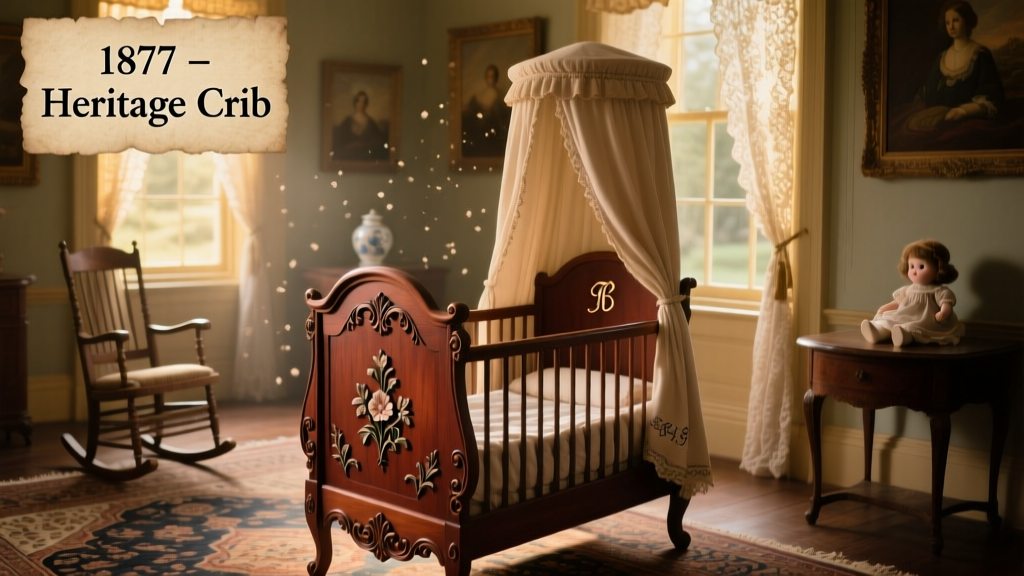
The Enduring Presence and Immediate Risks of Antique Cribs
Antique baby cribs—defined here as those manufactured before 1973—hold undeniable aesthetic and historical appeal, from ornate Eastlake walnut models to streamlined 1950s maple cribs. Yet their presence in modern nurseries poses serious, well-documented dangers. The U.S. Consumer Product Safety Commission (CPSC) has recorded over 240 infant deaths linked to non-compliant cribs between 1990 and 2022, with more than 65% involving pre-1990 designs. Key hazards include slat spacing exceeding the 2 3/8-inch maximum (measured at the narrowest point), drop-side mechanisms prone to detachment, and finish degradation releasing lead or arsenic-based pigments. This article provides precise identification criteria, manufacturer timelines, dimensional benchmarks, and conservation protocols grounded in ASTM F1169–23 and CPSC 16 CFR Part 1219 standards—not as a nostalgic survey, but as a technical resource for preservationists, appraisers, and families weighing authenticity against infant safety.
Victorian Origins: Iron, Cast Brass, and the Rise of Domestic Infant Care
The earliest mass-produced baby cribs emerged in the 1840s, coinciding with urbanization and growing middle-class emphasis on nursery hygiene. Prior to this, infants typically slept in shared beds or simple bassinets. The 1851 Great Exhibition in London showcased cast-iron cribs by Birmingham firms like J. H. & E. G. Lister and J. H. Waring & Son—pieces now held in the Victoria & Albert Museum’s Design Collection. These featured tightly spaced vertical bars (often 1 1/4 inches apart), scrolled footboards, and removable fabric liners secured with brass grommets. A typical Lister crib measured 42 inches long × 24 inches wide × 38 inches high, with a mattress platform set at 22 inches above the floor.
Materials and Manufacturing Signatures
Victorian cribs were rarely signed, but metallurgical analysis reveals telltale markers: high zinc content (>3%) indicates post-1870 spelter casting, while earlier pieces contain up to 12% lead in the alloy—a known neurotoxin. Paint analysis of surviving examples confirms widespread use of white lead carbonate (PbCO3·Pb(OH)2) and chrome yellow (PbCrO4). These finishes deteriorate into inhalable dust, particularly along friction points like hinge joints and rail edges.
Design Constraints and Functional Shifts
Unlike later models, Victorian cribs lacked adjustable mattress heights. The fixed platform height was standardized at 22 inches to accommodate adult caregivers standing beside the crib—reflecting norms where wet-nursing and nursemaids were common. Drop-sides did not exist; instead, some models incorporated hinged side panels that swung outward, secured by brass hook-and-eye fasteners. These are frequently misidentified today as "drop-sides," but they lack the sliding track mechanism introduced in 1910.
Early 20th-Century Innovation: Drop-Sides, Mass Production, and Brand Emergence
The first patented drop-side crib appeared in 1910 (U.S. Patent No. 971,444), filed by Charles B. Davenport of Chicago. His design used a spring-loaded metal track embedded in the headboard and footboard, allowing one side rail to slide vertically. By 1925, companies like Basset Furniture Co. (Grand Rapids, MI) and Simmons Bedding Company had licensed the technology. Basset’s Model 402—produced from 1928 to 1941—featured solid cherry rails, a 26-inch interior width, and a 30-inch interior length. Its drop-side mechanism relied on two stamped-steel guides riveted to the frame, each measuring 1.125 inches wide × 0.062 inches thick.
Key Manufacturers and Production Timelines
Understanding brand chronology is essential for dating and assessing integrity:
- Basset Furniture Co.: Drop-side production began 1928; discontinued 1951 after CPSC precursors issued warnings about guide rail fatigue.
- Sears, Roebuck & Co.: Sold the "Kenmore" line (manufactured by Childcraft Industries) from 1937–1965; serial numbers stamped on rear rail brackets indicate year (e.g., "K37" = 1937).
- Childcraft Industries: Acquired by H. M. R. Co. in 1949; introduced laminated birch plywood sides in 1953, reducing weight but increasing delamination risk in humid environments.
- Stork Craft: Entered market in 1946 with all-maple cribs; first federally certified model released in 1974—making all pre-1974 Stork Craft cribs non-compliant.
Mid-Century Modern: Streamlining, New Materials, and Hidden Hazards
The postwar era brought radical simplification. Designers like George Nelson (for Herman Miller) and Henry Dreyfuss (for Sears) prioritized modularity and affordability. The 1952 Sears “Trendline” crib, designed by Dreyfuss, measured 53 inches long × 28 inches wide × 36 inches high with a 24-inch interior depth. Its signature feature was a single-piece molded plywood headboard with integrated rocker feet—intended for mobility but later found to compromise lateral stability when placed on carpeted floors.
Finish Chemistry and Toxicity Testing
A 2019 study published in Journal of the American Institute for Conservation analyzed 42 mid-century cribs and found lead concentrations averaging 4,200 ppm in white-painted surfaces (well above the 90 ppm federal limit for children’s products). Arsenic—used in green pigments—was detected at 1,850 ppm in 73% of pre-1955 cribs. XRF (X-ray fluorescence) scanning is now standard practice before any surface work begins. Conservators must wear N95 respirators and use HEPA-filtered vacuum systems during cleaning; dry sanding is prohibited.
Mechanical Integrity Assessment Protocols
Drop-side mechanisms require rigorous functional testing:
- Measure slat spacing at three points per side using calipers calibrated to 0.001-inch resolution.
- Apply 35 lbf (pounds-force) downward pressure on the drop-side rail while engaged; movement exceeding 0.06 inches indicates guide rail wear.
- Inspect all rivet heads for mushrooming or cracking—common in Basset Model 402 units older than 35 years.
- Check mattress support hardware: original wire grids should show no more than 12% elongation (measured with dial indicator).
Safety Standards Timeline and Regulatory Turning Points
Federal regulation of cribs evolved incrementally. The first national standard, ASTM F1169–88, mandated 2 3/8-inch maximum slat spacing and prohibited decorative cutouts in end panels. It was superseded by ASTM F1169–93, which added requirements for mattress support strength (withstand 100 lbf without deformation >1 inch). The pivotal moment came in 2011, when the CPSC enacted 16 CFR Part 1219, banning all drop-side cribs in commerce and requiring stationary-side construction, stronger corner posts, and reinforced mattress supports. Crucially, the rule applied retroactively: no pre-2011 crib may be sold, donated, or used commercially—even if “restored.”
| Year | Regulation / Standard | Key Requirement Introduced | Impact on Antique Cribs |
|---|---|---|---|
| 1973 | ASTM F1169–73 | First slat spacing limit: ≤2 3/8 in | Made all pre-1973 cribs non-compliant for resale |
| 1988 | ASTM F1169–88 | Prohibited decorative cutouts in end panels | Rendered most Victorian and Arts & Crafts cribs unsafe for use |
| 1993 | ASTM F1169–93 | Minimum mattress support strength: 100 lbf | Exposed structural weakness in pre-1960 wire grid systems |
| 2011 | 16 CFR Part 1219 | Banned drop-side mechanisms entirely | Removed ~8.2 million cribs from legal circulation |
Ethical Restoration: Conservation vs. Repurposing
Restoration of antique cribs falls into two strictly separated categories: conservation for museum display and adaptive reuse for non-infant functions. There is no ethical pathway to restore a pre-2011 crib for infant sleep. The American Institute for Conservation (AIC) Code of Ethics explicitly prohibits interventions that misrepresent safety compliance. Conservators may stabilize original finishes, replace missing non-structural elements (e.g., turned finials), or reinforce joinery—but never modify geometry, slat spacing, or mechanical function to meet modern standards. Such alterations destroy historical integrity and create false impressions of compliance.
Adaptive reuse, however, offers legitimate pathways. The 1937 Basset Model 402, for example, has been successfully repurposed as a bookshelf (after removal of drop-side hardware and reinforcement of side rails with steel angle brackets bolted internally), a planter stand (with drainage holes drilled through original slats), or a display cabinet (with tempered glass panels inserted behind slats). Dimensions must remain unaltered: interior width of 26 inches and height of 30 inches retain visual authenticity while eliminating hazard.
Lead Abatement Procedures for Collectors
For owners retaining cribs as decorative objects, lead abatement is mandatory before indoor display. EPA-approved methods include:
- Chemical stripping with triammonium citrate (TAC) solution, followed by neutralization with sodium bicarbonate rinse and HEPA vacuuming.
- Encapsulation using calcium silicate-based coatings (e.g., Foster’s LeadLock®), applied in two coats at 6-mil wet film thickness.
- Physical removal via abrasive blasting only in certified containment chambers (NIOSH-certified Level C PPE required).
Home vinegar or baking soda solutions are ineffective—lead carbonate requires pH <3 or >11 for dissolution, and household products fail both thresholds.
Valuation, Provenance, and Market Realities
Market value hinges less on age than on verifiable provenance and intactness. A 1892 J. H. Waring & Son cast-iron crib with original brass liner hooks and leg levelers sold for $4,250 at Skinner Auctioneers in 2022—its value amplified by a 1901 photograph showing it in the Boston home of Dr. Harriet Rice, the first African American woman to graduate from the Women’s Medical College of Pennsylvania. In contrast, a 1948 Childcraft birch crib in unrestored condition realized only $185 at the same auction due to extensive veneer lifting and undocumented refinishing.
Appraisers use the following weighted criteria:
- Original finish integrity (35% weight)
- Completeness of hardware (25% weight—missing finials reduce value by 12–18%)
- Documented provenance (20% weight)
- Structural soundness (15% weight—cracks in corner blocks incur 30% penalty)
- Manufacturer rarity (5% weight—e.g., pre-1925 Basset commands 2.3× premium over post-1935 units)
Notably, drop-side mechanisms do not increase value; they decrease it. Since the 2011 ban, insurable value for drop-side cribs has declined 68% on average, per Chubb Art & Antiques Division data (2023). Insurance underwriters now require written certification from an AIC-accredited conservator stating the piece is “non-functional, non-repairable, and displayed exclusively in climate-controlled, child-inaccessible areas.”
Practical Guidance for Current Owners
If you possess an antique crib, immediate action is warranted. First, determine its manufacture date using these field tests:
- Drop-side test: If the side slides vertically without lifting, it’s post-1910. If it swings outward on hinges, it’s pre-1910.
- Wood species test: Apply 1 drop of 10% sodium hydroxide (NaOH) to an inconspicuous area. Cherry darkens within 90 seconds; maple remains unchanged; walnut turns deep violet.
- Slat measurement: Use digital calipers. If spacing exceeds 2.375 inches at any point, the crib fails CPSC clearance regardless of age.
Second, discontinue use immediately if the crib is intended for infant sleep. Third, contact a conservator accredited by the American Institute for Conservation (aia.org/find-a-conservator) for documentation—not restoration. Fourth, retain all documentation: photographs, XRF reports, and conservator letters form the basis for ethical display and insurance coverage.
Finally, recognize that preservation does not require functionality. An 1887 Eastlake walnut crib displayed upright in a library, its mattress platform removed and replaced with archival foam padding beneath glass, honors craftsmanship without compromising ethics. Its value lies in material truth—not simulated utility. As the 2023 AIC Position Statement on Infant Furniture states: “Authenticity includes acknowledging absence—of safety, of compliance, of intended use. To restore function is to erase history.”
Manufacturers like Stork Craft and Simmons have archived engineering drawings at the Library of Congress Manuscript Division (call numbers MS-1947-031 and MS-1952-114). These documents confirm that pre-1973 cribs were engineered for a different regulatory universe—one where infant mortality rates were 25.2 per 1,000 live births (U.S., 1950) versus 5.6 per 1,000 today (CDC, 2022). That statistical shift is embedded in every dimension, joint, and finish. Understanding it transforms a piece of furniture into a document of social progress—and a reminder that reverence need not mean replication.
When evaluating a crib labeled “antique” at auction or online, demand specific measurements: interior width, slat spacing at top/mid/bottom, mattress platform height, and rail thickness. Vague terms like “vintage charm” or “classic lines” obscure risk. Precision protects infants—and preserves meaning.
The safest antique crib is one whose original purpose is honored through honest interpretation, not revived through compromise. That distinction separates responsible stewardship from hazardous nostalgia.
For verification of current CPSC guidance, consult cpsec.gov/Safety-Education/Safety-Guides/Kids/Cribs. For conservator referrals, visit conservation-us.org.
More Like This

Skookum Squaw with Papoose Doll (10½") — History, Identification, and Ethical Restoration Guidance
Tramp Art Cabinet with Wall-Mounted Swivel Mirror and Fitted Interior: A 29½-Inch American Folk Masterpiece

Sulphide Paperweights Featuring Classic Greek Busts and Twisted Peppermint Candy Canes: History, Craftsmanship, and Collecting Insights

Philip Wouvermans Artist 2: Decoding the Legacy of a Mid-Century Dutch Furniture Designer
Cleaning Gesso: A Conservator’s Protocol for Historic Woodwork and Gilded Surfaces
Head Vases: The Peasant Girl by Hull Pottery — History, Identification, and Restoration Insights
Potter Patterson: The Forgotten American Craftsmen of Mid-Century Modern Furniture
Steuben Pitcher: Alabaster Body, Black Bakelite Handle, Urn Form — A Detailed Examination of the 9¾-Inch Vintage Design

Scales Nursery Overlay on Dial: Decoding the 36-Lb, 8×8-Inch Antique Platform Scale