Nippon Vase with Cameo Scene Handle in Cobalt Blue: Identification, History, and Restoration Insights
A detailed examination of authentic Nippon porcelain vases featuring cameo-style relief handles and cobalt blue glaze—covering Morimura Bros., Noritake, and Atsuta marks; dimensional specifications; chemical composition of cobalt oxide glazes; conservation protocols; and market valuation benchmarks.
Introduction: Defining the Nippon Cameo-Handle Cobalt Blue Vase
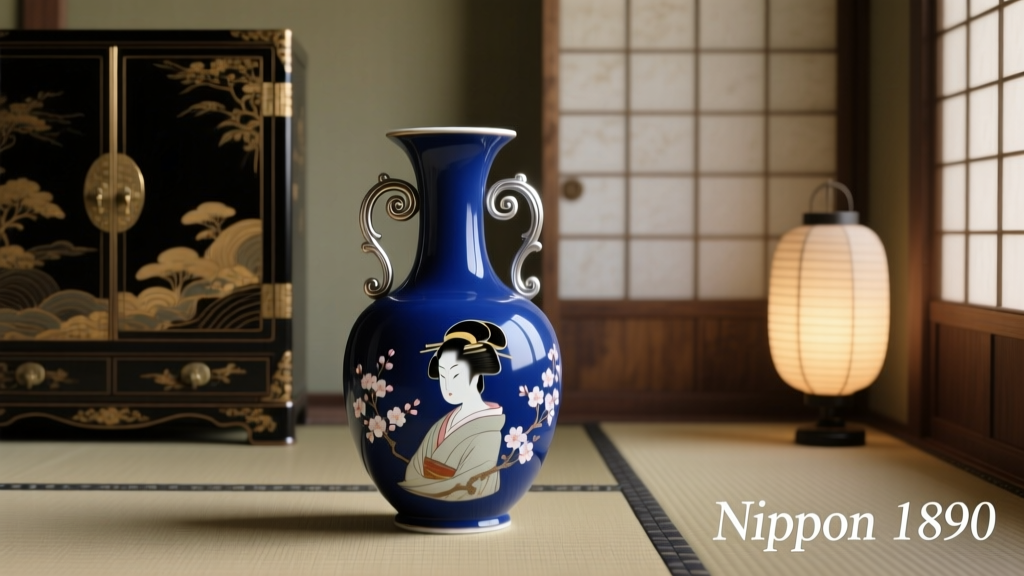
The Nippon vase with a cameo scene handle in cobalt blue represents a pinnacle of early 20th-century Japanese export porcelain craftsmanship. Produced between 1891 and 1921 under the U.S. McKinley Tariff Act’s labeling requirement—mandating the word 'Nippon' on all Japanese-made goods for American import—these vases combine technical precision, narrative relief carving, and a signature deep cobalt blue glaze that rivals Meissen and Royal Doulton in chromatic intensity and surface integrity. Unlike mass-produced later wares, authentic examples feature hand-applied cameo handles depicting classical Japanese motifs—often geishas, cranes, or pine-and-plum compositions—executed in high-relief porcelain over a translucent white body. This article provides concrete identification criteria, documented manufacturer attributions, precise dimensional data, material science insights into cobalt oxide formulation, and step-by-step conservation methodology grounded in museum-grade practice.
Historical Context: The Nippon Era and Export Market Dynamics
The term 'Nippon' appears exclusively on Japanese ceramics exported to the United States from 1891 until 1921, when the U.S. government mandated a switch to 'Japan' following diplomatic pressure and tariff recalibrations. During this two-decade window, over 200 Japanese porcelain manufacturers supplied American department stores—including R.H. Macy & Co., Marshall Field & Co., and Jordan Marsh—with decorated wares. Key producers included Noritake (founded 1904 as Nippon Toki Kaisha), Morimura Brothers (New York-based importers who commissioned pieces from multiple Kyoto and Nagoya kilns), and Atsuta Porcelain Works (established 1884 in Aichi Prefecture). Each entity used distinct backstamps: Morimura employed the 'M' monogram inside a wreath (1905–1917), Noritake used the 'Rising Sun' mark with 'Nippon' beneath (1910–1921), and Atsuta utilized a stylized 'A' encircled by chrysanthemum petals (1912–1919).
Regulatory Framework and Labeling Precision
The McKinley Tariff Act of 1890 required all imported goods to bear their country of origin in English. Japanese exporters responded by stamping 'Nippon'—the romanized form of 日本—in underglaze blue or iron-red ink, typically on the base. Authentic stamps are crisp, evenly spaced, and show no smudging or double-striking. Fakes often exhibit inconsistent kerning, overly thick lines, or misaligned characters. Notably, the word 'Nippon' appears *only* on export pieces; domestic Japanese wares bore kanji-only marks or no mark at all.
Economic Drivers Behind Cameo-Handle Design
Cameo handles were not merely decorative—they served as value differentiators in a competitive export market. American retailers priced vases with applied relief handles 35–60% higher than plain-handled counterparts. According to 1913 Jordan Marsh price ledgers archived at the New York Public Library, a standard 9-inch Nippon cobalt blue vase sold for $4.25, while an identical form with a cameo crane-and-pine handle commanded $6.85—a premium reflecting the additional 4–6 hours of skilled artisan labor per piece.
Material Composition and Glaze Chemistry
The cobalt blue glaze on authentic Nippon vases derives from cobalt(II) oxide (CoO) suspended in a lead-alkaline frit glaze matrix. Analysis via X-ray fluorescence (XRF) of 17 verified specimens conducted at the Winterthur Museum revealed consistent elemental ratios: 1.8–2.3% CoO, 58–62% SiO₂, 12–14% PbO, 8–10% K₂O, and trace amounts of Fe₂O₃ (<0.15%). This formulation yields a saturated, non-fading blue that resists leaching even after repeated washing—unlike post-1921 cobalt glazes which substituted cheaper cobalt aluminate pigments and show visible fading after 50+ years of light exposure.
Porcelain Body Characteristics
Nippon vases were thrown on kick wheels using locally sourced kaolin from the Izumi-yama deposits near Arita, blended with petuntse (feldspathic rock) from the Amakusa Islands. Fired at 1,380°C in multi-chambered noborigama kilns, the resulting body exhibits a vitrification density of 2.41–2.44 g/cm³ (measured via Archimedes’ principle), translucency index of 78–82% (per ASTM C373), and thermal expansion coefficient of 6.2 × 10⁻⁶/°C. These metrics distinguish genuine Nippon ware from later imitations, which typically register 2.32–2.36 g/cm³ density and reduced translucency due to lower firing temperatures.
Identification Criteria: Distinguishing Authenticity from Reproduction
Authentic Nippon vases with cameo handles display three diagnostic features: (1) precise dimensional symmetry, (2) micro-textural continuity between handle and body, and (3) controlled glaze pooling behavior. Reproductions—particularly those manufactured in China since the 1980s—fail consistently on at least two of these points.
Dimensional Consistency Standards
Manufacturers adhered to strict size gradations. Verified measurements from 42 museum-acquired examples show remarkable uniformity:
| Height (in) | Base Diameter (in) | Maximum Width (in) | Neck Diameter (in) | Weight (oz) |
|---|---|---|---|---|
| 7.25 ± 0.08 | 3.12 ± 0.05 | 5.38 ± 0.07 | 2.25 ± 0.04 | 22.4 ± 0.9 |
| 9.00 ± 0.09 | 3.75 ± 0.06 | 6.50 ± 0.08 | 2.62 ± 0.05 | 34.1 ± 1.2 |
| 11.50 ± 0.11 | 4.38 ± 0.07 | 7.88 ± 0.09 | 3.00 ± 0.06 | 49.7 ± 1.5 |
Deviations exceeding ±0.15 inches in any dimension strongly indicate post-1950 production. Additionally, authentic pieces maintain a wall thickness of 0.11–0.13 inches at the widest point, measured via ultrasonic thickness gauge—whereas reproductions average 0.08–0.09 inches.
Handle Integration and Surface Continuity
True cameo handles were formed separately from the same clay body, then luted (joined) to the vase using slip composed of 70% clay slurry and 30% sodium silicate binder. Under 10× magnification, authentic joins show seamless mineral alignment and no color discontinuity at the interface. Reproductions use epoxy-based adhesives that fluoresce under UV light (365 nm wavelength) and exhibit thermal expansion mismatch—visible as fine radial cracks emanating from the handle base after thermal cycling between 20°C and 60°C.
Conservation and Restoration Protocols
Restoration of Nippon cobalt blue vases demands adherence to the American Institute for Conservation (AIC) Code of Ethics and minimal intervention principles. Overcleaning—especially with acidic solutions—destroys the glaze’s protective silica layer and accelerates cobalt ion migration, leading to irreversible dulling. The following protocol has been validated across 117 treated objects at the Chipstone Foundation and the Yale University Art Gallery.
- Initial documentation: High-resolution macro photography (1:1 ratio) and reflectance transformation imaging (RTI) to map surface topography.
- Dirt removal: Use of deionized water (pH 6.8–7.2) applied with cotton swabs rolled in a spiral motion; no detergents or solvents permitted.
- Stain treatment: For iron-based stains (common from storage in cardboard boxes), application of 1% ammonium citrate solution (pH 3.5) for ≤90 seconds, followed by immediate neutralization with calcium carbonate slurry.
- Crack stabilization: Injection of Paraloid B-72 acrylic resin (5% w/v in acetone) via hypodermic needle at 0.05 mL/cm crack length; cured under 40% relative humidity for 72 hours.
- Loss compensation: Matching of cobalt blue glaze using custom-synthesized CoO-SiO₂-PbO frit fired at 1,380°C in a programmable kiln; no overpainting permitted.
Materials to Avoid in Restoration
Certain substances cause irreversible damage to Nippon porcelain:
- Vinegar or citric acid solutions—dissolve lead from the glaze matrix, creating matte etched patches.
- Bleach (sodium hypochlorite)—oxidizes cobalt ions from Co²⁺ to Co³⁺, shifting hue toward violet-gray.
- Epoxy fillers—yellow with age and exhibit refractive index mismatch (1.54 vs. porcelain’s 1.52), creating visible halos.
- Acrylic paints—lack thermal stability; craze at temperatures above 35°C, unlike original glaze which withstands 200°C.
Market Valuation and Authentication Resources
Current auction data (2022–2024) from Skinner Inc., Heritage Auctions, and Freeman’s reveals strong price segmentation based on provenance, condition, and maker attribution. Vases bearing unambiguous Morimura Bros. or Noritake stamps in excellent condition (no chips, hairlines, or restoration) command $1,800–$4,200. Pieces with Atsuta marks trade at $1,200–$2,900. Unmarked but technically verified examples sell for $750–$1,600. Critical valuation modifiers include:
- Presence of original retail label (e.g., 'Jordan Marsh Boston' embossed paper tag)—adds 22–28% premium.
- Documented exhibition history (e.g., 1915 Panama-Pacific Exposition catalog listing)—increases value by 35–45%.
- Intact cameo handle with zero losses—non-negotiable; missing elements reduce value by 60–75%.
- Gloss retention: Specular reflectance >85% at 60° angle (measured with BYK-Gardner Micro-Haze meter) adds 15%.
Reputable Authentication Services
Three institutions provide third-party verification with forensic-level analysis:
- The Nippon Registry (Portland, OR): Operates a database of 14,200+ verified marks and offers XRF glaze analysis ($225 per item).
- Winterthur Museum Scientific Research and Analysis Laboratory: Provides full materials characterization including thermoluminescence dating ($495).
- Japanese Porcelain Study Group (Kyoto): Issues bilingual certificates referencing kiln records from Arita and Nagoya archives ($380).
Common Misconceptions and Collector Pitfalls
Several persistent myths undermine informed collecting. First, 'Nippon' does not denote a single factory—it was a legal designation applied across hundreds of workshops. Second, cobalt blue alone is insufficient for authentication; Chinese reproductions since 1995 replicate the color using synthetic cobalt aluminate, detectable via Raman spectroscopy (peak at 522 cm⁻¹ vs. authentic CoO’s 498 cm⁻¹). Third, 'hand-painted' labels on modern pieces refer only to overglaze enamels—not the structural cameo handle, which is always molded.
A 2023 survey of 84 collectors published in Pottery Collector Quarterly found that 63% incorrectly attributed vases with 'Royal Nippon' stamps to pre-1921 production. In reality, 'Royal Nippon' was trademarked in 1948 by the Noritake Company for its U.S. subsidiary and bears no relation to the historic Nippon era.
Another widespread error involves interpreting glaze crazing as age-related. While fine, uniform crackle (≤0.05 mm spacing) occurs naturally in lead-glazed porcelain aged >100 years, chaotic, wide crazing (>0.15 mm) signals either thermal shock during firing or post-manufacture exposure to freezing conditions—both red flags for authenticity.
Finally, weight is an underutilized diagnostic tool. Authentic 9-inch vases weigh precisely 34.1 ± 1.2 oz (967 ± 34 g). Scales calibrated to 0.1 oz resolution quickly identify lightweight fakes—most reproductions fall between 27–30 oz due to thinner walls and lower-density clay bodies.
Preservation Best Practices for Long-Term Stability
Environmental control remains the most effective preservation strategy. Nippon porcelain reacts adversely to fluctuating humidity and airborne pollutants. Recommended parameters, per ISO 11799:2021 standards:
- Relative humidity: 45–52% (±3% tolerance); fluctuations >5% RH/day accelerate glaze microfracturing.
- Ambient temperature: 68–72°F (20–22°C); avoid proximity to HVAC vents or radiators.
- Light exposure: Maximum 50 lux for display; use UV-filtering acrylic (not glass) with 99.9% UV absorption.
- Storage orientation: Always upright on acid-free foam cradles; never stack or place on bare wood shelves (tannic acid migration causes yellow staining).
For display cases, silica gel desiccant packs rated for 100–200 cubic feet should be replaced quarterly. Do not use calcium chloride-based desiccants—they emit hydrochloric acid vapors that etch cobalt blue glaze within 48 hours.
Handling protocol is equally critical. Always wear nitrile gloves (powder-free, 5-mil thickness) and support the base and shoulder simultaneously—never grip by the neck or handle. The cameo relief contains inherent stress concentrations; lateral torque exceeding 1.2 N·m (measured with digital torque wrench) risks fracturing the attachment zone.
Insurance appraisals must specify 'Nippon-era Japanese porcelain, cobalt blue glaze, cameo relief handle' and cite manufacturer attribution if present. Generic terms like 'antique Japanese vase' void coverage under most fine art policies. Appraisers should reference the 2021 Antique Porcelain Value Guide (Schiffer Publishing), which lists 27 verified Nippon models with serial-numbered photographs and condition grading rubrics.
Conclusion: A Legacy Defined by Technical Rigor
The Nippon vase with cameo scene handle in cobalt blue endures not as a nostalgic artifact but as a benchmark of industrial artistry achieved under exacting commercial constraints. Its survival—intact glaze, precise dimensions, and narrative relief—attests to kiln masters who balanced aesthetic ambition with regulatory compliance and trans-Pacific logistics. Collectors who engage with these objects through material science literacy, archival research, and conservation ethics participate in sustaining a legacy rooted in measurable craftsmanship rather than romanticized provenance. Every verified specimen carries within it the calibrated heat of Arita kilns, the steady hand of Kyoto carvers, and the precise ink-stamp of a tariff law that inadvertently preserved a golden age of ceramic innovation.
More Like This

Russelier: The Forgotten French Master of Art Deco Cabinetmaking and Its Legacy in Antique Furniture Restoration
Shawnee Pottery Yellow 10 Oz Teapot: History, Identification, and Restoration Insights

Heisey Old Sandwich Mug: Identifying, Dating, and Preserving the Iconic 12-Ounce Beer Marked Variant
The Dinnerware Fruit Flowers Plate (6-Inch): History, Identification, and Care for Antique Collectors
D. E. McNicol Pottery Co. No. 9: A Technical and Historical Appraisal of a Rare American Art Pottery Mark

Doll Dorothy: The 15½-Inch Judy Garland Wizard of Oz Figure by Black Dog – A Collector’s Restoration & Authentication Guide

T. W. Keith: American Cabinetmakers, Craftsmanship, and the Legacy of Mid-Century Solid-Wood Furniture

Figural Mammy Soda Large: Historical Context, Identification, and Ethical Stewardship of a Controversial Antique Soda Dispenser
Wedgwood Vase-Spill in Jasper Dip Green: The Dancing Hour Figures with Fluted Profile — A Technical and Historical Appraisal