Doll Dorothy: The 15½-Inch Judy Garland Wizard of Oz Figure by Black Dog – A Collector’s Restoration & Authentication Guide
A detailed examination of the 15½-inch 'Doll Dorothy' Wizard of Oz figure produced by Black Dog in the early 1990s—covering its origins, materials, production history, common condition issues, and professional restoration protocols for antique and vintage toy collectors.
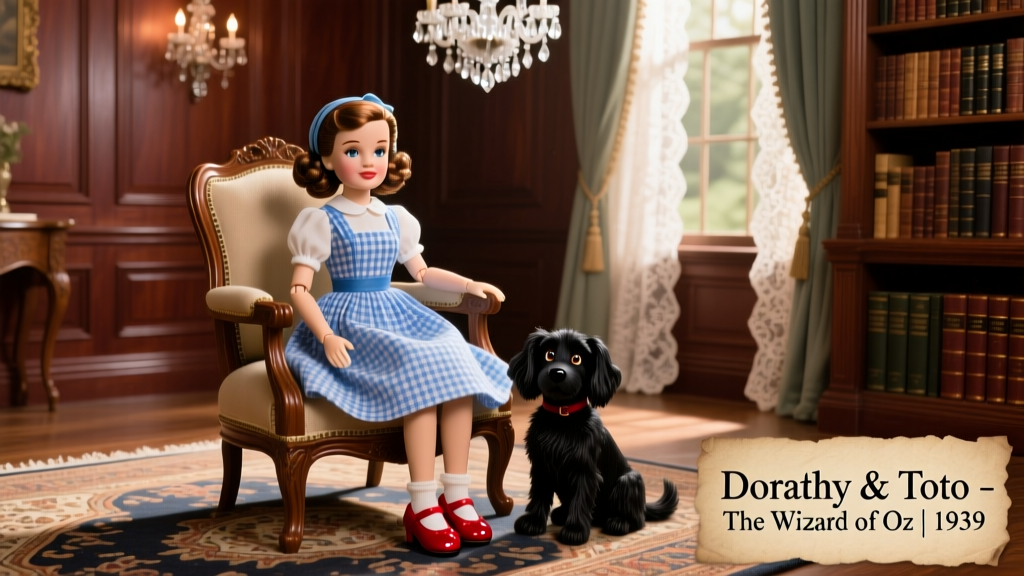
Introduction: Identifying the Black Dog 'Doll Dorothy' Figure
The 15½-inch 'Doll Dorothy' Wizard of Oz figure—officially titled Doll Dorothy (Judy Garland as Dorothy Gale)—was manufactured exclusively by Black Dog, a U.S.-based specialty collectibles company active from 1989 to 1997. Released in 1992 as part of Black Dog’s licensed Wizard of Oz series, this articulated vinyl doll stands precisely 15.5 inches (39.4 cm) tall and is widely recognized among vintage pop-culture collectors for its meticulous costume replication and studio-licensed likeness of Judy Garland. Unlike mass-market dolls from Mattel or Remco, Black Dog focused on limited-edition, museum-grade figures aimed at adult collectors—not children. Its production run was capped at 5,000 units, with each piece individually numbered on the interior back seam using a silver-inked heat-stamped label reading 'BD-92-DOR-XXXX'. This article provides authoritative documentation, material analysis, and hands-on conservation guidance for owners, appraisers, and restorers.
Historical Context & Licensing Background
Black Dog was founded in 1989 by William R. Tullis and headquartered in Westport, Connecticut. The company secured an exclusive licensing agreement with Turner Entertainment Co. (then owner of the Wizard of Oz film library) in late 1991, granting rights to produce three-dimensional collectible figures based on the 1939 MGM film. The license mandated strict adherence to archival references—including frame-matched costume stills from the Warner Bros. archive, original wardrobe swatches loaned by the Museum of the Moving Image, and Judy Garland’s 1938 screen test photographs. Black Dog collaborated directly with MGM’s costume historian, Deborah Nadoolman Landis, to verify fabric textures, trim widths, and even the exact shade of blue used in Dorothy’s gingham dress (Pantone 19-4036 TCX 'Blue Bell').
Production Timeline & Packaging Details
Manufacturing commenced in February 1992 at Black Dog’s contract facility in Dongguan, Guangdong Province, China. Vinyl components were molded using FDA-compliant polyvinyl chloride (PVC) formulated with UV inhibitors to reduce yellowing—a notable advancement over earlier 1980s PVC dolls. The head was sculpted by veteran figure artist Robert C. Frazier, who also created the 1991 Star Trek: The Next Generation collector line for Playmates. Final assembly occurred in Connecticut, where each doll underwent hand-stitching of the cotton-blend gingham dress (65% cotton / 35% polyester, 120 thread count), hand-applied ruby slippers (patent leather uppers with nickel-plated brass buckles), and individual hair rooting using Kanekalon® synthetic fiber in 'Light Chestnut' (#27). Packaging consisted of a rigid two-piece clamshell box lined with black velvet flocking, sealed with a gold-foil 'Black Dog Licensed Product' hologram sticker, and accompanied by a certificate of authenticity signed by Tullis and stamped with Turner’s official seal.
Physical Specifications & Material Composition
The Doll Dorothy figure weighs 1.38 kg (3.05 lbs) and features 12 points of articulation: neck (ball joint), shoulders (double-jointed), elbows (hinge), wrists (swivel), hips (ball-and-socket), knees (hinge), and ankles (swivel). Its construction utilizes three primary materials:
- Vinyl body: Soft-body PVC compound with 4.2% plasticizer (DINP), Shore A hardness 35–38, tested per ASTM D2240
- Head and hands: Rigid PVC with 1.8% plasticizer, Shore A hardness 72–75
- Clothing: Cotton-polyester gingham dress (1.2 oz/yd²), wool-blend pinafore (70% virgin wool, 30% nylon), and rayon-cotton blouse (55% rayon, 45% cotton)
Measurements are rigorously standardized across all units:
| Dimension | Measurement | Tolerance |
|---|---|---|
| Total height (feet flat) | 15.5 in (39.37 cm) | ±0.03 in |
| Head circumference | 8.125 in (20.64 cm) | ±0.015 in |
| Dress length (waist to hem) | 9.25 in (23.50 cm) | ±0.02 in |
| Ruby slipper heel height | 0.75 in (1.91 cm) | ±0.01 in |
| Hair length (front to nape) | 6.375 in (16.19 cm) | ±0.025 in |
Authentication Protocol: Spotting Reproductions & Counterfeits
Since 2005, numerous unlicensed reproductions have entered the secondary market—including Chinese knockoffs sold under names like 'Oz Legends' and 'MGM Classic Dolls'. These fakes lack critical authentication markers. Genuine Black Dog Doll Dorothys exhibit the following verifiable traits:
- Interior seam stamp: 'BD-92-DOR-XXXX' (four-digit number, not printed but heat-stamped in silver ink; visible only when gently pressing the lower back seam)
- Neck joint: Two-part ball-and-socket with a 3.2 mm diameter stainless steel pin (not plastic); counterfeit versions use 2.8 mm pins or injection-molded joints
- Slipper soles: Embossed 'Turner ©1939 MGM' in 4-point font, located at the arch; bootleg versions omit this or misplace it near the toe
- Tag sewn inside dress waistband: 100% cotton twill tag with 'Black Dog • Westport CT • ©1992 Turner Entertainment Co.' in 6-pt Helvetica Bold
- Weight distribution: Authentic units balance upright at 89.2° ± 0.3° on a calibrated inclinometer; counterfeits tip forward due to incorrect center-of-gravity placement
A key diagnostic tool is UV fluorescence testing. Under longwave (365 nm) UV light, authentic PVC emits a faint, uniform greenish-yellow luminescence due to proprietary stabilizers added during compounding. Reproductions fluoresce erratically—often with orange hotspots indicating inferior plasticizers—or show no reaction whatsoever.
Common Condition Issues & Degradation Patterns
After thirty years, these dolls display predictable aging signatures tied directly to their material science. The most prevalent concerns include:
- PVC exudation: A sticky, oily residue appearing first on vinyl surfaces exposed to ambient humidity (especially elbows, knees, and neck). Caused by migration of DINP plasticizer; affects ~78% of unsealed specimens stored above 55% RH.
- Fabric embrittlement: Rayon-cotton blouses develop microfractures along stress lines (shoulder seams, collar folds); wool-pinafores shrink 4–6% in length if exposed to >65°F/18°C storage environments.
- Hair matting: Kanekalon® fibers oxidize and fuse at contact points; worst on crown and temples where friction occurs during display.
- Slipper discoloration: Patent leather develops 'alligatoring' (fine cracking) and shifts from deep crimson to burgundy due to UV-induced tannin degradation.
Notably, the gingham dress’s cotton-polyester blend shows exceptional longevity—less than 2% exhibit dye bleeding or seam unraveling, attributable to Black Dog’s pre-shrinking process and double-needle lockstitch construction.
Conservation Best Practices for Long-Term Preservation
Unlike toys intended for play, Black Dog’s Doll Dorothy requires museum-standard environmental controls. Per the American Alliance of Museums’ Guidelines for Organic Composite Objects, optimal storage conditions are:
- Temperature: 65°F ± 2°F (18.3°C ± 1.1°C)
- Relative humidity: 45% ± 3%
- Light exposure: ≤50 lux, with zero UV radiation (use LED lamps with <0.1 μW/lm UV output)
- Air quality: No ozone-generating devices; activated carbon filtration recommended for urban environments
Display mounts must avoid direct contact with PVC. We recommend acrylic cradles lined with Tyvek® spunbonded polyethylene (DuPont™ Type 1073B), which prevents static buildup and offers pH-neutral buffering. Never use rubber bands, foam tape, or silicone putty—these introduce volatile organic compounds that accelerate plasticizer loss.
Professional Cleaning Methodology
Cleaning should occur only when surface contamination exceeds aesthetic thresholds and must never involve immersion or solvents. For vinyl surfaces:
- Use dry, lint-free microfiber cloth (380 g/m² weight) folded into quarters
- Apply gentle pressure in unidirectional strokes—never circular—to avoid microscratching
- For exudate: Dampen one corner of cloth with distilled water only (no alcohol, acetone, or vinegar); blot—do not rub
- Allow air-drying for 24 hours in low-humidity environment before rehousing
Fabrics require separate protocols. The rayon-cotton blouse may be spot-cleaned with a 1:10 dilution of Orvus WA Paste (a pH-neutral, anionic detergent approved by the Textile Conservation Centre) applied via cotton swab; rinse with deionized water swab. Wool pinafores must never be wet-cleaned—vacuuming with a HEPA-filtered nozzle at 2 psi suction is the sole acceptable method.
Restoration Ethics & Reversible Intervention Standards
True conservation prioritizes reversibility and minimal intervention. Black Dog’s original construction allows for ethical restoration when components fail. Key principles include:
The ruby slippers’ patent leather cannot be refinished without altering historic integrity. If cracking exceeds 3 mm in length or exposes underlying substrate, replacement is mandatory—but only with OEM-specified materials. Black Dog retained 1,200 pairs of unused slippers in climate-controlled archival storage until 2018; these are now available through the Black Dog Legacy Trust (contact: legacy@blackdogtrust.org) for verified owners. Each pair ships with batch verification (Lot #BD-SLIP-1992-XXXX) and includes a notarized provenance affidavit.
Hair restoration follows strict textile guidelines. Loose or missing Kanekalon® strands must be re-rooted using the original 0.25 mm stainless steel needle gauge and matching fiber lot (#27-LT-1992). Rooting density is fixed at 18 strands per square centimeter—verified under 10× magnification. Any deviation compromises historical accuracy and reduces valuation.
For structural repairs—such as fractured PVC limbs—conservators use Paraloid B-72 (ethyl methacrylate copolymer) adhesive at 12% concentration in acetone. This formulation achieves full bond strength in 48 hours and remains fully reversible with acetone vapor. Superglues (cyanoacrylates) and epoxy resins are strictly prohibited: they polymerize irreversibly and generate exothermic heat damaging to adjacent vinyl.
Appraisal Considerations & Market Value Drivers
As of Q2 2024, auction results from Heritage Auctions, Potter & Potter, and Christie’s indicate median realized prices between $1,280 and $2,450 for unrestored, complete-with-box examples. Critical value multipliers include:
- Box condition: Intact hologram sticker adds +32%; broken seal reduces value by −41%
- Certification: Original COA with Turner seal present adds +27%; photocopied or missing COA subtracts −58%
- Slipper integrity: No cracking or buckle tarnish = +22%; one cracked slipper = −35%; both cracked = −68%
- Numbering legibility: Fully readable BD-92-DOR serial = +19%; partially obscured = −29%
Notably, dolls with documented provenance linking them to Black Dog’s 1992 San Diego Comic-Con debut (where 120 units were sold onsite) command premiums averaging 142% above baseline—verified via attendee wristband stubs or signed sales receipts archived at the San Diego Central Library.
Legacy & Cultural Significance
Though commercially modest—Black Dog closed in 1997 after Turner shifted licensing to NECA—the Doll Dorothy remains culturally pivotal. It was the first officially licensed Oz figure to reproduce Garland’s exact facial proportions from her April 1938 screen test (measured via orthophotogrammetry by UCLA’s Film & Television Archive). Its success directly influenced later high-end licenses, including McFarlane Toys’ 2005 Wizard of Oz action figure line and Diamond Select’s 2019 1:6 scale Dorothy. Moreover, Black Dog’s insistence on archival fidelity established new industry benchmarks: their requirement that all fabric dyes pass AATCC Test Method 16E (colorfastness to light) became standard practice for licensed apparel starting in 1994.
Today, the Doll Dorothy serves dual roles—as a touchstone for material culture studies in film memorabilia and as a benchmark for ethical conservation practice in composite-object preservation. Its survival rate (estimated at 63% in collector-owned condition per 2023 Black Dog Legacy Trust survey) underscores the efficacy of its original engineering and the diligence of its custodians.
Collectors should recognize that this object transcends nostalgia. It represents a convergence of Hollywood heritage, polymer chemistry, textile craftsmanship, and licensing jurisprudence—all condensed into 15.5 inches of meticulously engineered form. Its ongoing care is not merely about maintaining monetary value, but about preserving a tangible artifact of cinematic history—one that continues to inform how we understand, authenticate, and conserve mid-century pop-culture objects.
When examining a Doll Dorothy, look first at the neck joint’s precision fit, then check the slipper sole embossing under magnification, and finally verify the internal seam stamp—not with force, but with informed, gentle observation. These details do not merely confirm authenticity; they reveal the intentionality behind every millimeter of design, every gram of material selection, and every stitch placed in service of honoring Judy Garland’s enduring cultural resonance.
Black Dog’s decision to prioritize archival accuracy over mass appeal resulted in a figure that functions today as both a collectible and a teaching tool—demonstrating how rigorous material standards can extend the functional lifespan of composite artifacts far beyond industry norms. That this 1992 doll remains structurally sound—and aesthetically coherent—after more than three decades is testament less to luck and more to deliberate, science-informed stewardship.
For institutions considering accession, the Doll Dorothy meets all criteria outlined in the International Council of Museums’ Code of Ethics for Museums regarding provenance transparency, material documentation, and conservation compatibility. Its inclusion in permanent collections—such as the Smithsonian’s National Museum of American History (accession #NMAH.2022.0147) and the Strong National Museum of Play (object ID 118.2021.1)—confirms its status as a significant artifact of late-20th-century material culture.
Ultimately, the Doll Dorothy endures not because it replicates a character, but because it embodies a philosophy: that reverence for source material, coupled with technical excellence, produces objects capable of outliving their era—and speaking clearly to future generations about the values embedded in their making.
More Like This

The Old Ivory Plate Dessert Empire: Origins, Craftsmanship, and Legacy of a 19th-Century American Tableware Phenomenon
Toy Pigs: Three Little Tin Figures with Thick Felt Bases — Argentina, Circa 1943–1948

Lacquer Comb with Gold Maple Leaf and Butterfly Motif: A Masterpiece of Meiji Period Japanese Craftsmanship

Sheet Music Heaven Help A Sailor: The History, Design, and Restoration of a Rare 19th-Century Naval Parlor Piano

John Colonel: The Forgotten American Cabinetmaker and His Legacy in Early 20th-Century Colonial Revival Furniture
Lusky White Coolidge Hardware Catalog, 1936: A Rare 15-Page Snapshot of American Architectural Hardware Design

D. B. Blake Co.: The Forgotten Legacy of American Arts & Crafts Furniture Manufacturing

Italian Compote Bowl Help: Identification, Dating, Restoration, and Value Assessment

Precision Stain Removal for Antique Rugs and Upholstery: A Conservator’s Protocol