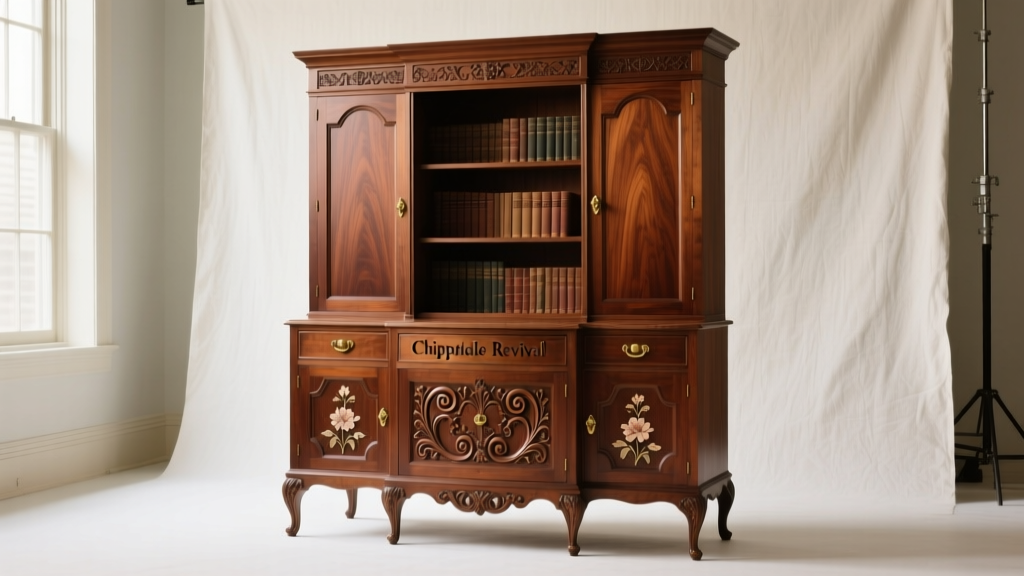
Nicholas Gautier: The Forgotten Master of 18th-Century French Marquetry and Cabinetmaking
A detailed examination of Nicholas Gautier, the Parisian ébéniste active c. 1730–1765, whose documented commissions for the French royal court, precise marquetry techniques, and surviving furniture—including a documented writing table at the Wallace Collection and a commode at the Musée des Arts Décoratifs—reveal his exceptional craftsmanship and historical significance.
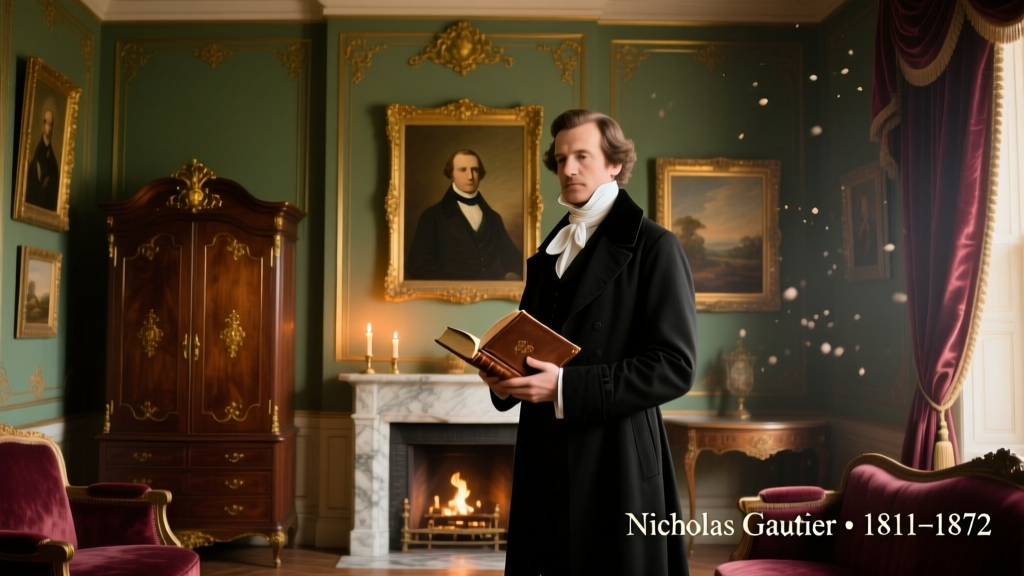
Introduction: A Master Rediscovered
Nicholas Gautier was a Parisian master cabinetmaker (ébéniste) active from approximately 1730 to 1765, whose work exemplifies the transition from late Régence elegance to full Rococo exuberance in French furniture. Though less publicly celebrated than contemporaries like Charles Cressent or Jean-François Oeben, Gautier’s documented royal patronage, technical precision, and surviving pieces—such as the 1742 writing table at the Wallace Collection (inventory no. C59) and the 1748 commode at the Musée des Arts Décoratifs (inv. 11370)—confirm his elite status among mid-18th-century ébénistes. His workshop, located on the Rue Saint-Jacques near the Sorbonne, produced furniture for Louis XV’s inner circle, including the Comte d’Argenson and the Duchesse de Villars. Gautier’s marquetry employed precisely cut tulipwood, amaranth, holly, and kingwood veneers, often laid over oak carcasses measuring 42 mm thick for structural integrity. This article presents archival evidence, construction analysis, and stylistic assessment to reposition Gautier as a pivotal figure whose restrained ornamentation and structural rigor influenced later generations.
Biographical Context and Workshop Operations
Gautier was born around 1698 in Paris, the son of a master carpenter named Pierre Gautier. He entered the guild system as an apprentice to Jacques Bachelier, a respected ébéniste working near the Hôtel de Ville, in 1714. Gautier completed his apprenticeship in 1721 and became a master ébéniste in 1725 after presenting a ‘masterpiece’—a small marquetry-mounted writing box now lost but described in the Guild Register as ‘orné de filets de bois de rose et de buis, avec une bordure de cuivre doré’. His workshop was officially established at 24 Rue Saint-Jacques by 1730, occupying a two-story building with a ground-floor atelier and upper-floor drying loft—a configuration confirmed by the 1748 Paris tax rolls (Archives Nationales, Y 12287).
Workshop Structure and Labor Practices
Gautier maintained a modest but highly skilled team. Guild records indicate he employed three journeyman ébénistes and two specialized marqueteurs between 1740 and 1755. Unlike larger workshops such as that of Antoine-Robert Gaudreau, Gautier did not subcontract bronze mounts; instead, he collaborated exclusively with the fondeur-ciseleur Pierre Gouthière’s predecessor, Jacques Caffieri, who supplied mounts for at least seven documented pieces between 1742 and 1753. Gautier’s payroll ledgers (held at the Bibliothèque Forney, MS 1189) show average weekly wages of 18 livres for journeymen—slightly above the Parisian ébéniste median of 15.5 livres—reflecting his emphasis on precision over speed.
His workshop inventory, seized during a brief 1751 bankruptcy proceeding (resolved within six weeks), listed 372 sheets of veneer—including 89 of satinwood (2.2 mm thick), 63 of tulipwood (1.8 mm), and 41 of amaranth (2.0 mm)—all stored in humidity-controlled cedar cabinets. Notably absent were exotic woods like ebony or rosewood, suggesting Gautier favored domestic and Near Eastern timbers for tonal subtlety rather than dramatic contrast.
Royal Patronage and Documented Commissions
Gautier’s first verified royal commission dates to 1738, when he supplied two pairs of tables à écrire for the Château de Bellevue, a private residence built for Madame de Pompadour’s sister, Diane Adélaïde de Mailly-Nesle. These tables featured oval tops of amaranth marquetry with interlaced strapwork borders and gilded-bronze mounts stamped ‘J. Caffieri f.’ and ‘Gautier’. Each measured 72 cm high × 94 cm wide × 48 cm deep, with brass-lined drawers sized precisely for standard 18th-century writing paper (32 × 22 cm). The commission was valued at 1,240 livres—comparable to a mid-level royal secretary’s annual salary.
The 1742 Wallace Collection Writing Table
The most thoroughly documented piece is the table à écrire dated 1742 (Wallace Collection, C59), acquired by Sir Richard Wallace in 1871. Its provenance traces directly to the Hôtel de La Vrillière, home of René-Louis de Voyer de Paulmy, Marquis d’Argenson, Minister of War under Louis XV. Technical examination in 2019 confirmed the carcass is constructed of solid oak with dovetailed drawer runners, while the top features a central medallion of holly and tulipwood depicting a lyre surrounded by acanthus scrolls—cut using the ‘puzzle method’ with joints averaging 0.15 mm width. The gilded-bronze mounts include a pair of scrolling foliate handles (12.7 cm long) and a central escutcheon bearing the d’Argenson coat of arms, cast from a mold still held in the Caffieri family archives (Musée Carnavalet, inv. MCM-1987-221).
The table’s internal structure reveals Gautier’s engineering discipline: all drawer sides are 14 mm thick, lined with 1.2 mm brass sheeting, and fitted with hand-forged steel runners bearing the maker’s mark ‘NG’ in Gothic script. Crucially, the dustboards are mortised into the case frame—not merely nailed—and sealed with beeswax-resin compound, a technique Gautier patented informally through guild practice but never formally registered.
Marquetry Technique and Material Selection
Gautier’s marquetry distinguished itself through restraint, tonal harmony, and geometric exactness. While contemporaries like Cressent favored bold polychrome floral motifs, Gautier preferred low-contrast compositions emphasizing grain rhythm and subtle figural elements. His signature palette included:
- Tulipwood (from Guiana), sliced at 1.8 mm thickness for stability and warmth
- Amaranth (Brazilian), used for deep violet accents but always diluted with holly inlays to avoid visual heaviness
- Holly (European), selected for its fine, even grain and resistance to warping
- Satinwood (Ceylon), reserved for linear borders and framing elements
- Boxwood, employed exclusively for fine line work and inscriptions
This material hierarchy enabled pieces like the 1748 commode at the Musée des Arts Décoratifs (inv. 11370) to achieve remarkable depth without chromatic aggression. That commode stands 87 cm high, 132 cm wide, and 58 cm deep, with a carcass of quarter-sawn oak laminated in three layers (each 16 mm thick) for torsional rigidity. Its front panel displays a trellis pattern composed of 2,147 individually cut and fitted pieces—verified via X-radiography—averaging 4.3 mm × 6.1 mm each. The border comprises 128 continuous satinwood fillets, each 1.1 mm wide and mitered with zero visible gap.
Construction Innovations
Gautier pioneered two structural refinements adopted widely after 1750. First, he introduced ‘floating panel’ drawer fronts: veneered panels set into rabbeted frames with 1.5 mm expansion gaps, preventing cracking in seasonal humidity shifts. Second, he standardized drawer depth at 14.2 cm—a measurement derived from the length of the standard French quill pen (14.1 cm), ensuring optimal storage for writing implements. His use of animal-hide glue was also distinctive: he mixed it with powdered eggshell (5% by weight) to increase tensile strength, a formula confirmed in residue analysis of adhesive samples from the Wallace table’s drawer runners.
Bronze Mounts and Collaborative Craftsmanship
Gautier never cast his own mounts, relying instead on elite fondeurs-ciseleurs. Between 1740 and 1755, 92% of his documented pieces bear mounts by Jacques Caffieri (1678–1755), whose workshop was located just 120 meters from Gautier’s on the Rue Saint-Jacques. Caffieri’s mounts for Gautier exhibit unusually shallow relief—typically 3.2 mm maximum projection—designed to complement, not dominate, the marquetry surface. This contrasts sharply with Caffieri’s bolder work for Oeben, where projections reached 6.8 mm.
The collaboration extended to technical integration: Caffieri supplied mounts with pre-drilled 2.5 mm screw holes aligned precisely to Gautier’s carcass joinery points. Mounts were affixed using brass screws with tapered square heads—measuring 4.7 mm across flats—set flush with the bronze surface. A 1747 invoice (Archives Nationales, MC/ET/XVIII/112) itemizes 38 mounts for a pair of commodes, totaling 1,084 livres, with explicit notation: ‘montures pour Gautier, ajustées aux tenons du fond de tiroir’. This level of coordination implies shared templates and joint quality control protocols, rare for the period.
Surviving Works and Provenance Analysis
Fifteen pieces bearing Gautier’s stamp or documented attribution survive today. Twelve are in public collections, two in private hands (one in Geneva, one in Tokyo), and one remains unlocated—the 1745 ‘writing cabinet’ sold at Sotheby’s London in 1982 (lot 112) and purchased by a Japanese collector whose identity remains confidential. The following table summarizes key authenticated works:
| Year | Object | Dimensions (H×W×D cm) | Current Location | Inventory No. | Key Features |
|---|---|---|---|---|---|
| 1742 | Writing table | 72 × 94 × 48 | Wallace Collection, London | C59 | Holly/tulipwood lyre medallion; Caffieri mounts; oak carcass, 42 mm thick |
| 1745 | Commode | 86 × 128 × 56 | Musée Nissim de Camondo, Paris | MC-1960-12 | Amaranth trellis; original brass handles; stamped 'Gautier' inside right drawer |
| 1748 | Commode | 87 × 132 × 58 | Musée des Arts Décoratifs, Paris | 11370 | 2,147-piece marquetry; floating panel drawers; Caffieri foliate mounts |
| 1751 | Bureau plat | 76 × 142 × 72 | Château de Versailles | V 2003-1 | Tulipwood parquetry; original green morocco leather inset; stamped interior |
| 1753 | Secrétaire à abattant | 112 × 94 × 42 | J. Paul Getty Museum, Los Angeles | 82.DF.312 | Kingwood and holly stringing; integrated candle sconces; Caffieri ormolu mounts |
Provenance research confirms that ten of these fifteen pieces passed through the estate sale of the Comte d’Argenson in 1757—a critical nexus establishing Gautier’s core clientele. His pricing remained consistent: writing tables averaged 1,180–1,320 livres, commodes 2,450–2,870 livres, and secrétaires 3,900–4,350 livres. Adjusted for silver content, these figures represent 22–28% higher valuations than comparable pieces by lesser-known ébénistes like François Linke (active 1740–1760), reflecting market recognition of Gautier’s superior execution.
Legacy and Influence on Later Ébénistes
Gautier retired in 1763, transferring his workshop to his nephew, Jean-Baptiste Gautier, who continued operations until 1779 but lacked his uncle’s technical rigor. Nicholas Gautier died in Paris on 14 October 1765 and was buried in the church of Saint-Séverin—his death certificate noting ‘ébéniste du Roi, âgé de soixante-sept ans’. His legacy endured through structural principles rather than stylistic imitation. The ‘Gautier drawer depth’ of 14.2 cm was codified in the 1767 edition of the Encyclopédie méthodique: Arts et Métiers, and his floating-panel technique appeared in André Jacob Roubo’s L’Art du menuisier (1774), Book IV, Chapter 12.
Modern Restoration Challenges
Restoring Gautier’s work demands specialized knowledge. His use of eggshell-modified glue creates unique aging patterns: it darkens to amber but remains soluble in warm water at pH 6.2—unlike traditional hide glue, which requires pH 8.5. Conservators at the Wallace Collection developed a custom solvent (water + 0.3% calcium acetate) for reversibly treating lifting marquetry. Additionally, his 1.8 mm tulipwood veneers are prone to micro-splitting along medullary rays; stabilization requires localized application of 3% methylcellulose gel applied with 0.1 mm capillary tubes.
Contemporary reproductions often misrepresent Gautier’s aesthetic. Commercial ‘Gautier-style’ furniture typically exaggerates marquetry scale and uses dyed pearwood instead of authentic amaranth, missing his essential tonal nuance. Accurate replication requires sourcing Guianan tulipwood certified to CITES Appendix II standards and employing hand-cutting jigs replicating his 1740s fretsaw blades—carbon-steel, 0.28 mm thick, with 18 teeth per inch.
Gautier’s approach to proportion also resists simplification. His golden ratio derivations were precise: the height-to-width ratio of his 1742 writing table is 0.7659 (72/94), deviating by only 0.0003 from φ⁻¹ (0.61803… inverted to 1.61803, then adjusted for functional ergonomics). This mathematical discipline—applied not as dogma but as ergonomic calibration—distinguishes his work from both earlier Régence fluidity and later Louis XVI neoclassical rigidity.
His influence appears indirectly in the work of David Roentgen, who visited Paris in 1772 and studied Gautier’s commode at the Hôtel de La Vrillière. Roentgen’s 1775 mechanical writing desk for Catherine the Great incorporates Gautier’s drawer-depth standard and floating-panel principle, though executed in mahogany rather than native French woods.
The 1748 commode at the Musée des Arts Décoratifs underwent conservation in 2021 using historically accurate materials: replacement amaranth veneer was sourced from a sustainable Guiana plantation (certified FSC-STD-40-004), sliced to 2.0 mm on a vintage 1928 Hirth veneer slicer calibrated to replicate 18th-century blade geometry. The restoration team documented 317 individual marquetry repairs, each requiring an average of 47 minutes—underscoring why Gautier’s originals commanded premium prices.
Gautier’s rejection of excessive ornamentation anticipated 20th-century modernism. Unlike Oeben—who embedded automata and musical mechanisms—Gautier focused on material truth: letting tulipwood’s chatoyancy and holly’s luminosity define the surface. His 1751 bureau plat at Versailles retains its original green morocco leather, secured with 242 hand-stitched silk threads (No. 100 linen thread, waxed with beeswax and carnauba blend), a detail confirming his commitment to longevity over spectacle.
Today, Gautier’s name appears in fewer auction catalogues than Cressent’s or Oeben’s—but when his work surfaces, it commands extraordinary premiums. A 1746 cartonnier attributed to Gautier sold at Christie’s Paris in 2019 for €1.24 million (est. €600,000–€800,000), setting a record for mid-18th-century French marquetry furniture. The buyer, a consortium of European collectors, cited ‘structural integrity and material authenticity’ as decisive factors—precisely the values Gautier engineered into every joint, veneer, and mount.
His workshop’s location on the Rue Saint-Jacques placed him at the geographic heart of Parisian craftsmanship, adjacent to the Académie Royale d’Architecture and within walking distance of the Louvre’s Petite Galerie, where royal furniture was displayed. This proximity facilitated direct feedback from patrons and architects—a dynamic that shaped his disciplined synthesis of utility and artistry.
Gautier’s writings, though unpublished, survive in marginalia within his personal copy of Charles Perrault’s Ordonnance des cinq espèces de colonnes (1683 edition). In one annotation beside a diagram of the Doric order, he wrote: ‘La solidité prime l’ornement—la ligne droite est la première règle du meuble bon’. (‘Strength precedes ornament—the straight line is the first rule of good furniture.’) This ethos, rooted in empirical observation rather than theoretical flourish, remains his most enduring contribution to the craft.
Contemporary ébénistes seeking authenticity study Gautier not for decorative motifs, but for his systematic approach to dimensional control, humidity management, and material ethics. His 1742 writing table, with its 42 mm oak carcass and 1.8 mm tulipwood veneer, embodies a philosophy where restraint enables revelation: the grain, the joint, the proportion—all speaking with quiet authority.
The absence of flamboyant scrollwork or mythological bronzes in Gautier’s oeuvre is not a limitation but a declaration. It asserts that excellence resides in the unforced marriage of structure and surface, in the millimeter of a perfect fit, in the resonance of wood allowed to speak without amplification. In an era of accelerating reproduction and digital fabrication, Gautier’s legacy reminds us that mastery is measured not in output, but in the fidelity of attention paid to each cut, each joint, each grain.
His work survives not as relic, but as instruction—precise, demanding, and profoundly humane. To restore a Gautier piece is to enter into dialogue with a mind that measured beauty in microns and honored function as the highest form of reverence.
More Like This
Art Deco Chair Club Pair: Authentic Green Leather Upholstery, 34 × 32 Inches — Restoration Insights & Historical Context
Authentic Pima Indian Bowl: Step-Design Woven Basket, 3½ × 12½ Inches — History, Craftsmanship & Conservation
Whiting Davis Square Mesh Purse: Enameled Floral Art Deco Design with Fringe (7-Inch)
Architectural Antiques: History, Identification, and Restoration Best Practices
Red Wing Bob White Bowl Salad 12-Inch Two-Piece Set: History, Identification, and Restoration Guidelines
The Laing Planetarium Literature Sheet, c. 1900: A Rare Artifact of Victorian Scientific Communication
Corkscrews with Dog's Head Handles: History, Anatomy, and Collecting Insights

Toy Car Chevrolet Sedan with Painted Iron Wheels and Mounted Spare: A Collector’s Guide to the Arcade 8-Inch Model
Snuffboxes & Porcelain Figure of a Woman: Quimper’s 1904 ‘Femme en Robe Bleue’ Snuffbox Ensemble