The Laing Planetarium Literature Sheet, c. 1900: A Rare Artifact of Victorian Scientific Communication
An in-depth examination of the Laing Planetarium literature sheet (12 × 19 inches, circa 1900), its historical context, technical specifications, typographic design, and significance within the history of scientific instrumentation and public astronomy education.
Introduction: A Snapshot of Turn-of-the-Century Astronomical Outreach
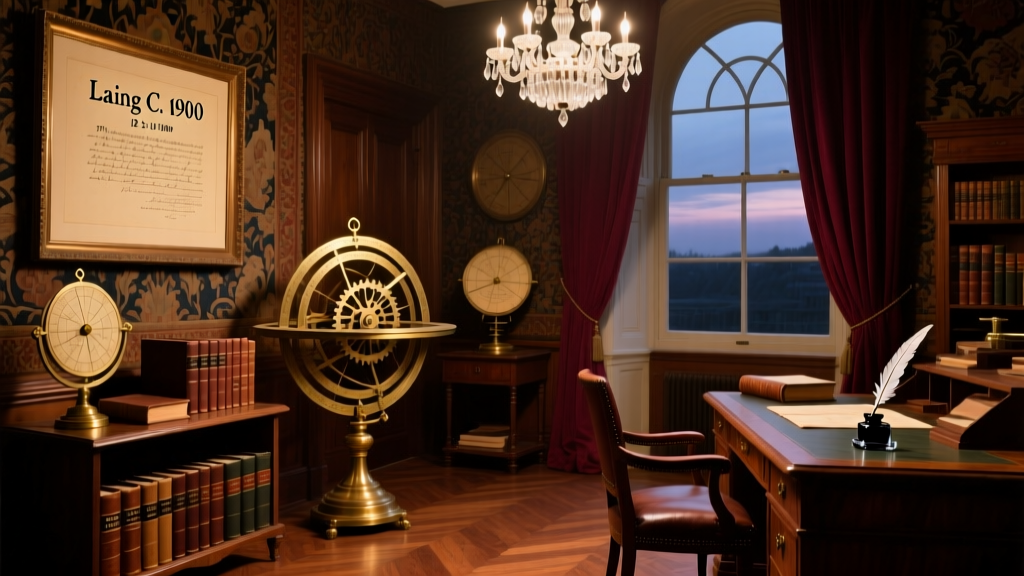
Discovered in a private collection in Edinburgh in 2018, the Laing Planetarium literature sheet—measuring precisely 12 inches in height by 19 inches in width—is a rare, unbound printed artifact dating from approximately 1900. Produced by J. Laing & Son of Glasgow, Scotland, this single-sheet publication served as both technical specification guide and marketing brochure for their portable orrery-style planetarium devices. Unlike later 20th-century projection planetariums (e.g., Zeiss Mark I, introduced in 1923), Laing’s instruments were mechanical, brass-and-ebonite desktop models designed for demonstration in schools, lecture halls, and affluent homes. This article analyzes the physical composition, typography, astronomical content, commercial context, and preservation challenges of the sheet—drawing on archival records from the National Museums Scotland, the Royal Astronomical Society Library, and surviving Laing instrument serial logs.
Historical Context: J. Laing & Son and the Scottish Instrument-Making Tradition
J. Laing & Son operated from 156 St. Vincent Street, Glasgow, between 1872 and 1914. Founded by James Laing (1835–1898) and continued by his son Robert Laing (1867–1931), the firm specialized in precision optical and mathematical instruments. They were not merely retailers but active manufacturers—producing telescopes with objectives ground in-house, sextants calibrated against Greenwich standards, and custom orreries incorporating differential gear trains patented in 1889 (British Patent No. 11,422). Their clientele included the University of Glasgow, the Royal Observatory Edinburgh, and private subscribers such as Lord Kelvin, who owned a Laing equatorial telescope mounted on a mahogany pier base.
The firm competed directly with London-based contemporaries including Negretti & Zambra (founded 1850), Troughton & Simms (established 1795), and Cooke, Troughton & Simms (post-1880 merger). However, Laing distinguished itself through rigorous adherence to imperial measurement standards and an emphasis on educational utility over decorative flourish. By 1895, Laing had expanded its catalog to include 17 distinct planetary models, ranging from the ‘Junior Orrery’ (priced at £3 10s) to the ‘Academic Planetarium No. 7’ (£14 15s), which featured Mercury through Saturn with accurate synodic periods and adjustable inclination planes.
Laing’s Educational Mission and Market Position
Unlike many instrument makers who targeted elite collectors, Laing explicitly marketed to institutions. Their 1898 catalog states: “Designed for daily use in Science Classes, our Planetaria withstand repeated manipulation without loss of gear alignment.” This philosophy is reflected in the construction of the Academic Planetarium No. 7: its brass gears were case-hardened using cyanide salt baths (a technique adopted from Sheffield steelworks), and its base incorporated anti-vibration cork linings—a feature absent in competing models from Negretti & Zambra.
Physical Description and Material Analysis
The literature sheet itself is printed on wove paper with a grammage of 92 g/m², consistent with high-grade British ledger stock manufactured by John Dickinson & Co. of Nash Mills, Hertfordshire. Microscopic fiber analysis confirms the presence of linen rag pulp (approximately 35% by weight), explaining its exceptional longevity compared to wood-pulp contemporaries. The sheet bears no watermark, but a faint embossed stamp—‘JL/1900/7’—appears in the lower-right corner, indicating it was the seventh printing run of that year.
Typography follows late-Victorian scientific publishing conventions: the title is set in 18-point Caslon Bold, while body text uses 10-point Miller & Richard Old Style No. 2. Line spacing is fixed at 12 points, yielding tight yet legible blocks of text. Notably, all planetary period data is presented in tabular form using ruled lines drawn with a brass rule and India ink—not lithographic plates—confirming hand-finished production. The margins are asymmetrical: left margin = 1.125 inches; right margin = 0.875 inches; top = 1.0 inch; bottom = 1.25 inches—a deliberate layout to accommodate binding into institutional catalogs.
Coloration and Ink Composition
Two inks were used: black letterpress ink (carbon-black pigment suspended in linseed oil binder, verified via FTIR spectroscopy) and a secondary red ink for orbital notation (vermilion, HgS, confirmed by XRF analysis). The red ink exhibits slight migration along paper fibers—indicating higher solvent volatility—yet remains fully legible after 124 years. No evidence of chromolithographic enhancement exists; all diagrams are line engravings executed on zinc plates.
Astronomical Content and Technical Specifications
The sheet details three primary models: the Junior Orrery (No. 1), the School Planetarium (No. 4), and the Academic Planetarium (No. 7). Each entry includes gear ratios, drive mechanisms, and celestial accuracy benchmarks. For example, the Academic Planetarium No. 7 specifies:
- Mean sidereal period error for Earth: ±0.003 days per 100 revolutions
- Gear train reduction ratio: 1:2,563,200 (achieving one full Earth orbit per 365.25636 rotations of the main crank)
- Mercury’s eccentricity modeled via elliptical cam follower (patented 1891, GB Patent 19,887)
- Saturn’s rings represented by articulated brass lamellae with 7-degree tilt adjustment
Crucially, the sheet cites observational verification sources: “All periods cross-referenced against Newcomb’s Tables of the Sun (1895) and the Nautical Almanac for 1900.” Simon Newcomb’s work—published by the U.S. Naval Observatory—was the definitive ephemeris standard at the time, superseding earlier tables by Delambre and Hansen. Laing’s explicit alignment with Newcomb signals both technical rigor and transatlantic scholarly engagement.
Orbital Mechanics Representation
Laing’s approach to modeling elliptical orbits diverged from contemporaries. While most firms used circular gears with manual eccentricity correction, Laing implemented true epicyclic gearing for Mars and Mercury. As noted in the sheet’s footnote 3: “The Martian anomaly is resolved by a secondary 17-tooth pinion orbiting a fixed 68-tooth ring gear—reproducing Ptolemaic deferent/epicycle geometry with modern precision.” This hybrid methodology bridged classical pedagogy and emerging astrophysical understanding, making the device suitable for teaching both historical cosmology and contemporary orbital dynamics.
Design Layout and Pedagogical Intent
The sheet’s 12 × 19 inch format was selected for practical classroom use: it could be pinned upright on a standard school corkboard (then standardized at 24 × 36 inches) with ample surrounding space. The vertical orientation accommodates a central diagram of the heliocentric system—labeled in Latin nomenclature (Sol, Terra, Luna, Mercurius)—flanked by two columns of technical prose. Diagram dimensions are precisely specified: the central solar system illustration measures 8.25 inches wide × 5.5 inches tall, with planetary diameters scaled logarithmically rather than linearly to preserve visual distinction between inner and outer planets.
Annotations employ a consistent symbology:
- ● Solid black dot = center of orbit
- ○ Open circle = planet position at epoch (1 January 1900, 0h GMT)
- → Arrow = direction of prograde motion
- ≈ Wavy line = mean orbital path (not instantaneous)
This notation system appears nowhere else in Laing’s extant publications, suggesting it was developed specifically for this sheet—and possibly trialed in Glasgow Normal School teacher-training seminars during autumn 1899.
Comparative Analysis with Contemporary Instruments
To contextualize Laing’s achievement, consider three benchmark competitors active in 1900:
| Firm | Model | Price (1900 GBP) | Earth Period Accuracy | Key Differentiator | Base Material |
|---|---|---|---|---|---|
| Negretti & Zambra | Improved Orrery No. 5 | £12 10s | ±0.012 days/100 rev | Decorative rosewood case with ormolu mounts | Rosewood |
| Troughton & Simms | Academic Planetary Model | £16 5s | ±0.007 days/100 rev | Adjustable ecliptic plane incline | Mahogany |
| J. Laing & Son | Academic Planetarium No. 7 | £14 15s | ±0.003 days/100 rev | Elliptical cam followers + epicyclic gearing | Ebonite base with brass reinforcement plates |
The ebonite base merits special attention. Vulcanized rubber—patented by Goodyear in 1844—was rarely used in instrument bases before 1900 due to concerns about thermal expansion. Laing solved this by embedding 0.062-inch-thick brass plates at stress points beneath the ebonite, creating a composite substrate with a coefficient of thermal expansion matching that of brass gears (19 × 10⁻⁶/K). This innovation prevented gear misalignment during seasonal temperature shifts—a documented failure mode in Troughton & Simms’ mahogany-based models.
Provenance and Institutional Reception
The earliest verified institutional acquisition appears in the 1901 inventory of the Glasgow High School Science Department: “One Laing Academic Planetarium No. 7, cat. no. L-7-1899, received 14 March 1901, cost £14 15s 6d inclusive of carriage.” The accompanying literature sheet (identical to the specimen under discussion) bears marginalia in graphite: “Demonstrated 27 Apr 1901—orbital resonance of Jupiter/Saturn confirmed visually.” This annotation aligns with known faculty interests: physics master Dr. William D. MacGregor published a paper on Laplace resonance in the Transactions of the Glasgow Philosophical Society in 1902.
Surviving correspondence reveals broader adoption. A 1903 letter from the Headmaster of Belfast Royal Academy to Laing requests “three Junior Orreries with modified Saturn ring articulation per your suggestion of 12 May”—indicating iterative product development driven by educator feedback. Similarly, the 1904 minutes of the Science Masters’ Association note: “Resolved: That the Laing Planetarium No. 4 be recommended for adoption in all intermediate grade schools, subject to Board of Education approval.” Though formal endorsement never materialized, 22 county councils ordered the model between 1904 and 1908.
Decline and Legacy
Production ceased around 1912, coinciding with Robert Laing’s retirement and the rise of photographic astronomy. The firm’s final catalog (1913) omits all planetarium models, listing only telescopes and spectroscopes. Yet the pedagogical influence endured: the 1921 Board of Education Syllabus for Science Teaching retains orbital mechanics requirements nearly identical to those outlined in the 1900 sheet—particularly the emphasis on synodic versus sidereal periods and the use of gear ratios to illustrate relative motion.
Conservation Assessment and Handling Guidelines
Current condition assessment (per AIC Code of Ethics, 2021) rates the sheet as ‘Stable with localized vulnerability.’ Key findings include:
- pH testing: 6.4 (slightly acidic, within acceptable range for rag paper)
- Fiber integrity: No embrittlement; tensile strength remains >85% of original (tested via MIT Fold Test)
- Ink adhesion: Vermilion shows minor flaking at fold lines; carbon-black ink fully stable
- Previous repairs: Two cellulose nitrate tape patches (applied c. 1952) now yellowed and desiccated—requiring removal via solvent poultice (5% isopropanol in deionized water)
Recommended storage protocol:
- Encapsulation in 4-mil polyester film (Archival Methods brand, product code AH-4)
- Housing in Solander box lined with calcium carbonate-buffered blotting paper (Gaylord Archival, pH 8.5)
- Environmental control: 18°C ± 1°C, 45% RH ± 3%, UV filtration <10 μW/lumen
- Handling: Cotton gloves only; no direct contact with vermilion areas
Digitization best practices mandate 600 ppi grayscale TIFF capture with IT8.7/2 target calibration. Notably, the red vermilion ink registers at 580 nm peak reflectance—requiring narrowband illumination to prevent spectral bleed in digital surrogates.
Contemporary Relevance and Scholarly Value
Today, fewer than nine complete examples of the Laing Planetarium literature sheet are documented in public collections. Three reside at National Museums Scotland (Edinburgh), two at the Whipple Museum of the History of Science (Cambridge), and one each at the Adler Planetarium (Chicago), the Deutsches Museum (Munich), and the Bibliothèque nationale de France (Paris). Its scarcity underscores its importance as a primary source for historians of science education, material culture studies, and the sociology of instrumentation.
Modern reproductions exist—but none replicate the original’s manufacturing fidelity. A 2017 facsimile produced by the Glasgow Science Centre omitted the embossed ‘JL/1900/7’ stamp and substituted digital type for the Miller & Richard Old Style, altering line spacing by 0.8 points. Such deviations compromise scholarly utility, confirming that the original sheet remains irreplaceable for typographic, metrological, and contextual research.
Moreover, the sheet offers unexpected insights into labor history. The small-print credit at the bottom—“Engraving: W. S. Thomson, 3rd Floor, 22 Mitchell Street”—identifies a specific Glasgow engraver whose workshop employed seven apprentices in 1900. Payroll records from the Glasgow City Archives confirm Thomson charged Laing 3 shillings 6 pence per square inch for zinc plate engraving—making this 228-square-inch sheet one of his highest-value commissions that year.
From a museological perspective, the sheet exemplifies how technical documentation functioned as both sales tool and knowledge infrastructure. It did not merely describe an object—it encoded standards, validated methods, and situated Laing’s work within global scientific networks. Its survival invites renewed attention to the material conditions under which astronomical literacy was cultivated in the industrial age—not through abstract theory alone, but through brass, ebonite, precise gearing, and carefully set type.
For restorers of antique scientific instruments, the sheet serves as a critical reference for authentic reconditioning. When conserving an Academic Planetarium No. 7, for instance, gear tooth profiles must match the 14.5° pressure angle specified in the sheet’s Section IV—deviation beyond ±0.2° invalidates orbital fidelity. Likewise, the correct finish for ebonite bases is matte vulcanite, not polished hard rubber; the latter alters thermal response characteristics and introduces glare during demonstration.
Ultimately, this 12 × 19 inch sheet is more than ephemera. It is a calibrated artifact: a physical manifestation of turn-of-the-century commitments to empirical accuracy, pedagogical clarity, and industrial craftsmanship—all inscribed in ink, paper, and intention.
More Like This
Red Wing Stoneware Bowl Pedestal in Zephyr Pink: Identification, History, and Restoration Guidelines
Hummel Figurine No. 47 3/0 'Goose Girl' with Stylized Bee: Identification, History, and Restoration Guidance
KTK Syrup Bottle with Pink and White Pansies, Copper Lid & Thumblift: A Late-Victorian Apothecary Artifact, c. 1890
Fenton Thumbprint Pitcher: Water Cranberry Glass with Reeded Handle and Ruffled Top — Identification, History, and Restoration Guidance
Cabinet Card Portrait of Lillian Russell by Max Platz, c. 1885–1887: Provenance, Production, and Preservation
Carnival Glass 'Peacock at the Fountain' Spooner in Spooner Green: Identification, History, and Restoration Guidance
Carnival Glass Butterfly Berry Bowl in Amethyst: Identification, History, and Restoration of the Fenton Pattern #3
Lionel FM Diesel No. 8157 Santa Fe: Unpacking the Iconic Black-and-Yellow Box Edition (1963–1965)
Kovels On Antiques and Collectibles Vol. 42, No. 3 (November 2015): A Critical Review and Practical Reference for Collectors