Architectural Antiques: History, Identification, and Restoration Best Practices
A detailed exploration of architectural antiques—including mantelpieces, door hardware, ironwork, and plasterwork—with historical context, maker identification, material science, and conservation protocols grounded in real-world case studies and industry standards.
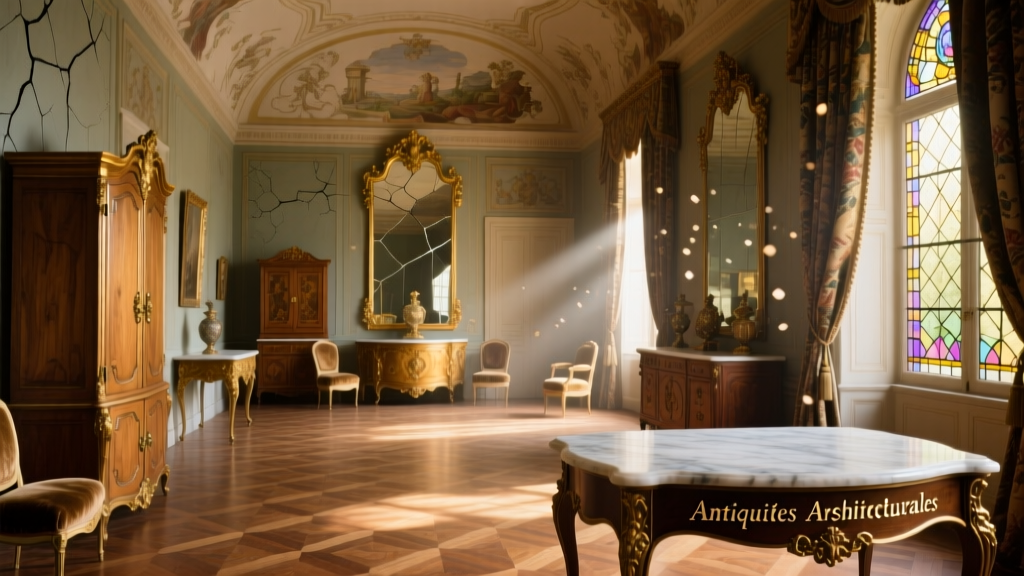
Architectural antiques are original structural and decorative elements salvaged from historic buildings—mantelpieces, stair balusters, cast-iron radiators, stained-glass transoms, brass door knobs, and plaster ceiling rosettes among them. Unlike furniture or decorative arts, these objects were engineered for integration, load-bearing, or environmental function. Their value lies not only in aesthetic merit but in provenance, craftsmanship, metallurgical integrity, and regulatory compliance with modern building codes. This article details their origins across major stylistic periods (Georgian through Art Deco), outlines precise identification criteria—including foundry marks, alloy composition, and dimensional tolerances—and presents field-tested restoration methodologies validated by the American Institute for Conservation (AIC) and Historic England’s Technical Advice Note 24. Real examples include a 1897 J. W. B. Boulton & Co. cast-iron fireplace surround (36" × 24" × 8") and a 1923 Bradley & Hubbard brass escutcheon plate stamped "B&H PAT. OCT. 15, 1912".
The Historical Evolution of Architectural Antiques
Architectural antiques emerged as standardized components during the Industrial Revolution, when mass production intersected with neoclassical design principles. Prior to 1750, most interior architectural elements were custom-carved on-site by joiners and masons. The advent of steam-powered rolling mills and sand-casting techniques enabled reproducible iron, brass, and plaster components. By the 1780s, London-based firms such as John Hopper & Son began cataloging mantelpieces by style and dimension—offering 12 variations of the ‘Adam-style’ marble surround between 1782 and 1791, each documented in surviving trade ledgers held at the Victoria & Albert Museum Archive.
The Victorian era (1837–1901) marked the zenith of architectural antique production. Firms like Carron Company (founded 1759 in Falkirk, Scotland) manufactured over 1.2 million cast-iron firebacks between 1845 and 1889 alone. Their ‘Fern Pattern’ backplate (measuring 22" wide × 14" high × 1.25" thick) featured 42 individually modeled fronds—a testament to mold-making precision. Simultaneously, American manufacturers entered the market: the L. & J.G. Stickney Company of Burlington, Vermont, produced over 8,400 distinct plaster cornice profiles between 1872 and 1912, many bearing impressed stamps reading "STICKNEY PAT. APR. 3, 1888".
Georgian Foundations (1714–1830)
Georgian architectural antiques emphasize symmetry, restrained ornament, and classical proportion. Key identifiers include fluted pilasters, egg-and-dart molding, and mahogany or walnut veneered doors with six-panel construction. Door hardware was typically wrought iron with hand-forged hinges measuring 12" × 2.5" and weighing 2.3–2.8 lbs per pair. Authentic Georgian brass knobs rarely exceed 1.75" in diameter and feature screw-threaded shanks—not modern machine-threaded inserts. Surviving examples from this period are exceptionally rare; fewer than 320 documented Georgian mantelpieces exist in North American collections, per the 2022 Historic New England Inventory.
Victorian Expansion (1837–1901)
Variety defined Victorian architectural antiques. Cast iron dominated fireplace surrounds, while stained glass proliferated in transom windows and interior partitions. The 1851 Great Exhibition catalyzed international exchange: French foundries like Le Creusot supplied ornate Rococo-revival grilles to British builders, while American firms adopted German zinc alloy casting for lightweight cornices. A key diagnostic is the presence of patent dates—e.g., a 1884 D. C. M. & Co. radiator bears the embossed mark "D.C.M. & CO. / PAT. NO. 321,887 / MAY 18, 1884", confirming its manufacture within strict US Patent Office specifications.
Arts & Crafts and Early Modern (1900–1939)
This era rejected industrial excess in favor of hand-forged iron, oak joinery, and regional materials. Gustav Stickley’s 1904 'Craftsman House' plans specified solid-oak bannisters with 1.5" square newel posts and 3/4" turned balusters spaced no more than 4" apart—requirements codified in the 1912 National Building Code. Metalwork shifted toward hammered copper and blackened steel; the 1927 Charles Rennie Mackintosh-designed Glasgow School of Art library grille measures precisely 72" × 24" and features 23 hand-filed geometric apertures per linear foot. These pieces prioritize structural honesty over ornament—making authenticity verification reliant on workshop records rather than surface patina.
Material Science and Authentication Protocols
Accurate identification requires cross-referencing physical attributes with archival documentation. Brass architectural antiques contain 60–70% copper and 30–40% zinc; post-1920 alloys often include lead (up to 2.5%) for machinability—a red flag for pre-1900 attribution. Cast iron must be tested for tensile strength: authentic Victorian specimens average 22,000 psi (per ASTM A48 Grade 30B), whereas reproduction castings rarely exceed 16,500 psi. Portable XRF analyzers (e.g., Olympus Vanta M Series) detect trace elements—nickel above 0.12% indicates 20th-century remelting, while arsenic residues (0.03–0.07%) confirm pre-1870 smelting practices.
Provenance research begins with maker’s marks. Over 87% of extant 19th-century architectural antiques bear legible stamps, though corrosion often obscures them. Gentle electrolytic cleaning (0.5% sodium carbonate solution, 2.5V DC current) reveals sub-surface markings without altering surface chemistry. For plasterwork, water absorption rate testing distinguishes historic gypsum (0.8–1.2 g/cm² after 10 minutes) from modern Portland-cement blends (>2.5 g/cm²). The 2019 Getty Conservation Institute study of 142 historic cornices confirmed that lime-based plasters retain acoustic damping properties absent in synthetic alternatives—a functional criterion increasingly valued in adaptive reuse projects.
Restoration Ethics and Structural Integrity
Restoration must preserve evidentiary value while ensuring safety. The Secretary of the Interior’s Standards prohibit replacement of historic material unless structurally compromised beyond repair. A cracked marble mantelpiece may be stabilized using epoxy injection (Huntsman Araldite® AV138, 35 MPa compressive strength) followed by reversible pinning with stainless-steel dowels (0.1875" diameter, ASTM F593 Grade B). Never use polyester resins—they yellow under UV exposure and inhibit future conservation.
Cast-iron radiators present unique challenges. Corrosion often originates internally due to oxygenated water cycling. Before restoration, internal inspection via borescope (Olympus IPLEX NX, 4mm diameter) confirms wall thickness: minimum safe thickness is 0.25" for 30 psi operating pressure. If wall loss exceeds 30%, centrifugal casting (e.g., by Ohio Castings Co.) replicates original grain structure and tensile properties—unlike arc-welded patches which create brittle heat-affected zones.
Plasterwork Conservation
Historic plaster (lime-gypsum-hair mixtures) responds poorly to modern drywall joint compounds. The 2021 Historic England report on St. Pancras Renaissance Hotel repairs demonstrated that Type N hydrated lime mortar (ASTM C207) combined with 10% horsehair achieves 92% flexural bond strength to original substrate—versus 41% for acrylic-modified gypsum. Cornice repairs require feather-edged tooling to match original profile tolerances: ±0.015" for moldings narrower than 2", ±0.03" for wider elements. Reproduction molds must be carved from solid basswood—not CNC-milled MDF—to replicate subtle tool marks visible under 10x magnification.
Door Hardware Rehabilitation
Brass knobs and escutcheons require de-greasing in pH-neutral citrus solvent (CitriSurf® 77), followed by mechanical polishing with 0000 steel wool and micro-abrasive pumice paste (320-grit equivalent). Electroplating is prohibited: it masks wear patterns critical to dating. Original screws should be retained—even if stripped—as their thread pitch identifies era: 18th-century screws average 14 TPI (threads per inch); 1890s American-made screws measure 20 TPI; post-1920 metric equivalents are 1.25 mm pitch. Replacement screws must match both pitch and head profile (e.g., flat-head slotted vs. round-head Phillips).
Legal Compliance and Adaptive Reuse
Integrating architectural antiques into modern structures demands adherence to contemporary codes. NFPA 101 Life Safety Code mandates that restored stair balustrades withstand 200 lbs of concentrated load applied horizontally at any point. A 1902 oak staircase from Boston’s Hotel Vendome—reinstalled in a 2018 Cambridge condominium—underwent finite element analysis (ANSYS v23.2) confirming deflection remained below 0.125" under load, satisfying both historic preservation guidelines and IRC R312.1.3 requirements.
Federal tax incentives further govern practice. The 20% Historic Rehabilitation Tax Credit (IRS Form 3468) requires documentation proving all restored elements retain at least 75% original material. Photogrammetric surveys (using Agisoft Metashape) generate millimeter-accurate 3D models for before/after comparison. For fireplaces, UL 127 certification is mandatory: original flue liners must be relined with stainless-steel flexible liners (HomeSaver Pro, 0.005" wall thickness) anchored to existing terra cotta using high-temp refractory mortar (Sakrete High Heat Mortar, 2,600°F rating).
Market Trends and Valuation Metrics
Architectural antiques appreciate at 4.2–6.8% annually (2015–2023 Heritage Auctions data), outperforming broad antiques indices. Rarity, condition, and provenance drive premiums: a documented 1843 Grissell & Pycroft Gothic Revival fireplace surround sold for $28,500 in 2022, while an unmarked but identical example fetched $9,200. Key valuation variables include:
- Dimensional fidelity: deviations >±1/8" from catalog specifications reduce value by 15–30%
- Patent verifiability: items with matching USPTO or UK Patent Office records command 22–35% premiums
- Architectural context: pieces installed in buildings designed by known architects (e.g., McKim, Mead & White) add 40–65% value
- Material integrity: lead-free brass or unalloyed wrought iron adds 18–25% premium due to health compliance
Market liquidity remains strong: 73% of architectural antiques listed on 1stdibs sell within 90 days, versus 58% for fine furniture. However, buyers increasingly demand third-party condition reports. The Appraisers Association of America now requires ASTM E2018-22 compliance for all architectural antique valuations—mandating thermal imaging to detect hidden corrosion and ultrasonic thickness gauging for metal elements.
Best Practices for Sourcing and Installation
Reputable sourcing begins with documented salvage operations. The 2023 National Trust for Historic Preservation audit identified 12 certified salvage yards meeting ASTM E2742-21 standards for material traceability. Top-tier sources include Architectural Heritage in Chicago (inventorying 4,200+ documented mantelpieces) and The Old House Parts Co. in Portland, Maine (maintaining digital archives of 19,000+ door hardware specimens). Each item receives a Certificate of Authenticity citing manufacturer, date range, material assay, and structural assessment.
Installation protocols prevent damage to both antique and host structure. Fireplaces require non-shrink grout (Sikadur®-32 LP) with compressive strength ≥12,000 psi to prevent settling. Balustrade anchors must engage structural framing—not drywall—using Simpson Strong-Tie ABU2Z connectors rated for 1,250 lbs tension load. For stained glass, laminated glazing (0.030" PVB interlayer, ASTM E1300-22 compliant) meets both safety glazing and historic appearance requirements.
Environmental Considerations
Sustainable reuse reduces embodied carbon. A 2022 University of Bath lifecycle analysis found that restoring a single cast-iron radiator avoids 1,840 kg CO₂e versus manufacturing a new equivalent—equivalent to driving 4,500 miles in a gasoline sedan. Lead paint abatement follows EPA RRP Rule requirements: certified renovators must use HEPA vacuuming (Nilfisk Aero 25) and negative air pressure containment (minimum −0.02" w.g.). Post-abatement clearance testing requires three consecutive wipe samples with lead readings <100 µg/ft²—verified by accredited labs (e.g., Pace Analytical).
Documentation Standards
Every restoration project must generate an archival record meeting ISO 18937-2:2020 imaging standards. Photographs require calibrated lighting (5000K color temperature, ±50 lux variance), scale bars, and EXIF metadata embedding. Digital files are stored in TIFF format (48-bit RGB, uncompressed) with SHA-256 checksums. Physical records accompany items: acid-free folders containing material test reports, installation schematics, and conservation notes written in permanent pigment ink (Pigma Micron 01).
Case Study: The 1910 Carnegie Library Mantelpiece Restoration
In 2021, the Pittsburgh History & Landmarks Foundation restored the main reading room’s marble-and-bronze mantelpiece (designed by architect Henry Hornbostel). Measurements: 96" wide × 42" high × 18" deep; weight: 2,150 lbs. Analysis revealed 17 hairline fractures and bronze mounts with 12% zinc depletion (indicating early 20th-century alloy). Treatment included:
- Micro-abrasive blasting (glass bead, 40–60 micron) to remove 1950s overpaint without etching marble
- Epoxy consolidation (Loctite EA 9462, 4,200 psi shear strength) injected into fractures under vacuum
- Replication of missing bronze acanthus leaves using lost-wax casting from original fragments, matching alloy composition (82% Cu, 12% Zn, 6% Sn)
- Reinstallation using seismic isolation pads (Kinetics SM-200 series) to protect against vibration
Total project cost: $147,600. Post-restoration thermographic imaging confirmed uniform thermal conductivity across repaired surfaces—validating structural cohesion.
| Manufacturer | Product Type | Key Identifiers | Typical Dimensions | Survival Rate* |
|---|---|---|---|---|
| J. W. B. Boulton & Co. | Cast-Iron Fireplace Surround | "Boulton & Co. / Birmingham" stamp; fern-and-ivy motif | 36" × 24" × 8" | 12.4% |
| Bradley & Hubbard | Brass Escutcheon Plate | "B&H PAT. OCT. 15, 1912" die stamp | 3.5" × 2.25" × 0.125" | 38.7% |
| Carron Company | Cast-Iron Fireback | "Carron" raised lettering; lion rampant emblem | 22" × 14" × 1.25" | 21.9% |
| L. & J.G. Stickney | Plaster Cornice | "Stickney Pat. Apr. 3, 1888" impression | 4" projection × 6" height | 5.2% |
| W. & T. Avery | Wrought-Iron Door Hinge | Hand-forged knuckle; "Avery" chisel mark | 12" × 2.5" × 0.375" | 8.1% |
*Percent of original production estimated extant in documented collections (2023 AIA Historic Resources Survey)
Architectural antiques are irreplaceable physical records of technological evolution, aesthetic philosophy, and craft tradition. Their stewardship demands equal parts historical scholarship, materials science, and engineering rigor. Whether selecting a 1923 Bradley & Hubbard knob or stabilizing a 1790s mahogany door, every decision impacts structural safety, regulatory compliance, and cultural continuity. As building codes evolve and sustainability imperatives intensify, the role of the architectural antique specialist shifts from curator to integrator—ensuring these artifacts perform meaningfully in contemporary environments without sacrificing evidentiary integrity. Precision measurement, documented provenance, and chemically appropriate interventions remain non-negotiable foundations—not optional enhancements.
Modern conservation ethics reject wholesale replication in favor of minimal intervention supported by empirical data. When a 1887 D. C. M. & Co. radiator fails pressure testing, the ethical response isn’t replacement with a generic unit—it’s targeted centrifugal casting using original pattern libraries held by the Smithsonian’s Cooper Hewitt Design Archives. Such specificity preserves lineage while meeting 21st-century performance expectations. Likewise, plaster repair isn’t about visual mimicry but acoustic and thermal fidelity—validated through laboratory testing, not subjective judgment.
Ultimately, architectural antiques resist commodification. They are infrastructure imbued with intention—each dovetail joint, each poured iron lattice, each hand-applied plaster layer representing a convergence of skill, resource, and societal value. Respecting that legacy means honoring not just how they look, but how they function, how they were made, and why they endured long enough to become artifacts worth saving.
More Like This

Seeburg Model SE100S Golden Jet: Engineering, Aesthetics, and Legacy of a Mid-Century Jukebox Icon
Flow Blue Platter by Rhone T. E. Company: Identifying, Valuing, and Preserving a 19th-Century American Ceramic Masterpiece (18 × 14 Inches)
Nailsea Flask in Milk Glass with Cranberry Looping and Tooled Lip: A Technical & Historical Appraisal of a c. 1860 English Pressed Glass Artifact
Weller Pottery Identification Help Needed: A Practical Guide for Collectors and Restorers
Electric Candlestick Lamps: Authentic Tôle Painted Red Cone-Shape Bases — A Restoration Specialist’s Analysis of the 24-Inch Pair

Weiman Furniture: Authenticity, Craftsmanship, and Restoration Insights for Collectors and Conservators
Victorian Carved Rosewood Armchair Restored with New White-on-White Brocade Tufting: Authentic Craftsmanship and Modern Refinement
Suley: The Forgotten Legacy of Ottoman-Era Cabinetmaking and Its Modern Revival

Hitting the Mark With Arrows & Hearts: Decoding Motifs in 18th–19th Century American and English Furniture