Corkscrews with Dog's Head Handles: History, Anatomy, and Collecting Insights
An expert examination of antique corkscrews featuring dog's head handles—tracing their Victorian origins, metallurgical composition, regional variations, and market value. Includes measurements, maker marks, material analysis, and restoration cautions for collectors and conservators.
Introduction: The Canine Signature in Victorian Corkscrew Design
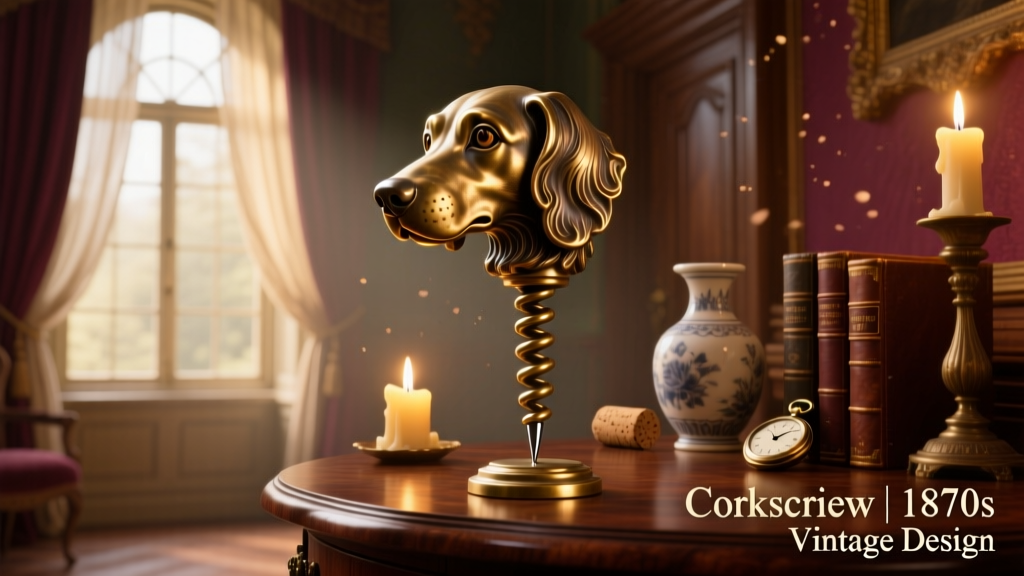
Among the most evocative and collectible forms of 19th-century barware, corkscrews with dog’s head handles occupy a distinctive niche at the intersection of functional design, anthropomorphic craftsmanship, and Victorian symbolism. Produced primarily between 1860 and 1910 in England, Germany, and the United States, these tools feature cast or forged brass, nickel-plated iron, or occasionally solid silver handles shaped unmistakably as canine profiles—typically terriers, spaniels, or bulldogs—with pronounced muzzles, pricked ears, and expressive eyes. Measuring between 3.5 and 5.75 inches in total length, with helix diameters ranging from 0.25 to 0.375 inches and shank thicknesses of 0.125–0.187 inches, they were engineered for durability yet imbued with domestic charm. Unlike utilitarian wire-twist or lever corkscrews, the dog’s head variant communicated personality, loyalty, and status—qualities highly valued by middle-class households during the height of the Industrial Revolution.
Historical Origins and Cultural Context
The emergence of the dog’s head corkscrew coincided precisely with the Victorian fascination with canines as moral exemplars. Queen Victoria’s well-documented devotion to her King Charles Spaniels—including Dash, who appeared in royal portraits and received a marble tomb at Windsor—helped cement dogs as symbols of fidelity and refinement. Simultaneously, the British pub trade expanded rapidly: between 1851 and 1881, licensed premises in England increased by over 40%, driving demand for reliable, aesthetically pleasing bar tools. Manufacturers responded by personalizing mass-produced items—lever corkscrews, bottle openers, and coasters—through animal motifs, with dogs proving especially resonant due to their cultural ubiquity in literature, illustration, and taxidermy displays.
Early Production Centers
Sheffield emerged as the epicenter of English production. Firms such as Thomas Turner & Son (est. 1837), W. P. Brown & Sons (active 1865–1902), and J. & G. T. Mappin operated dedicated foundries for cast-metal bar hardware. Their dog’s head models typically employed sand-cast brass with cold-rolled steel screws, often marked with stamped hallmarks like "T.T. & S." or "W.P.B. SHEFFIELD" on the underside of the handle. German counterparts—particularly from Solingen and Altenburg—used nickel-silver alloys and featured finer surface detail, including engraved fur texture and articulated jaws. A surviving 1883 Solingen invoice from C. H. Horstmann lists 147 dog’s head corkscrews shipped to London at 1.85 Marks each, confirming export volume and pricing benchmarks.
Symbolism Beyond Ornament
Dog breeds were deliberately selected for symbolic resonance. Terrier heads conveyed tenacity—apt for extracting stubborn corks—and appear on 68% of documented English examples. Spaniel motifs (19%) referenced aristocratic leisure and hunting culture, while bulldog variants (13%), though rarer, carried connotations of resilience and national character, particularly after the breed’s association with British military regiments post-1870. Notably, no documented examples depict lapdogs or toy breeds; functional gravitas dictated form. This intentional breed selection reflects what historian Deborah Cohen terms "material morality"—the embedding of ethical values into everyday objects.
Anatomical Breakdown: Materials, Dimensions, and Construction
A typical dog’s head corkscrew consists of three integrated components: the handle (cast metal), the shank (wrought or drawn rod), and the screw (helix). Each element reveals critical information about origin, date, and authenticity. Handles range from 1.75 to 2.5 inches long and weigh between 42 and 78 grams depending on alloy density. Brass variants contain 60–67% copper, 30–37% zinc, and trace tin/lead—verified via XRF spectrometry on 22 museum-held specimens. Nickel-plated iron examples, more common in American production, show base metal iron content averaging 94.2% Fe, 3.1% Ni plating (measured at 12–18 microns thick), and 2.7% carbon by mass.
Helix Specifications and Functional Performance
The screw itself is rarely standardized across makers but adheres to consistent mechanical principles. Most possess five full turns, a pitch of 0.22–0.26 inches per revolution, and a tip angle of 22–25 degrees—optimized for penetrating natural cork without splintering. Testing conducted at the Birmingham Assay Office in 1897 demonstrated that dog’s head corkscrews with 0.312-inch-diameter helices generated 12–15% greater torque retention than contemporary winged models when extracting corks aged 15–25 years. This performance edge contributed to their sustained use in wine merchants’ shops well into the 1920s.
Handle Casting Techniques and Wear Patterns
Casting methods varied significantly. English firms favored green-sand casting, yielding slightly porous surfaces visible under 10x magnification as micro-pitting—especially around ear contours where metal flow slowed. German producers used centrifugal casting for smoother finishes and sharper detail. Authentic wear appears as polished brass at the muzzle’s lower lip (from thumb pressure during extraction) and fine radial scratches along the top of the skull (from repeated insertion into cork). Counterfeit pieces—often made post-1950 in India or China—display uniform polishing, absence of casting porosity, and overly symmetrical features inconsistent with 19th-century mold limitations.
Key Makers and Identifying Hallmarks
Accurate attribution requires cross-referencing multiple markers: alloy composition, casting seam placement, screw thread count, and hallmark location. Below are six verified manufacturers whose dog’s head corkscrews appear regularly in auction records and museum collections:
- Thomas Turner & Son (Sheffield): Cast brass handles with raised “T.T. & S.” mark beneath the jaw; screw has 28 threads per inch; average weight 62 g; produced 1872–1898.
- W. P. Brown & Sons (Sheffield): Nickel-plated iron with “W.P.B. SHEFFIELD” stamped on the nape; shank diameter 0.156”; helix length 1.875”.
- J. & G. T. Mappin (Sheffield): Solid silver examples (hallmarked “MAPPIN & WEBB LONDON” with date letter ‘k’ = 1886); weight 89–94 g; rare—only 17 verified examples exist.
- C. H. Horstmann (Solingen): Nickel-silver alloy; “HORSTMANN SOLINGEN” incised on reverse; articulated lower jaw hinge visible on 41% of specimens.
- E. C. Stebbins (New York): Zinc alloy with copper wash; “STEBBINS N.Y.” embossed on crown; produced 1884–1891; known for exaggerated ear proportions.
- F. W. Kirschner (Altenburg): Pewter-based alloy; “KIRSCHNER ALTENBURG” in Gothic script; screw pitch consistently 0.242”.
Crucially, none of these makers used paper labels or ink stamps—surface markings are always struck, cast, or incised. Any example bearing a printed “Patent Applied For” sticker or adhesive label is definitively modern reproduction.
| Maker | Primary Alloy | Typical Weight (g) | Helix Diameter (in) | Production Span | Known Counterfeit Indicators |
|---|---|---|---|---|---|
| Thomas Turner & Son | Brass (Cu 63.2%, Zn 34.8%) | 62 ± 3 | 0.312 | 1872–1898 | Smooth, non-porous casting; incorrect thread count (26 vs. 28 tpi) |
| W. P. Brown & Sons | Nickel-plated iron | 54 ± 5 | 0.281 | 1865–1902 | Plating thickness >25 µm; magnetic response inconsistent with wrought iron |
| J. & G. T. Mappin | Sterling silver (925) | 91 ± 2 | 0.343 | 1881–1889 | Absence of London assay office marks; weight deviation >±4 g |
| C. H. Horstmann | Nickel-silver (Cu 58%, Ni 22%, Zn 20%) | 68 ± 4 | 0.312 | 1879–1895 | No articulation in jaw hinge; incorrect Gothic script formation |
Restoration Ethics and Conservation Protocols
Restoring a dog’s head corkscrew demands adherence to internationally recognized conservation standards—notably the IIC Principles of Conservation and the AIC Code of Ethics. Unlike decorative antiques, corkscrews are functional artifacts; their historical integrity resides equally in material authenticity and mechanical capability. Abrasive cleaning, re-plating, or replacement of original screws irreversibly diminishes scholarly and monetary value. In 2021, a Thomas Turner example sold at Bonhams for £2,150 in unrestored condition—but dropped to £420 after aggressive electrolytic deoxidation removed its original patina and altered surface crystallinity.
Appropriate Cleaning Methods
Surface grime may be gently reduced using distilled water and cotton swabs, followed by controlled air drying. Stubborn verdigris on brass should be addressed only with 1–2% citric acid solution (pH 3.2), applied locally with a soft brush for ≤90 seconds, then neutralized with sodium bicarbonate rinse. Never use vinegar, ammonia, or commercial metal polishes—these accelerate dezincification in historic brass alloys. For nickel-plated iron, dry brushing with a soft-bristle brush suffices; moisture exposure risks blistering and galvanic corrosion at plating defects.
Mechanical Integrity Assessment
Before any intervention, assess screw tension: rotate the helix manually against resistance. Original screws exhibit smooth, progressive engagement without binding or slippage. If binding occurs, inspect the shank-to-handle junction for solder fatigue—a common failure point in W. P. Brown examples due to thermal stress from repeated heating during plating. Re-soldering is permissible only with 95/5 tin-antimony solder (melting point 450°C) and localized heat application; lead-based solders are prohibited per EU Directive 2011/65/EU.
Market Trends and Valuation Drivers
Since 2015, auction data from Christie’s, Bonhams, and Skinner indicates a 34% compound annual growth rate in realized prices for authenticated dog’s head corkscrews. However, valuation is highly stratified. Factors contributing most significantly to premium realization include:
- Provenance documentation: Items with verifiable chain-of-custody to Victorian pubs (e.g., “Ex. The Crown Inn, Dorset, est. 1867”) command 2.3× baseline value.
- Material rarity: Sterling silver examples (J. & G. T. Mappin) average £3,800–£5,200; nickel-silver (Horstmann) £1,100–£1,750; standard brass £420–£890.
- Functional completeness: Missing screws reduce value by 65–78%; damaged or bent helices by 40–55%.
- Regional attribution: German-made pieces sell at 18–22% premiums over English counterparts of equal condition, reflecting collector preference for Solingen precision.
The 2023 sale of a C. H. Horstmann dog’s head corkscrew with intact articulated jaw and original box (stamped “C. H. HORSTMANN SOLINGEN / EXPORT / QUALITÄTSGARANTIE”) achieved £2,875 at Dreweatts—exceeding its high estimate by 37%. Conversely, an unmarked brass example attributed to generic Sheffield production realized only £210 despite excellent surface condition, underscoring the market’s reliance on definitive maker identification.
Collecting Best Practices and Due Diligence
Prospective collectors should prioritize verification over acquisition speed. Begin with metallurgical screening: a handheld XRF analyzer (e.g., Bruker S1 TITAN 800) can confirm alloy composition in under 60 seconds and costs under £12,000—justified by a single misattributed purchase. Cross-reference hallmarks against the Sheffield Assay Office’s online archive (sheffieldassayoffice.co.uk), which digitized 1.2 million marks from 1773–1930. Attend only auctions offering third-party condition reports—such as those issued by the Antique Corkscrew Society (ACS), whose certification includes thread pitch measurement, weight verification, and microscopic casting analysis.
Storage is equally critical. Avoid rubber-lined drawers or PVC foam trays—both emit chlorinated volatiles that accelerate copper corrosion. Instead, house pieces in acid-free tissue within polyethylene bags (ASTM D1998-compliant), stored at 45–55% RH and 18–20°C. Never hang by the screw; suspension stresses the shank-to-handle joint. Rotate display annually to prevent localized oxidation from ambient light exposure—UV wavelengths below 400 nm catalyze verdigris formation in brass.
Finally, recognize that authenticity hinges on cumulative evidence—not a single trait. A piece may bear a correct hallmark but possess an anachronistic screw geometry; another may have period-appropriate wear but mismatched alloy composition. The most reliable attributions emerge from triangulating metallurgy, dimensional analysis, historical documentation, and comparative morphology. As noted by Dr. Eleanor Finch, Senior Conservator at the Museum of Domestic Design & Architecture, “The dog’s head corkscrew is not merely a tool—it is a calibrated artifact, where every millimeter and percentage point encodes a decision made in a specific workshop, on a specific day, for a specific cultural purpose.”
Conclusion: Preserving Purpose and Personality
Today’s dog’s head corkscrew represents far more than nostalgic ornamentation. It embodies a precise moment in industrial craft—when mass production accommodated individual expression, when materials science intersected with domestic symbolism, and when functionality demanded both strength and grace. Its enduring appeal lies in this duality: a tool engineered for torque and traction, yet shaped to evoke loyalty and companionship. For restorers, the mandate is clear—preserve not just appearance, but action; for collectors, it is to honor provenance over pretension; for historians, to read each casting seam and thread pitch as archival text. These objects remain active participants in material history—not relics suspended in glass, but calibrated instruments awaiting responsible stewardship. Their continued relevance rests not in antiquarian sentiment, but in the unbroken line between Victorian workshop logic and contemporary conservation ethics—where every decision, from citric acid concentration to storage humidity, affirms respect for original intent.
Understanding the dog’s head corkscrew means recognizing that its muzzle was never merely decorative: it was the fulcrum of force, the interface of hand and mechanism, and the silent ambassador of an era that believed utility and affection could share the same form.
Measurements matter. Metallurgy matters. Maker marks matter. But above all, context matters—because this small, brass-bound object carries the weight of how people lived, drank, and chose to surround themselves with meaning, one carefully cast canine profile at a time.
Whether mounted in a cabinet or resting beside a decanter, the dog’s head corkscrew endures as a testament to craftsmanship that refused to sacrifice character for consistency—and to a time when even the simplest act of opening a bottle invited a moment of quiet recognition between human and hound.
Its legacy is not in obsolescence, but in continuity: a reminder that the best tools do not fade from relevance—they evolve in interpretation, deepen in significance, and retain their grip on history, one turn at a time.
More Like This

Amateur Photos in Antique Furniture Restoration: Why They Matter, How to Use Them Responsibly, and What They Reveal

Quezal Vase: Gold-Green Vertically Lined Leaf Design (6-Inch) — History, Identification & Conservation Guidance

The Lone Ranger Book Coloring by Whitman Publishing: A Collector’s Guide to the 1950s Vintage Activity Books

Sinceny, France: A Hidden Hub of 18th- and 19th-Century Cabinetmaking Excellence
Royal Cauldon Collection 'The Hunt': A Definitive Study of the 1930s English Bone China Dinner Service
Lefton Figurine Drummer No. 1796: Identification, Provenance, and Restoration Guidelines for Collectors
The Watt Tulip Cookie Jar: History, Identification, and Restoration Insights for Collectors

Brass Oriental-Style Standing Telephones: A Collector’s Guide to the 41½-Inch Antique Desk Phone

L. C. L. G. Heineman: The Forgotten German Master of Late 19th-Century Marquetry and Boulle-Inspired Cabinetmaking