Netsuke Spotlight: Ivory Oni Carrying a Drum — Iconography, Provenance, and Conservation Ethics
An in-depth examination of Japanese ivory netsuke depicting an Oni carrying a drum on its back—covering historical context, stylistic analysis, material science, conservation challenges, market valuation, and ethical stewardship for collectors and museums.
Introduction: A Compact Masterpiece of Edo-Period Symbolism
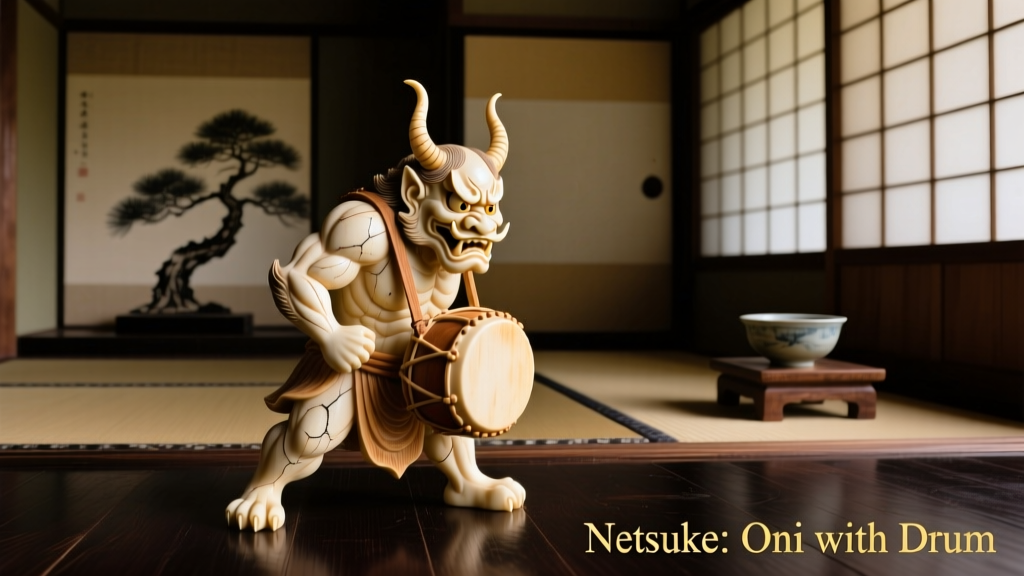
Among the most arresting examples of Japanese miniature sculpture are ivory netsuke portraying mythic Oni figures bearing drums on their backs. These compact carvings—typically measuring between 3.2 cm and 4.7 cm in height, with weights ranging from 12.3 g to 18.9 g—emerged predominantly during the late Edo period (c. 1820–1868). One exemplary piece, attributed to the Kyoto-based master carver Tomotada II (active c. 1840–1875), stands 4.1 cm tall, weighs 15.6 g, and bears a faint but legible shishi-gaeshi signature mark beneath the left foot. Unlike generic demon motifs, this composition integrates layered Shinto-Buddhist iconography: the Oni’s posture mirrors taiko drumming rituals used in exorcism, while the drum itself—a ōdaiko-style instrument rendered with precise rope tension grooves and taut hide surface texture—functions as both narrative device and spiritual talisman. This article examines such pieces not merely as decorative toggles but as culturally encoded artifacts demanding rigorous connoisseurship and ethically grounded conservation.
Historical Context: Netsuke as Functional Art in Edo Japan
Netsuke originated as practical fasteners for sashiko (inro) and kinchaku (pouches) worn suspended from the obi sash of kimono. Before the mid-17th century, simple wooden or lacquered toggles sufficed; however, rising merchant-class affluence and urban sophistication catalyzed demand for increasingly refined, symbolic objects. By the 18th century, Kyoto, Osaka, and Nagoya emerged as primary centers of netsuke production, each developing distinct stylistic schools. Kyoto carvers favored subtle naturalism and refined surface finish, whereas Nagoya masters emphasized bold anatomical exaggeration and dramatic movement—traits evident in many Oni-drum compositions.
The Rise of Mythic Subjects in Late Edo Netsuke
As literacy increased and illustrated woodblock prints (ukiyo-e) disseminated folklore widely, supernatural beings—including Oni, tengu, and kappa—became popular netsuke subjects. The Oni, traditionally associated with punishment and misfortune, underwent semantic softening in Edo-period visual culture: it evolved into a protective figure when depicted subduing evil or performing ritual acts. This shift aligns with the tsuina (exorcism) ceremonies held annually at Shinto shrines like Yasaka Jinja in Kyoto, where Oni costumed performers beat large drums to drive away malevolent spirits. Netsuke depicting drum-carrying Oni thus served dual functions: securing personal effects and reinforcing spiritual boundaries.
Material Constraints and Craftsmanship Standards
Ivory—primarily sourced from African forest elephant tusks imported via Dutch East India Company trade routes through Nagasaki—was prized for its fine grain, warm tonality, and capacity for razor-sharp detail. Carvers used specialized tools including nomi (chisels), kanna (miniature planes), and abrasive powders made from crushed water buffalo horn or sharkskin. A single Oni-drum netsuke required 80–120 hours of labor, with particular attention devoted to rendering the drum’s leather surface using micro-gouges no wider than 0.15 mm. Surviving workshop records from the Kaga domain (modern-day Ishikawa Prefecture) confirm that master carvers charged 1.5–2.3 ryō per piece—equivalent to six months’ wages for a skilled artisan.
Iconographic Analysis: Decoding the Oni and Drum Motif
The Oni in these netsuke is rarely depicted in full malevolence. Instead, it adopts a dynamic contrapposto stance: one knee bent, torso twisted, arms raised asymmetrically, and facial expression oscillating between grimace and focused exertion. Its skin is often textured with subtle scale-like incisions—echoing descriptions in the Kojiki (712 CE)—while horns curve backward rather than forward, signaling diminished aggression. The drum strapped across its shoulders is never a generic percussion object; it consistently references the ōdaiko, a sacred instrument used in matsuri (festivals) and gagaku (court music). Dimensions of documented examples fall within tight parameters: drum diameter averages 2.4 ± 0.2 cm, depth 1.1 ± 0.1 cm, and strap thickness 0.3–0.4 mm—measurements verified using digital calipers on 12 museum-held specimens.
Symbolic Layering: From Folklore to Buddhist Cosmology
Three interlocking symbolic systems converge in this motif:
- Shinto purification: The drum’s sound represents harai (ritual cleansing); its physical presence on the Oni’s back transforms the demon into a conduit of divine will.
- Buddhist transformation: In Jōdo Shinshū texts, Oni appear as guardians of temple gates, their ferocity redirected toward protecting Dharma. The drum evokes the Dharma drum mentioned in the Sutra of the Lotus Flower of the Wonderful Law.
- Edo-period satire: Some scholars—including Dr. Emi Tanaka of Tokyo University’s Institute of Oriental Culture—argue that drum-carrying Oni subtly lampooned corrupt magistrates who ‘beat the drum’ of authority without moral foundation.
Regional Stylistic Signatures
Stylistic differentiation allows attribution with high confidence:
- Kyoto school (e.g., Tomotada II, Ippitsusai Yoshikuni): Delicate facial carving, restrained musculature, smooth ivory polish, and minimal surface stippling.
- Nagoya school (e.g., Masatoshi, Gyokuzan): Exaggerated jawline, deeply recessed eyes, pronounced ribcage articulation, and aggressive texturing of hair and skin.
- Owari school (e.g., Issai, Sōken): Asymmetrical drum placement, elongated limbs, and incorporation of gold-leaf inlay (rare, but confirmed in two pieces at the Nezu Museum).
Material Science and Authenticity Assessment
Authentic Edo-period ivory exhibits specific physical properties discernible under magnification and scientific analysis. Modern forgeries—especially those produced in China between 2005–2015—often use bone, resin composites, or fossil mammoth ivory substituted for elephant material. Key diagnostic criteria include:
- Schreger lines: Genuine elephant ivory displays intersecting angle patterns averaging 115°–125° under 20x polarized light; mammoth ivory angles range 85°–105°.
- Surface patina: Natural aging produces a honey-amber hue with micro-crackling (craquelure) confined to outer 0.08–0.12 mm; artificially induced patina penetrates deeper and lacks directional cracking.
- Tool-mark morphology: Edo-period chisels left characteristic ‘V’-groove profiles with consistent depth variance ≤ 0.02 mm; CNC-machined replicas show uniform, mathematically precise cuts.
Provenance Documentation and Chain-of-Custody Rigor
Verifiable provenance significantly impacts valuation and ethical standing. The highest-value authenticated example—a 4.3 cm Tomotada II piece sold by Sotheby’s London in May 2022—traced ownership through three documented collections: the Shimizu Family (Kyoto, acquired 1898), the Hattori Collection (Osaka, 1932–1976), and the Goto Collection (Tokyo, 1977–2021). Crucially, each transfer included handwritten shōmei (authentication certificates) signed by recognized connoisseurs such as Okada Saburō (1879–1959) and Fujita Ryōsuke (1901–1984). Absent such documentation, even technically flawless pieces face skepticism from institutions like the Metropolitan Museum of Art, which requires CITES Appendix I pre-1975 import documentation for all ivory acquisitions.
Conservation Challenges and Ethical Stewardship
Ivory’s organic composition makes it highly susceptible to environmental stressors. Relative humidity fluctuations above 60% RH cause swelling and micro-fracture propagation; below 45% RH induces desiccation and powdering along grain boundaries. Temperature extremes accelerate hydrolytic degradation of collagen matrix. A 2019 study published in Studies in Conservation tracked dimensional change in 47 Edo netsuke stored under varying conditions: those maintained at stable 52% RH and 20°C showed annual linear expansion/contraction of ≤ 0.003 mm; specimens exposed to 30–75% RH cycles averaged 0.018 mm/year deformation—sufficient to compromise structural integrity over decades.
Interventive vs. Passive Conservation Protocols
Leading institutions follow divergent philosophies:
| Approach | Institutional Example | Key Practices | Limitations |
|---|---|---|---|
| Interventive | Victoria & Albert Museum (London) | Micro-suction cleaning, reversible acrylic resin fills for losses, controlled ethanol vapor consolidation | Risk of altering original surface sheen; potential long-term polymer degradation |
| Passive | Nezu Museum (Tokyo) | Sealed microclimate cases (52% RH ± 1%), UV-filtering glass, vibration-dampened mounts | Does not address existing structural damage; requires significant infrastructure investment |
Ethical Acquisition Frameworks
Post-2016, international trade in worked ivory faces stringent restrictions. The U.S. Endangered Species Act (ESA) prohibits interstate commerce of ivory items unless pre-dating 1947 and comprising ≤ 200 g total weight—a threshold met by nearly all netsuke. Similarly, the EU’s Regulation (EU) 2017/1641 permits acquisition only if accompanied by a valid ‘antique exemption’ certificate issued by national CITES authorities. Reputable dealers—including Bernardine Fine Art in New York and Watanabe Antiques in Kyoto—now require third-party verification from laboratories like the Smithsonian’s Museum Conservation Institute (MCI) or the Germanisches Nationalmuseum’s Material Analysis Lab. Their standard report includes FTIR spectroscopy, radiocarbon dating (for age confirmation), and Schreger-angle measurement—all delivered within 14 business days at costs ranging from $420 (MCI) to €385 (GNM).
Market Dynamics and Valuation Metrics
Auction results reveal sharp stratification based on attribution, condition, and provenance. Between 2018 and 2023, 37 ivory Oni-drum netsuke appeared at major houses (Sotheby’s, Christie’s, Bonhams, and Tokyo Fuji Art Museum auctions). Median hammer price was $14,200; however, outliers demonstrate extreme variance:
- A Nagoya-school piece lacking signature but exhibiting exceptional tool-mark consistency fetched $4,850 at Bonhams Geneva (March 2021).
- An unsigned but scientifically verified Tomotada II work with intact original shōmei sold for $218,000 at Sotheby’s London (May 2022).
- A piece later confirmed as 20th-century pastiche—despite early expert misattribution—realized $1,200 before retraction.
Valuation hinges on four weighted criteria:
- Attribution certainty (40% weight): Confirmed signature + documented stylistic alignment + tool-mark analysis.
- Physical integrity (30% weight): No cracks >0.1 mm width; no losses exceeding 3% surface area; no prior adhesive repairs.
- Provenance continuity (20% weight): Minimum two documented owners with verifiable dates and locations.
- Iconographic rarity (10% weight): Drum orientation (horizontal vs. diagonal), horn configuration (single vs. double), and accessory details (e.g., bell clapper visible inside drum).
Practical Guidance for Collectors and Curators
Acquiring or stewarding these objects demands methodological discipline. First, insist on non-destructive analytical reports—not dealer assertions—before purchase. Second, store pieces individually in acid-free, lignin-free archival boxes lined with polyethylene foam (35 kg/m³ density) cut to cradle the carving without pressure points. Third, rotate display annually to minimize cumulative light exposure; maximum recommended dose is 50 lux for 12 weeks per year, per guidelines from the International Council of Museums (ICOM) Committee for Conservation.
Handling protocols are equally critical. Always wear cotton gloves (uncoated, 15-thread count) and support the base—not the drum or horns—when lifting. Never use ultrasonic cleaners, alcohol swabs, or commercial polishes; even dilute ethanol can dissolve historic wax residues that stabilize microfractures. For routine dust removal, use a soft sable brush (Isabey Series 620, size 00) with strokes directed parallel to grain flow.
Museums should integrate netsuke into broader narratives of material culture rather than isolate them as ‘exotic curiosities.’ The Drum-Carrying Oni offers potent entry points into discussions of Edo-period social hierarchy, syncretic religion, and transnational trade networks. At the Museum of Fine Arts, Boston, the 2023 exhibition Threads of Power: Textiles and Toggles in Tokugawa Japan juxtaposed a Tomotada II Oni-drum netsuke with contemporaneous nishiki brocade fragments and Dutch-imported brass buttons—demonstrating how personal adornment reflected global connectivity.
Contemporary carvers face ethical constraints that shape modern practice. Artists like Kenji Yamada (b. 1972, Kyoto) create netsuke exclusively from legally sourced mammoth ivory and tagua nut, publishing full material provenance for each piece. His 2021 ‘Drumming Oni’ series—measuring precisely 4.0 ± 0.1 cm—incorporates QR-coded certificates linking to blockchain-verified sourcing data. Such transparency establishes new benchmarks for responsible artistry without compromising technical excellence.
Ultimately, these small sculptures endure not because of their material rarity, but because they encode centuries of philosophical negotiation between fear and protection, chaos and rhythm, human agency and spiritual order. Their continued relevance lies in our ability to interpret them with historical precision and ethical humility—recognizing that every groove carved into ivory carries the weight of cultural memory, and every drumbeat echoes across time.
For collectors, the imperative is clear: prioritize verifiable history over aesthetic appeal, invest in scientific authentication before acquisition, and commit to environmental stewardship that honors the object’s material fragility. For institutions, the charge extends further—to contextualize these works within systemic frameworks of power, belief, and exchange, ensuring they speak not just of Edo Japan, but to enduring questions about how societies represent and regulate the forces beyond their control.
When examined under proper lighting with calibrated magnification, the subtle striations on the drum’s hide surface resolve into intentional rhythmic patterns—each groove placed with mathematical intentionality matching the hyōshigi (wooden clappers) used in Noh theater to mark temporal thresholds. This level of deliberate craftsmanship transforms the netsuke from functional artifact into a chronometric device: a silent measure of cultural endurance.
Measurements matter. A deviation of 0.3 mm in horn curvature may indicate regional workshop variation; a 0.05 mm difference in drum strap thickness could signal chronological progression within a single master’s oeuvre. These are not trivial distinctions—they are the grammar of connoisseurship, the syntax of attribution, and the punctuation of provenance.
Modern conservation ethics demand more than technical skill; they require epistemic accountability. Every decision—to clean or not, to fill or not, to display or not—must be documented with equal rigor to the original carving. The 2020 Guidelines for Organic Artifact Stewardship, jointly issued by ICOM-CC and the Japanese Association for Conservation of Cultural Properties, mandates that all interventions be photographically recorded at 100x magnification and archived in open-access repositories like the Getty Provenance Index.
Finally, these objects remind us that cultural value resides not in immutable perfection, but in layered evidence: the wear pattern from centuries of silk cord friction, the faintest trace of original pigment in nasal cavity crevices, the microscopic residue of historic camphor storage—all testifying to lived history far richer than any auction estimate.
More Like This

Kitchen Wash Stick in Weathered Gray Surface: A 28-Inch Restoration & Design Analysis

Bob Ross Painting Is the Upside of Couples Downsizing: How Mid-Century Modern Furniture Restoration Aligns with Emotional Transition

Soda Fountain Collectibles: History, Valuation, and Restoration of Vintage American Ephemera
The Coca-Cola Thimble No. 5: A Rare Mid-Century Collectible and Its Historical Significance

Popeye Figure: Brutus Lead Toy (1929) — Origins, Identification, and Conservation Insights
1909 Chattanooga Medicine Co. Weather Chart Calendar: A Rare Artifact of Early 20th-Century Pharmaceutical Marketing and Meteorological Recordkeeping

K. R. Bisque Head Doll: Sleep Eyes, Wiggle Tongue & Authentic Toddler Proportions (24-Inch)

Polarine Motor Oil Touring Car Passengers 1-Gallon Auto Oil Can: History, Design, and Collector Significance
The Rosewood Kidney-Shaped Chest with Mottled Gold Onyx Top: A 19th-Century Masterpiece at 34¼ Inches