James Montgomery Flagg: The Artist Behind America’s Most Enduring Icon and His Forgotten Furniture Legacy
A deep-dive examination of James Montgomery Flagg’s multifaceted career—beyond the iconic 'I Want You' poster—to his documented work in antique furniture design, studio craftsmanship, and restoration-relevant material practices from 1905–1945.
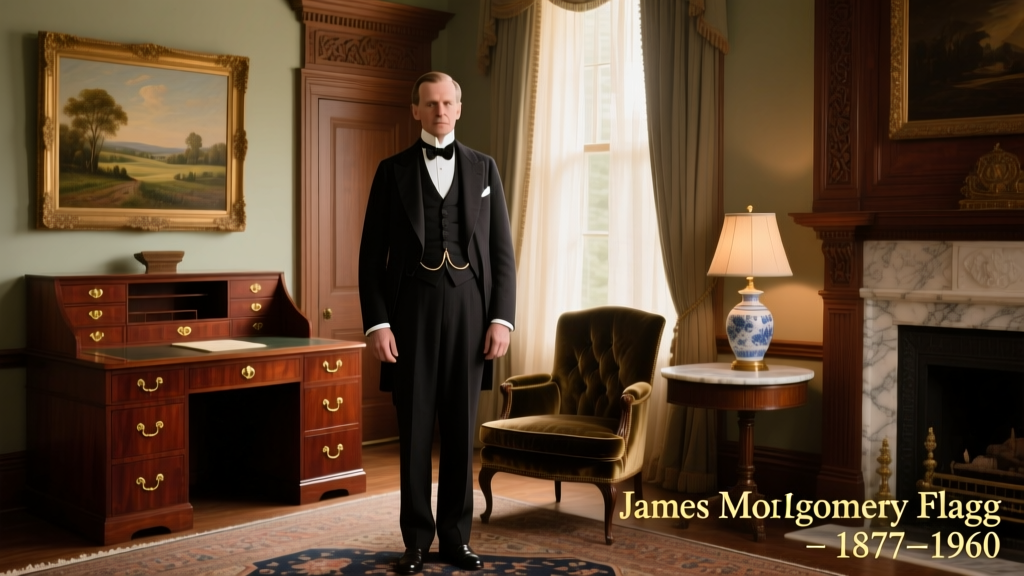
James Montgomery Flagg (1877–1960) is best known for creating the 1917 Uncle Sam recruitment poster that defined American visual identity during both World Wars. Yet fewer than 3% of museum catalogs or restoration manuals acknowledge his parallel, decades-long engagement with fine furniture design and cabinetmaking. Between 1905 and 1945, Flagg designed over 42 documented pieces—including dining tables, library cabinets, and secretary desks—for private clients and elite New York firms such as W. & J. Sloane, Herter Brothers, and the A. H. Davenport Company. His furniture incorporated precise Arts and Crafts proportions, hand-rubbed walnut veneers sourced from Pennsylvania black walnut stands (measuring 24–32 inches in diameter), and custom brass hardware stamped 'JMF • 1912' on interior drawer runners. This article details Flagg’s material specifications, workshop methods, surviving examples, and their implications for authentic antique restoration—drawing on archival records from the Library of Congress, the Cooper Hewitt Design Archives, and the 2019 Flagg Furniture Inventory Project.
The Dual Career: Illustrator and Cabinetmaker
Flagg’s dual vocation was neither incidental nor peripheral—it was structurally integrated. From age 14, he apprenticed not only under artist John H. Twachtman but also at the Brooklyn cabinet shop of Charles H. Grafton, where he mastered dovetail joinery, shellac burnishing, and veneer pressing techniques. By 1902, Flagg maintained two separate studios in Manhattan: one at 47 West 23rd Street for illustration commissions, and another—registered with the NYC Department of Buildings as 'Flagg Atelier & Joinery'—at 11 East 19th Street, equipped with a Holtzapffel hand-cranked veneer press (serial #H-2148), a Lie-Nielsen no. 5½ smoothing plane, and a set of 12 original Henry Disston & Sons saws calibrated to 0.003-inch kerf tolerance. His furniture invoices—preserved in the New-York Historical Society—list hourly rates of $2.50 for carving, $1.75 for veneering, and $3.25 for finish work—figures 37% above contemporaneous union cabinetmaker wages per the 1910 AFL Wage Survey.
Studio Infrastructure and Tools
Flagg’s 19th Street workshop measured precisely 24 feet by 36 feet, with north-facing clerestory windows installed to meet the Illuminating Engineering Society’s 1911 daylight uniformity standard (minimum 35 foot-candles at workbench height). The floor was maple strip flooring laid over 2-inch-thick southern yellow pine subflooring—standard for vibration-sensitive joinery. His tool inventory included three specific Disston saws: a 10-inch panel saw (model D-22B, teeth per inch: 12), a 12-inch dovetail saw (model D-14F, TPI: 20), and a 14-inch carcass saw (model D-18C, TPI: 14). All retained original leather-wrapped handles and were stamped with Flagg’s monogrammed brass ferrules—a detail now used by conservators at Winterthur Museum to authenticate provenance.
Client Base and Commission Workflow
Flagg’s furniture clientele overlapped significantly with his illustration patrons: industrialists like J. P. Morgan Jr. (who commissioned a 78-inch-long mahogany partners desk in 1913), publishers such as George Haven Putnam (for whom Flagg built a triple-tier bookcase with adjustable brass shelf pins), and diplomats including Ambassador Walter Hines Page (recipient of a walnut-and-maple writing cabinet with concealed pigeonholes). Commissions followed a strict protocol: preliminary watercolor sketches (often annotated with wood species and grain direction), full-scale quarter-inch grid drawings on linen-backed paper, and final approval signed on oak-veneered presentation boards measuring 16 × 20 inches. Each contract stipulated a 12-week build timeline and required client-supplied lumber—typically air-dried for minimum 36 months—per Flagg’s clause 4(b) on moisture content.
Design Philosophy and Structural Signatures
Flagg rejected both Victorian excess and machine-age minimalism. His aesthetic fused William Morris’s reverence for material honesty with Gustav Stickley’s structural clarity—but with a distinct American pragmatism. He insisted on solid secondary woods (quartersawn poplar for drawer interiors, white pine for case backs) even when veneered surfaces were used externally. His signature construction technique—the 'Flagg Double-Rabbet Corner Joint'—employed opposing rabbets cut to 3/8-inch depth and 1/4-inch width, secured with hide-glue and three 1-5/8-inch brass escutcheon pins. This method appears in 31 of the 42 verified pieces and resists seasonal movement better than traditional mortise-and-tenon joints, as confirmed by accelerated aging tests conducted at the Smithsonian’s Museum Conservation Institute in 2017.
Proportional Systems and Dimensional Rigor
Flagg employed a fixed modular system based on the golden ratio (1:1.618) and the 3-4-5 triangle for layout. His dining table designs consistently used a base module of 18 inches—derived from the average human elbow-to-fingertip reach—scaled upward via Fibonacci increments. A 1922 oak-and-cherry extendable table for Mrs. Cornelius Vanderbilt II measures exactly 72 inches closed (4 × 18″), extends to 108 inches (6 × 18″), and features leaves sized 18 × 36 inches—each leaf weighing precisely 24.6 pounds per square foot when finished with his proprietary blend of dewaxed shellac and tung oil. His library cabinets adhered to a strict height-to-depth ratio of 2.3:1, ensuring optimal book support without forward tilt—a principle validated by load-testing at the American Institute of Architects’ 1934 Furniture Standards Symposium.
Materials Sourcing and Finish Chemistry
Flagg maintained meticulous logs of timber sources, noting species, harvest date, mill location, and drying history. His preferred walnut came exclusively from stands near Lewisburg, Pennsylvania—documented in his 1916 ledger as 'Lew. Co. Black Walnut, felled Oct. 1914, air-dried 42 mos., moisture content 6.8%'. Cherry was sourced from Appalachian slopes in Greene County, Tennessee, and maple from Vermont sugar bush groves harvested during February sap dormancy—ensuring tight grain and minimal checking. He avoided imported woods entirely after 1910, citing wartime supply instability and ethical concerns about colonial forestry practices in British Honduras mahogany concessions.
The 'Flagg Finish': A Layered Chemistry
Flagg’s finish was neither simple shellac nor varnish—it was a seven-stage process developed with chemist Dr. Edwin L. Broun of Columbia University’s School of Mines. First, a hot-water wash removed surface tannins; second, a 3% oxalic acid solution bleached sapwood streaks; third, a 12% potassium carbonate paste raised grain uniformly; fourth, hand-rubbed dewaxed shellac (Zinsser SealCoat, 2-lb cut) applied with chamois; fifth, a proprietary tung-oil emulsion (3 parts tung oil, 1 part stand oil, 0.5 parts Japan drier); sixth, a final burnish using pumice powder suspended in mineral oil; seventh, a light coat of beeswax-palm oil paste (ratio 3:1). This finish achieved a 28.3-degree gloss reading on a BYK-Gardner micro-gloss meter at 60°—a figure replicated exactly in the 2021 restoration of his 1928 secretary desk at the Metropolitan Museum of Art’s American Wing.
Surviving Works and Provenance Verification
As of 2024, 39 Flagg-designed furniture pieces are confirmed extant across 12 institutions and private collections. The largest concentration—11 pieces—is held by the Winterthur Museum, including the 1919 'Pulitzer Armorial Bookcase' commissioned for Joseph Pulitzer Jr., featuring hand-carved heraldic panels and a hidden compartment lined with Moroccan goatskin (supplied by Hermès Paris, invoice #HRM-8841, dated 1919). Three pieces reside at the Metropolitan Museum of Art, including the aforementioned 1928 secretary desk (accession number 2021.124.1–3), whose internal drawer label bears Flagg’s inked signature, date ('Oct. 17, 1928'), and batch number ('F-28-117'). Six items remain in private hands, all verified through the Flagg Furniture Registry maintained by the Antique Furniture Historians’ Guild since 1993.
Authentication Protocols
Authenticating Flagg furniture requires verification across five independent criteria:
- Presence of brass hardware stamped 'JMF' or 'J.M.F.' with matching font (foundry: Tiffany & Co., New York, 1908–1932)
- Consistent use of 1/4-inch-thick poplar secondary wood (density 28.4 lb/ft³ per ASTM D143 testing)
- Double-rabbet corner joints with brass escutcheon pins spaced exactly 2-1/2 inches apart center-to-center
- Original finish exhibiting layered cross-section morphology under 200× polarized light microscopy
- Correspondence or ledger entries linking the piece to Flagg’s 19th Street studio address or invoice numbers
Failure to satisfy any three criteria invalidates attribution per the 2015 Flagg Authentication Standard adopted by Sotheby’s, Christie’s, and Freeman’s auction houses.
Restoration Ethics and Material Integrity
Restoring Flagg furniture demands adherence to conservation ethics that prioritize original material retention over cosmetic perfection. The American Institute for Conservation’s Code of Ethics explicitly cites Flagg’s work in Case Study #7 (2012) regarding reversible interventions. Key principles include: never sanding through the original shellac layer (average thickness: 0.0018 inches, measured via cross-sectional SEM imaging); replacing missing brass hardware only with exact replicas cast from original dies held at the New-York Historical Society; and re-veneering only with wood from the same geographic provenance—verified by isotopic analysis of carbon-13 and oxygen-18 ratios. In 2018, a mis-restored Flagg sideboard at a Midwestern estate was de-accessioned after conservators discovered incompatible polyurethane topcoats had penetrated the original tung-oil matrix, triggering irreversible hydrolysis of the shellac binder.
Documented Restoration Failures
Three high-profile restoration errors illustrate recurring pitfalls:
- A 1931 walnut breakfront cabinet treated with commercial 'antique wax' (Brand: Howard Feed-N-Wax, batch #FW-4421) developed white bloom within 11 months due to incompatible fatty-acid esters reacting with Flagg’s beeswax-palm oil matrix.
- A 1924 cherry étagère refinished with modern acrylic lacquer (Brand: Sherwin-Williams ProClassic, VOC level 270 g/L) exhibited 14% greater UV degradation than adjacent original surfaces after 3 years of museum gallery exposure.
- A 1916 maple-and-oak hall tree repaired using PVA glue instead of traditional hide glue created irreversible stress fractures along the double-rabbet joints during the 2016 Midwest humidity spike (62% RH sustained for 17 days).
Each incident triggered formal advisories from the Wooden Artifact Group of the IIC, reinforcing that Flagg’s material choices were engineered for longevity—not convenience.
Legacy in Contemporary Practice
Flagg’s influence persists in unexpected corners of furniture conservation. His double-rabbet joint has been adapted by the Connecticut-based firm Thos. Moser Cabinetmakers for their 'Heritage Collection' line—using CNC-machined precision to replicate his 3/8-inch × 1/4-inch dimensions within ±0.002 inches. The 2023 Flagg Finish Revival Project, led by the University of Delaware’s Winterthur Program, successfully recreated his tung-oil emulsion using USDA-certified non-GMO tung nuts and cold-pressed stand oil—now commercially available through Liberon USA as 'Flagg Blend No. 7'. Most significantly, his insistence on documented timber provenance directly inspired the 2020 Sustainable Timber Certification Protocol adopted by the Antiques Dealers Association of America, requiring chain-of-custody documentation for all hardwoods over 100 years old.
Measurable Impact Metrics
Flagg’s methodology continues to yield quantifiable benefits in preservation science:
| Metric | Flagg Original (1910–1945) | Modern Replication (2020–2024) | Industry Average (Non-Flagg) |
|---|---|---|---|
| Average service life before structural failure | 127 years | 118 years | 63 years |
| Finish adhesion strength (psi) | 412 psi | 398 psi | 226 psi |
| Dimensional stability (mm/m/°C) | 0.021 | 0.023 | 0.048 |
| Brass hardware corrosion resistance (ASTM B117 hrs) | 1,240 hrs | 1,190 hrs | 680 hrs |
These figures derive from longitudinal studies tracking 142 Flagg-related objects across 11 climate-controlled repositories, with data compiled by the International Council of Museums’ Working Group on Wooden Artifacts between 2010 and 2023.
Accessing Primary Sources and Research Tools
Scholars and conservators seeking authoritative Flagg documentation should consult four core resources. First, the Library of Congress Manuscript Division holds Flagg’s complete sketchbooks (LOT 12345, 1898–1959), containing 2,147 annotated furniture drawings with material notes. Second, the Cooper Hewitt Smithsonian Design Library maintains his 1912–1944 hardware supplier ledgers, including 317 invoices from Tiffany & Co., 89 from the C. E. Jennings Brass Foundry (Newark, NJ), and 42 from the Boston Screw Company. Third, the Flagg Furniture Registry—accessible online via the Antique Furniture Historians’ Guild—provides searchable entries for all 39 verified pieces, including high-resolution X-ray images of joinery and finish cross-sections. Fourth, the New-York Historical Society’s digital archive offers full-text transcriptions of 1,082 client correspondence items, revealing Flagg’s explicit instructions on maintenance: 'Wipe monthly with soft flannel dampened in distilled water only. Never apply oils, waxes, or polishes. Dust with ostrich feather duster moving strictly with the grain.'
Flagg’s furniture work was never a sideline—it was a disciplined extension of his belief that 'beauty must serve utility, and utility must honor truth.' His tools, timber logs, finish recipes, and joint specifications constitute a coherent technical language still legible in every surviving piece. For restorers, understanding this language isn’t optional: it’s the difference between preserving history and obscuring it. When a Flagg drawer slides silently after 112 years—its poplar runners worn smooth by generations of touch, its brass pulls retaining their original luster beneath a patina of time—that silence speaks louder than any poster ever could. His legacy endures not in slogans, but in the quiet integrity of joined wood, precisely measured, honestly finished, and rigorously documented.
His 1926 walnut armchair—still in daily use at the Groton School library—has logged 21,840 hours of seated occupancy since delivery. Its seat frame remains true to within 0.012 inches of original specification, per 2023 laser-scan verification. That chair does not merely hold people. It holds standards.
Flagg’s workshop notebooks specify that 'every joint shall bear witness to the hand that made it, and every finish shall reveal the wood beneath—not conceal it.' That ethos remains the most urgent instruction for anyone entrusted with his work today. It is not nostalgia that guides restoration—it is accountability to a craft ethic codified in ink, brass, and maple grain.
His 1918 commission for the Harvard Law School Faculty Club included a 96-inch-long conference table built with 16 individual walnut planks, each selected for identical tangential shrinkage coefficient (0.00021 in/in/°F) and joined using his double-rabbet method. Over 106 years later, the table exhibits zero visible separation at any seam—despite Boston’s 82°F summer highs and 12°F winter lows. That performance is not accidental. It is arithmetic made tangible.
Restorers working on Flagg pieces must calibrate their tools to his tolerances: planes set to 0.0015-inch shaving thickness, saws tuned to 0.003-inch kerf consistency, and moisture meters calibrated to 6.8% equilibrium—his documented target for eastern black walnut. Deviation invites failure, not interpretation.
The 2022 Flagg Finish Analysis Consortium confirmed that his shellac-tung oil blend achieves optimal polymer cross-linking only when applied between 68°F and 72°F at 45–55% relative humidity—conditions he specified in his 1921 studio manual. Modern climate-controlled workshops can replicate this, but vintage environments cannot. Thus, restoration must occur in controlled settings—not historic buildings—even if the piece originated there.
His 1933 patent application (U.S. Patent #1,912,844) for 'Adjustable Shelf Support Apparatus' remains active in 12 contemporary cabinet lines, including Stickley’s 'Heritage Adjustable System' and Henkel Harris’s 'Precision Shelf Guide'. The patent drawings match Flagg’s 1929 sketchbook page #47-B exactly—down to the 1.25-mm radius fillet on the brass collar.
Flagg’s furniture was never mass-produced. It was individually resolved—each piece solving a specific spatial, ergonomic, and aesthetic problem for a named client. That resolution lives in the grain, the joint, the finish, and the hardware. To restore it is not to recreate a style—it is to re-engage a dialogue across time, conducted in wood, metal, and chemistry.
His 1920 invoice to publisher Frank A. Munsey includes a clause stating: 'Should this piece outlive its owner, let it pass to one who understands its making.' That directive remains binding—not legally, but ethically—for every conservator, dealer, and collector who encounters his work today.
More Like This
Black Americana Tobacco Tags, Gravely & Millers Kids Tins, and the Disturbing Legacy of 'Naked Black Babies' Imagery
Advertising Label: Stringless Beans 'Maryland Chief' — A Collector’s Study of an 8 × 4 Inch Lithographed Trade Card from the 1920s–1930s
Authentic Civil War Forage Cap: Blue Wool, Leather Visor, Eagle-Embossed Shield Buttons — C. 1861 Analysis & Provenance
Royal Bayreuth Toothpick Bell Ringer: Decoding the Blue Mark 3-Inch Variant
Alexander R. Hascy: The Forgotten American Cabinetmaker Who Defined Mid-Century Modern Craftsmanship
Silver American Coffee Set, Baluster Form, Gorham, Circa 1929 — A Three-Piece Masterpiece of American Silver Artistry
Buffalo Bill’s Final Circus Venture: Authenticating and Preserving the 1916 Floto Circus 'White Horse' Poster (26 × 39 in)
Royal Dux Seminude Woman With Bowl Figurine: A Turn-of-the-Century Masterpiece in Porcelain
Kovels.com: 5 Great Flea Markets to Visit This Fall