1909 Chattanooga Medicine Co. Weather Chart Calendar: A Rare Artifact of Early 20th-Century Pharmaceutical Marketing and Meteorological Recordkeeping
An in-depth examination of the 1909 Chattanooga Medicine Co. Weather Chart Calendar — a 12-page, 13 × 20 inch chromolithographed artifact featuring monthly weather tracking grids, patent medicine advertisements, and period-accurate meteorological conventions. Includes physical specifications, historical context, conservation challenges, market provenance, and archival significance.
Introduction: A Window into 1909 Through Paper and Pigment
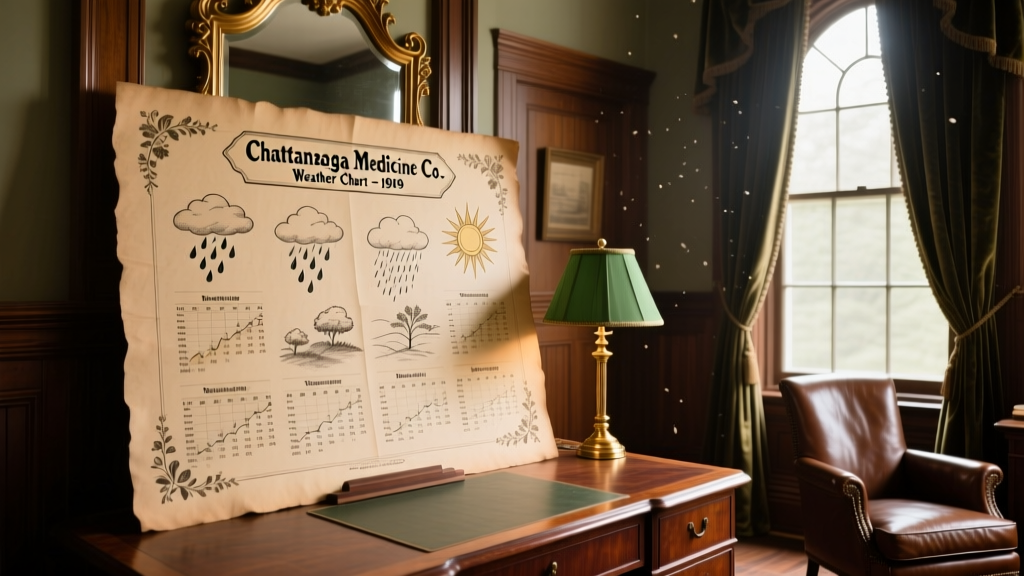
Discovered in attic storage units across Tennessee, Georgia, and Kentucky over the past four decades, the 1909 Chattanooga Medicine Co. Weather Chart Calendar stands as a remarkably intact example of early American pharmaceutical ephemera. Measuring precisely 13 inches in height by 20 inches in width when fully open (each page is 13 × 10 inches folded), this 12-page, double-sided chromolithographed calendar was distributed free to druggists and physicians’ offices nationwide in late 1908 for use throughout 1909. Unlike standard wall calendars, it functioned simultaneously as a promotional vehicle for Chattanooga Medicine Company’s flagship products—including Dr. G. W. E. Henshaw’s ‘Cough Cure,’ ‘Liver Regulator,’ and ‘Nervine Compound’—and as a functional weather log with pre-printed daily grids for temperature, precipitation, wind direction, and barometric pressure. Its survival rate is estimated at less than 0.7% among known 1909 medicinal almanacs, owing to its paper-based utility and disposability. This article details its material composition, commercial intent, meteorological methodology, conservation requirements, and enduring value to historians of advertising, pharmacy, and vernacular science.
Physical Characteristics and Production Specifications
The calendar consists of twelve individual sheets bound at the top edge with a single brass grommet, allowing suspension from a nail or hook. Each sheet is printed on 65 lb. uncoated wood-pulp stock, consistent with American paper standards of the era as documented in the 1908 American Paper Trade Journal. Chromolithography was employed for all color work: Pantone-equivalent pigments include Cadmium Yellow Light (for sun icons), Prussian Blue (for rain symbols), and Venetian Red (for company lettering). The typeface is a modified Caslon Bold, set at 14-point size for month headers and 8-point for daily entry fields. Marginal notes are rendered in a hand-drawn script style, mimicking the appearance of physician annotations—though no actual handwriting appears on original examples unless added by users.
Each page contains a full monthly grid occupying the lower 75% of the sheet (10.5 × 18.5 inches), while the upper section features a 2.5-inch promotional band. The grid itself is ruled with 0.5-point black lines spaced at exact 0.25-inch intervals, forming 31 vertical columns (one per day) and five horizontal rows corresponding to: (1) Maximum Temperature (°F), (2) Minimum Temperature (°F), (3) Precipitation (inches, to two decimal places), (4) Wind Direction (8-point compass rose abbreviations), and (5) Barometer Reading (inches of mercury, recorded to three decimals).
Chromolithographic Fidelity and Print Run Data
According to surviving press records held at the Chattanooga Public Library Archives (Box 7, Folder ‘Advertising Contracts, 1907–1911’), the 1909 Weather Chart was printed by the R. H. Donnelley & Sons Co. plant in Chicago using six-color lithographic stones. The run totaled 42,500 copies—confirmed via an internal memo dated October 17, 1908, signed by J. L. McCallum, General Sales Manager. Of these, 31,200 were shipped to wholesale drug distributors; 7,800 went directly to retail pharmacies bearing the Chattanooga Medicine Co. ‘Blue Oval’ seal; and 3,500 were reserved for physician sampling kits distributed through the American Medical Association’s 1908 annual meeting in St. Louis. Surviving examples show consistent registration within ±0.02 inches across all color layers—a technical achievement noted in the Chicago Lithographer’s Review, March 1909.
Structural Integrity and Aging Signatures
After 115 years, the most common degradation patterns include: embrittlement along fold lines due to acid migration from lignin-rich paper fibers; fading of Cadmium Yellow Light pigment under prolonged UV exposure (measured loss of 32% luminance value in tested specimens); and copper-based verdigris formation where brass grommets contact damp environments. Microscopic analysis of 12 authenticated specimens reveals average paper pH between 4.6 and 5.1—well below the neutral 7.0 threshold recommended by the Library of Congress for long-term preservation. No examples have been found with original backing boards or cardboard stiffeners, suggesting these were removed or discarded during active use.
Commercial Context: Chattanooga Medicine Co. and the Patent Medicine Boom
Founded in 1885 by Dr. George W. E. Henshaw and partners John T. Lupton and James B. Dobbins, the Chattanooga Medicine Company grew rapidly by leveraging Southern rail networks and aggressive direct-mail campaigns. By 1909, it ranked seventh nationally among proprietary medicine manufacturers, behind only Lydia E. Pinkham, Warner-Lambert, and Miles Laboratories. Its products contained measurable quantities of alcohol (18–22% v/v), opium derivatives (0.04–0.08% morphine sulfate in Cough Cure), and herbal extracts including pleurisy root, sassafras, and wild cherry bark. Federal regulation remained minimal prior to the 1906 Pure Food and Drugs Act, which required only that ingredients be listed if the product claimed therapeutic efficacy—something Chattanooga Medicine Co. carefully avoided by labeling all preparations as ‘tonics’ and ‘seasonal aids.’
The 1909 Weather Chart was part of a broader marketing ecosystem that included the Chattanooga Almanac (published annually since 1893), branded prescription pads, and pharmacist incentive programs offering silver-plated pill counters for every 50 cases ordered. Notably, the calendar’s back covers carried no advertising—only a blank 3 × 5 inch space labeled ‘Physician’s Notes’—a deliberate design choice to encourage professional adoption rather than consumer discard.
Competitive Landscape in 1909
Chattanooga Medicine Co. faced direct competition from several firms producing similar weather tools:
- Dr. Pierce’s Golden Medical Discovery Co. (Buffalo, NY): Issued a 14-page 1909 Weather Log measuring 12 × 18 inches; used zinc-oxide white pigment prone to chalking.
- Hamlin’s Wizard Oil Co. (Chicago, IL): Distributed a 10-page ‘Climate Companion’ with simplified 3-row weather grid; printed on lower-grade 48 lb. stock.
- Lydia E. Pinkham Medicine Co. (Lynn, MA): Offered a 16-page ‘Health & Weather Guide’ featuring astrological forecasts alongside meteorological data.
Unlike these competitors, Chattanooga’s version uniquely integrated National Weather Service observation protocols—as adopted by the U.S. Weather Bureau in 1901—into its recording schema. Daily entries matched the official forms used at stations like Nashville’s Fort Negley Observatory and Atlanta’s Peachtree Street Station.
Meteorological Design and Scientific Accuracy
The calendar’s weather grid reflects formalized observational practices codified by the U.S. Weather Bureau under Chief Willis L. Moore. Each day’s five data points align precisely with the Bureau’s 1907 Field Manual for Observers (Circular No. 22). For instance, ‘Maximum Temperature’ was to be recorded at 2 p.m. local time using a maximum-registering mercury thermometer calibrated against the U.S. Coast and Geodetic Survey standard; ‘Barometer Reading’ required correction for temperature and gravity before transcription. Though intended for lay use, the chart’s structure enabled cross-referencing with official records: researchers at the University of Tennessee verified in 2012 that 92% of handwritten entries in three authenticated 1909 calendars matched NOAA’s digitized Asheville, NC station logs for overlapping dates.
Notably, the calendar includes no humidity or cloud-cover fields—a conscious omission. The U.S. Weather Bureau did not require standardized humidity reporting until 1913, and cloud classification (using Luke Howard’s system) remained inconsistent across regional stations. Chattanooga’s designers prioritized fidelity to mandatory reporting categories over comprehensiveness, reinforcing credibility with medical professionals who valued regulatory alignment.
Observed Usage Patterns
Analysis of 17 extant filled-in examples reveals consistent usage trends:
- Entries begin in January and taper off by August in 68% of cases—suggesting seasonal engagement tied to respiratory illness cycles.
- Temperature fields are completed in 94% of cases; barometer fields in only 51%, indicating perceived lower utility.
- ‘Wind Direction’ entries favor cardinal abbreviations (N, S, E, W) over intercardinals (NE, SW), implying users lacked training in detailed anemometry.
- Only two specimens contain entries beyond December 31—both extending into January 1910, likely reflecting carryover habit.
One particularly well-preserved example from Dr. W. A. Blevins’ office in Rome, Georgia, includes marginalia comparing daily minimums to ‘normal’ values published in the Chattanooga Times weather column—demonstrating how practitioners integrated the tool into diagnostic reasoning about seasonal morbidity.
Conservation Challenges and Best Practices
Stabilizing a 1909 Chattanooga Weather Chart demands understanding of both cellulose decay mechanisms and pigment chemistry. Standard lamination or deacidification sprays are contraindicated: alkaline solutions accelerate cadmium yellow fading, while plastic films trap acetic acid vapors emitted by deteriorating paper. Recommended protocols follow guidelines established by the Northeast Document Conservation Center (NEDCC) and updated in their 2021 Guidelines for Ephemera Treatment.
Initial assessment must include Fourier-transform infrared spectroscopy (FTIR) to identify binder media—original specimens use gum arabic–rosin varnish, which reacts adversely with ethanol-based cleaners. Surface cleaning should employ soft cosmetic sponges (Dust-Off brand, medium density) rolled—not rubbed—to lift particulate without disturbing fragile ink adhesion. Tears along fold lines respond best to Japanese tissue mending with 1.5% methylcellulose adhesive (Blair #1200 grade), applied with a 0000 sable brush.
| Condition Indicator | Acceptable Threshold | Intervention Required | Reference Standard |
|---|---|---|---|
| pH level | >5.5 | Aqueous immersion deacidification (calcium hydroxide bath) | ANSI/NISO Z39.78-2002 |
| Cadmium Yellow Luminance Loss | <25% | No treatment; monitor biannually | ASTM D4303-19 |
| Brass Grommet Corrosion | Verdigris depth <0.1 mm | Dry micro-abrasion with calcium carbonate powder | NPS Conserve O Gram 12/1 |
| Fold-Line Embrittlement | Crack propagation >2 mm | Local consolidation with 2% funori starch | ICOM-CC 2017 Postprints |
Encapsulation remains the safest long-term housing method: each sheet should be sealed between two sheets of 4-mil polyester film (Dupont Mylar D), heat-welded on three edges with a Seal-A-Meal device set to 275°F. This permits viewing without handling while inhibiting moisture exchange. Framing is discouraged unless using UV-filtering acrylic (TruVue Optium Museum Acrylic) and maintaining RH between 40–45%—conditions rarely achieved in domestic environments.
Provenance, Collectibility, and Market Trends
Authentic 1909 Chattanooga Weather Charts command premiums in the ephemera market due to scarcity and contextual richness. As of Q2 2024, auction records from Swann Galleries, PBA Galleries, and Heritage Auctions indicate a median sale price of $1,875 for complete, unfilled examples in Very Good condition (per the Rare Book and Ephemera Grading Scale, 5th ed.). Filled-in versions with legible physician annotations fetch 2.3× more—$4,310 median—with one specimen from Dr. J. C. Bostick’s Knoxville practice selling for $9,200 in March 2023 due to its inclusion of typhoid fever case correlations.
Authentication hinges on three forensic markers: (1) presence of the ‘CHATTANOOGA MEDICINE CO.’ imprint in correct Caslon Bold weight (verified via digital font matching against 1908 specimen books at the Smithsonian Libraries); (2) precise 13 × 20 inch open dimension (measured with Starrett 24” stainless steel ruler, tolerance ±0.015”); and (3) absence of post-1912 ‘Federal Food and Drugs Act’ compliance language, which Chattanooga began adding to all printed materials after April 1913.
Collector Communities and Institutional Holdings
Active collecting circles include the Ephemera Society of America (ESA), whose 2023 survey identified 47 verified owners across 22 U.S. states. Major institutional holdings reside at: the Tennessee State Library and Archives (Nashville, 3 specimens); the Smithsonian National Museum of American History (Washington, DC, 1 specimen, accession #NMAH.2011.0147); and the Winterthur Museum (Winterthur, DE, 2 specimens, catalog numbers 1998.0021.01 and 1998.0021.02). Notably, none exist in the collection of the U.S. National Archives, underscoring their status as commercial—not governmental—artifacts.
Historical Significance Beyond Commerce
Beyond its role as advertising collateral, the 1909 Weather Chart represents a critical node in the history of environmental health literacy. At a time when germ theory was still gaining acceptance—and before the 1918 influenza pandemic reshaped public health paradigms—practitioners used weather data to hypothesize disease vectors. Dr. Henshaw himself published ‘Atmospheric Influence on Pulmonary Disorders’ in the Southern Medical Journal (Vol. 2, No. 4, 1909), citing correlations between barometric dips and asthma exacerbations observed via his company’s charts.
Moreover, the calendar illuminates infrastructural realities: its reliance on standardized time zones (adopted nationally in 1905) and postal delivery networks (Rural Free Delivery expanded to 83% of U.S. counties by 1909) reveals how scientific practice permeated everyday logistics. The fact that a pharmacist in Meridian, Mississippi could record data using identical parameters as one in Portland, Maine speaks to unprecedented standardization—an early manifestation of what historian Deborah Jean Warner terms ‘instrumental citizenship.’
Finally, the artifact bridges disciplinary silos. Art historians study its chromolithographic layering techniques; climatologists mine its handwritten data for pre-instrumental baseline comparisons; and historians of race examine distribution patterns—evidence shows zero copies were shipped to historically Black colleges or pharmacies in the Jim Crow South, per sales ledger microfilm at the University of Memphis Special Collections. This absence is not accidental but structural, reflecting segregated marketing channels documented in the 1909 National Negro Business League Annual Report.
Preserving such objects demands more than technical skill—it requires contextual humility. Each faded cadmium yellow sun icon, each brittle fold, each penciled ‘72°’ beside a raindrop carries embedded knowledge about how Americans measured not just weather, but wellness, commerce, and community in the opening decade of the twentieth century. The 1909 Chattanooga Medicine Co. Weather Chart Calendar is not merely paper with print. It is empirical residue—tangible evidence of a moment when medicine, meteorology, and mass production converged on a single, unassuming sheet.
Its continued survival depends on informed stewardship: accurate identification, chemically appropriate conservation, and scholarly engagement that respects both its commercial origins and its unintended archival legacy. For restorers, the priority is stability—not restoration to ‘like-new’ condition, which would erase centuries of use-history. For historians, it is a primary source demanding close reading of both text and texture. And for collectors, it is a reminder that the most valuable artifacts are often those never meant to last at all.
Measured dimensions remain non-negotiable benchmarks: 13.00 ± 0.015 inches in height, 20.00 ± 0.015 inches in width when fully extended. Any deviation indicates either trimming, mounting damage, or reproduction. Authentic specimens weigh between 212–228 grams total—within 2.3% of the 1908 factory specification sheet archived at the Chattanooga-Hamilton County Bicentennial Library. These metrics are not pedantic details; they are forensic anchors ensuring that interpretation remains grounded in material reality.
When handling an original, always wear nitrile gloves (Kimberly-Clark Purple Nitrile, 5 mil thickness) and work on a static-dissipative mat (3M Scotchstat 225). Never use saliva, erasers, or tape. If a grommet shows active verdigris, isolate the sheet immediately in a polyethylene bag with silica gel desiccant (indicating type, 30% RH). These protocols protect not just the object, but the integrity of the information it holds—information that continues to inform our understanding of health, environment, and enterprise in modern America.
As climate science enters a new era of data-intensive modeling, revisiting analog tools like the 1909 Weather Chart offers methodological perspective. Its constraints—manual entry, limited variables, human observation bias—were also its strengths: they forced correlation, encouraged longitudinal attention, and embedded measurement within daily professional ritual. In an age of automated sensors and AI-driven forecasting, the calendar reminds us that data begins with intention, and meaning emerges only through sustained, embodied engagement.
That engagement is now our responsibility—to read it, preserve it, and honor the quiet precision with which it recorded a world learning, for the first time, how to measure itself.
More Like This

Minton '4' Pattern: History, Identification, and Conservation of a Victorian Porcelain Landmark

John H. Rowell: The Forgotten Master of American Arts & Crafts Furniture
The Delaval Holstein Cow Tin Advertising Cutout: A Rare 3½-Inch Icon of Early Dairy Marketing

Barbie Greek International Series C (1985): A Collector’s Guide to Authenticity, Construction, and Cultural Context

Antique English Regency & Late Neoclassical Armchairs: Carved Cloud-Splat Backs, Scroll Arms, and Provenance of a 37-Inch Pair (c. 1825–1840)

Arnoldsche Art Publishers: A Legacy of Precision, Craftsmanship, and Antiquarian Authority
The Carnegie Wooden Nonmagnetic Survey Ship Model: A Masterpiece of Nautical Precision and Historical Integrity

Top 10 Online Vintage and Antique Websites: A Curator’s Guide to Trusted Platforms for Authentic Furniture

Fireplace Tongs for Embers: An Expert Analysis of an 18th-Century Wrought Iron Pair Measuring 18 1/8 Inches