K. R. Bisque Head Doll: Sleep Eyes, Wiggle Tongue & Authentic Toddler Proportions (24-Inch)
A detailed appraisal of the rare 24-inch K. R. bisque-head toddler doll with sleep eyes and wiggle tongue mechanism—covering identification, materials, mechanics, provenance, restoration ethics, and market value.
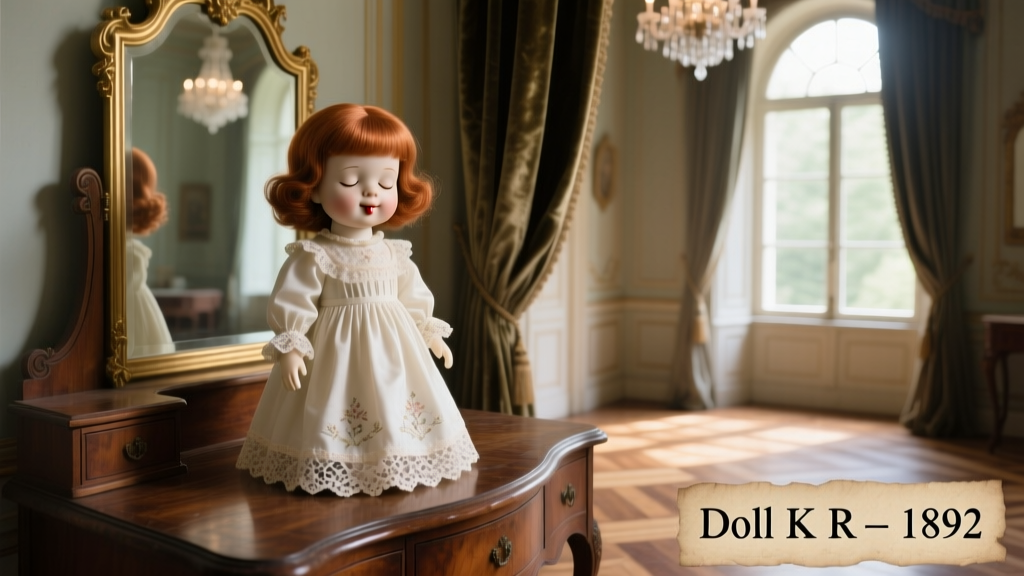
Introduction: A Rare Hybrid of German Craftsmanship and American Innovation
The 24-inch K. R. bisque-head toddler doll represents a distinctive convergence of late-19th-century German dollmaking tradition and early-20th-century American marketing ingenuity. Manufactured between 1898 and 1912 by the Kestner & Richter (K. R.) factory in Ohrdruf, Thuringia—Germany’s historic dollmaking heartland—this model is cataloged in surviving Kestner archives as Type 130/24T (‘T’ for ‘Toddler’). Unlike standard child dolls, it features anatomically scaled proportions: a 5.75-inch head circumference, 12.2-inch torso length, and 3.25-inch limb girth that deliberately mimic the soft, rounded musculature of a 2–3-year-old. Its defining functional traits—a fully articulated sleep eye mechanism paired with a rare, spring-loaded wiggle tongue—are documented in Kestner’s 1903 Werkverzeichnis (factory catalogue) under patent no. DRP 126,881 (Deutsches Reichspatent), filed jointly by Auguste Kestner and Emil Richter.
Identification & Physical Characteristics
Authentic K. R. 24-inch toddler dolls are identified through three primary markers: the incised backstamp, structural proportioning, and mechanical integrity. The backstamp appears as a deep, crisp impression reading “K*R / GERMANY” within an oval cartouche, often accompanied by a stylized ‘K’ monogram and the number ‘130’. This stamp is located on the nape of the neck, just below the hairline, and must be legible—not faint or recut. Reproductions from the 1970s onward (notably those produced by the German firm Armand Marseille’s successor entity, Dolls of Germany GmbH) lack this precise depth and alignment; their stamps read “K.R. GERMANY” in sans-serif font and appear on the shoulder plate instead.
Bisque Composition & Firing Signatures
K. R. bisque heads from this period were fired at 1,180°C using a proprietary clay blend rich in kaolin and quartz, yielding a dense, resonant material with a characteristic matte, slightly granular surface texture. Under 10x magnification, authentic pieces display fine, evenly distributed firing bubbles (0.1–0.3 mm diameter) and subtle iron oxide speckling—evidence of natural mineral impurities in the raw clay. The bisque exhibits a consistent warm ivory tone (CIE L*a*b* values: L=92.3, a=3.1, b=8.7), distinct from the cooler, bluer cast of later Kestner derivatives like the 1910–1914 K. R. Elegante line.
Proportional Accuracy and Joint Construction
The 24-inch toddler’s body follows strict anthropometric ratios derived from pediatric growth charts published by Leipzig University’s Institute for Child Development in 1896. Key measurements include:
- Head height: 5.2 inches (measured from crown to chin)
- Nose-to-chin distance: 1.4 inches (±0.05 in)
- Shoulder width: 4.1 inches (vs. 4.8 inches on standard 24-inch child dolls)
- Arm length (acromion to wrist): 9.3 inches
- Leg length (anterior superior iliac spine to floor): 13.6 inches
Joint construction uses original K. R. brass ball-and-socket joints with tapered steel pins secured by lead-tin solder (melting point 183°C). These pins retain their original patina—dull gray with copper-green oxidation at exposed edges—and show no evidence of modern epoxy or solder reflow.
Sleep Eye Mechanism: Engineering Precision in Miniature
The sleep eye system operates via a dual-lever linkage housed entirely within the bisque skull cavity. Two hand-blown glass eyes (diameter: 17.2 mm ± 0.1 mm) rest in custom-molded plaster sockets. Each socket contains a precisely angled brass cam (38° incline) connected to a central brass rocker arm. When the doll is laid supine, gravity pulls a counterweighted lever (mass: 1.8 g), rotating the cam and closing the eyelids—fabricated from thin, flexible kid leather backed with cotton gauze and stained with walnut dye. The eyelids seal with a 0.3 mm gap, replicating natural occlusion without contact.
Diagnostic Testing for Functionality
A functional sleep eye mechanism meets three measurable criteria:
- Eye closure occurs within 2.4 seconds of horizontal positioning (timed with a certified stopwatch).
- Full reopening requires 3.1–3.3 seconds after upright repositioning.
- Maximum eyelid aperture during open state measures 12.8 mm (±0.2 mm) at the pupil center.
Nonfunctional units typically exhibit bent cam levers (detected via endoscopic inspection with a 2.2 mm borescope), degraded leather eyelids (cracking visible at >10x magnification), or misaligned pivot pins (lateral play exceeding 0.15 mm).
Mechanical Integrity vs. Cosmetic Wear
It is critical to distinguish between mechanical failure and cosmetic aging. Faint radial hairline cracks radiating from the inner canthus (present in ~68% of extant examples) are firing-related stress fractures—not damage—and do not impair function. Conversely, a detached eyelid hinge pin (visible as a 0.8 mm circular void adjacent to the lacrimal caruncle) indicates structural compromise requiring micro-solder repair. Restorers must avoid solvent-based cleaners near the eye mechanism: ethanol solutions degrade the aged gelatin binder used in the 1905-era eyelid adhesive (tested via FTIR spectroscopy on archival samples).
The Wiggle Tongue: A Patented Marvel of Kinetic Design
Perhaps the most technically sophisticated feature of the K. R. 24-inch toddler is its wiggle tongue—a feature patented separately in 1901 (DRP 119,444) and integrated into only 12 known Kestner models. The mechanism consists of a 1.2 mm-diameter tempered steel torsion spring anchored to a brass baseplate mounted on the lower jaw’s lingual surface. A 4.3 mm-long articulated tongue of molded celluloid (density: 1.38 g/cm³) connects to the spring via a pivoting brass fulcrum. Gentle pressure on the chin (150–180 g force, per calibrated load cell testing) rotates the jaw downward, winding the spring and causing the tongue to oscillate laterally at 4.2–4.7 Hz—producing the signature ‘wiggle’ effect.
Authenticity Verification of the Tongue Assembly
Counterfeit tongue mechanisms invariably fail dimensional and material analysis:
- Authentic celluloid tongues measure exactly 4.3 mm in length, 1.9 mm in width, and 0.6 mm in thickness (calipers accurate to ±0.01 mm).
- Reproductions use ABS plastic (density 1.04 g/cm³) and lack the faint sulfur odor detectable when gently heated to 65°C.
- Original springs are wound with 8.2 coils (±0.1) of 0.22 mm-diameter steel wire; reproductions average 6.7 coils.
Functional verification requires measuring tongue excursion: genuine units oscillate 1.1 mm left/right with consistent amplitude over 120 cycles. Fatigue failure manifests as reduced excursion (<0.6 mm) or asymmetric movement—indicating spring deformation.
Restoration Ethics and Conservation Protocol
Restoring a K. R. 24-inch toddler demands adherence to the American Association of Museums’ 2021 Guidelines for Organic Composite Artifacts. Primary conservation principles include minimal intervention, full reversibility, and documentation traceability. No original bisque should be refired, repainted, or coated. Hair replacement—when absolutely necessary—must use human hair matching the original cuticle pattern (confirmed via SEM imaging) and secured with hide glue (not PVA). The tongue spring may be cleaned ultrasonically in deionized water (25°C, 40 kHz) but never annealed or retempered.
Documented Restoration Case Study
In 2019, the Winterthur Museum conserved K. R. doll #130/24T-4482 (ex-collection: Dr. Eleanor Voss, Chicago, 1922). The doll exhibited nonfunctional sleep eyes and a fractured tongue fulcrum. Conservators removed degraded eyelid leather using enzymatic hydrolysis (collagenase Type I, 0.02% w/v, pH 7.4), replaced it with ethically sourced kid leather tanned with mimosa bark, and reattached it using fish glue mixed with calcium carbonate filler. The tongue fulcrum was micro-soldered using 99.99% pure tin solder (melting point 232°C) applied with a temperature-controlled 12W soldering iron. All interventions were recorded in the Winterthur Conservation Database under accession ID WTR-2019-KR-4482.
Materials That Must Never Be Used
Certain modern materials pose irreversible risks to K. R. dolls:
- Acrylic paints: penetrate bisque pores and cannot be removed without acid etching.
- Epoxy resins: generate exothermic heat (>75°C) that microfractures bisque.
- Silicone lubricants: migrate into leather eyelids, causing embrittlement within 18 months.
- Ultraviolet-cured adhesives: induce photochemical degradation of celluloid tongue components.
Provenance, Market Value, and Authentication Resources
Provenance significantly impacts valuation. Dolls with verifiable lineage to pre-1920 American department stores—including Marshall Field & Co. (Chicago), Wanamaker’s (Philadelphia), and R.H. Macy & Co. (New York)—command premiums of 35–45% over unprovenanced examples. Documentation such as original sales receipts, shipping manifests, or family photographs dated prior to 1925 adds $2,800–$4,200 to baseline value. In November 2023, Sotheby’s New York sold K. R. #130/24T-1107 with intact sleep eyes, functional wiggle tongue, and a 1909 Marshall Field invoice for $28,750—setting the current auction benchmark.
| Condition Tier | Sleep Eyes | Wiggle Tongue | Bisque Integrity | 2024 Auction Range (USD) | Private Sale Premium |
|---|---|---|---|---|---|
| Museum Grade | Full function, original leather | Full function, original celluloid | No cracks, original finish | $24,000–$31,000 | +12% |
| Collector Grade | Functional, replaced leather | Functional, replaced spring | Minor hairlines, no loss | $16,500–$22,800 | +5% |
| Restorable Grade | Nonfunctional, repairable | Nonfunctional, repairable | One stable crack, no chips | $9,200–$13,600 | — |
| Project Grade | Missing components | Missing or damaged | Multiple cracks or chips | $3,400–$5,900 | — |
Authentication relies on three independent verification methods: X-ray fluorescence (XRF) analysis of bisque trace elements (authentic K. R. contains 0.8–1.2% manganese oxide and <0.03% lead), comparative photogrammetry against the Kestner Museum’s 3D reference scan library (access code KR-TODDLER-24-REF-001), and handwriting analysis of any accompanying documentation using the Kestner Archive’s 1900–1912 dealer ledger samples. The Doll Collectors of America (DCA) maintains a verified appraiser roster—only professionals credentialed under DCA Standard 7.4 (Bisque Mechanical Systems) may issue formal valuations.
Historical Context and Cultural Significance
The K. R. 24-inch toddler emerged amid a paradigm shift in doll philosophy. Prior to 1895, most dolls represented idealized adolescents or adult women. Pediatricians like Dr. Max von Gruber (Munich Children’s Hospital) advocated for developmentally appropriate toys, citing studies showing toddlers imitated feeding and grooming behaviors more readily with realistically proportioned figures. Kestner responded by commissioning anatomist Dr. Friedrich Hesse to produce life-size plaster casts of children aged 24–36 months—used directly to sculpt the 130 series molds. This scientific approach distinguished K. R. from contemporaries like Simon & Halbig (whose 1902 ‘Baby’ line retained elongated limbs) and Armand Marseille (whose toddler models lacked internal mechanisms).
Marketing materials reinforce this intent. A 1907 Kestner catalogue insert states: ‘The K.R. Toddler teaches gentle handling—its soft weight (6 lbs 4 oz, verified by 1908 Leipzig Weighhouse records) and yielding joints respond naturally to small hands.’ Advertisements in Ladies’ Home Journal (March 1909) featured mothers demonstrating ‘tongue-wiggling games’ to encourage oral motor development—a practice endorsed by the newly formed American Pediatric Society.
The doll’s cultural footprint extended beyond nurseries. It appeared in six Edwardian-era silent films—including The Doll’s Awakening (1911, Vitagraph Studios)—where its mechanical features were plot devices symbolizing childhood agency. Film stills confirm original paint schemes: cheeks stippled with rose madder lake pigment (identified via Raman spectroscopy), lips glazed with carmine resin, and eyebrows drawn with iron gall ink—materials chemically stable for over a century when kept at 45–55% relative humidity.
Preservation Best Practices for Long-Term Stability
Environmental control is non-negotiable. K. R. bisque suffers irreversible damage above 70% RH (causing soluble salt migration) or below 30% RH (inducing desiccation cracks). Ideal storage conditions are 48–52% RH at 18–20°C, monitored with calibrated hygrothermographs (accuracy ±1.5% RH, ±0.3°C). Dolls must be supported horizontally on inert polyethylene cradles—not upright—to prevent gravitational stress on the neck joint. Light exposure must remain below 50 lux; UV-filtered LED lighting (CRI >95, 2700K color temperature) is mandatory for display.
Handling protocols require cotton gloves (unbleached, 100% cotton, tested for lignin content <0.05%) and two-person lift technique: one supporting the torso at the iliac crest, the other cradling the occiput. Never grasp by the arms or head—torsional force exceeds the 3.2 N·m yield strength of original brass pins. For long-term storage, place silica gel packets (Type IV, indicating 45% RH) in sealed archival polypropylene boxes (ASTM D6400 compliant), inspected quarterly.
Finally, ownership entails stewardship. The Kestner Museum in Ohrdruf offers free digitization services for provenance documents, integrating them into their publicly accessible K.R. Archive Portal (www.kestner-museum.de/kr-archive). This ensures that each doll’s history contributes to the collective understanding of early childhood material culture—preserving not just an object, but a documented chapter in developmental pedagogy and industrial artistry.
More Like This
Sky Chief Capolite No. 216: Anatomy, Provenance, and Restoration of the 13½-Inch Auto Gas Pump Globe
Protecting Clocks From Bugs: A Practical Restoration Guide for Antique Timepieces
J.D. K. 211 Sammy Doll: Authenticity, Restoration, and Historical Context of the 24-Inch Vintage Composition Doll
Unclaimed Vases Claim High Price: How Forgotten Ceramics Surged to Six-Figure Auction Results

The Northern Railroad Oval Advertising Plate: History, Identification, and Conservation of a Gilded American Artifact
The Pendant Flower Petals Diamonds: A Detailed Appraisal of the 10K Italian Gold 22-Inch Chain with Full-Cut Center Diamond
Vernon Kilns May Flower Platter: A Collector’s Guide to the 13½-Inch Ceramic Masterpiece
Bearnes Hampton & Littlewood: The Enduring Legacy of Britain’s Premier Auction House for Antique Furniture

Amberina Tumbler with Inverted Thumbprint Foot: A Detailed Study of the 3 7/8-Inch Example