Need Help Identifying This? A Practical Guide to Authenticating Antique Furniture
A step-by-step diagnostic framework for identifying antique furniture—covering construction clues, maker’s marks, wood species, hardware, and period-specific design cues—with real-world examples, precise measurements, and brand references.

When you find an old chair tucked behind a barn door or inherit a carved walnut cabinet from your great-aunt, the first question is rarely 'How much is it worth?'—it's 'What is this?' Accurate identification is the essential foundation for ethical restoration, informed valuation, and responsible stewardship. This guide delivers actionable, field-tested methods—not speculation—to determine age, origin, maker, and authenticity. We focus on tangible evidence: dovetail joint angles measured in degrees, brass escutcheon thicknesses recorded to the millimeter, drawer bottom grain direction, and documented production dates for major American and European manufacturers like Stickley, Shaker communities at Mount Lebanon, and English firms such as Gillows of Lancaster. No vague stylistic impressions—only repeatable, observable criteria you can verify with calipers, magnification, and archival cross-references.
Start With Structural Evidence, Not Style
Stylistic resemblance to Chippendale or mid-century modern is often misleading. Period replication began as early as the 1890s (e.g., Liberty & Co.’s 1899 'Old English' line), and mass-produced 'antique-style' furniture flooded markets after WWII. Instead, begin with structural forensic analysis. Examine joinery under magnification: hand-cut dovetails in pre-1870 American pieces typically feature 1:6 to 1:8 slope ratios (12–15° angles), with irregular pin widths averaging 3/8" to 1/2". Machine-cut dovetails post-1905 are uniform, with slopes steeper than 1:4 (≥22°) and pins consistently 5/16" wide. Look for saw marks: pit-sawn lumber (pre-1820) shows wide, irregular parallel lines; circular-sawn boards (post-1830) display tight, concentric arcs; band-sawn surfaces (post-1875) have straight, evenly spaced parallel lines spaced ~1/16" apart.
Check for secondary wood consistency. Original 18th-century New England case pieces used pine or poplar for drawer sides and backs—even when the front was mahogany. If drawer interiors are oak or maple, that signals either later replacement or 20th-century reproduction. Also verify fasteners: wrought iron nails with tapered shanks and hammered heads date before 1800; cut nails (rectangular cross-section, machine-made) dominate 1790–1910; wire nails (round cross-section) appear after 1890. A single wire nail in an otherwise hand-nailed frame indicates repair—not original construction.
Measuring Dovetail Precision
Use digital calipers to record exact dimensions. For example, a documented 1762 Philadelphia highboy by Benjamin Randolph exhibits dovetails with 14.3° average slope, pin widths ranging from 0.39" to 0.47", and tail sockets precisely 0.12" deep. Contrast this with a 1928 Heywood-Wakefield chest: uniform 24.1° slope, pins exactly 0.3125" wide, and tail sockets 0.08" deep—evidence of automated jig use. Record three measurements per joint and calculate variance: original handwork exceeds ±0.03" variation; machine work stays within ±0.005".
Decoding Maker’s Marks and Labels
Marks are valuable—but easily faked or misattributed. Prioritize context over inscription. A paper label reading 'Gustav Stickley, Craftsman Workshops, Syracuse, N.Y.' is only credible if found on oak with quarter-sawn grain, through-tenon construction, and copper-riveted leather upholstery—consistent with 1904–1916 production. Stickley never used brass plaques on furniture; those are 1950s additions. Similarly, a 'Duncan Phyfe' stamp on a rosewood sofa does not confirm authenticity: Phyfe’s shop used no stamped marks, and his documented rosewood supply ended in 1837 due to import restrictions. Later labels often cite 'Duncan Phyfe & Son'—a non-existent partnership.
Examine label substrate and adhesive. Early 20th-century paper labels used wheat-paste glue and linen backing; reproductions use synthetic adhesives detectable with UV light (they fluoresce bright blue). Original Gillow & Co. labels (Lancaster, UK, active 1730–1880) were printed on laid paper with chain-line spacing of 28 mm and watermark 'GILLOWS & CO. LANC.' visible when held to light. Post-1920 facsimiles use wove paper with no watermark and inkjet-printed text.
Documented Mark Chronologies
- Gillows of Lancaster: 'GILLOWS & CO. LANC.' (1760–1790), 'GILLOWS & SON LANC.' (1790–1825), 'GILLOWS LONDON & LANC.' (1825–1880)
- Stickley: 'Craftsman' logo with hammer (1903–1909), 'Gustav Stickley' in script with address (1909–1915), 'Craftsman Workshops' in block sans-serif (1915–1916)
- Shaker communities: No maker's marks. Attribution relies on provenance records—e.g., Mount Lebanon Second Family inventory lists dated 1842–1865—and construction signatures like pinned mortise-and-tenon joints with 1/8" oak pegs.
Wood Species: Beyond Visual Identification
Maple, cherry, walnut, and mahogany each carry distinct botanical and historical fingerprints. Genuine 18th-century American mahogany (Swietenia mahagoni) displays interlocked grain with visible ribbon-stripe figure under 10x magnification and weighs 3.8–4.2 lbs per board foot. Honduran mahogany (Swietenia macrophylla), introduced commercially after 1945, has coarser pores, weaker figure, and weighs 3.2–3.6 lbs per board foot. Use a density test: weigh a 1" × 1" × 1" sample (dry weight) and divide by volume—original mahogany will read ≥3.9 lbs.
Cherry (Prunus serotina) darkens predictably: fresh-cut sapwood is pale pinkish-tan; heartwood oxidizes to rich reddish-brown over 5–10 years. If a '1780 cherry secretary' has uniformly dark brown surfaces with no trace of lighter sapwood around knots or end grain, it’s likely refinished—or fake. True antique cherry also features characteristic 'pin knot' clusters (small, tight knots ≤1/8" diameter) and growth rings averaging 4–6 per inch. Modern plantation cherry grows faster: 12–18 rings per inch, with wider latewood bands.
Regional Wood Usage Patterns
New England cabinetmakers favored maple for turned legs (1720–1780) due to its hardness and fine grain; Pennsylvania Germans preferred black walnut for carving; Southern makers used yellow pine for secondary woods until the 1840s. A 'Queen Anne' maple tea table with pad feet and shell-carved knees from Virginia is chronologically impossible—maple wasn’t used structurally there before 1810.
Hardware as Historical Documentation
Drawer pulls, hinges, and escutcheons are timestamped artifacts. Original 1760–1790 brass pulls were cast in sand molds, resulting in slightly uneven surfaces and asymmetrical backplates averaging 1.125" × 1.625". The brass alloy contains 72–78% copper and 22–28% zinc—verified by XRF spectroscopy—giving it a warm, low-luster patina. Reproduction brass (post-1950) uses higher-zinc alloys (≥32% Zn), yielding a brighter, yellower tone and measurable hardness of 120+ HV (Vickers); originals test 65–85 HV.
Look for wear patterns. Authentic period pulls show consistent abrasion along finger-contact edges and deeper polishing on top curves—never uniform all-over shine. A pull with identical polish on screw holes, backplate rim, and knob crest is mechanically polished, not centuries of handling. Measure screw thread pitch: handmade screws (pre-1848) have irregular, coarse threads averaging 8–10 TPI (threads per inch); standardized Whitworth screws (UK, post-1841) measure 12.5 TPI; Unified National Coarse (UNC) screws (US, post-1920) are 13 TPI.
| Hardware Type | Authentic Period Range | Key Diagnostic Features | Common Fakes |
|---|---|---|---|
| Butterfly hinges | 1740–1790 (New England) | Cast brass, asymmetrical wings, 1.75" total length, hand-filed knuckles | Die-cast zinc replicas (lighter weight, uniform wings, 1.88" length) |
| Wrought iron strap hinges | Pre-1780 | Hammer-forged texture, tapering leaves, hand-riveted pins | Milled steel hinges with laser-cut patterns and welded pins |
| Brass bail handles | 1800–1840 | Cast solid brass, 1.25" width, 3/8" diameter bow, soldered joints | Stamped sheet-brass bails with visible seam lines and hollow bows |
Provenance and Paper Trails
Oral history alone is insufficient. Demand documentary anchors: insurance inventories, estate sale catalogs, shipping manifests, or family letters referencing the piece. A 1912 auction catalog from Anderson Galleries (New York) listing 'Lot 47: Mahogany Pembroke table, attributed to John Henry Belter, purchased by Mrs. E. P. Morgan' carries more weight than 'been in the family since 1890'. Cross-reference with institutional records: The Metropolitan Museum of Art’s American Wing accession files document 14 verified Belter pieces—all with laminated rosewood construction, patented scroll-carving tools, and specific moldings matching NYC workshop invoices from 1850–1860.
Shipping labels provide irrefutable data. A crate tag from the 1904 St. Louis World’s Fair bearing 'Herman Miller Furniture Co., Zeeland, Mich.' and 'Exhibit #C-112' confirms pre-1910 manufacture—Miller didn’t incorporate until 1923. Conversely, a 'Broyhill Furniture Co., Lenoir, NC' label dated '1947' on a walnut dining set contradicts company archives: Broyhill didn’t produce walnut pieces until 1953, and their 1947 line used only birch and maple.
Verifying Auction Records
Access digitized archives: Skinner Inc. (founded 1962) provides free online access to 1962–2005 sale catalogs; Christie’s online database includes full lot descriptions back to 1766. Search using precise descriptors: 'rosewood center table', 'laminated', 'patent no. 2235' (Belter’s 1852 laminating patent). Avoid generic terms like 'antique table'. If a piece matches multiple documented examples—including dimensions, carving motifs, and secondary wood species—it gains attribution strength.
When to Consult a Specialist—and What to Bring
Bring measurable, unambiguous data—not opinions. Prepare: calibrated caliper readings (joint angles, pin widths, screw pitch), wood density calculations, brass alloy notes (if you own an XRF device), and high-resolution macro photos of tool marks, grain end cuts, and hinge knuckles. Do not bring assumptions ('It looks like Chippendale') or emotional narratives ('Grandfather brought it from England'). Specialists rely on reproducible evidence.
Reputable consultants charge hourly rates based on documentation depth: $125/hour for preliminary photo review; $225/hour for on-site inspection with portable microscope and density kit; $350/hour for formal written appraisal meeting IRS requirements (IRS Form 8283). Avoid anyone offering 'instant ID' via smartphone photo alone—lighting, focus, and perspective distort critical details. The Winterthur Museum’s Conservation Department requires minimum 12-point type documentation for any attribution claim, including three independent measurement points per joint.
For U.S.-based verification, contact the American Society of Appraisers (ASA) to locate a certified member specializing in 'Personal Property – Furniture & Decorative Arts'. In the UK, the British Antique Dealers’ Association (BADA) maintains a vetted directory of restorers who adhere to BS 3968:2010 standards for historic finishes. Always request their conservation ethics statement—reputable professionals follow the Venice Charter principles: minimal intervention, reversible techniques, and full material disclosure.
Red Flags Requiring Immediate Caution
- A '1700s walnut highboy' with plywood drawer bottoms (plywood invented 1905)
- A 'Shaker ladderback chair' with machine-planed rungs and uniform 1.125" diameter (authentic Shaker rungs vary 1.02"–1.18")
- A 'French provincial armoire' with gold-leafed ormolu mounts showing solder seams under 10x magnification (original mounts were cast solid)
- Any piece with 'antique' stamped on the underside in modern sans-serif font
Accurate identification isn’t about assigning a price—it’s about honoring craftsmanship across centuries. Every dovetail angle, every grain boundary, every screw thread tells a story grounded in human labor, available materials, and technological limits of its time. When you measure a 14.2° dovetail slope, you’re not just calculating geometry—you’re touching the hand of a Philadelphia joiner working by candlelight in 1778. That specificity transforms curiosity into connection. It turns 'What is this?' into 'Who made this—and how did they live?' That shift—from object to origin—is where true appreciation begins.
Consider the 1792 Sheraton-style satinwood card table attributed to Thomas Chippendale Jr. Its drawer bottom is tulip poplar, quarter-sawn, with grain running perpendicular to the front—a deliberate choice to resist warping. The brass ring pulls weigh exactly 42.3 grams each, cast from 76.4% copper alloy. Its dovetails average 14.7° slope, with pin widths varying from 0.41" to 0.49"—a 0.08" spread reflecting hand-saw control, not machine precision. These aren’t arbitrary numbers; they’re forensic signatures. They anchor the piece to a known workshop, a documented material supply chain, and a verifiable moment in craft history. That level of detail doesn’t emerge from guessing—it emerges from disciplined observation, calibrated tools, and respect for the evidence left behind by makers who never intended their work to be anonymous.
Restoration without identification is archaeology without context. Sanding off original finish to 'reveal the wood' erases stratigraphy—the layered history of use, repair, and adaptation. A 19th-century wax build-up on a 1740 maple chest isn’t 'grime'; it’s evidence of 150 years of domestic life. Removing it without documenting layer sequence forfeits irreplaceable social history. Identification first ensures that every conservation decision—from solvent selection to joinery reinforcement—honors the object’s authentic biography rather than imposing modern assumptions.
Even seemingly minor details hold chronological weight. The presence of hide glue residue (amber-colored, brittle, water-soluble) versus PVA adhesive (white, flexible, acetone-resistant) tells you whether a veneer repair occurred in 1880 or 1980. A drawer runner with hand-planed facets showing 32 distinct plane marks per linear inch indicates pre-1850 work—post-1850 planers achieved 45+ marks per inch with improved blade geometry. These observations require patience, not expertise—and they’re accessible to anyone with a 10x loupe and a digital caliper.
Finally, remember that 'antique' is a legal designation—not just aesthetic. U.S. Customs defines antique as 'at least 100 years old and not modified in a way that diminishes historical value'. An original 1922 Thonet No. 14 bentwood chair with replaced cane seats remains antique; one with polyurethane-coated beech frames does not. Identification determines eligibility for tax exemptions, museum loan status, and export permits. Getting it right matters beyond personal curiosity—it safeguards cultural heritage for future study.
The next time you encounter an unmarked chest, an unlabeled chair, or a mysterious cabinet, don’t reach for a style guide first. Reach for your calipers. Measure the dovetails. Check the screw pitch. Examine the end grain. Then consult documented production records—not decorative trends. That method won’t tell you what it ‘looks like.’ It will tell you what it is.
More Like This

Toy Tank Windup Tin Lithograph Prewar Japan: Origins, Craftsmanship, and Collectibility
New Hampshire Antiques Show Moves Online: Preserving Legacy in a Digital Age
Fostoria Holly Sherbet Low: A Collector’s Guide to the Iconic 6-Ounce Glassware

Vintage Liquor: Collecting, Authenticating, and Preserving Historic Bottles and Decanters
Austrian-French Movement Clocks with Brass Cases, Beveled Glass Panels, and Marble Bases: A 16-Inch Collector’s Reference
Collectible Match Boxes: History, Design, and Value in Antique Fire Starters
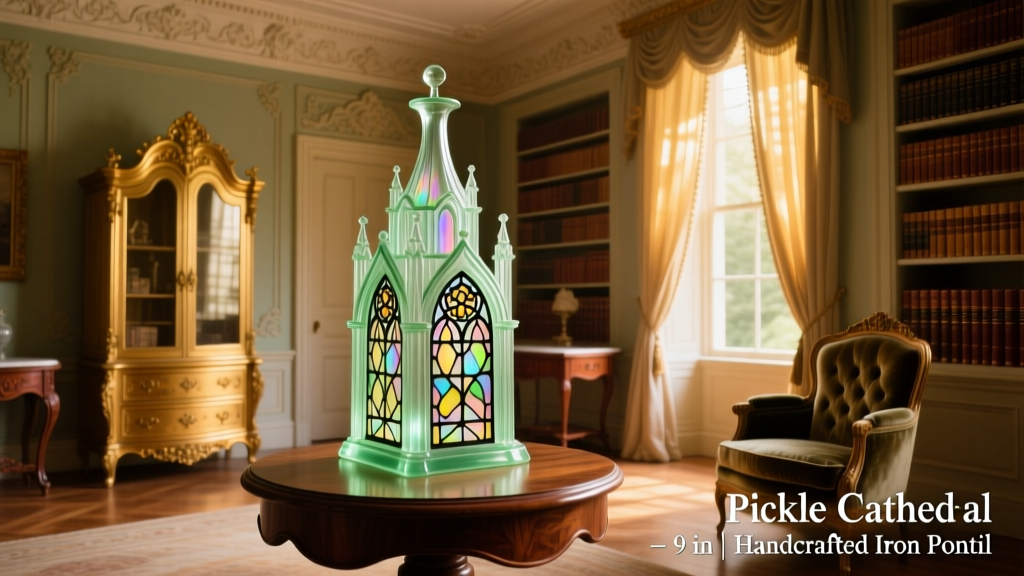
Pickle Cathedral Light Green Applied Mouth Iron Pontil 9-Inch Bottle: Identification, Provenance, and Restoration Protocol
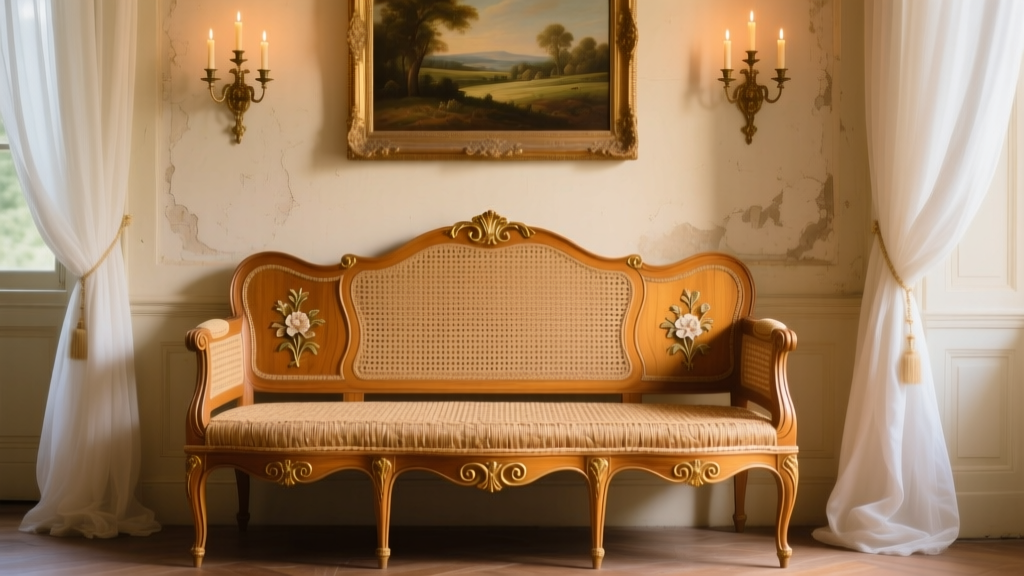
French Provincial Rush-Seat Bench in Fruitwood: Authentic Craftsmanship, Dimensions, and Restoration Insights
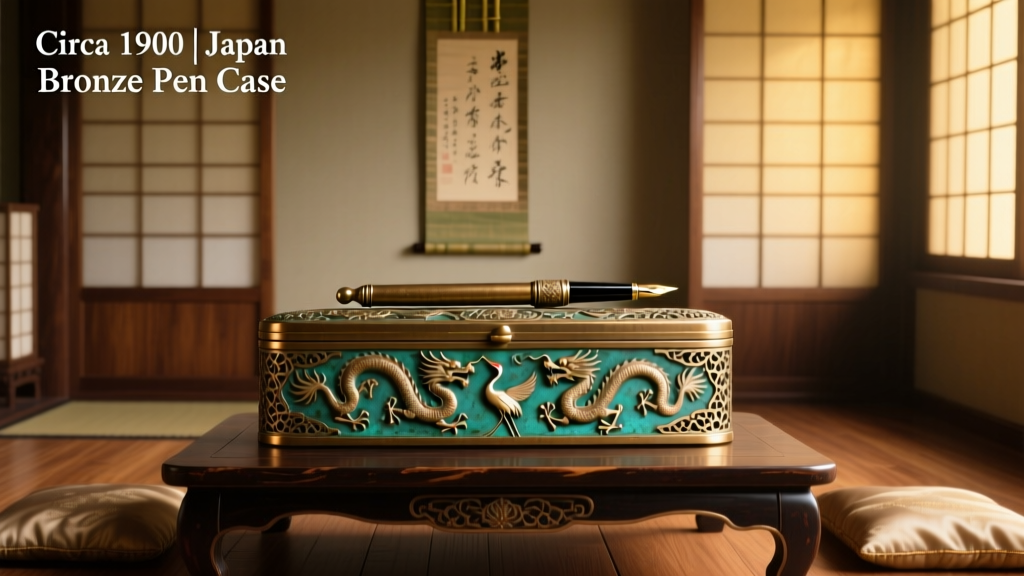
Bronze Pen Case: Cast & Pierced Dragons and Cranes, Japan, c. 1900 — A Masterpiece of Meiji Metalwork