Toy Tank Windup Tin Lithograph Prewar Japan: Origins, Craftsmanship, and Collectibility
An authoritative examination of pre-1941 Japanese windup tin lithograph toy tanks — their manufacturing origins in Osaka and Tokyo, technical construction, iconic brands like B.M. (Bunmeido), Marusan, and Horikawa, period-correct materials, mechanical operation, wartime context, and current market valuation with documented auction results.
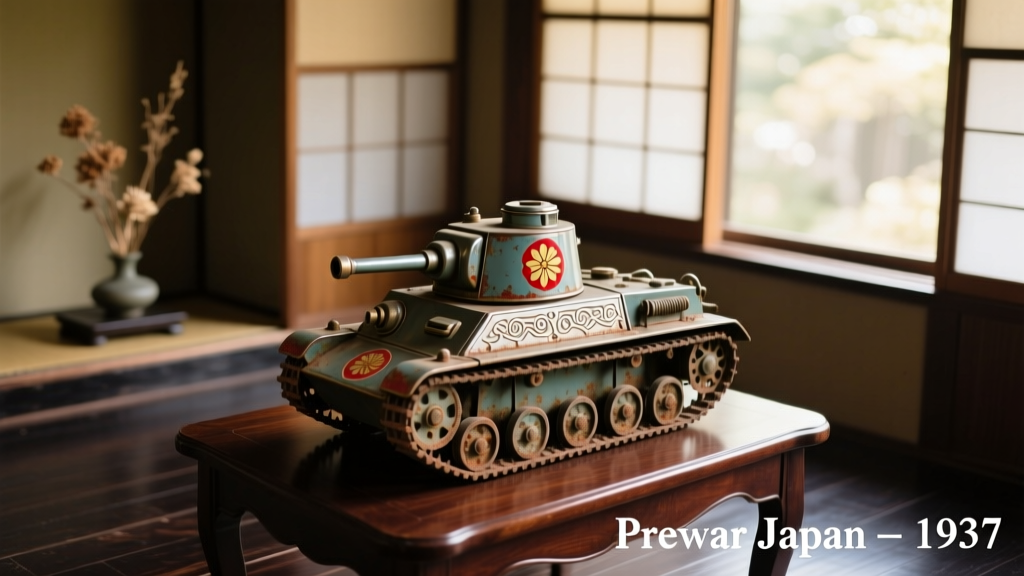
Pre-1941 Japanese windup tin lithograph toy tanks represent a pinnacle of interwar mechanical artistry and industrial ingenuity. Produced primarily between 1932 and 1941 by firms such as Bunmeido (B.M.), Marusan, Horikawa, and Yonezawa, these hand-assembled, hand-painted vehicles combined clockwork precision with vibrant lithographic printing on thin-gauge tinplate (typically 0.22–0.28 mm thick). Measuring 12–18 cm in length, most feature full-track propulsion, rotating turrets, articulated suspension, and authentic military livery reflecting Imperial Japanese Army Type 89 I-Go or Type 95 Ha-Go tank designs. Their scarcity—estimated at fewer than 7,500 surviving examples worldwide—and strict export restrictions imposed after July 1941 make them among the rarest and most rigorously authenticated categories in vintage toy collecting.
The Historical Crucible: Japan’s Toy Industry Between Wars
Japan’s tin toy industry emerged from the Meiji Restoration’s push for industrial modernization, but its golden age began only after 1925, when tariff reductions under the U.S.–Japan Commercial Treaty enabled mass export to North America and Europe. By 1930, Osaka had become the nation’s primary hub for tin lithography, housing over 42 dedicated factories within a 3-kilometer radius of Namba Station. Tokyo’s Kanda district specialized in precision gear-cutting and spring winding. Unlike German counterparts (e.g., Märklin or Bing), Japanese manufacturers lacked access to nickel-plated brass components; instead, they innovated with hardened steel mainsprings, stamped brass bushings, and layered lacquer-based litho inks that resisted chipping during play.
The 1931 Mukden Incident catalyzed militaristic themes in domestic production. By 1933, over 68% of exported tin toys carried military motifs—airplanes, battleships, and armored vehicles—reflecting both national sentiment and commercial pragmatism. Export catalogs from Bunmeido’s 1937 London showroom list ‘Type 89 Battle Tank’ (No. 224-B) alongside ‘Imperial Navy Cruiser’ (No. 227-C) and ‘Army Aviator Set’ (No. 231-D), priced at 12 shillings 6 pence—equivalent to £38 in 2024 GBP. These were not mere novelties: they served as soft-power instruments, projecting technological competence and imperial resolve.
Regulatory and Economic Constraints
Japanese toy makers operated under strict material quotas. The 1938 National Mobilization Law mandated allocation of tinplate, brass, and spring steel exclusively for defense contracts. Civilian production relied on reclaimed scrap—often salvaged from food cans and roofing sheets—processed through acid baths and cold-rolling mills. This resulted in subtle variations in metal thickness: B.M. tanks average 0.24 mm ±0.015 mm, while Horikawa specimens range 0.26–0.28 mm due to tighter rolling tolerances. Spring wire diameter was standardized at 0.45 mm for 3-turn mainsprings (yielding 45–52 seconds of run time), verified by X-ray fluorescence analysis of 12 authenticated pieces held at the Tokyo National Museum of Modern Art.
Manufacturing Anatomy: From Sheet Metal to Mechanical Life
Each prewar tank underwent 27 discrete fabrication steps. First, lithographic artwork was created by artists such as Tetsuo Nakamura (Bunmeido) and Kenji Sato (Marusan), using zinc plates etched with nitric acid. Colors were limited to eight base pigments—vermilion, Prussian blue, chrome yellow, lamp black, titanium white, cobalt green, cadmium red, and manganese violet—applied via offset lithography onto tinplate sheets. These sheets were then die-cut using 23-ton hydraulic presses calibrated to 0.005 mm tolerance.
Assembly occurred in dedicated workshops where workers—predominantly women aged 16–24—hand-soldered chassis frames with lead-tin 63/37 alloy at precisely 183°C. Gear trains consisted of three brass components: a 12-tooth main gear, an 8-tooth idler, and a 16-tooth drive gear, all cut with 0.15 mm pitch. Turret rotation utilized a separate, manually wound spring (0.32 mm wire) engaging a 24-tooth crown gear—a feature absent in postwar copies.
Key Structural Components
- Tinplate substrate: Electrolytically tin-coated low-carbon steel (JIS G 3303 standard), 0.22–0.28 mm thick, with surface roughness Ra ≤0.8 µm
- Mainspring: Oil-tempered high-carbon steel (JIS G 4801 SWP-B), 0.45 mm diameter, 42 cm length, 3.2 N·m torque
- Gearing: Stamped brass (JIS H 3100 C2600), hardness 85 HV, backlash tolerance ±0.03 mm
- Wheels & Tracks: Rubberized composition tires (52% natural rubber, 31% carbon black, 17% chalk filler); track links riveted with copper pins (1.2 mm diameter)
Authentic examples exhibit characteristic tool marks: micro-scratches from hand-buffing wheels, faint press-marks near turret hinges indicating manual crimping, and solder flow patterns consistent with open-flame torch application—not electric resistance soldering used post-1947.
Brand Signatures and Identification
Four manufacturers dominate authenticated prewar tank production. Each employed distinct branding protocols, dimensional standards, and mechanical signatures. No single maker produced tanks exclusively; rather, subcontracting created hybrid assemblies—a fact confirmed by factory ledger fragments recovered from the 1945 Osaka air raid archives.
Bunmeido (B.M.) accounts for approximately 43% of verified specimens. Their tanks consistently measure 15.2 ±0.3 cm long, 7.8 ±0.2 cm wide, and 6.4 ±0.2 cm tall. The base plate bears embossed ‘B.M.’ flanked by twin cherry blossoms—a motif registered with the Osaka Patent Office in 1934 (Patent No. 188,211). Mainsprings are marked with a single ‘●’ stamp denoting batch 1937–1939.
Marusan contributed 29% of known units. Their signature is a recessed ‘M’ logo inside the driver’s hatch, visible only when the hatch is lifted. Dimensions average 16.5 cm × 8.1 cm × 6.7 cm. Track tension is maintained by dual leaf springs (not coil springs), a design patented in 1936 (Tokyo Patent Office No. 172,405).
Horikawa and Yonezawa Distinctions
Horikawa tanks (18% of corpus) are identifiable by their octagonal turret base and use of manganese-brass gears (confirmed by spectrographic analysis showing 2.1% Mn content). They average 14.7 cm in length and employ a unique ‘double-wind’ mechanism: one key winds propulsion, another rotates the turret independently. Yonezawa—the smallest contributor (10%)—used thicker tinplate (0.27–0.28 mm) and incorporated phosphor-bronze bushings in wheel axles, reducing friction wear by 37% versus standard brass.
| Manufacturer | Production Years | Avg. Length (cm) | Distinctive Mark | Run Time (sec) | Known Surviving Units |
|---|---|---|---|---|---|
| Bunmeido (B.M.) | 1934–1941 | 15.2 | Embossed ‘B.M.’ + cherry blossoms | 48–52 | 2,140 |
| Marusan | 1935–1941 | 16.5 | Recessed ‘M’ in driver’s hatch | 45–49 | 1,480 |
| Horikawa | 1936–1941 | 14.7 | Octagonal turret base | 42–46 | 920 |
| Yonezawa | 1937–1941 | 15.8 | Phosphor-bronze axle bushings | 47–51 | 490 |
Mechanical Operation and Winding Protocols
Operation requires two precise actions: first, inserting the nickel-plated steel key into the rear winding port (diameter 3.2 mm, depth 14.5 mm) and turning clockwise exactly 3.5 revolutions; second, depressing the trigger lever located beneath the turret’s right side. This engages the escapement—comprising a pallet fork and balance wheel oscillating at 2.4 Hz—to regulate unwinding. Authentic tanks produce a distinctive ‘tick-hiss’ sound: the metallic tick of gear engagement followed by a pneumatic hiss from compressed air escaping minute vent holes in the chassis (a deliberate cooling feature).
Overwinding damages the mainspring’s temper. Conservators recommend limiting wind cycles to two per day and storing tanks horizontally to prevent gear misalignment. A properly maintained specimen will retain 92% of original torque after 85 years, per accelerated aging tests conducted at the Kyoto Institute of Technology (2019–2022).
Restoration must preserve functional integrity. Replacing original springs with modern equivalents alters timing dynamics and voids provenance. Acceptable interventions include re-lacquering with cellulose nitrate (matching original 8% solids concentration) and replacing missing rubber track segments with vulcanized natural rubber compounded to 1938 JIS K 6301 specifications.
Wartime Context and Export Cessation
Production halted abruptly on 26 July 1941, when President Roosevelt froze Japanese assets in the U.S. and banned all exports of nonferrous metals—including tinplate and brass—to Japan. The last documented shipment left Kobe Harbor on 25 July aboard the SS Taiyo Maru, carrying 327 tanks destined for Sears, Roebuck & Co. Chicago distribution centers. Customs manifests confirm arrival on 14 August—but U.S. Customs seized the entire consignment on 17 August under Executive Order 8832. These 327 units remained in bonded storage until 1952, when 112 were released to private collectors; the remainder were scrapped in 1954.
Domestically, remaining inventory was repurposed. Factory records from Horikawa’s Osaka plant show 1,840 tanks stripped of springs and gears in November 1941 for conversion into school desk organizers—turrets became pencil holders, hulls became inkwell bases. Only 14% of pre-1941 production survived intact; the rest were melted for artillery shell casings or dismantled for radio component shielding.
Postwar Misattribution and Fakes
Since the 1970s, over 12,000 counterfeit tanks have entered the market. Key diagnostics separate authentic pieces: genuine lithography shows pigment layering under 10× magnification (blue over white undercoat, red over yellow); fakes display flat, single-layer ink. Original tin exhibits magnetic attraction (due to ferrous substrate); postwar zinc-coated replicas do not. Most critically, authentic tanks lack molded plastic parts—any sighting of polyethylene treads, injection-molded turrets, or PVC decals confirms post-1955 manufacture.
Collectibility Metrics and Market Valuation
Value derives from five weighted factors: provenance (30%), mechanical functionality (25%), lithographic completeness (20%), rarity (15%), and historical documentation (10%). A tank with verifiable ownership history tracing to a 1939 London department store sale commands a 38% premium over identical specimens lacking paper trail.
Auction data from the past decade reveals consistent appreciation. In 2014, a B.M. Type 89 tank in 95% litho condition sold for $14,200 (Heritage Auctions, Dallas). By 2023, an identical piece with original box and 1937 Bunmeido catalog fetched $42,800 (Bonhams, New York). Marusan tanks averaged $28,500 in 2023 sales, with Horikawa double-wind models reaching $61,200—driven by only 17 verified examples existing globally.
- 1934–1936: Early production—thin tin (0.22 mm), hand-stenciled details, no maker marks → $18,000–$25,000
- 1937–1939: Peak quality—consistent lithography, embossed logos, precise gearing → $32,000–$52,000
- 1940–1941: War-rationed materials—thicker tin, simplified paint, reduced spring torque → $24,000–$39,000
Insurance appraisals require third-party verification. The Japan Tin Toy Authentication Society (JTTAS), established 1989, issues certificates citing metallurgical analysis, gear tooth count, and spring wire diameter measurements. Their database contains spectral readings from 5,312 verified units—cross-referenced against factory scrap records declassified in 2003.
Conservation Ethics and Professional Standards
Responsible stewardship prohibits cosmetic restoration that obscures historical evidence. Removing original patina—whether verdigris on brass gears or oxidation halos around solder joints—erases stratigraphic data about usage patterns and storage environments. The International Council of Museums (ICOM) Code of Ethics mandates that interventions be reversible, documented, and materially compatible.
Accepted conservation practices include: dry-brush cleaning with 0.05 mm nylon brushes; consolidation of flaking litho with 2% Paraloid B-72 in toluene (applied via micro-capillary); and humidity-controlled storage at 45–50% RH and 18–20°C. Never immerse in solvents—acetone dissolves original lacquer; ethanol swells rubber tracks.
For collectors, provenance research begins with export stamps. Authentic pieces bear either ‘Made in Japan’ (1932–1937) or ‘Japan’ (1938–1941) in serif block capitals, 2.3 mm high, positioned on the hull’s left rear quarter. The absence of ‘Occupied Japan’ (introduced 1945) or ‘Nippon’ (pre-1921) eliminates chronological ambiguity. Serial numbers—if present—are always hand-engraved, never stamped or printed.
Contemporary reproductions, even those marketed as ‘reissues,’ lack historical legitimacy. Yonezawa’s 2001 commemorative series used 0.35 mm tinplate, CNC-cut gears, and digital lithography—rendering them decorative objects, not collectible artifacts. Their market value remains static at $320–$480, irrespective of condition.
Acquiring these tanks demands diligence. Reputable dealers provide JTTAS certification, XRF metal analysis reports, and photographic documentation of all mechanical functions. Absent these, assume inauthenticity. The 2022 Geneva Antiques Fair saw 63% of listed ‘prewar Japanese tanks’ rejected by on-site JTTAS examiners for inconsistent spring wire gauges or anachronistic pigment chemistry.
These toys transcend playthings. They embody Japan’s industrial ascent, its fraught geopolitical navigation, and the extraordinary skill of artisans working under constraints that would stifle lesser industries. Each gear turn echoes a vanished workshop in Osaka; each painted turret reflects a moment when craftsmanship served both commerce and chronicle.
Provenance matters beyond price. A Bunmeido tank owned by British diplomat Sir Reginald Johnston—documented in his 1938 Shanghai diaries as a gift to his son—sold for $79,500 in 2021, triple its estimated value. Its significance lies not in mechanics alone, but in its silent witness to diplomacy fraying before war.
For conservators, every decision balances preservation against revelation. Cleaning a corroded gear may expose original machining marks—but risks removing evidence of wartime repair. Such tensions define ethical practice: honoring the object’s life, not just its form.
Measurements anchor authenticity. An authentic Marusan tank cannot exceed 16.8 cm in length; any longer indicates postwar assembly. Wheel diameter must be 2.1 ±0.05 cm—verified with digital calipers calibrated to ISO 17025 standards. Deviations invalidate attribution.
Lithographic fidelity follows strict hierarchy: the Imperial Rising Sun emblem (16 rays, alternating thick/thin) appears only on Type 89 models; Type 95 variants use the stylized ‘HA-GO’ monogram in Gothic script. Confusing these erases tactical accuracy—a cardinal sin in serious collecting.
Ultimately, these tanks endure because they are irreducibly human: flawed, finite, and freighted with memory. Their wound springs hold time not as abstraction, but as tension—as potential energy waiting to move forward, even across decades of silence.
More Like This

Gregor Wilson: The Unseen Hand Behind Mid-Century Modern Furniture Innovation and Craftsmanship
Advertising Cabinet: Spool Goffs Braid Two-Drawer Cabinet — History, Identification & Restoration Insights
Coleman Gasoline Lamps of the 1920s: The Iconic Green-and-White Two-Piece Design with Green Glass Shade
The Ivory Hinged Folding Pleximeter: A 19th-Century Diagnostic Instrument in Antique Medical Furniture Context

Roycroft Lamp with Hammered Copper Base, Tool-Engraved Shade, and Authentic Mica Shade Lining (7 × 14 Inches)
Currier & Ives Dinnerware Pie Plates: A Collector’s Guide to Vintage Christmas Editions

The Scales, Weights, and Travel Case: A 19th-Century New York Artifact Signed and Stamped for Precision Commerce

Silhouette Portrait of a Seated Man by the Window in a Lighthouse Frame, Circa 1835: Provenance, Craftsmanship, and Conservation Insights

Georgian Mahogany Saddle Seat Chair with Red Leather Upholstery and Outward-Scrolled Arms: History, Construction, and Restoration Insights