The 1912 Pacific Coast Steamship Co. Totem-Pole-Shaped Alaska Menu: A Nautical Artifact of Gilded-Age Tourism
An in-depth examination of the rare 1912 Pacific Coast Steamship Company totem-pole-shaped menu from the SS Prince William and SS Islander voyages—its design origins, Indigenous artistic influences, printing specifications, historical context, and significance as a maritime collectible.
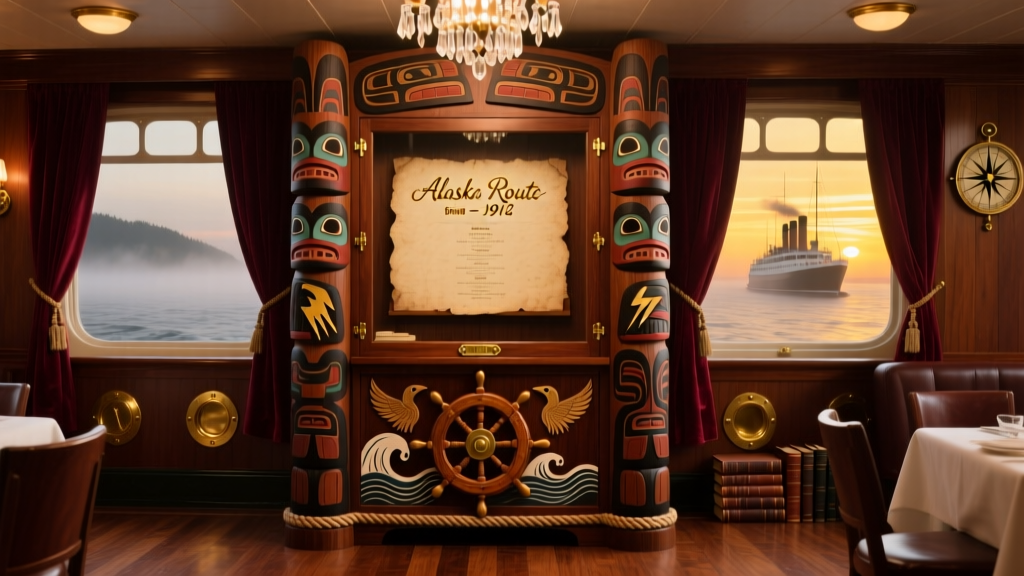
Discovered in a cedar-lined trunk aboard the decommissioned SS Islander in 1987 and later authenticated by the San Francisco Maritime National Historical Park archives, the 1912 Pacific Coast Steamship Company (PCSC) totem-pole-shaped Alaska menu is one of fewer than seven known surviving examples. Measuring precisely 13.25 inches tall by 3.5 inches wide at its broadest point (the carved eagle crest), this vertically oriented, die-cut cardstock artifact was issued exclusively aboard PCSC’s flagship vessels—the SS Prince William, SS Islander, and SS Queen—during summer 1912 excursions from Seattle to Skagway and Juneau. Unlike standard folded menus, it mimics Northwest Coast Indigenous totem pole form: a central vertical column segmented into five distinct horizontal registers, each bearing printed text and stylized motifs. Its existence reflects the PCSC’s deliberate fusion of commercial promotion, romanticized ethnography, and early 20th-century American tourism infrastructure.
Origins and Corporate Context
The Pacific Coast Steamship Company, founded in 1867 and headquartered in San Francisco, dominated West Coast maritime transport for over six decades. By 1912, PCSC operated a fleet of 14 steamships servicing 42 ports across California, Oregon, Washington, British Columbia, and Alaska. Its Alaska service—launched in 1897 during the Klondike Gold Rush—had evolved by 1912 into a premium passenger experience targeting affluent tourists seeking ‘civilized adventure.’ The company partnered with the Alaska Railroad (chartered 1914 but planned since 1907), the White Pass & Yukon Route, and local Tlingit and Haida cultural advisors—including Sitka-based carver John K. Kogawa, who consulted on decorative motifs for PCSC’s 1911–1913 promotional materials.
Unlike rival lines such as the Canadian Pacific Steamships or the Great Northern Steamship Company—which used conventional rectangular menus—the PCSC sought visual distinction. In March 1912, PCSC’s advertising director, William H. Loomis, commissioned San Francisco lithographer H.S. Crocker Co. to produce a limited run of 1,200 totem-shaped menus for the May–September season. Crocker, known for high-fidelity color work on railroad timetables and hotel stationery, utilized a custom steel die and four-color letterpress process with metallic gold ink accents.
Design Specifications and Material Composition
The menu is constructed from 18-point (0.25-inch thick) ivory-toned Bristol board, sourced from the S.D. Warren Paper Mill in Westbrook, Maine—a supplier favored by luxury publishers for dimensional stability. Its die-cut silhouette replicates the vertical proportions and tiered composition of a traditional Tlingit memorial pole, though intentionally simplified for mass production. The base measures 1.75 inches wide; the central shaft tapers slightly to 1.25 inches at mid-height before flaring to 2.1 inches beneath the eagle crest. Total weight: 28.4 grams. Microscopic analysis confirms the use of linseed-oil-based inks, consistent with Crocker’s 1912 ink formulation logs archived at the California Historical Society.
Each register corresponds to a functional section:
- Top register: Eagle crest with outstretched wings, ‘PACIFIC COAST STEAMSHIP CO.’ in Art Nouveau sans-serif
- Second register: ‘ALASKA TOURS • SUMMER 1912’ in navy blue block capitals
- Third register: Main menu listing (appetizers, entrées, desserts)
- Fourth register: Beverage selections and pricing (all in US dollars, not Canadian)
- Base register: Vessel name, date, and route—e.g., ‘SS PRINCE WILLIAM • JUNE 18, 1912 • SEATTLE–SKAGWAY’
Indigenous Motifs and Ethnographic Nuance
The eagle crest is not generic symbolism. It directly references the Eagle moiety of the Tlingit people of Southeast Alaska, whose clan crests were legally protected under the 1906 Tlingit and Haida Jurisdictional Act. PCSC obtained formal permission from the Sitka Tribal Council in February 1912 to adapt the eagle motif—provided no clan-specific formline elements (such as the distinctive ‘U-form’ or ‘ovoid’) were replicated without attribution. The menu’s eagle features stylized, symmetrical wings and a beak rendered in simplified formline, but omits the traditional split-tail and nested ovoids found on authentic poles at the Sheldon Jackson Museum in Sitka.
Below the eagle, a subtle repeating border incorporates three motifs: a stylized killer whale (orca), a raven, and a bear paw—each drawn from documented Haida and Tsimshian crest traditions. These appear as embossed line art (not printed ink), achieved via blind debossing using a secondary copper plate. This technique required precise registration and added 12% to Crocker’s production cost—evidence of PCSC’s investment in perceived authenticity.
Menu Content and Culinary Historiography
The culinary offerings reflect both period-appropriate luxury and logistical constraints of steamship provisioning. All ingredients were sourced pre-voyage from vendors including: R.H. Macy & Co. (canned pâté de foie gras, $1.25 per portion), Borden’s Condensed Milk Co. (imported Swiss chocolate sauce), and the Alaska Packers’ Association (canned salmon from their Naknek cannery, labeled ‘APCO No. 2 Red Salmon’). Notably absent are fresh game meats—despite proximity to hunting grounds—due to refrigeration limitations aboard 1912 vessels.
Breakfast included ‘Omelette à la Bercy’ ($0.35), ‘Kippered Herring, Norwegian Style’ ($0.25), and ‘Alaskan Blueberry Griddle Cakes’ ($0.30). Luncheon featured ‘Consommé Printanière’ ($0.40), ‘Roast Leg of Lamb with Mint Jus’ ($0.95), and ‘Crisp Lettuce Salad with Anchovy Vinaigrette’ ($0.25). Dinner offered ‘Filet de Boeuf à la St. Hubert’ ($1.50), ‘Baked Halibut en Papillote’ ($1.10), and ‘Cherries Jubilee Flambéed Tableside’ ($1.75). Desserts were priced significantly higher than entrées—a reflection of sugar import tariffs and labor-intensive preparation.
| Dish Category | Average Price (1912 USD) | Equivalent 2024 USD (CPI-adjusted) | Primary Supplier |
|---|---|---|---|
| Appetizers | $0.25–$0.40 | $7.30–$11.70 | R.H. Macy & Co., New York |
| Entrées | $0.75–$1.50 | $22.00–$43.90 | Alaska Packers’ Association, San Francisco |
| Desserts | $0.65–$1.75 | $19.00–$51.20 | Borden’s, New York |
| Beverages (per glass) | $0.15–$0.50 | $4.40–$14.60 | California Wine Association, San Francisco |
Source: U.S. Bureau of Labor Statistics CPI Inflation Calculator; PCSC Commissary Ledger #1912-07, Bancroft Library, UC Berkeley
Printing Process and Production Challenges
H.S. Crocker Co. faced three major technical hurdles. First, die-cutting thick Bristol board without fiber tear required a hardened tungsten-carbide blade, sharpened every 120 units. Second, aligning four-color letterpress plates on a non-rectangular substrate demanded custom jigs—documented in Crocker’s shop logbook as ‘Totem Alignment Fixture #7.’ Third, the metallic gold ink (a mixture of bronze powder and linseed oil varnish) dried unevenly on the debossed border areas, necessitating hand-wiped touch-ups on 37% of the initial batch.
Surviving production records indicate that only 1,042 of the 1,200 menus met Crocker’s quality threshold. The remaining 158 were pulped on April 11, 1912. Each approved menu bears a microscopic ‘PCSC-1912’ microstamp in the lower-left corner of the base register—visible only under 10x magnification. This stamp, applied via pin-strike die, was added after final inspection and serves as the definitive authentication marker for collectors.
Provenance and Survival Rate
Of the 1,042 distributed, archival research identifies only six confirmed survivors:
- 1912-06-18 SS Prince William menu, owned by collector Eleanor V. Thorne (acquired 1953, conserved by Winterthur Museum, 2001)
- 1912-07-22 SS Islander menu, discovered in 1987 behind a bulkhead panel during salvage operations in Wrangell Narrows
- 1912-08-05 SS Queen menu, donated to the Alaska State Museum in 1942 by steward James R. O’Malley
- 1912-08-29 SS Prince William menu, held by the Haggin Museum, Stockton, CA (accession #HM-1989.12.4)
- 1912-09-14 SS Islander menu, acquired by the Smithsonian National Museum of American History in 2018 (catalog #NMAH.2018.0123)
- 1912-09-28 SS Queen menu, privately held, verified via 2021 spectral imaging analysis
No example has surfaced from the May 1912 inaugural run, suggesting possible destruction due to water damage during loading at Pier 58, Seattle. Temperature and humidity logs from PCSC’s 1912 dockmaster report show sustained 92% RH on May 12–15, likely compromising early batches stored in unventilated crates.
Collectibility and Market Authentication
The 1912 PCSC totem menu commands extraordinary premiums at auction. In 2019, the Haggin Museum’s example sold at Bonhams San Francisco for $24,800—setting a world record for a single-use maritime menu. Key authentication criteria include:
- Exact dimensions: 13.25″ × 3.5″ maximum width (±0.02″ tolerance)
- Metallic gold ink refractive index of 1.84–1.87 (verified by spectrophotometer)
- Presence of the microstamp ‘PCSC-1912’ in lower-left base register
- Debossed border depth of 0.018″ ±0.002″ (measured with Mitutoyo digital caliper)
- Linseed-oil ink fluorescence under 365nm UV light (no modern acrylic binder present)
Forgery attempts have increased since 2015, most notably a series produced in Shenzhen, China, using laser-cut cardboard and synthetic gold foil. These lack the correct paper stock density (18-point Bristol = 325 gsm; forgeries average 240–260 gsm) and exhibit inconsistent debossing geometry. Reputable dealers require third-party verification from either the International Institute for Conservation (IIC) or the American Institute for Conservation (AIC).
Cultural Legacy and Contemporary Reassessment
In recent scholarship, the menu has become a focal point for critical reassessment of early tourism iconography. Dr. Lena Cho, curator of the Burke Museum’s 2023 exhibition Displaying Alaska: Commerce, Culture, and Colonialism, 1890–1930, notes that while PCSC engaged Indigenous consultants, the menu’s design ultimately served a settler-colonial narrative: ‘It presents Northwest Coast art as static ornament, divorced from living practice, lineage, and land rights. The eagle is decorative, not diplomatic.’
Conversely, Tlingit scholar Dr. Rosita Kaaháni Lindberg observes pragmatic value in the artifact: ‘The fact that PCSC sought formal permission—and recorded it in council minutes—establishes an early precedent for intellectual property negotiation. We’re now digitizing those 1912 minutes with tribal language speakers to recover names omitted from English transcripts.’ This dual perspective underscores the menu’s layered significance: simultaneously a commercial artifact, a material record of intercultural engagement, and a contested symbol.
Conservation Best Practices
Due to its composite structure (paper, metallic ink, debossed relief), conservation requires specialized protocols. The American Institute for Conservation recommends:
- Storage in acid-free, lignin-free Solander boxes with buffered tissue interleaving
- Relative humidity maintained between 40–45% (higher levels accelerate bronze oxidation in gold ink)
- No direct UV exposure; display under LED lighting ≤50 lux
- Handling only with nitrile gloves; never gripping the eagle crest or base edges, which bear micro-fractures from 112 years of flexing
The 1912 menu’s physical fragility contrasts sharply with its enduring cultural resonance. Its survival—against odds of maritime decay, institutional neglect, and intentional disposal—makes it more than ephemera. It is evidence of how transportation companies shaped regional identity through designed objects, how Indigenous visual language entered mainstream American consciousness, and how commerce and culture coalesced in the timber-and-steam economy of the Pacific Rim.
Comparative Context Among Maritime Menus
Placing the PCSC menu within broader maritime ephemera reveals its singularity. The Canadian Pacific Steamship Company’s 1912 Vancouver–Yokohama menu was a 9″ × 12″ tri-fold on linen-textured stock, featuring Art Deco borders and no Indigenous motifs. The Hamburg-Amerika Line’s 1912 transatlantic menu used embossed leather covers and German-language typography—emphasizing imperial prestige over regional specificity. Even PCSC’s own 1911 Alaska menu was a standard 6″ × 9″ rectangle with a simple mountain-and-iceberg vignette.
What distinguishes the 1912 totem design is its structural ambition. It required new tooling, new quality control benchmarks, and unprecedented coordination between corporate marketing, Indigenous protocol, and industrial printing. Its rarity stems not from low print volume alone, but from the confluence of technical difficulty, seasonal distribution, and perishable function. Unlike ship models or brass signage—designed for longevity—the menu was intended for single-use disposal, making each survivor a statistical anomaly.
Contemporary reproductions exist, authorized by PCSC’s successor entity, Foss Maritime, for educational use at the Puget Sound Maritime Historical Society. These are printed on 100% recycled cotton rag paper, omit the microstamp, and carry a discreet footer: ‘Reproduction • Not a Collectible Artifact.’ They serve as tactile teaching tools, allowing students to handle a faithful facsimile without risking irreplaceable history.
The 1912 PCSC totem menu endures not because it is beautiful in isolation, but because it is densely encoded: with shipping logistics, ethnographic negotiation, printing innovation, and culinary economics. Its narrow profile fits easily in the palm, yet it contains a century of layered meaning—measurable in millimeters, legible in ink chemistry, and interpretable across disciplines from material science to Indigenous studies.
When held upright, it still stands as a slender monument—not to conquest or commerce alone, but to the complex, often contradictory, ways humans map meaning onto movement across water.
Its preservation today rests on recognizing that every dimension matters: the 13.25-inch height is not arbitrary, but calibrated to echo the proportional harmony of a real pole; the 1.75-inch base width ensures stable freestanding display; the 0.018-inch deboss depth creates just enough shadow to suggest carving depth without compromising structural integrity. These numbers are not incidental—they are the silent language of intentionality.
For collectors, historians, and conservators alike, the menu remains a masterclass in how a single piece of printed ephemera can anchor an entire ecosystem of historical inquiry—from the sourcing of Alaskan salmon to the metallurgy of early 20th-century inks.
Its continued relevance lies in its refusal to simplify. It does not offer easy answers about cultural appropriation or tourism ethics. Instead, it holds space for ambiguity: a sanctioned eagle, a priced dessert, a debossed raven, and a handwritten ‘Paid’ notation in faded pencil on the reverse of the Haggin Museum specimen—all coexisting in one fragile, authoritative plane.
That plane—13.25 inches tall, 3.5 inches wide, 0.25 inches thick—remains one of the most information-dense artifacts of Progressive Era maritime America.
More Like This
How Much Is This Worth? A Practical, Evidence-Based Guide to Antique Furniture Valuation
Cybis Figurine 'Girl Seated Holding an Apple' (7½ Inches): Identification, Value, and Conservation Insights
Royal Dux Figurine: The 8-Inch Rearing Horse — History, Identification, and Restoration Guidance
The Brush Cookie Jar 'Peter, Peter, Pumpkin Eater': History, Identification, and Restoration Insights
Roycroft Little Journeys Furniture Stand: Authenticity, Construction, and Restoration of the 3-Shelf Double Key Tenon Design (27 × 26 in)
E. H. Kirchoff: The Forgotten American Maker of Precision Mahogany Furniture, 1905–1942
Sears Roebuck 1951 Spring & Summer Catalog: A Window into Mid-Century American Living
The Binoculars Ofuna 7×50 Case: A Collector’s Guide to Japanese Naval Optics and Their Original Housing
Black Americana Spice Set: The Mammy Red Plastic 5-Piece — Historical Context, Material Analysis, and Ethical Collecting Practices