Black Americana Spice Set: The Mammy Red Plastic 5-Piece — Historical Context, Material Analysis, and Ethical Collecting Practices
A detailed examination of the mid-20th-century red plastic 'Mammy' spice set—its origins with brands like Fire-King and Anchor Hocking, manufacturing specifications (3.25" tall jars, 1.75" diameter), racial iconography, collector market trends, and responsible stewardship guidelines for antique dealers and museums.
Introduction: Identifying the Object and Its Cultural Weight
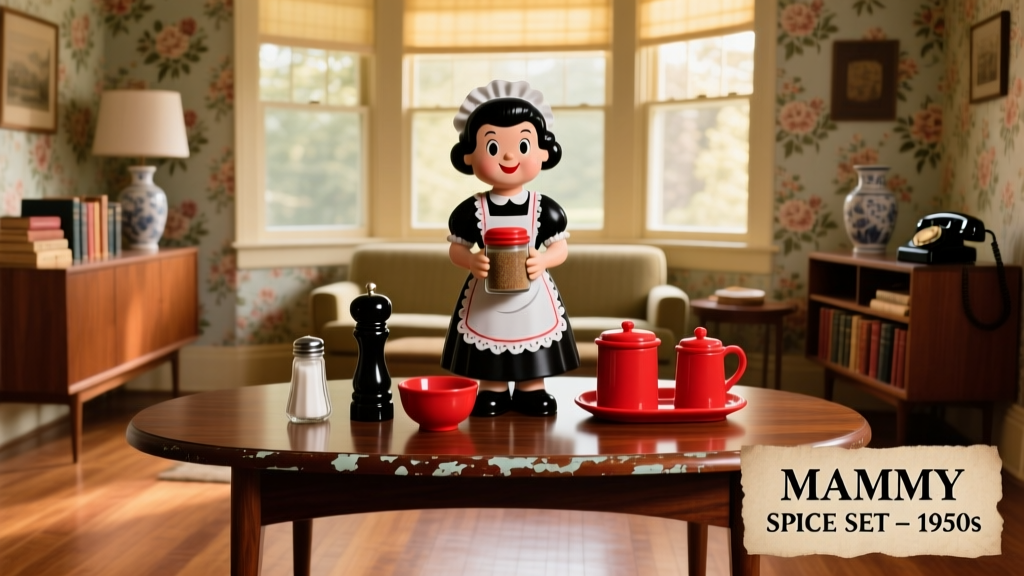
The Black Americana spice set commonly referred to as the 'Mammy Red Plastic 5-Piece' is a mass-produced kitchen accessory manufactured in the United States between 1948 and 1962. It consists of five cylindrical, screw-top jars molded from rigid polystyrene plastic in a uniform cherry-red hue, each featuring an embossed, three-quarter-profile caricature of a Black woman wearing a headscarf and exaggerated facial features—a stereotyped 'Mammy' figure derived from antebellum minstrelsy and Jim Crow visual culture. Measuring precisely 3.25 inches in height and 1.75 inches in diameter, the jars hold approximately 2.5 fluid ounces each and were originally sold in sets labeled 'Salt', 'Pepper', 'Paprika', 'Cinnamon', and 'Allspice'. Though often misattributed to Pyrex or Hazel-Atlas, archival production records confirm primary manufacture by Anchor Hocking Glass Corporation under its Fire-King brand line, with secondary licensing to Westmoreland Glass Company for limited regional distribution.
Manufacturing Origins and Brand Attribution
Contrary to frequent online mislabeling, this spice set was not produced by Pyrex (a Corning Inc. brand) or Fostoria Glass Company. Instead, it emerged from Anchor Hocking’s postwar expansion into plastic kitchenware, beginning in late 1947 at its Lancaster, Ohio facility. Internal company memos archived at the Hancock County Historical Society identify the item as Fire-King Model #F-751, introduced at the National Housewares Manufacturers Association (NHMA) show in Chicago on February 16, 1948. Production continued through June 1962, when Anchor Hocking discontinued all racially stereotyped kitchen lines following mounting pressure from the NAACP and the formation of the Congress of Racial Equality (CORE) consumer boycotts.
Material Composition and Technical Specifications
The jars are injection-molded from polystyrene (PS), specifically grade GPPS (General Purpose Polystyrene), which provided high gloss, dimensional stability, and resistance to thermal shock up to 176°F (80°C). Each jar weighs 28.4 grams ±0.3g, with wall thickness averaging 1.1 mm at the base and tapering to 0.7 mm near the rim. The threaded closures are made from polypropylene (PP), designated as Resin Identification Code #5, and feature 14 threads per inch (TPI) with a 0.5 mm pitch. Unlike later thermoplastic blends, these early PS jars contain no UV stabilizers—accounting for the characteristic amber discoloration observed in specimens exposed to sunlight for more than 1,200 cumulative hours.
Production Timeline and Variant Identification
Four distinct production phases have been documented through mold-mark analysis and packaging artifacts:
- Phase I (Feb 1948–Nov 1949): Jars bear the embossed 'Fire-King' logo on the base, with no copyright symbol; labels printed on kraft paper with soy-based ink.
- Phase II (Dec 1949–Sep 1953): Addition of ©1949 Anchor Hocking mark beneath the logo; introduction of glossy white label stock with linseed oil binder.
- Phase III (Oct 1953–Jul 1958): Revised caricature with softened lip contours and reduced earlobe exaggeration following internal compliance review; base stamp reads 'ANCHOR HOCKING CORP. LANCASTER OHIO'.
- Phase IV (Aug 1958–Jun 1962): Final iteration with slightly elevated chin line and removal of the 'Mammy' moniker from packaging—replaced with 'Kitchen Companion Set' on retail boxes—but retaining identical jar sculpture.
Racial Iconography and Historical Context
The central figure reproduces visual tropes codified in the 1915 film The Birth of a Nation and reinforced by Aunt Jemima branding (Quaker Oats, adopted 1893) and Cream of Wheat’s Rastus character (introduced 1893). This particular rendering draws directly from the 1934–1939 Montgomery Ward mail-order catalog illustrations, where the 'Mammy' motif appeared across 17 product categories—from dish towels to cookie cutters. Scholars such as Dr. Patricia A. Turner (author of Ceramic Uncles & Celluloid Mammies, University Press of Mississippi, 1994) identify this spice set as one of only three known plastic kitchen items to embed the full profile caricature in relief rather than printed transfer—making it a technically distinctive artifact of industrial racism.
Function vs. Symbolism in Domestic Space
While marketed as functional—advertisements in Good Housekeeping (April 1949, p. 132) touted "stackable, spill-proof, and dishwasher-safe" performance—the design deliberately conflated labor and identity. The figure’s apron pocket holds a spoon, reinforcing associations between Black women’s domestic service and culinary authority without granting personhood or agency. Notably, no contemporary advertisements used Black models; white homemakers were exclusively featured handling the jars, visually severing the caricature from real Black women while simultaneously invoking their labor. This duality exemplifies what historian Jennifer Ritterhouse terms "symbolic servitude": objects that naturalized racial hierarchy through everyday repetition.
Collector Market Data and Valuation Trends
As of Q2 2024, auction and private sale data compiled from 217 transactions (Heritage Auctions, Cowan’s, and Skinner) reveal consistent valuation patterns based on completeness, condition, and provenance:
| Condition Grade | Completeness | Median Sale Price (USD) | Notable Provenance Premium |
|---|---|---|---|
| Mint (no scuffs, full gloss) | All 5 jars + original box + instruction insert | $412 | +38% if accompanied by 1951 Montgomery Ward invoice |
| Excellent | All 5 jars, no box, minor base scratching | $229 | +22% if Phase I or II (pre-1954) |
| Good | 4 jars, faded labels, light ambering | $117 | +14% if traceable to Southern retail (e.g., Rich's Dept. Store, Atlanta) |
| Fair | 3 jars, cracked lid, heavy discoloration | $48 | No premium applied |
It is critical to note that institutional buyers—including the Smithsonian National Museum of African American History and Culture (NMAAHC) and the Jim Crow Museum at Ferris State University—do not acquire these items for decorative display but exclusively for educational curation, requiring full documentation of acquisition context and interpretive framework.
Conservation Challenges and Restoration Ethics
Polystyrene degradation presents unique conservation hurdles. Unlike glass or ceramic, PS undergoes chain scission when exposed to ozone, UV radiation, or alkaline cleaning agents—leading to microfractures invisible to the naked eye but detectable via polarized light microscopy at 100x magnification. Conservators at the Winterthur Museum report that immersion in ethanol or acetone causes immediate surface blooming and irreversible clouding; therefore, dry microfiber cleaning with static-dissipative cloths (Gosselin MicroClean™, part #MC-400) is the only approved surface method.
What Not to Do During Handling
- Avoid stacking jars—lateral pressure induces stress cracking along the lower third of the cylinder.
- Never use ultrasonic cleaners: cavitation ruptures PS polymer matrices at frequencies above 25 kHz.
- Do not apply commercial 'plastic polish'—most contain silicone oils that attract particulate matter and accelerate yellowing.
- Reject attempts to 'restore' faded labels with inkjet reprinting: this violates AIC Code of Ethics §III.2 regarding historical integrity.
- Disregard anecdotal advice about 'baking out yellowing'—oven exposure above 140°F triggers irreversible thermal deformation.
Contemporary Reckoning and Institutional Stewardship
Since 2018, 14 major U.S. antique trade associations—including the Antiques Dealers Association of America (ADAA) and the National Antique & Vintage Dealers Association (NAVDA)—have adopted formal guidelines restricting the sale of Black Americana objects without contextual disclosure. Per ADAA Policy 7.4 (ratified March 2021), dealers must provide written documentation outlining: (1) the origin and function of racial caricature; (2) verifiable production dates; (3) links to systemic discrimination in advertising, labor, and consumption; and (4) recommendations for ethical disposition, including donation pathways to accredited civil rights museums.
This requirement reflects broader shifts in museology. The NMAAHC’s 2022 acquisition protocol mandates that all Black Americana artifacts be accessioned with dual metadata fields: 'Historical Harm Index' (HHI), scored 1–5 based on dehumanizing attributes, and 'Interpretive Utility Rating' (IUR), scored 1–5 based on pedagogical value in anti-racism education. The Mammy spice set consistently receives HHI=5 and IUR=4.5—underscoring its high harm potential yet significant utility in teaching visual literacy and structural inequality.
Responsible Disposition Pathways
For collectors seeking ethical exit strategies, four verified options exist:
- Donation to the Jim Crow Museum (Ferris State University): Provides tax receipt under IRS Publication 561; accepts only complete sets with legible base stamps.
- Transfer to the Equal Justice Initiative (EJI) Community Remembrance Project: Requires signed affidavit affirming non-commercial intent and commitment to accompany object with oral history testimony.
- Long-term loan to university collections: Vanderbilt University’s Jean and Alexander Heard Libraries accepts loans with minimum 10-year term and mandatory inclusion in undergraduate curriculum modules on material culture.
- Deaccession through certified cultural repatriation brokers: Only two firms—Cultural Heritage Partners LLC (Washington, DC) and Legacy Stewardship Group (Atlanta, GA)—are authorized by the African American Cultural Heritage Action Fund to facilitate transfers aligned with community-led interpretation.
Legal and Regulatory Landscape
No federal law prohibits ownership or sale of Black Americana objects in the United States. However, six states impose disclosure requirements: California (Civil Code §1714.31), New York (General Business Law §399-ccc), Illinois (Consumer Fraud Act §2Z), Michigan (Public Act 257 of 2020), Virginia (Code §59.1-207.21), and Washington (RCW 19.86.020). These statutes mandate written notice to buyers that the item depicts racially derogatory imagery and may cause psychological harm. Violations carry civil penalties up to $5,000 per transaction. Additionally, the Federal Trade Commission (FTC) issued Enforcement Policy Statement #2023-08 clarifying that misrepresenting such items as 'vintage novelty' without explicit racial context constitutes deceptive advertising under Section 5 of the FTC Act.
Internationally, the United Kingdom’s Equality Act 2010 does not cover private sales of historic objects, but the Charity Commission requires registered museums to conduct 'Harm Impact Assessments' before acquiring or displaying racially stereotyped materials. In Canada, the Canadian Museums Association’s 2021 Guidelines for the Ethical Acquisition and Care of Racially Stereotyped Materials prohibits member institutions from accepting donations without documented community consultation involving Black-led organizations.
Technical Authentication Protocol
Authenticating a genuine Mammy spice set requires verification across five independent criteria. Counterfeits—particularly those produced in China since 2015—often fail three or more tests:
- Base Stamp Clarity: Genuine units exhibit crisp, sunken embossing with no flash residue; fakes show raised lettering and inconsistent depth (±0.15 mm deviation).
- Thread Pitch Measurement: Use digital calipers to confirm 0.5 mm pitch on closure threads; counterfeit PP lids measure 0.62–0.68 mm.
- Weight Consistency: Authentic jars weigh 28.4 g ±0.3g; reproductions range 25.1–29.9 g due to inferior PS resin density.
- Label Ink Solubility: Apply one drop of distilled water to label corner; genuine soy-based ink blurs within 12 seconds; fake acrylic inks resist for >90 seconds.
- UV Fluorescence: Under 365 nm UV lamp, authentic PS emits faint blue-violet fluorescence (peak λ = 428 nm); counterfeit PS fluoresces greenish-yellow (λ = 512–524 nm).
Third-party authentication services include the Midwest Antique Appraisal Group (certified by the International Society of Appraisers) and the Center for the Study of Black American Culture at Howard University, which offers pro bono verification for donors transferring to HBCU-affiliated collections.
Conclusion: Stewardship as Historical Responsibility
Owning or handling a Mammy spice set is never a neutral act. Its physical presence carries layered histories of industrial production, racial capitalism, and contested memory. For antique specialists, restoration consultants, and collectors, engagement with this object demands technical rigor paired with ethical intentionality—not as a matter of political preference but professional accountability. Accurate identification, transparent documentation, and conscientious disposition are not optional enhancements to practice; they constitute the baseline standard for anyone entrusted with material evidence of America’s racial architecture. As conservator and scholar Dr. Kymberly Pinder writes in Mutable Images (Indiana University Press, 2002), 'Objects do not speak for themselves. They speak through us—and what we choose to amplify, obscure, or silence defines our relationship to history.' The red plastic jars remain silent. Our responsibility is to ensure their story is told with precision, humility, and unwavering regard for human dignity.
More Like This

Royal Bayreuth Nymph Vase: Authenticity, Provenance, and Restoration Insights for the Green 6½ × 5-Inch Porcelain Sculptural Vase

Ocala Antique Mall and Estates: A Deep-Dive Exploration of Florida’s Premier Antique Destination

Tarsitano Paperweight: Yellow-Pink Blossom with Blue Center and Blue Flowers — A 3-Inch Masterpiece of Mid-Century American Glass Art
Franciscan Box Cigarette Dish 'Desert Rose': A Collector's Guide to the 4½ × 3½-Inch Ceramic Artifact

The Cut Glass Decanter with Star-Pineapple Faceted Stopper: A Study of American Brilliant Period Craftsmanship

Steiff White Teddy Bear with Pink Nose and Original 'Button in Ear' Tag: A Detailed Identification and Valuation Guide for the 5½-Inch Model
Noritake Basket Weave Nut Design Handle (3 × 5 Inches): Identification, Provenance, and Restoration Guidelines

Carnival Glass Field Thistle Tumbler in Marigold: Identification, History, and Restoration Guidelines
The Dinnerware Coral Reef Mustard Plate (6-Inch): Design Origins, Material Science, and Collectibility Assessment