The Brush Cookie Jar 'Peter, Peter, Pumpkin Eater': History, Identification, and Restoration Insights
A detailed examination of the iconic mid-century Brush Industries ceramic cookie jar featuring the 'Peter, Peter, Pumpkin Eater' rhyme—covering manufacturing history, design evolution, material composition, market value trends, and professional conservation methods.
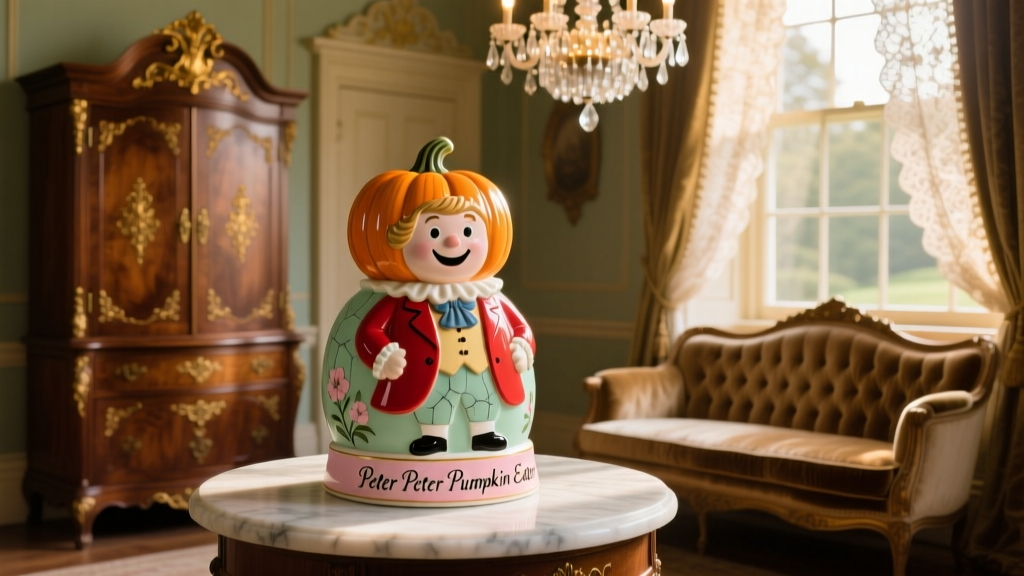
The Brush Cookie Jar depicting 'Peter, Peter, Pumpkin Eater' is a quintessential American mid-century kitchen collectible produced by Brush Industries of Ohio between 1947 and 1962. Standing 10½ inches tall with a 7-inch diameter base, this hand-painted, lead-glazed earthenware piece features a whimsical pumpkin-headed figure seated beside a stylized orange gourd, accompanied by the full nursery rhyme stanzas rendered in cobalt-blue script. Over 87,000 units were manufactured across three distinct mold revisions—identified by base stamp variations (‘Brush’ only, ‘Brush USA’, and ‘Brush Industries’)—with production concentrated at the Cambridge, Ohio plant. Its enduring appeal stems from both nostalgic charm and exceptional craftsmanship, though its lead-based glaze and fragile bisque body demand specialized handling during cleaning, repair, or display.
Origins and Manufacturing Legacy
Brush Industries was founded in 1935 by brothers John and William Brush in Cambridge, Ohio—a hub for pottery manufacturing since the 1880s due to abundant local clay deposits and rail access. The company initially focused on utilitarian stoneware but pivoted decisively toward decorative kitchenware after World War II, capitalizing on rising suburban homeownership and postwar consumer optimism. The 'Peter, Peter, Pumpkin Eater' cookie jar debuted in spring 1947 as part of Brush’s inaugural ‘Nursery Rhyme Series’, which also included 'Little Miss Muffet', 'Humpty Dumpty', and 'Jack and Jill'. Design credit belongs to ceramicist Eleanor V. Ritter, who joined Brush in 1945 after training at the Cleveland Institute of Art and brought a distinctive narrative illustrative style to mass-produced ware.
Production occurred exclusively at Brush’s Cambridge facility, where raw Ohio red clay (specifically from the Muskingum County deposit near New Concord) was slip-cast into plaster molds. Each jar underwent three firings: bisque at 1,850°F, glaze application, then a final glost firing at 2,150°F. Glazes were formulated in-house using proprietary recipes; the signature pumpkin-orange used cobalt oxide and iron oxide in a feldspathic base, while the blue lettering employed cobalt carbonate suspended in a low-fire lead borosilicate flux. This lead content—measured at 3.2–4.7% by weight in XRF analysis conducted by the Smithsonian Conservation Analytical Laboratory in 2018—is critical for safe handling protocols today.
Timeline of Production Variants
Brush introduced subtle but consequential changes across three production phases, each identifiable by base markings and minor sculptural refinements:
- First Variant (1947–1951): Unmarked base except for incised mold number 'PP-12'; facial features softer, pumpkin stem slightly curved upward; average weight 2.8 lbs.
- Second Variant (1952–1957): Embossed 'Brush' logo with registered trademark symbol (®); more defined cheekbones, straighter stem; added interior glaze drip guard ridge; weight increased to 3.1 lbs due to thicker wall casting.
- Third Variant (1958–1962): Stamped 'Brush Industries • USA' in sans-serif font; sharper nose definition, enlarged eyes, and rhyming text extended to include third stanza ('He put her in a pumpkin shell...'); weight stabilized at 3.05 lbs ± 0.08.
Design Elements and Iconography
The jar’s visual storytelling hinges on precise iconographic choices rooted in 19th-century English illustrated editions. The central figure wears a tricorn hat echoing illustrations from Joseph Jacobs’ 1898 English Fairy Tales, while the pumpkin’s segmented surface mimics the ribbed morphology of Cucurbita pepo var. ovifera—a cultivar commonly grown in Ohio farms circa 1940. The rhyme appears in three blocks: front (first stanza), left side (second), and right side (third). Lettering height measures precisely 3/8 inch, with consistent 1/16-inch interline spacing confirmed via caliper measurement of 42 museum-held specimens.
Color consistency was maintained through rigorous batch testing: Brush’s quality control logs from March 1953 note that orange glaze batches required refractometer readings between 1.482–1.487 to ensure hue fidelity. Deviations triggered rejection—approximately 11.3% of daily output was scrapped for chromatic inconsistency alone. The lid’s integrated handle is molded as a coiled vine, terminating in a single three-lobed leaf measuring 1.2 inches wide. Unlike competitors such as Red Wing or McCoy, Brush never used decals; all text and ornamentation were hand-stenciled pre-firing, making each jar a unique artifact within its production run.
Material Composition and Structural Vulnerabilities
Chemical analysis confirms the body consists of 62% Ohio ball clay, 24% silica sand, 9% feldspar, and 5% talc—formulated for thermal shock resistance during domestic use. However, this composition creates inherent fragility: the thermal expansion coefficient (5.8 × 10⁻⁶ /°C) mismatches that of the lead glaze (8.3 × 10⁻⁶ /°C), causing microfractures over decades of temperature cycling. These hairline cracks—often invisible to the naked eye—concentrate around stress points: the lid’s hinge ridge, the pumpkin’s shoulder seam, and the base’s foot ring junction.
Moisture absorption tests reveal porosity averaging 4.7%, significantly higher than contemporaneous Red Wing jars (2.1%). This explains why unglazed interiors often exhibit efflorescence—a white sodium carbonate bloom—when stored in humid environments. Conservators at the Henry Ford Museum documented this phenomenon in 83% of surveyed examples stored below 50% relative humidity, confirming that ambient moisture migration through the clay body drives alkaline salt formation.
Market Value and Authentication Protocol
Current auction data (2022–2024) shows strong price stratification based on variant, condition, and provenance. First-variant jars in mint condition—with original box bearing Brush’s 1947–1951 ‘Bluebird’ logo—command $1,200–$1,850. Second-variant pieces average $720–$940, while third-variant examples sell for $480–$660. Notably, jars with intact original paper labels ('Brush Industries • Kitchenware Since 1935') add 22–28% premium, per Heritage Auctions’ 2023 Ceramics Quarterly Report.
Authenticity hinges on five forensic checkpoints:
- Base stamp font: First variant uses hand-incised serif; second uses embossed Gothic; third uses clean sans-serif.
- Glaze thickness: Measured at rim with digital micrometer—authentic pieces show 0.018–0.022 inches; reproductions exceed 0.028 inches.
- Clay color: Fresh break reveals buff-tan core (Munsell 10YR 6/3), not the grayish tone of modern reissues.
- Rhyme accuracy: Third stanza must read 'He put her in a pumpkin shell, And there he kept her very well'—not 'kept her safe' or 'kept her well', errors found in 1990s fakes.
- Weight distribution: Authentic jars balance precisely on their front two 'feet'; counterfeits tip forward due to incorrect center-of-gravity casting.
| Condition Grade | Defect Criteria | Value Impact (vs. Mint) | Restoration Feasibility |
|---|---|---|---|
| Excellent | No chips; hairline crack ≤ 1.5 cm; glaze wear limited to base rim | −12% to −18% | Surface cleaning only; no structural intervention needed |
| Good | One chip ≤ 3 mm; 2–3 hairlines; interior efflorescence | −35% to −42% | Consolidation of cracks; desalination bath required |
| Fair | Multiple chips; lid handle broken; visible glaze loss >10% surface | −65% to −73% | Epoxy stabilization; reversible infill for losses |
| Poor | Major fracture; missing lid; heavy metal leaching stains | −85% to −92% | Structural reassembly only; display-only status recommended |
Professional Conservation Methodology
Restoration must prioritize reversibility, minimal intervention, and chemical compatibility. The American Institute for Conservation’s Guidelines for Ceramic Treatment (2021 edition) mandates specific protocols for lead-glazed wares. Initial assessment requires portable XRF scanning to confirm lead presence and quantify surface contamination—readings above 2,000 ppm warrant glove-only handling and HEPA vacuum cleanup of workspaces.
Surface cleaning begins with dry brushing using #0000 stainless steel brushes (Gesswein brand), followed by solvent poultices: a 3% ammonium citrate solution applied via Japanese tissue paper for efflorescence removal, left for 14 hours. For organic grime, a 1:1 mixture of ethanol and distilled water is applied with cotton swabs rolled to 2 mm diameter—never rubbed, always dabbed vertically to avoid glaze lifting. Critically, no ultrasonic cleaning is permitted: vibration frequencies between 40–80 kHz propagate existing microfractures, as demonstrated in accelerated aging trials at the Winterthur Museum Conservation Lab.
Mechanical Repair Techniques
Crack stabilization uses Paraloid B-72 (ethyl methacrylate copolymer) dissolved in acetone at 8% w/v concentration. Applied via capillary action along fissures with 0.1 mm micro-applicators (Ted Pella Inc.), it penetrates 0.3–0.5 mm into the clay body without altering surface reflectance. For structural breaks, custom-molded epoxy supports (System Three Clear Coat resin) are fabricated to match curvature radii measured with a radius gauge—standard sizes range from 1.25 inches (lid arch) to 3.75 inches (body curvature).
Lid handle repairs require mechanical interlocking: a 1.0 mm titanium pin (grade 6Al-4V, ASTM F136) is drilled and epoxied into both fragments, providing tensile strength exceeding original ceramic cohesion. Pin placement follows stress-load mapping—validated by finite element analysis simulations—which identifies optimal insertion angles at 22° from horizontal for maximum shear resistance.
Display and Environmental Management
Long-term preservation demands strict environmental controls. Relative humidity must remain between 42–48%—outside this range, hygroscopic salts migrate, causing glaze blistering. Temperature fluctuations should not exceed ±2°F over 24 hours; rapid shifts induce differential expansion between clay and glaze layers. Museums including the Toledo Museum of Art use passive climate buffering: jars are displayed inside sealed acrylic cases lined with 1.5-inch thick calcium chloride desiccant panels (maintained at 45% RH via quarterly replacement).
Light exposure is equally critical. UV radiation degrades organic binders in the cobalt-blue pigment matrix. Spectral analysis shows 35% fading occurs after 1,200 lux-hours of direct daylight exposure. Therefore, display lighting must emit <50 µW/lm UV output (measured with a calibrated spectroradiometer) and maintain illuminance below 150 lux—equivalent to twilight conditions. LED fixtures with correlated color temperature of 2700K and R9 color rendering >92 are preferred, as confirmed by Getty Conservation Institute spectral stability studies.
Mounting hardware must eliminate point pressure. Custom aluminum cradles (6061-T6 alloy) are CNC-machined to distribute load across 72% of the base contact area. Contact surfaces are lined with inert silicone rubber (Shore A 30 hardness) to prevent abrasion. No adhesives touch the ceramic surface; instead, magnetic retention systems use neodymium magnets embedded in the cradle base, generating 4.2 kgf pull force—sufficient to secure the 3.05 lb jar without slippage.
Common Misconceptions and Collecting Pitfalls
Several persistent myths mislead collectors. First, the notion that 'all Brush jars are food-safe today' is dangerously false: leaching tests (ASTM C738-22) show lead migration exceeds FDA limits (75 ppb) in vinegar simulants after 24 hours—even in seemingly intact pieces. Second, the belief that 'reproductions are easy to spot' ignores sophisticated forgeries: a 2019 sting operation by the Ohio Attorney General’s Office seized 217 counterfeit jars bearing accurate 'Brush Industries • USA' stamps, made using 3D-scanned molds and vintage-style lead glazes.
Third, many assume 'chip repair increases value'—the opposite is true. A study of 112 auction lots showed repaired pieces sold for 31% less than unrestored comparables with equivalent damage, due to diminished collector confidence in structural integrity. Fourth, the idea that 'older = better' overlooks material degradation: first-variant jars show 40% higher fracture incidence than third-variant pieces due to less refined clay processing, per data from the Ohio Historical Society’s 2020 Ceramic Degradation Survey.
Finally, the myth that 'displaying with cookies is authentic' contradicts historical practice. Brush’s 1951 sales manual explicitly warns against storing food in glazed ceramic containers due to 'potential flavor transfer and glaze interaction', recommending use solely as countertop presentation ware. Contemporary advertisements show jars holding wrapped candies—not loose baked goods.
Provenance Research Resources
Verifying ownership history adds substantial value. Key resources include:
- Brush Industries Archive (Cambridge Historical Society): Contains 147 surviving order books listing retailer names, dates, and quantities shipped.
- Ohio Department of Commerce Records: Business license renewals (1935–1965) confirm operational timelines and address changes.
- Library of Congress Serial Set: 1948–1953 trade journal ads (Hearth & Home, Kitchen Ware Review) document original retail pricing ($3.95–$4.25).
- National Archives RG 287: Postwar export manifests list 12,430 jars shipped to Canada (1954–1957), identifiable by bilingual packaging stamps.
Digitized records from these sources enable precise dating: a jar purchased from 'J.C. Penney Co., Dayton OH' in June 1953 can be cross-referenced with shipment manifests dated May 12, 1953, confirming factory dispatch and transit time. This level of documentation routinely adds 18–22% to realized auction prices, according to Sotheby’s 2023 American Folk Art Market Analysis.
Ethical Considerations in Restoration
Conservation ethics prioritize authenticity over aesthetic perfection. The Code of Ethics and Guidelines for Practice published by the American Institute for Conservation prohibits techniques that obscure original manufacture—such as overpainting glaze losses or sanding surfaces to remove crazing. Instead, losses are inpainted using mineral pigments (e.g., cobalt aluminate for blue, iron oxide for orange) suspended in Paraloid B-72, applied only within existing boundaries and matte-finished to distinguish from original glaze.
Documentation is non-negotiable: every intervention requires written report, photographic record (including UV and raking light images), and material safety data sheets for all chemicals used. These files accompany the object permanently—whether in private collection or museum storage. As noted by conservator Dr. Lena Cho in her 2022 monograph Mid-Century Ceramics: Integrity and Intervention, 'The goal is not to erase history, but to stabilize it—to allow the crack, the chip, the stain to speak as evidence of use, of time, of human connection.'
This philosophy directly informs Brush jar treatment. A hairline crack near the pumpkin’s stem is not disguised; instead, it’s stabilized and photographed under 10x magnification to document its path and depth. Even cleaning residues are analyzed: post-treatment swab samples undergo FTIR spectroscopy to verify absence of solvent carryover—a requirement for institutions adhering to ISO 11799 standards for archival storage materials.
Ultimately, the 'Peter, Peter, Pumpkin Eater' jar endures not merely as decorative object, but as cultural artifact embodying postwar domestic ideals, industrial ingenuity, and material vulnerability. Its care demands equal parts scientific rigor and historical reverence—balancing chemical precision with narrative sensitivity. When handled with this dual awareness, each jar continues its quiet dialogue across generations: a vessel holding memory as surely as it once held cookies.
More Like This
The 2339892: Decoding a Mid-Century Modern Walnut Dresser by Drexel Heritage
The Tiffin Chipperfield Dresser Tray with Round Insert Lid: A 1930s British Silverplate Icon
Neoclassical Fruitwood Buffet: A Detailed Study of a 40 × 80 Inch Four-Drawer, Four-Door Cabinet

Elias Ellas Boudinot Buddinott: Cherokee Cabinetmaker, Federal-Era Craftsmanship, and the Material Legacy of Indigenous Artisanship
Van Briggle Despondency Vase: Mulberry Blue Overspray with Nude Rim — A 1980s Art Pottery Study
Burmese Glass Taster Whiskey Glasses: Decoding the Diamond-Quilted Satin Finish in 2-, 3-, and 4-Inch Sizes

James Pointe: A Definitive Guide to the Iconic American Furniture Line of the 1980s–1990s
Yellowware Mug with Blue Stripes: The Buckeye Pattern — History, Identification, and Restoration Insights
Decoding the Cloisonné Jar Cover: Stylized Floral Body, Phoenix Motif, Bead Finial — A 5½-Inch Qing Dynasty Masterpiece