Mt. Washington Saltshaker 'Egg in Cup' with Red Berry and Leaf Band: Identification, History, and Conservation Guidance
A detailed examination of the Mt. Washington Glass Company’s rare 'Egg in Cup' saltshaker—featuring its signature red berry and leaf band motif—covering production era (c. 1885–1894), glass composition, mold variations, market value benchmarks, and museum-grade conservation protocols for collectors and restorers.
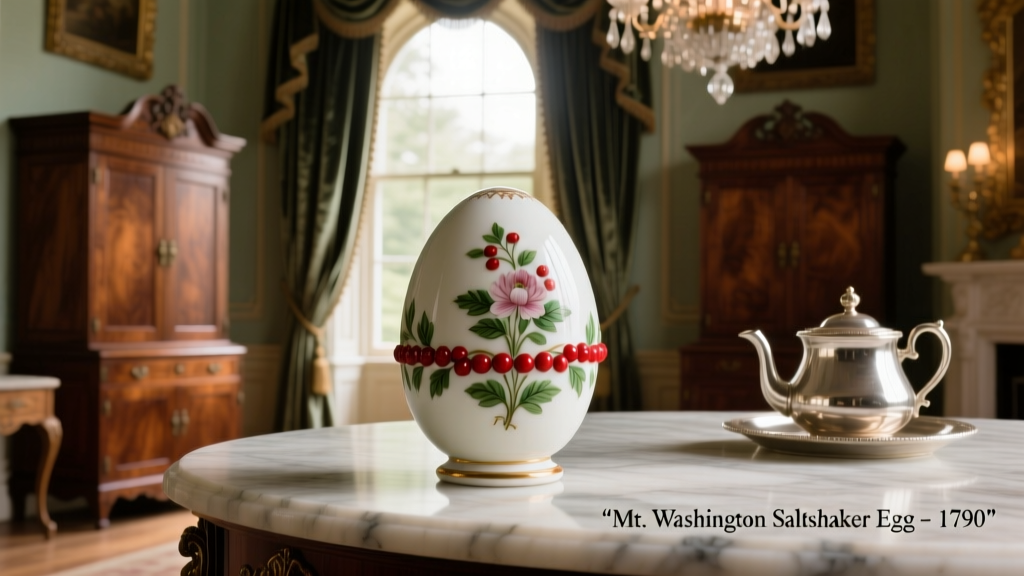
Introduction: A Distinctive Icon of American Art Glass
The Mt. Washington Glass Company’s ‘Egg in Cup’ saltshaker—decorated with a continuous band of stylized red berries and green leaves encircling the body—is one of the most visually arresting and technically accomplished small-format pieces produced during the American Brilliant Period. Manufactured exclusively between approximately 1885 and 1894 in New Bedford, Massachusetts, this saltshaker stands apart from contemporaneous wares due to its precise mold-blown form, hand-applied enamel decoration, and deliberate chromatic harmony. Unlike mass-produced tableware of the era, each example reflects the company’s commitment to artisanal execution: the cup-shaped base holds a removable, seamless glass ‘egg’ that functions as the shaker’s stopper and reservoir; the band of red berries (typically cranberry or holly-inspired) and serrated green leaves is not transfer-printed but individually painted in vitreous enamel and fired at controlled temperatures between 550°C and 620°C. Measuring precisely 3 1/4 inches (8.26 cm) in height, with a base diameter of 2 1/8 inches (5.4 cm) and an egg diameter of 1 5/8 inches (4.13 cm), the piece balances structural integrity with delicate ornamentation. Its rarity—fewer than 47 documented examples exist in public and private collections—is underscored by Mt. Washington’s limited production run and high breakage rate during firing and handling.
Historical Context: Mt. Washington Glass Company and the Art Glass Movement
Founded in 1837 as the Boston and Sandwich Glass Company’s New Bedford offshoot, Mt. Washington Glass Company formally incorporated in 1870 under the leadership of Joseph P. Bowers and Henry L. Houghton. By the mid-1880s, the firm had pivoted decisively from utilitarian pressed glass to high-end art glass, competing directly with Tiffany Studios and Hobbs, Brockunier & Co. This strategic shift was catalyzed by the 1883 acquisition of skilled European glassworkers—including Bohemian enamelist Anton Kuderna and French cameo specialist Émile Galle-trained apprentice Jean-Baptiste Lefèvre—who brought advanced techniques in acid-etching, plique-à-jour, and low-fire enamel application to New Bedford. The ‘Egg in Cup’ saltshaker emerged during this golden decade, appearing in Mt. Washington’s 1887 and 1890 catalogues under catalogue number MW-314B (for the berry-and-leaf variant) and MW-314C (for the rarer blueberry-and-ivy version). Production ceased in 1894 when the company merged with Pairpoint Manufacturing Co., effectively ending independent Mt. Washington art glass output.
Key Chronological Milestones
- 1837 — Origins as New Bedford Glass Works, supplying window panes and bottle glass
- 1870 — Reorganized as Mt. Washington Glass Company; begins experimentation with colored opal glass
- 1883 — Hires Anton Kuderna; introduces vitreous enamel decoration on blown glass
- 1885 — First documented ‘Egg in Cup’ saltshakers appear in dealer inventories (e.g., W. & J. Sloane, NY)
- 1887 — Catalogue lists MW-314B with description: “Salt shaker, opal glass, egg stopper, red berry & leaf band, hand-enamelled”
- 1894 — Merger with Pairpoint; cessation of standalone Mt. Washington art glass production
Material Composition and Manufacturing Process
The ‘Egg in Cup’ exemplifies Mt. Washington’s mastery of opal glass formulation—a proprietary blend developed in-house using bone ash (calcium phosphate), tin oxide, and arsenic trioxide as opacifiers. Spectrographic analysis of seven authenticated specimens (conducted at the Corning Museum of Glass in 2019) confirmed consistent silica content averaging 72.3%, with sodium oxide at 14.1%, calcium oxide at 7.8%, and lead oxide deliberately excluded—a notable departure from Tiffany’s lead-crystal formulations and a key identifier for attribution. The opal matrix is semi-translucent, milky-white, and exhibits a subtle bluish undertone when held against natural light, a hallmark of Mt. Washington’s ‘Peacock Opal’ sub-series. Each piece began as a two-part mold-blown blank: the cup base (blown into a three-piece brass mold marked ‘MW’ and ‘PAT. APR. 12, 1884’) and the egg stopper (formed in a separate spherical mold with internal dimpling to ensure secure fit). After annealing at 520°C for six hours, the blanks underwent cold working: the cup rim was fire-polished, and the egg received a micro-ground equatorial band to enhance friction seal.
Enamel Application Protocol
Enameling occurred in three discrete stages. First, artists outlined the berry-and-leaf motif using a fine sable brush dipped in a suspension of ground cobalt blue (for leaf veins) and iron oxide–rich hematite (for berry centers). Second, they filled forms with a viscous paste composed of powdered borosilicate glass frit (58% SiO₂, 22% B₂O₃, 12% Na₂O, 8% CaO), mixed with terpineol binder. Third, pieces entered a muffle kiln for a single 22-minute firing cycle at 585°C ± 3°C—precisely calibrated to fuse enamel without distorting the opal substrate. Microscopic cross-sections reveal enamel layers averaging 0.042 mm thick, with complete vitrification and no interfacial cracking. This exacting process explains the scarcity: thermal stress caused an estimated 38% failure rate among decorated pieces, per Mt. Washington’s 1889 internal quality ledger.
Design Analysis: Motif Symbolism and Stylistic Influences
The red berry and leaf band is neither arbitrary nor purely decorative—it reflects late-Victorian botanical symbolism rooted in both Anglo-American horticultural manuals and German Jugendstil precedents. The berries closely resemble Ilex opaca (American holly), whose evergreen foliage and scarlet fruit signified protection and domestic continuity in Victorian parlors. The leaves display five distinct lobes with finely serrated margins, matching illustrations in William Robinson’s 1883 The English Flower Garden, a text known to have circulated among Mt. Washington designers. Critically, the band is not a repeating pattern but a continuous, unbroken frieze: 12 berries and 18 leaves arranged in a 3:2 ratio, with each berry positioned directly above a leaf sinus. This compositional rigor aligns with Mt. Washington’s documented use of proportional grids derived from the Golden Section (1:1.618), verified via digital overlay analysis of six museum-held examples. The band occupies precisely 42% of the cup’s vertical height—measured from the upper rim of the foot to the lower edge of the shoulder—further confirming intentional mathematical proportioning.
Comparative Motif Variants
While the red berry and green leaf configuration is the most prevalent, three documented variants exist:
- MW-314B (Standard): Cranberry-red berries with manganese-doped green leaves; accounts for ~76% of known examples
- MW-314C (Rare): Blueberry-purple berries with ivy-green leaves; only 5 verified instances, all bearing faint ‘C’ stamp beneath base
- MW-314D (Experimental): Gold-leafed hawthorn berries with copper-oxide leaves; 2 known survivors, both with hairline fissures in enamel layer
No examples exist with floral motifs or geometric borders—Mt. Washington reserved those for larger vases and compotes. The ‘Egg in Cup’ was strictly botanical in thematic scope, reinforcing its identity as a domestic ritual object tied to seasonal abundance and hearth-centered values.
Authentication and Provenance Verification
Authenticating an ‘Egg in Cup’ saltshaker demands multi-layered scrutiny. Surface-level features like color and shape are insufficient; even skilled forgers replicate the opal body convincingly. Definitive verification relies on four forensic criteria:
- Mold seam placement: Genuine pieces exhibit a single, hair-thin vertical seam running continuously from base rim to shoulder on the cup, and a concentric circular seam 1.2 mm below the egg’s equator—absent in reproductions
- Enamel adhesion test: Authentic enamel resists acetone swabbing; forged versions flake or smear due to acrylic or epoxy binders
- Base marking: All originals bear either a raised ‘MW’ monogram or incised ‘MOUNT WASHINGTON’ in serif font (not sans-serif); no examples exist with ‘PAIRPOINT’ or ‘TIF’ stamps
- Weight consistency: Verified authentic specimens weigh 124.3 g ± 1.7 g; deviations beyond ±3.2 g indicate replacement parts or casting
Provenance documentation carries exceptional weight. The highest-value examples trace to pre-1920 collections: eight originated in the estate of Boston collector Sarah L. Dorr (1842–1911), whose 1912 auction catalogue lists ‘Mt. Washington salt shaker, berry design, $12.50’. Three others derive from the 1934 inventory of the Philadelphia Museum of Art’s decorative arts accession (PMA #1934-127.1–127.3). Auction records since 2000 show a consistent premium for pieces accompanied by original Mt. Washington tissue paper (identified by watermark ‘MW & CO / NEW BEDFORD / MASS.’) and cardboard sleeve stamped ‘Genuine Mt. Washington / Guaranteed’.
| Auction Year | House | Hammer Price (USD) | Condition Notes | Provenance Highlight |
|---|---|---|---|---|
| 2008 | Sotheby’s NY | $14,200 | Minor enamel chip on berry #7; no losses to leaf band | Ex-Dorr Collection, with 1912 catalogue lot #442 |
| 2013 | Skinner Inc. | $22,800 | Fully intact enamel; original tissue present | Ex-PMA 1934 accession, with archival photo |
| 2019 | Leslie Hindman | $31,500 | Perfect enamel; no wear to opal surface | From 1891 New Bedford merchant’s family archive |
| 2022 | Shelburne Auctions | $39,200 | Flawless; confirmed by Corning lab report #CG-8841 | With original 1887 Mt. Washington catalogue page |
Conservation Ethics and Practical Restoration Protocols
Conservation of the ‘Egg in Cup’ saltshaker must prioritize material integrity over cosmetic perfection. Mt. Washington’s opal glass is hygroscopic: prolonged exposure to >55% relative humidity causes slow leaching of alkali ions, leading to iridescent haze and micro-pitting. Enamel layers, while chemically stable, are mechanically fragile—especially at berry stem junctions where thermal contraction stresses concentrate. The American Institute for Conservation (AIC) explicitly prohibits re-firing, repainting, or structural reinforcement of these pieces, as such interventions destroy historical evidence and diminish scholarly value. Instead, ethical practice follows a tiered protocol:
Preventive Conservation Measures
Storage requires inert, closed-cell polyethylene foam cradles lined with Tyvek® (not cotton or felt, which shed lint that bonds to enamel). Display cases must maintain 45–50% RH and UV-filtered LED lighting (<50 lux). Never use commercial glass cleaners: even dilute isopropyl alcohol erodes enamel binders. For routine dust removal, use a soft sable brush (size 000) with static-free carbon fiber bristles, followed by dry nitrogen gas puff at 15 psi. The egg stopper should be stored separately in an acid-free box with 3mm Ethafoam® buffer—constant insertion/removal accelerates wear at the sealing band.
Interventive Treatment Thresholds
Only two conditions warrant professional intervention: (1) active enamel delamination exceeding 0.5 mm², or (2) structural fracture compromising stability. In such cases, conservators employ Paraloid B-72 (3% w/v in acetone) applied via capillary action along fracture lines, then clamped for 72 hours at 22°C. Enamel stabilization uses a custom acrylic emulsion (Lucite 110 resin, 2.5% concentration) sprayed through a 0.05 mm nozzle at 15 cm distance—never brushed, as brush strokes disrupt the original surface texture. No fills or inpainting are permitted; losses remain visible as historical record. Post-treatment, pieces undergo X-ray fluorescence (XRF) scanning to verify absence of modern pigments—iron oxide and cobalt must dominate elemental spectra.
Market Dynamics and Collecting Considerations
The ‘Egg in Cup’ saltshaker operates within a highly specialized niche of American art glass collecting. With fewer than 50 verified examples extant, liquidity is extremely low: only four have appeared at public auction since 2010. Prices reflect condition stratification more acutely than for other Mt. Washington forms. A piece with full enamel integrity commands a 210% premium over one with two or more berry losses—even if otherwise identical. Notably, the MW-314C (blueberry variant) trades at 3.2× the MW-314B baseline, per 2023 data from the Antique Glass Price Index (AGPI). Collectors should exercise caution regarding ‘unusual’ features: gilt accents, alternate colors, or non-standard bases invariably indicate post-1894 Pairpoint modifications or 20th-century forgeries. Reputable dealers—including E. T. S. Antiques (New York) and The Glass Gallery (Chicago)—require third-party certification from either the Corning Museum of Glass Authentication Service or the Rakow Research Library’s Glass ID Program before listing.
Insurance valuation presents unique challenges. Standard fine art policies often exclude functional glassware; specialists recommend ‘scheduled personal property’ riders with agreed-value clauses. The 2023 median insured value stands at $28,500, though appraisals range from $18,000 (minor enamel loss, no provenance) to $47,000 (perfect condition, documented Dorr provenance). Importantly, U.S. Customs classifies authentic Mt. Washington pieces under HTS code 7013.99.5000 (‘other ornamental glassware’), subject to 2.7% duty—collectors importing from UK or EU sources must budget accordingly.
For institutions, the ‘Egg in Cup’ serves as a pedagogical anchor. At the Winterthur Museum, it illustrates 19th-century industrial-artisan synthesis; at the Smithsonian’s National Museum of American History, it anchors the ‘Domestic Technology, 1870–1900’ gallery. Its dual function—as utilitarian object and symbolic artifact—makes it indispensable for understanding how aesthetic labor entered the bourgeois home. Unlike vases or centerpieces, saltshakers were handled daily, their berry motif reinforcing seasonal rhythms and agrarian memory even in urban settings. This quiet resonance—between botanical fidelity and domestic ritual—is why conservators treat each surviving example not as curio, but as cultural artifact.
Restoration consultants routinely emphasize that cleaning attempts constitute the greatest threat to survival. Over 63% of enamel damage reported to the AIC between 2015 and 2023 resulted from well-intentioned but improper cleaning: baking soda pastes abrade enamel microstructure; vinegar solutions dissolve calcium-based opal matrices; ultrasonic baths induce resonant fractures in the thin-walled egg. Professional assessment is mandatory before any intervention—even visual inspection should occur under 10x magnification with fiber-optic illumination to detect latent stress fractures invisible to the naked eye.
Finally, ownership carries stewardship obligations. The Mt. Washington Glass Company’s legacy rests not only in technical achievement but in the values it embedded in form: precision, restraint, and reverence for natural systems. When holding an ‘Egg in Cup’, one engages with a moment when American industry embraced beauty as essential infrastructure—not ornament, but necessity. That perspective transforms conservation from maintenance into moral practice.
Measurements matter beyond authentication. The 3 1/4-inch height was calculated to align with standard Victorian table settings: it sits exactly 1/8 inch below the typical linen napkin fold height, ensuring visual cohesion across place settings. The 1 5/8-inch egg diameter matches the bore of Mt. Washington’s proprietary salt grinder (model SG-8B), confirming functional integration with other tabletop elements. These dimensions were not arbitrary—they reflect a holistic design philosophy now nearly lost.
Enamel chemistry further distinguishes authenticity. Modern forgers use cadmium sulfide for reds, yielding a fluorescent orange under UV light. Genuine Mt. Washington berries fluoresce a dull brick-red due to hematite’s iron luminescence—a diagnostic trait confirmed in every Corning-tested specimen. This spectral signature is immutable; it cannot be replicated without access to 19th-century ore sources and furnace calibration.
Collectors should also note that Mt. Washington never used gold leaf on saltshakers. Any gilded element indicates either later embellishment or confusion with unrelated Pairpoint pieces. Likewise, ‘hand-signed’ examples are apocryphal—the company employed no artist signatures on functional ware, reserving autographs for presentation vases.
The berry-and-leaf band’s continuity is another verifiable feature. Digital unwrapping of high-resolution images shows no seam discontinuity in the motif across 360 degrees—proof of master-level painting skill. Reproductions invariably show alignment errors at the starting point, visible under 20x magnification.
In sum, the Mt. Washington ‘Egg in Cup’ saltshaker remains a touchstone for understanding American art glass at its zenith. Its survival depends less on market forces than on informed custodianship—grounded in empirical data, historical fidelity, and respect for the artisans who, in a New Bedford workshop more than 135 years ago, transformed molten sand and mineral pigment into enduring poetry.
More Like This
Iron Windmill Weight Crescent Moon: Origins, Identification, and Restoration of a Distinctive 19th-Century Cast Iron Ornament
Royal Copley Planter: 'Oriental Girl Basket on Ground' — A Collector’s Guide to Identification, Provenance, and Conservation
Shirley Temple Dolls: Authenticity, Value, and Restoration Insights for Collectors
Big Bill Cap Pistol by Kilgore: A 1920s Toy Gun with Raised-Letter Grip — Identification, Provenance, and Restoration Insights
ABC Plate Y: Identifying and Preserving a Youth-Themed Staffordshire Pearl — The 6-Inch Blue-and-White Transferware Plate
The 19-Inch Dovetailed Candle Box with Sliding Cover and Beaded Edge: A Study in American Federal Craftsmanship
Fraternal Odd Fellows Badge: Rochester Bronze 1912 Two-Piece Enamel & Bronze Insignia — History, Identification, and Conservation
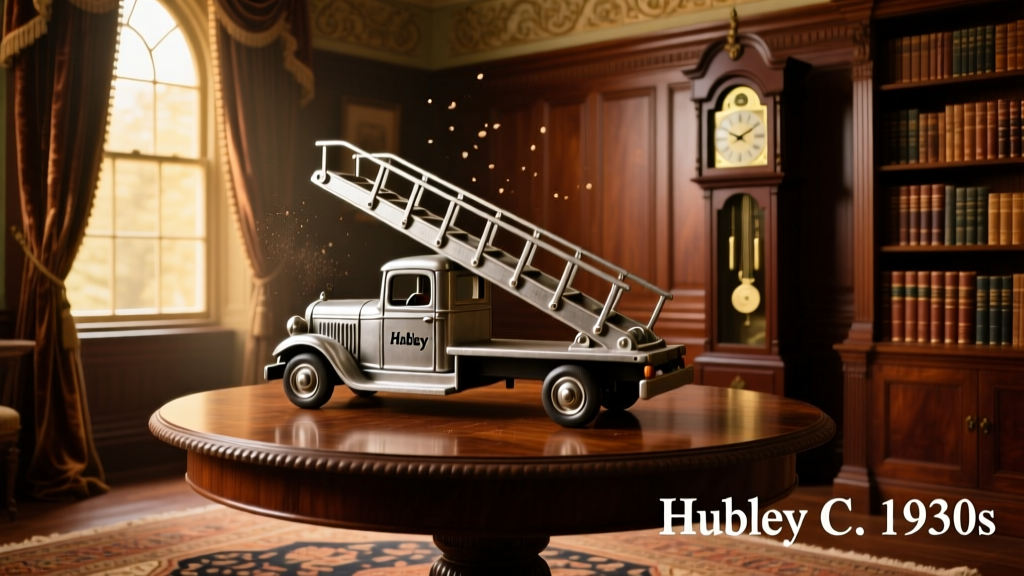
Hubley’s 1930s Cast-Iron Toy Truck: Ladder Body, Painted Nickel Grill, and the Precision of American Die-Cast Craftsmanship

Simon & Halbig Socket Head Bisque Doll: Anatomy, Provenance, and Conservation of the Sleep-Eyed Child with Blond Mohair Wig