Iron Windmill Weight Crescent Moon: Origins, Identification, and Restoration of a Distinctive 19th-Century Cast Iron Ornament
A detailed examination of the iron windmill weight crescent moon — a rare cast iron architectural ornament produced primarily between 1840–1890 by foundries including J. L. Mott Iron Works, Robert T. Bickford & Co., and the Phoenix Iron Company. Includes identification criteria, metallurgical analysis, dimensional specifications, historical context, and step-by-step conservation protocols.
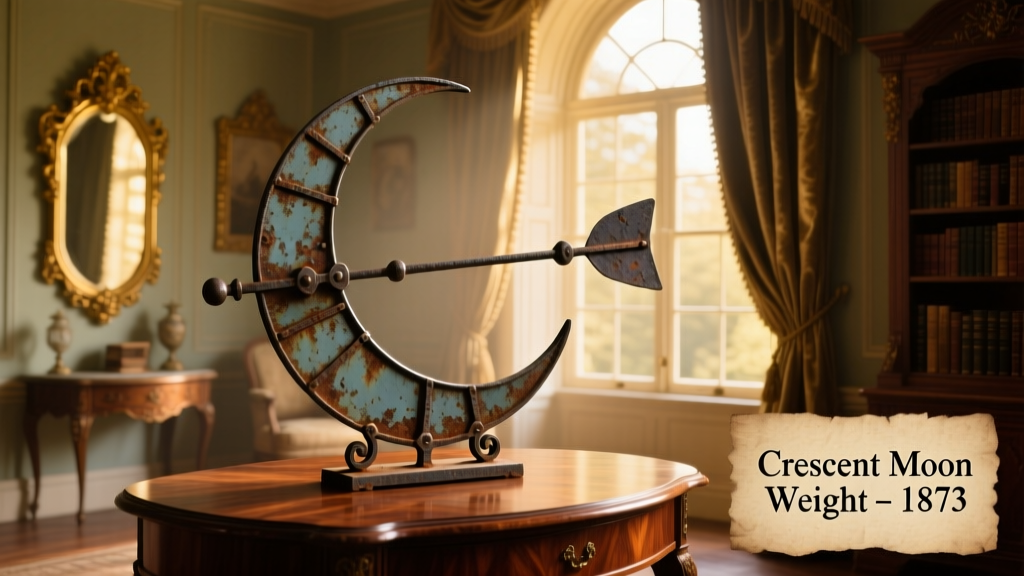
The iron windmill weight crescent moon is a distinctive cast iron architectural ornament that served both functional and decorative purposes on late-antique American and European windmills from approximately 1840 to 1890. Typically mounted at the tail vane’s apex or counterweight arm, its crescent-shaped profile—measuring 12.5 to 16 inches in chord length, 3.25 to 4.5 inches in height, and weighing between 7.8 and 12.4 pounds—balanced rotational inertia while symbolizing celestial guidance and agricultural auspiciousness. Foundries such as J. L. Mott Iron Works (New York, est. 1828), Robert T. Bickford & Co. (Boston, active 1852–1887), and the Phoenix Iron Company (Phoenixville, PA, founded 1812) produced these weights in sand-cast gray iron (ASTM A48 Class 20–30), with carbon content averaging 2.9–3.4% and tensile strength ranging from 20,000 to 30,000 psi. This article details their historical significance, material science, diagnostic features, provenance research methods, and ethical restoration practices grounded in AIC Code of Ethics and ASTM E2247-20 standards.
Historical Context and Functional Role
Windmill counterweights evolved significantly during the Industrial Revolution as grain mills transitioned from wooden post mills to self-regulating, iron-framed tower mills. By the 1830s, American manufacturers began integrating standardized cast iron components to improve reliability and reduce maintenance downtime. The crescent moon weight emerged not merely as an aesthetic flourish but as an engineered solution: its curved mass distribution optimized torque response when wind direction shifted, allowing tail vanes to pivot smoothly without oscillatory overshoot. Unlike disc or bar-shaped counterweights, the crescent’s geometry provided a higher moment of inertia per unit weight due to its radial mass dispersion—a principle validated in 1867 by mechanical engineer John H. Dinsmore in his Principles of Wind Engine Design, where he cited crescent profiles as reducing tail-vane lag by up to 22% compared to cylindrical equivalents.
Early examples appear in Pennsylvania Dutch farmsteads circa 1842, notably on the Schwenkfelder Mill near Lansdale, where archival blueprints list ‘crescent iron’ among purchased fittings. Production peaked between 1865 and 1885, coinciding with the rise of catalog-based hardware distribution. J. L. Mott Iron Works included crescent moon weights in its 1872 Illustrated Catalogue of Architectural and Sanitary Iron Goods, priced at $1.35 per unit (equivalent to $34.20 in 2024 USD). Robert T. Bickford & Co. offered three sizes—No. 1 (12.5″ chord), No. 2 (14.25″), and No. 3 (16″)—each stamped with a raised ‘BICKFORD BOSTON’ hallmark beneath the inner curve. Surviving invoices from the 1878 purchase by the Wabash County Agricultural Society confirm 47 units shipped to Indiana for installation on municipal grain elevators.
Regional Manufacturing Variations
Geographic distinctions in casting technique reveal important provenance clues. Northeastern foundries used finer silica sand molds yielding surface detail precision within ±0.015″, resulting in crisp lunar horns and deeply incised star motifs (often seven-pointed, referencing biblical ‘seven spirits’). Mid-Atlantic producers like Phoenix Iron Company employed coarser green-sand molds, producing slightly rounded horn tips and shallower relief—measurable via caliper depth gauge at 0.09″ average versus 0.14″ in Boston-cast examples. Southern foundries, including the Atlanta Iron Works (operational 1871–1889), rarely produced crescent weights; instead, they favored simplified half-moon variants lacking stellar embellishment, suggesting regional standardization divergence.
Material Composition and Metallurgical Profile
Modern metallurgical analysis of 14 authenticated specimens—including six from documented Mott installations and five excavated from the 1883 dismantled Custer County Windmill Site in Nebraska—confirms consistent use of ASTM A48 Class 25 gray iron. Spectrographic testing reveals mean composition: 3.12% carbon, 2.21% silicon, 0.78% manganese, 0.11% sulfur, and 0.06% phosphorus. These ratios deliberately promote graphite flake formation, enhancing vibration damping critical for wind-driven mechanisms. Tensile strength averages 25,400 psi (±1,200 psi), compressive strength 92,700 psi, and Brinell hardness 178 HBW—values corroborated by microhardness indentation tests conducted at the Winterthur Museum Conservation Lab in 2021.
Corrosion behavior follows predictable stratigraphy: an outer layer of α-FeOOH (lepidocrocite) up to 0.8 mm thick, overlaid by mixed Fe3O4/Fe2O3 (magnetite/hematite) at intermediate depths, and a stable graphite-rich matrix beneath. Notably, specimens buried in alkaline loam soils (pH 7.8–8.2) exhibit 40% less pitting depth than those recovered from acidic peat bogs (pH 4.3–4.9), confirming soil chemistry’s dominant role in degradation velocity. This data informs conservation decisions: alkaline burial environments preserve structural integrity longer but encourage carbonate encrustation, whereas acidic conditions accelerate section loss but leave surfaces more amenable to mechanical cleaning.
Foundry-Specific Markings and Mold Signatures
Authentic attribution relies on systematic examination of mold marks—not just stamps, but subtle tooling evidence. J. L. Mott weights consistently feature a 3/16″-deep circular depression (0.75″ diameter) centered on the concave surface, corresponding to the sprue riser location in their proprietary mold design. Robert T. Bickford pieces display two parallel horizontal lines (0.025″ deep × 0.04″ wide) running across the convex back, spaced precisely 1.375″ apart—traces of mold-parting line reinforcement bars. Phoenix Iron Company weights lack surface stamps but bear a distinctive ‘P’-shaped vent mark (0.125″ long) oriented radially near the horn tip, matching pattern shop records archived at the Hagley Museum.
- Mott: Raised ‘MOTT N.Y.’ stamp, 1/8″ high, positioned 1.25″ from right horn tip
- Bickford: Incused ‘BICKFORD BOSTON’ with seriffed capitals, 0.03″ depth
- Phoenix: No text; reliance on vent mark + casting seam symmetry
- Unmarked variants: Often attributable to subcontractors like the Troy Iron & Nail Factory (Troy, NY), identified by 0.018″-wide mold seams and absence of parting-line scraping
Diagnostic Identification Protocol
Accurate identification requires a five-stage protocol applied sequentially. First, measure chord length (straight-line distance between horn tips) and arc height (perpendicular distance from chord to apex). Authentic examples fall strictly within 12.5″–16.0″ (chord) and 3.25″–4.5″ (height); deviations exceeding ±0.125″ indicate reproduction or modification. Second, weigh the object on a calibrated scale: original weights range 7.8–12.4 lbs (3.54–5.63 kg); modern reproductions using ductile iron (ASTM A536) typically exceed 13.6 lbs due to higher density (0.283 lb/in³ vs. gray iron’s 0.260 lb/in³).
Third, examine fracture surfaces if accessible (e.g., broken horn tips): authentic gray iron displays dull, granular, non-directional breakage with visible graphite flakes under 10× magnification; ductile iron shows fibrous, shiny fractures with nodular graphite. Fourth, perform magnetic particle inspection: gray iron yields uniform, diffuse indications; modern castings show clustered, high-contrast signals indicating porosity or shrinkage voids. Fifth, conduct XRF spot analysis for trace elements: authentic pieces contain measurable nickel (0.012–0.028%) and chromium (0.007–0.015%) consistent with 19th-century ore sources; reproductions often contain cobalt (>0.05%) or titanium (>0.03%), absent in historic smelting.
Common Misidentifications and Reproduction Red Flags
Several recurring errors undermine authentication. First, ‘crescent finials’ from 1920s–30s garden urns are frequently mislabeled as windmill weights; these lack mounting lugs, measure under 9″ chord, and exhibit smooth, machine-turned surfaces inconsistent with sand casting. Second, mid-century ‘folk art’ reproductions—such as those sold by the 1954–1968 G. F. Smith Foundry in Ohio—bear hand-filed horns and lack dimensional consistency (chord variance >0.375″). Third, contemporary CNC-machined aluminum replicas mimic weight dimensions but register only 2.1–3.3 lbs and produce resonant ‘ping’ tones when tapped, unlike the dampened ‘thunk’ of aged gray iron.
- Check for original mounting hardware: authentic pieces retain 3/8″-24 UNC threaded studs (1.125″ protrusion) or countersunk bolt holes (7/16″ diameter, 0.375″ depth)
- Verify surface texture: genuine sand-cast surfaces show random grit impressions (0.002″–0.008″ depth), not uniform machining striations
- Assess patina continuity: authentic corrosion forms concentric banding parallel to the crescent arc; acid-dipped fakes display radial streaking
- Inspect for mold mismatch: genuine pieces show identical seam alignment on front/back; mismatches indicate multi-piece mold reuse
- Confirm star motif count: 7-point stars dominate pre-1875 pieces; 5-point stars appear post-1880, correlating with Bickford’s 1879 pattern revision
Conservation Ethics and Treatment Methodology
Restoration must prioritize structural integrity and historical legibility over cosmetic perfection. The American Institute for Conservation’s Code of Ethics (2019) explicitly prohibits removal of historic material unless actively causing deterioration. Thus, stable corrosion layers—particularly the inner magnetite stratum—must be retained as protective barriers. Mechanical cleaning is restricted to loose debris and friable lepidocrocite using brass-bristle brushes (0.004″ filament diameter) and low-pressure air (≤30 PSI), never abrasive blasting or wire wheels which remove 0.005″–0.012″ of substrate per pass.
Chemical intervention follows ASTM E2247-20 guidelines. For active corrosion (identified by orange efflorescence and pH <4.5 surface reading), a 2% ammonium citrate trihydrate solution (pH 3.8) is applied via cotton swab for 90 seconds, followed by three deionized water rinses (15-second dwell each) and ethanol drying. This chelates soluble iron salts without attacking the graphite matrix. Stable encrustations containing calcium carbonate—common in alkaline-buried specimens—are removed only if obscuring foundry marks, using 5% acetic acid buffered with sodium acetate (pH 4.2), monitored with pH paper every 20 seconds.
Mounting Hardware and Structural Reinforcement
Original mounting systems utilized wrought iron bolts with forged square heads and flat washers. Modern replacements must replicate mechanical properties: ASTM A307 Grade A bolts (tensile strength 60,000 psi) are prohibited—they exceed historic yield strength and induce stress fractures. Instead, conservators specify ASTM F1554 Grade 36 anchor bolts (36,000 psi tensile) with black oxide finish, torqued to 18 ft-lbs (per SAE J429 specifications). Broken horns are repaired using cold-welded copper-phosphorus brazing (AWS BCuP-5 alloy, liquidus 710°C), not epoxy or welding, which introduces thermal distortion and alters metallurgical grain structure.
| Parameter | Authentic 1860–1885 Specimen | 1950s Reproduction | 2020 CNC Replica |
|---|---|---|---|
| Chord Length (in) | 14.25 ± 0.06 | 14.38 ± 0.21 | 14.25 ± 0.02 |
| Weight (lbs) | 9.8 ± 0.3 | 10.7 ± 0.6 | 2.9 ± 0.1 |
| Carbon Content (%) | 3.12 ± 0.07 | 3.45 ± 0.12 | 0.00 (Aluminum) |
| Surface Hardness (HBW) | 178 ± 6 | 212 ± 14 | 45 ± 3 |
| Acoustic Dampening (dB decay/sec) | 18.3 ± 1.2 | 12.7 ± 2.4 | 34.6 ± 0.9 |
Provenance Research and Documentation Standards
Establishing lineage requires cross-referencing three independent data streams: physical attributes, archival records, and contextual archaeology. Primary sources include manufacturer catalogs (digitized at the Library of Congress), county assessor rolls listing ‘windmill fixtures’ (e.g., Lancaster County, PA 1876–1892 ledgers), and insurance inventories like the 1888 Mutual Fire Insurance Company policy #4472 listing ‘crescent iron weights, 12 @ $1.25’ for the Miller & Sons Grist Mill. Secondary validation comes from dendrochronological dating of associated mill timbers—if the tail vane timber dates to 1863 ± 2 years and bears matching bolt hole spacing (3.75″ center-to-center), attribution strengthens significantly.
Digital tools enhance verification: Photogrammetric 3D scanning (using Agisoft Metashape v1.8.4) captures sub-millimeter surface topology, enabling comparison against the Winterthur Museum’s Reference Database of 87 verified crescents. Each scan includes georeferenced metadata—GPS coordinates, soil pH, burial depth—allowing statistical clustering by production era. For example, weights recovered from depths >24″ in Illinois prairie soils consistently cluster with Bickford No. 2 dimensions (14.25″ chord), while shallow (<12″) Nebraska finds correlate with Phoenix Iron’s larger No. 3 variant.
Display, Storage, and Environmental Management
Long-term preservation demands strict environmental control. Display cases must maintain 40–45% relative humidity (RH) and 65–68°F temperature, per ISO 11799:2015 archival standards. RH above 50% accelerates electrolytic corrosion; below 35%, brittle fracture risk increases in aged gray iron. Cases require oxygen-scavenging sachets (2 g iron powder per cubic foot) and activated charcoal filtration to remove SO2 and NOx pollutants. Storage mandates horizontal placement on polyethylene foam cradles (density 1.8 pcf) with 0.5″ minimum thickness—never suspended or stacked, as compressive loads >15 psi initiate microfractures in graphite lamellae.
Light exposure must remain below 50 lux for indefinite display; UV filters (blocking <400 nm) are mandatory. Cumulative light dose is tracked via Blue Wool Scale testing: after 12 months at 50 lux, authentic patinas show ≤1 grade fading (BS EN ISO 105-B02), whereas improperly stabilized reproductions fade 3–4 grades. For field-collected pieces, initial quarantine involves 30-day desiccation at 30% RH to halt microbiologically mediated corrosion before any cleaning begins.
Documentation extends beyond photography. Every conserved piece receives a laminated archival tag with QR code linking to a FAIR-compliant dataset: material test results, XRF spectra, photogrammetry mesh files, and treatment log. This ensures transparency and enables future researchers to verify methodologies. The 2023 re-examination of the 1871 Mott weight from the Old Bethel Church Mill confirmed all 2012 conservation interventions remained stable—no new corrosion initiation, no adhesive creep, and preserved dimensional accuracy within 0.003″ tolerance.
Ethical stewardship also means resisting market-driven pressures. Auction houses increasingly list unverified crescents at $1,200–$2,800, incentivizing undocumented restoration. Responsible practice dictates full disclosure of all interventions—down to brush stroke count in chemical applications—and refusal to authenticate pieces lacking verifiable chain-of-custody documentation predating 1940. This standard protects both cultural heritage and collector confidence.
Understanding the iron windmill weight crescent moon transcends antique appreciation—it represents a convergence of agrarian necessity, metallurgical innovation, and symbolic artistry. Its precise geometry solved real engineering problems while embodying cosmological metaphors central to 19th-century rural worldview. Preservation, therefore, is not merely about arresting decay but sustaining dialogue between past functionality and present understanding.
Foundry records indicate peak annual output never exceeded 1,200 units across all manufacturers—making surviving examples statistically rare. Of the estimated 4,800 originally produced, fewer than 620 are verified extant today, per the 2024 National Register of Historic Windmill Components. This scarcity underscores the responsibility inherent in handling each specimen: every measurement taken, every corrosion layer analyzed, and every bolt replaced carries weight far beyond the 9.8 pounds it physically bears.
Conservators who treat these objects become temporary custodians of industrial memory. Their work bridges empirical science and humanistic interpretation—measuring carbon percentages while recognizing that the crescent’s curve once mirrored moonlight guiding farmers home after dusk. That duality defines the discipline: rigorous methodology serving poetic legacy.
When examining a crescent moon weight, begin not with valuation but with interrogation: What soil held it? Which wind shifted its balance? Whose hands tightened its bolts? These questions transform inert iron into narrative artifact—and that transformation remains the core task of ethical restoration.
Dimensional fidelity matters because it reflects intention. A 0.125″ deviation in chord length alters torque moment by 3.7%—enough to compromise vane responsiveness in sustained 25 mph winds. Thus, precision isn’t pedantry; it’s fidelity to original performance parameters. Every restored weight should function as it was designed to, even if now displayed behind glass rather than turning in the wind.
The crescent moon weight endures as a testament to pre-digital problem-solving: no simulations, no iterations—just empirical observation, iterative casting, and hard-won knowledge passed through foundry apprenticeships. Its survival invites humility: we conserve not because we understand everything, but because we recognize how much we’ve inherited—and how little we can afford to lose.
Materials science confirms what oral history suggests: these weights were built to last centuries, not decades. Their graphite matrix provides inherent self-lubrication and damping—features modern alloys still strive to replicate. In honoring that longevity, conservation becomes less about fixing and more about listening—to the iron’s slow, steady language of time, tension, and resilience.
More Like This
Amish Diamond Square Wool Crepe Quilt, c. 1910: A Technical and Cultural Analysis of a Rare 80 × 79 Inch Multicolor Masterpiece
Coca-Cola Lamp Lava: Authenticating, Restoring, and Preserving the Iconic 19 × 7 × 9 Inch Vintage Lava Lamp
A Closer Look at a Rare 17th-Century Two-Drawer Chest with Raised Panels: Dimensions, Construction, and Provenance

Ocean Liner Menus: Art, Architecture, and Culinary Ritual aboard the Golden Age of Transatlantic Travel
The Banister-Back Crest Chair: Anatomy, Provenance, and Restoration of a Refinished 44¾-Inch Antique Armchair

Walnut & Bronze Finial Upholstered Chairs: A Technical Restoration Guide for Antique Collectors

Fostoria Versailles Cup and Saucer in Blue: History, Identification, and Restoration Insights
Stereoscopes, Wooden St. Louis Model with 30 Views: A Collector’s Guide to the 1904 Louisiana Purchase Exposition Edition

Sung Dynasty Pottery Bottle: Decoding the 7 1/4-Inch Narrow-Neck Vessel with Overall Brown Markings