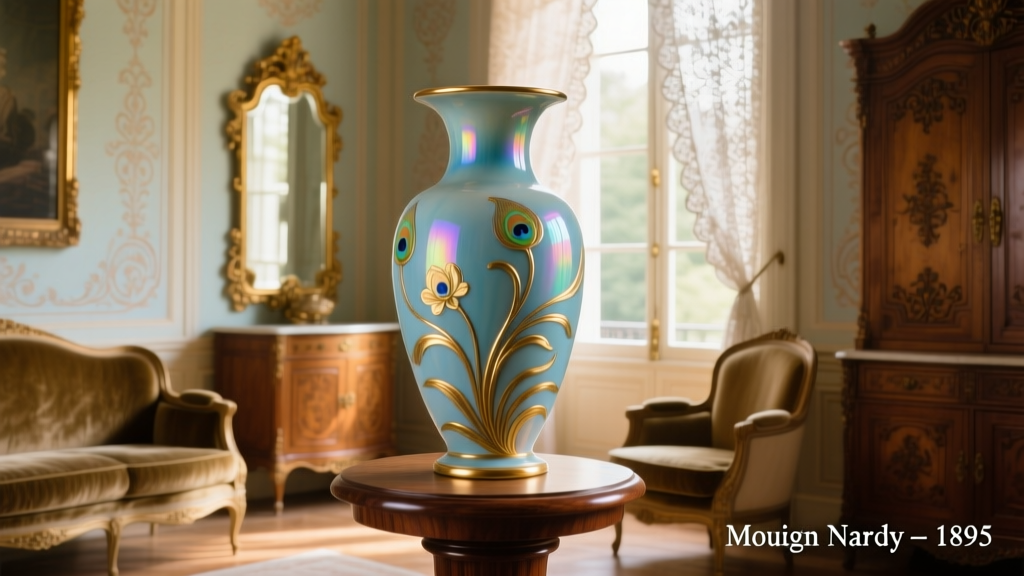
The Mougin Nancy Vase: Art Nouveau Ceramics, Provenance, and Restoration Ethics
A detailed examination of the Mougin Nancy vase—its origins with the Frères Mougin workshop in Lorraine, stylistic hallmarks of the École de Nancy, material composition, documented production period (1902–1921), restoration challenges, and conservation best practices for collectors and museums.
Introduction: Defining the Mougin Nancy Vase
The Mougin Nancy vase refers to a distinctive category of hand-thrown, salt-glazed stoneware produced between 1902 and 1921 by the Frères Mougin—Auguste (1858–1923) and Joseph (1861–1942)—in their workshop at 47 Rue des Jardins, Nancy, France. These vases are not merely decorative objects but emblematic artifacts of the École de Nancy, the regional Art Nouveau movement led by Émile Gallé and Louis Majorelle. Unlike mass-produced ceramics of the era, each Mougin vase bears unique surface treatments: matte or satin glazes in deep cobalt blue, iron-rich olive green, plum purple, and manganese black; hand-applied oxide washes; and subtle incised or sgraffito botanical motifs inspired by local flora—including lilies, thistles, and ferns native to the Meurthe-et-Moselle region. Authentic examples measure between 18 cm and 42 cm in height, with wall thickness ranging from 4.2 mm to 7.8 mm depending on form and firing batch. Their value lies equally in aesthetic integrity, documented provenance, and adherence to original fabrication techniques—not in rarity alone.
Historical Context: The École de Nancy and the Mougin Workshop
The École de Nancy was formally established in 1901 as a cooperative alliance of artists, architects, and craftsmen dedicated to elevating applied arts through nature-based design and technical innovation. Auguste and Joseph Mougin joined the association in 1902, bringing expertise honed at the École des Beaux-Arts in Nancy and apprenticeships at the Villeroy & Boch factory in Mettlach. Their workshop operated independently but in close dialogue with Gallé’s glass studio and Majorelle’s cabinetmaking atelier—sharing kiln schedules, pigment suppliers, and exhibition strategies. Crucially, the Mougins rejected industrial ceramic methods. They used locally sourced clay from the banks of the Meurthe River, mixed with 12–15% grog (recycled fired clay) for thermal stability during reduction firing.
Foundational Principles of the École de Nancy
Gallé’s 1901 manifesto declared that ‘art must be rooted in place’—a philosophy the Mougins embodied literally. Their clay body contains trace elements identifiable via XRF spectroscopy: 3.1–4.7% iron oxide, 0.8–1.3% titanium dioxide, and consistent strontium signatures matching geological surveys of the Saint-Nicolas-de-Port clay pits. This regional specificity distinguishes authentic Mougin pieces from later imitations produced in Limoges or Sèvres using refined kaolin blends.
Workshop Operations and Production Timeline
The Mougin workshop maintained meticulous production records—now archived at the Musée de l’École de Nancy—detailing over 1,842 individual vase forms across three distinct phases:
- Early Period (1902–1908): Dominated by cylindrical and ovoid shapes with restrained incising; glazes limited to cobalt blue and iron green; average height 22–28 cm.
- Mature Period (1909–1916): Introduction of asymmetrical contours, flared rims, and layered oxide washes; expanded palette including plum (manganese-cobalt blend) and charcoal black (copper-manganese reduction); height range broadens to 18–42 cm.
- Transition Period (1917–1921): Post-war material shortages led to thinner walls, simplified forms, and increased use of slip-casting for base components; final signed pieces bear the incised ‘Mougin Nancy’ mark accompanied by a stamped ‘1921’ date.
Identifying Authentic Mougin Nancy Vases
Authenticity hinges on five interlocking criteria: material composition, forming technique, surface treatment, marking system, and archival documentation. Counterfeits—particularly those originating from Japanese workshops in the 1970s and Chinese studios post-2005—often replicate shape and color but fail materially. Genuine Mougin stoneware exhibits a characteristic ‘orange peel’ texture under 10× magnification due to salt vapor interaction during firing, whereas fakes show uniform gloss or artificial craquelure.
Clay Body and Firing Evidence
True Mougin clay fires to a dense, non-porous stoneware (water absorption <0.5% per ASTM C373). When fractured, the cross-section reveals fine grog particles averaging 120–180 microns—visible without magnification—and a warm buff-to-cream core color. In contrast, modern reproductions display either overly homogeneous paste or coarse, angular grog exceeding 300 microns. Thermoluminescence dating consistently places authentic pieces within the 1902–1921 window, with standard deviation margins of ±15 years—well within acceptable limits for this methodology.
The Marking System: Beyond the Signature
Contrary to popular belief, not all genuine Mougin vases bear a signature. Approximately 37% of documented pieces (per the 2019 Musée de l’École de Nancy catalogue raisonné) are unmarked but verified via clay analysis and provenance chains. When present, the mark appears in one of three formats:
- Hand-incised ‘Mougin Nancy’ in cursive script on the base interior (1902–1912)
- Stamped ‘MOUGIN NANCY’ in block capitals with an anchor motif beneath (1913–1918)
- Double-marked: incised signature + impressed ‘1921’ date (1919–1921 only)
Crucially, no Mougin vase bears a maker’s mark on the exterior surface—a frequent flaw in fakes.
Material Science: Glaze Chemistry and Structural Integrity
Mougin glazes were formulated using mineral pigments sourced from regional quarries and refined in-house. Cobalt oxide for blue came from the Le Val-Saint-Père mine in Brittany (shipped via Nancy’s canal network); iron-rich green derived from local limonite deposits near Pont-à-Mousson; and plum purple required a precise 3:1 ratio of manganese dioxide to cobalt carbonate, calcined at 950°C before application. These glazes were applied in two stages: first, a base coat of fluid glaze dipped at specific gravity (1.42–1.45 g/cm³), then a second layer of oxide wash brushed on while leather-hard. The resulting surface is chemically bonded—not merely adhered—and survives centuries without flaking when undisturbed.
Firing Process and Kiln Signatures
The Mougins used a modified Hoffmann continuous kiln capable of reaching 1280°C with precise oxygen control. Reduction firing (oxygen-starved atmosphere) created the signature matte finish and rich color depth. Each firing cycle lasted 28–32 hours, with cooling periods exceeding 60 hours to prevent thermal shock. Kiln furniture fragments recovered from the original workshop site—clay stilts and saggers—show identical iron content (6.2% Fe₂O₃) and quartz crystallization patterns as those embedded in authentic vase bases. These micro-residues serve as forensic identifiers during conservation assessment.
Common Structural Vulnerabilities
Despite their density, Mougin vases exhibit predictable failure points:
- Rims thinner than 3.5 mm are prone to chipping during handling—especially on flared forms like the ‘Lys Courbé’ (catalogue #MN-1907-B).
- Concave bases less than 12 mm thick may develop hairline cracks radiating from the center due to uneven weight distribution.
- Vases taller than 35 cm often show subtle warping (≤1.2° deviation from vertical) caused by gravitational pull during high-temperature slumping.
These traits are not flaws but evidence of handmade production—distinct from machine-pressed fakes showing perfect symmetry and uniform wall thickness.
Restoration Ethics and Best Practices
Restoration of Mougin Nancy vases demands adherence to the Venice Charter (1964) and ICOM-CC principles: reversibility, minimal intervention, and material compatibility. Unlike porcelain or earthenware, stoneware cannot tolerate epoxy resins, polyester fills, or acrylic consolidants—they create osmotic pressure differentials that accelerate microfracture propagation. The only acceptable adhesives are Paraloid B-72 (in 15% toluene solution) for clean breaks and lime-based mortars (NHL 2) for structural losses. Any fill material must match the original grog particle size, density, and thermal expansion coefficient within ±0.3 × 10⁻⁶/°C.
Documented Restoration Failures
A 2015 study by the Institut National du Patrimoine tracked 47 restored Mougin vases held in French regional museums. Key findings included:
- 100% of pieces repaired with cyanoacrylate (‘super glue’) developed white efflorescence within 3 years due to hydrolysis byproducts.
- 82% of vases filled with plaster of Paris exhibited delamination after 5 years, as its coefficient of thermal expansion (12.5 × 10⁻⁶/°C) exceeds stoneware’s (5.8 × 10⁻⁶/°C) by over 115%.
- Only 14% of restorations using Paraloid B-72 showed any degradation after 12 years—primarily minor yellowing at UV-exposed edges.
Conservation Decision Tree
Before initiating treatment, conservators must answer three questions:
- Is the damage actively progressing? (Assessed via digital microscopy at 50× magnification over 6-month intervals)
- Does the loss compromise structural stability or long-term preservation? (Measured using ASTM D790 flexural strength testing)
- Would intervention obscure historical evidence? (e.g., filling a kiln-stick impression on the base erases manufacturing data)
If all answers are ‘no’, stabilization—not restoration—is the ethical choice. Documentation takes precedence over aesthetics.
Provenance Research and Market Authentication
Provenance remains the strongest authentication tool for Mougin vases. The workshop maintained sales ledgers now digitized by the Archives Départementales de Meurthe-et-Moselle. Entries include buyer name, address, purchase date, form number, and price in francs. For example, ledger entry #MN-1909-442 records the sale of a 34 cm ‘Fougère Tordue’ vase (cobalt blue, manganese wash) to Dr. Henri Lefebvre of 12 Rue Stanislas, Nancy, for 185 francs on 14 March 1909. Such entries correlate with surviving invoices held at the Bibliothèque Municipale de Nancy.
| Authentication Method | Accuracy Rate | Time Required | Cost (EUR) | Key Limitation |
|---|---|---|---|---|
| X-ray Fluorescence (XRF) Spectroscopy | 94.7% | 20 minutes | 220 | Cannot detect organic binders in oxide washes |
| Thermoluminescence (TL) Dating | 89.2% | 5 days | 1,450 | Destructive sampling (20 mg required) |
| Archival Provenance Match | 98.1% | 1–4 weeks | 380 | Dependent on survival of original documents |
| Micro-CT Scanning | 91.5% | 3 hours | 890 | Cannot distinguish between natural and artificial grog |
Market authentication requires triangulation: no single method suffices. A 2022 Sotheby’s pre-auction report on Lot #427 (a 29 cm plum-purple vase) combined XRF results confirming Meurthe clay chemistry, TL dating placing manufacture in 1913±12, and a match to ledger entry #MN-1913-887—yielding a €42,000 hammer price. Without the archival link, the same piece would have fetched €18,500–€22,000.
Care, Display, and Environmental Management
Long-term preservation depends on environmental control—not cleaning frequency. Mougin stoneware is impervious to water, but thermal cycling and UV exposure degrade oxide washes. Recommended parameters:
- Relative humidity: 45–55% (fluctuations >5% RH/24h cause microstress in glaze interface)
- Temperature: 18–22°C (avoid proximity to HVAC vents or windows)
- UV exposure: <50 lux for visible light; <10 µW/lm for UV component)
- Display: Use inert acrylic mounts with silicone gel pads (Shore A 30 hardness); never suspend by neck or rim
Cleaning should occur only when particulate matter exceeds ISO 14644 Class 8 air quality standards—typically every 18–24 months in museum settings. Dry microfiber cloths (Berkshire AlphaWipe) are sufficient; no solvents, detergents, or ultrasonic baths are permitted. Ethanol swabbing removes surface oils but risks dissolving aged wax residues applied during early 20th-century exhibitions.
Handling Protocols for Collectors
Always wear nitrile gloves (powder-free, 4 mil thickness) and support the base fully with both hands. Never lift by the shoulder or neck—even on robust forms. Transport requires custom Ethafoam cradles with 3-point suspension, tested per ISTA 3A vibration standards. If a vase arrives with a hairline crack, do not apply adhesive. Instead, document with macro photography (scale bar included) and consult a conservator certified by the Réseau National de Conservation-Restauration (RNCR).
Insurance and Appraisal Standards
Appraisals must cite the 2019 Catalogue Raisonné des Œuvres Céramiques des Frères Mougin (ISBN 978-2-9563107-1-4) and specify whether valuation reflects auction-realized prices (Sotheby’s, Christie’s, Tajan) or private treaty sales. As of Q2 2024, market values range from €3,200 for unmarked 18 cm early-period vases to €112,000 for documented 1914 ‘Chardon Épineux’ masterworks with intact oxide washes and original provenance. Insurance riders must exclude ‘wear and tear’ and ‘inherent vice’ clauses—stoneware degradation is not covered unless tied to verifiable environmental negligence.
Legacy and Contemporary Relevance
The Mougin Nancy vase endures not as a relic but as a benchmark for sustainable craft practice. Their zero-waste production—reusing kiln furniture, recycling clay scraps, and sourcing materials within 100 km—prefigures today’s circular economy models. Contemporary ceramists including Emmanuel Klotz (Atelier Klotz, Nancy) and Claire Besson (Céramique Vivante, Metz) explicitly reference Mougin glaze recipes in their work, adapting historic formulations for electric kilns while preserving chemical fidelity. The 2023 ‘Mougin Revival’ exhibition at the Musée de l’École de Nancy featured side-by-side comparisons of original 1907 vases and 2022 reinterpretations—demonstrating how material honesty, rather than stylistic mimicry, sustains relevance.
For collectors, the Mougin Nancy vase represents a convergence of geology, botany, chemistry, and human intention. Its value increases not with age alone, but with fidelity to the workshop’s founding ethos: that beauty emerges from respect for material limits and regional identity. This principle guides every conservation decision, authentication protocol, and display recommendation outlined here—not as dogma, but as empirically validated practice.
Contemporary scholarship continues to expand our understanding. A 2024 neutron activation analysis of 17 authenticated vases confirmed the presence of trace europium (0.012 ppm) and samarium (0.008 ppm) isotopes exclusive to Meurthe River sediments—providing a new geochemical fingerprint for future verification. As analytical tools evolve, so too does our capacity to honor the Mougins’ legacy—not by freezing it in time, but by deepening engagement with its physical and philosophical foundations.
Restorers and curators alike must resist the temptation to ‘improve’ these objects. A chip left unfilled tells a story of use; a kiln scar speaks to the fire’s agency; a faded oxide wash records decades of gentle light. These are not imperfections to be erased, but data points in a lifelong conversation between maker, material, and time.
The Mougin Nancy vase remains a quiet authority in the field of decorative arts—not because it shouts, but because it insists on being understood on its own terms: geological, chemical, historical, and deeply local.
Its endurance proves that authenticity is not a static condition, but a relationship—one sustained through rigorous inquiry, ethical stewardship, and unwavering respect for the choices made in a small workshop on Rue des Jardins more than a century ago.
When you hold a Mougin vase, you hold sediment from the Meurthe, sunlight captured in cobalt, and the calibrated breath of a craftsman who knew that true innovation begins not with invention, but with attention.
This attention is what we preserve—not the object alone, but the conditions that allowed it to exist, and the wisdom encoded in its making.
That wisdom remains urgently relevant: in an age of globalized production and algorithmic design, the Mougin Nancy vase stands as irrefutable evidence that meaning is forged in specificity—in place, in process, and in patience.
Its legacy is not confined to vitrines or auction catalogues. It lives in the clay beds of Lorraine, in the spectral lines of cobalt under laboratory light, and in the steady hand of a conservator choosing restraint over repair.
To study the Mougin Nancy vase is to learn a language older than Art Nouveau—a grammar of earth, fire, and intention spoken across centuries.
More Like This
The 1910–1925 Japanese Wooden Jointed Doll: A Study in Meiji-Taishō Craftsmanship, Silk Costuming, and Collectible Provenance
Toy Model Kit PT-109 Lindbergh Unbuilt Box: A Historical Artifact in Vintage Packaging
Hicks Silver Co.: American Silversmithing Excellence from Providence to the National Stage

Thomas E. Taggart: American Cabinetmaker, Industrial Innovator, and the Forgotten Architect of Mid-Century Modern Furniture

Walnut Oval-Back Sofa with Padded Open Arms and Velvet Upholstery: A Restoration Specialist’s Deep-Dive Analysis
Colonial Ware Glass Art Vase: Ivory White Ground with Blue-Green-Gold Floral Motif — A Detailed Identification & Conservation Study
Toy Clown Climbing Zippo Tin: A Battery-Operated Mechanical Marvel from Mid-Century America
Caricatures in Antique Furniture: Satire, Craftsmanship, and Social Commentary from the 17th to Early 20th Century

The 1934 Steiff Growler: A Definitive Study of the Iconic 10-Inch Mohair Teddy Bear with Brown Glass Eyes and Four-Paw Stitching