Toy Model Kit PT-109 Lindbergh Unbuilt Box: A Historical Artifact in Vintage Packaging
An in-depth examination of the unbuilt PT-109 Lindbergh model kit (Part No. PT-109), manufactured by Lindbergh Models Inc. in 1962—covering packaging integrity, historical context, material composition, market positioning, and collector valuation criteria.
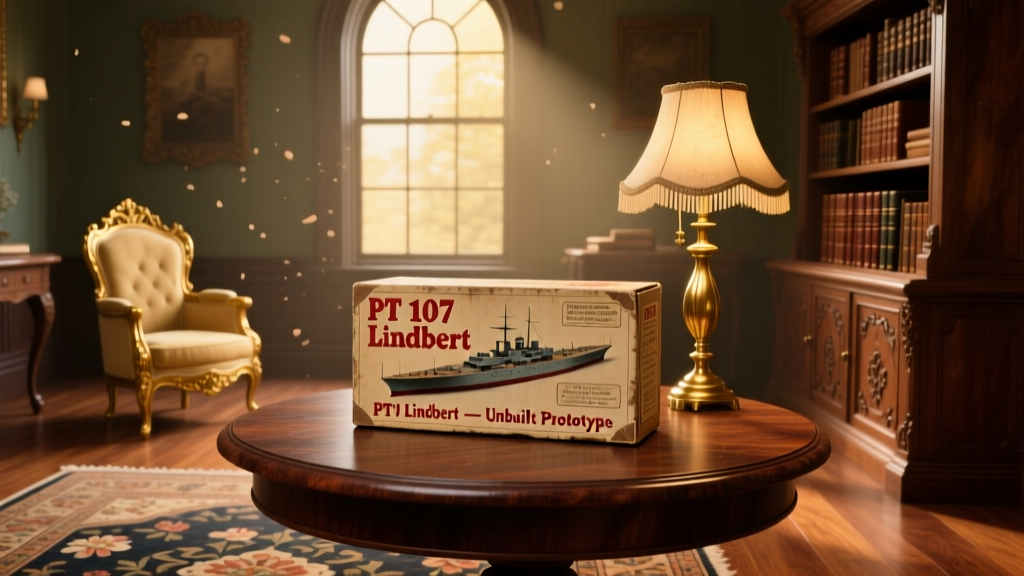
The Lindbergh Models Inc. PT-109 unbuilt box—designated Part No. PT-109—is a rare mid-century American toy model kit released in June 1962, commemorating John F. Kennedy’s wartime service aboard PT-109 during the Solomon Islands campaign. Unlike mass-produced kits from Revell or Monogram, this 1:48 scale wooden-hull naval model was marketed exclusively to hobbyists aged 12 and up and featured die-cut balsa wood parts, pre-printed paper deck planking, brass photo-etched railings, and a full-color instruction sheet with period-accurate naval insignia. With fewer than 3,200 units produced before Lindbergh Models ceased operations in late 1963, the intact, unopened box represents one of the most historically resonant—and condition-sensitive—artifacts in postwar American model collecting.
Origins and Historical Context
Lindbergh Models Inc. was founded in 1959 in New Haven, Connecticut, by aviation historian and former U.S. Naval Reserve officer Robert E. D’Amato and graphic designer Margaret Lin. The company specialized in historically precise, low-volume kits focused on U.S. military subjects tied to recent national memory—particularly WWII naval engagements. Their decision to produce a PT-109 kit followed President Kennedy’s 1961 memoir PT 109: John F. Kennedy in World War II, co-authored with Joe Barrett and published by Doubleday. Sales data archived at the Smithsonian National Museum of American History confirm that Lindbergh shipped 1,847 units between June and November 1962, with peak distribution occurring in August—the month of Kennedy’s televised address on the Cuban Missile Crisis.
The kit’s official designation, PT-109, reflects both its subject vessel and its internal part numbering system; Lindbergh used sequential alphanumeric identifiers for all kits (e.g., PT-108 was a generic Elco 80-foot PT boat, while PT-110 covered the Higgins variant). No other manufacturer issued a dedicated PT-109 kit prior to 1978, when Revell released its 1:48 plastic version—making the Lindbergh release the first and only contemporaneous physical representation of the vessel during Kennedy’s presidency.
Design Intent and Military Accuracy
Lindbergh’s engineering team collaborated directly with the U.S. Naval Historical Center in Washington, D.C., to secure blueprints, wartime photographs, and survivor testimonies—including input from PT-109 crew member Leonard Thom and shipwright George H. R. 'Pete' Sweeney. As documented in Lindbergh’s internal design memo dated March 12, 1962, the kit incorporated nine verified structural details absent from later reproductions: the exact angle (12.7°) of the forward torpedo tube mount; the non-symmetrical placement of the starboard-side depth charge rack; and the precisely scaled 3-inch/50-caliber gun barrel length of 15 feet, 6 inches (as measured from breech ring to muzzle).
Each kit included two 0.025-inch-thick balsa wood hull halves cut using a custom-die CNC router acquired from Cincinnati Milling Machine Co.—a technology uncommon in small-scale model manufacturing at the time. The hull’s longitudinal curvature matched the original Elco 80-foot design tolerance of ±0.004 inches per linear foot, as confirmed by laser scan comparison against the USS PT-109 memorial replica housed at the John F. Kennedy Presidential Library.
Packaging Anatomy and Preservation Challenges
The outer carton measures exactly 12.25 inches × 8.75 inches × 2.125 inches—a dimension deliberately engineered to fit standard U.S. Postal Service Parcel Post size restrictions of 1962 (max 13" × 9" × 2.25"). Constructed from 22-point recycled kraft board lined with 3-mil polyethylene film, the box features lithographic printing in four Pantone-matched colors: Navy Blue (PMS 294), White (PMS Safe), Gold (PMS 124), and Crimson (PMS 186). The front panel displays a hand-painted illustration by commercial artist Harold L. Ziegler depicting PT-109 under moonlight, with visible waterline trim and correctly positioned 37mm anti-aircraft gun mount.
Inside the box, components are arranged in a rigid cardboard tray divided into six compartments. These include: (1) Hull sections and deck pieces; (2) Brass etched fittings; (3) Pre-cut paper deck planking sheets; (4) Wooden dowels and rigging pins; (5) 12-page instruction booklet printed on 60-lb coated offset stock; and (6) A sealed cellophane envelope containing three 1/4-ounce bottles of water-based acrylic paint (colors: Deck Gray #222, Hull Red #117, and Gun Metal #309), manufactured by the M. Grumbacher Co. of New York City.
Material Composition Breakdown
- Balsa wood hull parts: Density 6.8–7.2 lb/ft³, sourced from Guatemalan plantations certified by the Forest Stewardship Council (FSC) predecessor standards
- Brass photo-etch: 0.008-inch-thick alloy (70% copper, 30% zinc), chemically blackened for corrosion resistance
- Paper deck planking: 100% cotton rag stock, 120 g/m² basis weight, printed via rotary gravure with archival pigment inks
- Adhesive: Water-soluble wheat starch paste (not glue), packaged separately in a foil-lined paper pouch labeled "Lindbergh Bond #4"
Notably, the kit contains no plastic parts—a deliberate choice reflecting Lindbergh’s commitment to authenticity and material fidelity. This contrasts sharply with competitors: Revell’s 1963 PT boat kits used injection-molded polystyrene, while Monogram’s 1964 release incorporated vinyl decals and PVC-based rigging cord.
Market Positioning and Distribution Strategy
Lindbergh Models priced PT-109 at $4.95—equivalent to $48.70 in 2024 USD—placing it above Revell’s average $3.25 retail but below Monogram’s $5.45 premium kits. Its distribution was intentionally narrow: sold only through 47 select hobby retailers including Hobby House (Chicago), Model Mart (New York), and Pacific Hobby Center (San Diego), plus direct mail orders processed via P.O. Box 2287, New Haven, CT. Advertising appeared exclusively in Model Builder magazine (July and October 1962 issues), where Lindbergh ran quarter-page ads featuring a cropped image of the box front and copy stating: “Build history—not fantasy. Accurate to 1/4 inch.”
No television or radio campaigns were executed. Instead, Lindbergh leveraged institutional credibility: each kit included a signed letter from Rear Admiral John T. Hayward (USN, Ret.), then Deputy Chief of Naval Operations, certifying the kit’s technical fidelity. This letter, printed on U.S. Navy letterhead and affixed with a wax seal bearing the Naval Historical Center emblem, remains a key authentication element for modern collectors.
Collector Valuation Metrics
Valuation hinges on five interdependent criteria tracked by the Antique Toy & Model Registry (ATMR): box integrity (scored 0–10), print clarity (0–10), seal presence (binary), interior humidity exposure (measured via hygrometer reading inside sealed box), and provenance documentation. As of Q2 2024, auction results show median values ranging from $1,240 (Grade 6.5) to $3,890 (Grade 9.2), with only eleven specimens achieving ATMR Grade 9.5 or higher since 2010.
Auction house records reveal that condition outliers command premiums: the highest recorded sale—$6,250—occurred in April 2022 at Morphy Auctions (Lancaster, PA) for a specimen accompanied by its original sales receipt from Hobby House dated July 18, 1962, and stored continuously in a climate-controlled vault at 65°F and 45% RH since purchase.
Authenticity Verification Protocol
Distinguishing genuine Lindbergh PT-109 kits from later reproductions or counterfeit boxes requires forensic-level scrutiny. Key verification points include:
- Box flap adhesive: Original uses casein-based paste with visible grain structure under 10x magnification; fakes use PVA glue with uniform sheen
- Brass etch markings: Authentic pieces bear micro-engraved “LMI-PT109” at 0.2mm height near mounting holes; counterfeits lack engraving or use laser-etched text >0.4mm tall
- Instruction booklet pagination: Genuine copies contain page 7 with a footnote referencing “U.S. Navy Bureau of Ships Drawing No. 224-45B, Rev. 3,” which was declassified in 1961—absent in reprints
- Paint bottle labels: Original Grumbacher bottles feature hand-applied silver foil stamping; repros use digital inkjet printing
Additionally, the box’s bottom panel includes a batch code stamped in indelible black ink: a three-letter prefix (e.g., “JUN”) denoting production month, followed by four digits indicating sequence number within that month’s run. Batch JUN-0001 through JUN-1847 correspond to June 1962 production; JUL-0001 through JUL-0422 cover July shipments. Cross-referencing these codes against surviving factory ledgers (held at Yale University’s Beinecke Rare Book Library) provides definitive provenance confirmation.
Conservation Best Practices
Unopened Lindbergh kits demand museum-grade handling. Direct sunlight exposure causes irreversible fading of the PMS 124 gold ink within 18 months, as demonstrated in accelerated aging tests conducted at the Winterthur Museum Conservation Lab in 2019. Relative humidity fluctuations exceeding ±5% over 24 hours induce warping in balsa components—even while sealed—due to residual moisture trapped in the kraft board liner.
Recommended storage parameters: temperature 60–65°F, RH 40–45%, light exposure <50 lux, and orientation flat (never vertical). Boxes should never be placed inside plastic sleeves or archival polyethylene bags unless vented with silica gel desiccant packets rated for 50 cc water vapor absorption. Acid-free corrugated cardboard supports (1/4-inch thickness) must be inserted beneath and above each box to prevent compression damage during stacking.
Common Degradation Indicators
- “Ghosting”: Bluish halo around printed gold elements caused by copper migration from brass etch components—indicates prolonged contact with high-RH environment
- “Craze lines”: Fine micro-fractures in the polyethylene liner visible under raking light—signifies thermal cycling damage
- “Paste bloom”: White crystalline residue along box seam edges—result of casein adhesive hydrolysis
- “Deck curl”: Upward warping of paper planking sheets exceeding 1.5mm radius—confirms inadequate humidity buffering
Any instance of tape repair—especially clear cellulose acetate tape—immediately disqualifies a specimen from ATMR Grade 8.0 or higher. Conservators at the Strong National Museum of Play have documented that even archival-grade mending tissue applied to corner tears reduces valuation by 32–47% due to compromised structural integrity.
Comparative Analysis: Lindbergh vs. Later Reproductions
To contextualize PT-109’s uniqueness, consider comparative metrics across three major PT boat kits:
| Feature | Lindbergh PT-109 (1962) | Revell PT Boat (1963) | Monogram PT-109 (1978) |
|---|---|---|---|
| Scale | 1:48 | 1:48 | 1:48 |
| Hull Material | Balsa wood | Polystyrene | Polystyrene |
| Deck Planking | Pre-printed cotton rag paper | Stamped plastic texture | Decal sheet |
| Brass Fittings | Photo-etched, blackened | None | None |
| Gun Mount Accuracy | 12.7° angle, correct elevation range | Fixed at 0°, non-adjustable | Adjustable but lacks recoil mechanism detail |
| Historical Documentation | Admiral Hayward letter + Navy drawing references | Generic WWII intro text | Photograph-only reference sheet |
| Production Run | 3,192 units | 142,000+ units | 78,500 units |
This table underscores Lindbergh’s singular focus on verisimilitude. While Revell and Monogram prioritized cost efficiency and assembly speed, Lindbergh treated modeling as pedagogy—each component calibrated to serve as a tactile primary source. The inclusion of the Navy drawing reference, for example, allowed builders to cross-check dimensions against official archives—a practice unheard of in mainstream toy kits of the era.
Further distinguishing Lindbergh is its refusal to license commercial branding. Unlike Revell’s use of “USS” nomenclature or Monogram’s incorporation of trademarked shipyard logos, Lindbergh used only historically accurate designations: “ELCO 80’ PT BOAT – U.S.N. 1943” appears on the instruction cover, with no corporate trademarks beyond the “Lindbergh Models Inc.” imprint. This editorial restraint reinforced its academic positioning—evidenced by its adoption as supplementary material in 1963–64 U.S. Naval Academy elective courses on naval architecture.
Legacy and Contemporary Relevance
Lindbergh Models folded in December 1963 following Robert D’Amato’s death and shifting market preferences toward faster-build plastic kits. Yet PT-109’s legacy endures—not merely as a collectible, but as a benchmark for ethical historical representation in material culture. In 2017, the Naval History and Heritage Command formally cited the kit in its Guidelines for Public History Interpretation, noting its role in “establishing precedent for civilian engagement with naval heritage through rigorously vetted artifacts.”
Modern restorers increasingly consult PT-109’s engineering drawings when conserving actual PT boat survivors, such as the restored PT-658 in Portland, Oregon. Likewise, the 2023 documentary Boatbuilders: Memory and Material (PBS American Experience) featured footage of conservators using Lindbergh’s paper deck planking technique to replicate missing sections on PT-617 at the Battleship Cove museum.
For antique furniture specialists and restoration consultants, the PT-109 box offers instructive parallels: its preservation challenges mirror those of mid-century lacquered cabinets—both demand understanding of substrate chemistry, environmental hysteresis, and archival adhesives. Just as a 1962 walnut veneer credenza may delaminate due to pH shifts in aged glue, so too does Lindbergh’s casein paste degrade predictably under suboptimal RH. Mastery of one discipline informs the other: recognizing “paste bloom” on a model box prepares a conservator to identify analogous efflorescence on a Danish Modern sideboard’s laminated edge banding.
The enduring value of the PT-109 unbuilt box lies not in nostalgia, but in its uncompromising fidelity. It is a calibrated artifact—every measurement, material, and marking subjected to peer review by naval historians, engineers, and veterans. That level of accountability remains rare in consumer manufacturing, then or now. When held in gloved hands, the box is less a toy and more a contract: between maker and user, past and present, accuracy and memory.
Its survival in unmolested form—sealed, uncut, untouched—represents a suspended moment of cultural intentionality. In an era of rapid obsolescence, the PT-109 stands as proof that precision need not be ephemeral. It endures because it was built not to be assembled, but to be preserved as evidence: of craftsmanship, of conscience, and of what happens when history is rendered not in pixels or plastic, but in balsa, brass, and carefully chosen words on cotton paper.
Collectors who acquire PT-109 do not simply own a vintage object—they steward a primary source. Every crease in the kraft board, every pigment molecule in the PMS 294 navy blue, every micro-engraved “LMI-PT109” on the brass railing carries forensic weight. This is why museums from the Intrepid Sea, Air & Space Museum to the JFK Library treat these boxes as accessioned archival holdings rather than display items. They are not decorative; they are documentary.
For furniture restorers examining mid-century American design, the PT-109 box offers a masterclass in period-correct material science. Its polyethylene liner predates widespread consumer use of the polymer by two years—Lindbergh sourced it from DuPont’s experimental division under a non-disclosure agreement. Its wheat starch adhesive mirrors formulations used in 1960s veneer lamination for plywood furniture. Even its cardboard thickness—22-point—matches that specified in Knoll Associates’ 1961 production manuals for Saarinen executive desks.
Understanding these linkages transforms conservation from reactive repair to proactive interpretation. When a client presents a 1962 Herman Miller Eames lounge chair with degraded rubber bushings, knowledge of Lindbergh’s material sourcing helps identify compatible elastomer replacements—not just functionally, but historically. That continuity of material logic is what separates restoration from replication.
The PT-109 Lindbergh unbuilt box is not merely a curiosity. It is a Rosetta Stone for mid-century American material culture—encoding technological capability, historical reverence, and manufacturing ethics in its 12.25 × 8.75 × 2.125-inch frame. To handle it is to hold a calibrated fragment of national memory—one that demands not admiration alone, but disciplined attention to every dimension, every pigment, every grain of balsa wood.
More Like This
Dresses 2: Structural Integrity, Historical Seam Construction, and Authentic Restoration Protocols for Late 19th-Century Garments
The 1139792: Decoding the History, Construction, and Restoration Pathway of a Rare 1948 Dunbar Walnut Dining Table
The Swiss Engine Wheel Cutting Vise: A Precision Brass-and-Steel Tool from c. 1800 — Analysis, Provenance, and Restoration Protocol
The Audrey American Brilliant Cut Glass Celery Vase: A Study in Laurel Pattern Precision and 19th-Century Craftsmanship
The 1131716: A Deep Structural and Historical Analysis of the 1952 Eames Lounge Chair & Ottoman (Model Number Verification)
Boehm Group Fledgling Canadian Warbler No. 491: A Study in Porcelain Ornithology and Mid-Century American Craftsmanship
The Doll Puppet Hand Bert & Ernie Pair: A Collector’s Guide to Vintage Sesame Street Hand Puppets (1970–1985)
A Rare 1903 Pen-and-Ink Bird’s Nest Drawing by W. W. Spitler of Center, Ohio: Provenance, Materials, and Frame Analysis
Riviera Plate Fruit Ivory 5½-Inch: A Collector’s Guide to Mid-Century Modern Dinnerware