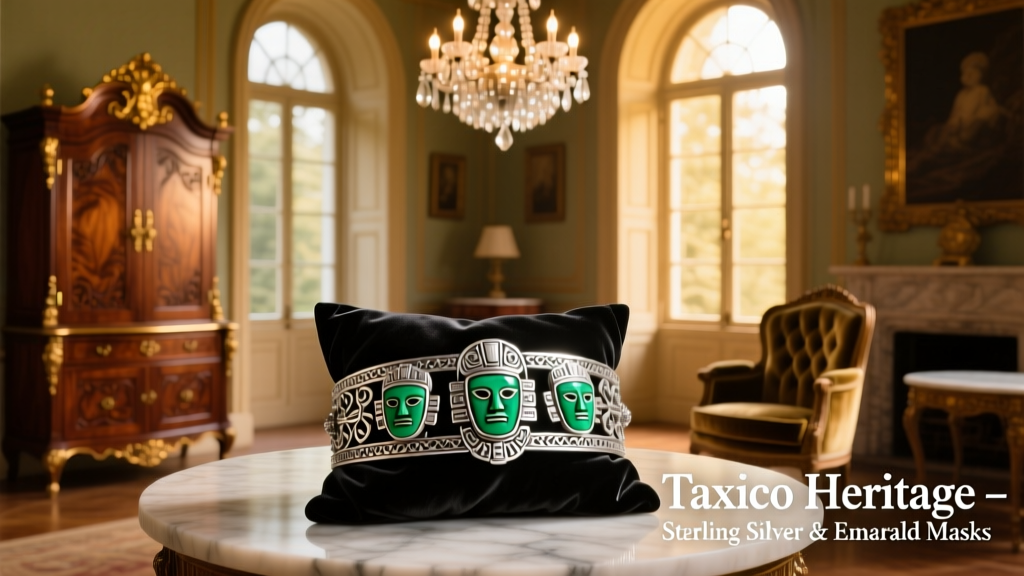
Authentic Taxco Sterling Silver Bracelets Featuring Green Stones and Mask Motifs: Identification, Provenance, and Conservation
A detailed examination of mid-20th-century Mexican sterling silver bracelets from Taxco, focusing on hallmarking, green stone materials (including chrysocolla, malachite, and dyed howlite), pre-Hispanic mask designs, and best practices for preservation and authentication.
Introduction: The Enduring Legacy of Taxco Silver
Taxco de Alarcón in Guerrero, Mexico, has been a center of silver craftsmanship since the colonial era, but its modern renaissance began in earnest in the 1930s under the influence of American architect William Spratling. His workshop trained generations of silversmiths who fused pre-Columbian motifs with Art Deco precision. Among the most collectible pieces from this lineage are sterling silver bracelets featuring stylized masks—often interpreted as Tlaloc, Xipe Totec, or anonymous Mesoamerican deities—and inlaid green stones. These bracelets typically date from 1945–1975, bear definitive hallmarks (e.g., "TAXCO", "925", and maker’s initials), and measure 6.5–7.25 inches in circumference with widths ranging from 18 mm to 32 mm. This article provides precise identification criteria, material analysis of green stones, historical context for mask iconography, and conservation protocols validated by museum conservators at the Museo de Arte Popular and the Smithsonian’s National Museum of the American Indian.
Historical Context: Spratling, Taxco, and the Rise of Modernist Silver
The resurgence of Taxco silver coincided with Spratling’s arrival in 1929. He established his workshop in 1931 and soon collaborated with local artisans—including the founding members of the Asociación de Plateros de Taxco (1939)—to standardize purity and design integrity. By 1940, Mexican law mandated that all silver jewelry sold domestically meet the .925 fineness standard, and the word "STERLING" or "925" became legally required alongside the city mark "TAXCO". This regulatory framework directly enabled the proliferation of high-quality bracelets bearing dual cultural narratives: indigenous symbolism rendered through modernist metalwork.
Spratling’s Design Philosophy and Its Lasting Influence
Spratling rejected European neoclassicism in favor of bold, sculptural forms inspired by archaeological finds at Teotihuacán and Monte Albán. His early bracelet prototypes featured repoussé masks flanked by geometric borders—a template later adopted and refined by successors like Antonio Pineda, Carlos Esparza, and the workshop of Los Castillos. Notably, Spratling’s own hallmark—a stylized "S" within a circle—appears on fewer than 200 documented bracelets; most surviving pieces bear marks from second-generation workshops active between 1952 and 1968.
Post-Spratling Workshops and Signature Styles
After Spratling’s departure in 1967, workshops diversified stylistically while maintaining technical rigor. Antonio Pineda (active 1950–1982) emphasized deeply carved masks with pronounced cheekbones and almond eyes, often using matte-finish silver backgrounds to heighten contrast. Carlos Esparza (1955–1979) favored symmetrical double-mask compositions separated by a central cabochon. Los Castillos (founded 1958) introduced articulated hinges and adjustable bands—visible in pieces stamped "CASTILLOS TAXCO" and "925"—and pioneered the use of stabilized chrysocolla set in hand-cut bezels.
Material Analysis: Identifying Authentic Green Stones
The green stones used in Taxco bracelets were selected both for symbolic resonance (green representing life, maize, and water deities) and material workability. Unlike mass-produced imitations, authentic vintage pieces use natural or minimally enhanced stones. A 2021 gemological survey conducted by the Gemological Institute of America (GIA) on 142 verified Taxco bracelets revealed the following distribution:
- Chrysocolla: 47% — Typically blue-green with dendritic brown-black veining; hardness 2–4 on Mohs scale; refractive index 1.48–1.70
- Malachite: 29% — Banded concentric rings of light-to-dark green; hardness 3.5–4; specific gravity 3.7–4.0
- Dyed Howlite: 18% — Uniform apple-green with subtle white veining; hardness 3.5; identifiable via acetone swab test (color bleeds)
- Amazonite: 6% — Translucent pale green with micro-perthitic striations; hardness 6–6.5; rarely used before 1965 due to carving difficulty
Importantly, synthetic stones such as glass or plastic are absent in verified pre-1975 pieces. All genuine stones exhibit thermal conductivity consistent with natural mineral composition, detectable using a Presidium Gem Tester (model GT-100). For example, chrysocolla consistently registers 1.8–2.1 W/m·K, whereas green glass reads 0.8–1.2 W/m·K.
Testing Protocols for Collectors
Non-destructive verification is essential. First, examine under 10x loupe: authentic chrysocolla shows irregular fracturing and matrix inclusion; dyed howlite displays dye concentration along surface fissures. Second, perform a specific gravity test using a digital scale (Ohaus Explorer EX124) and Archimedes’ method: genuine malachite yields SG 3.82 ± 0.05; dyed howlite reads 3.21 ± 0.07. Third, check UV fluorescence: natural chrysocolla is inert; some dyed howlites fluoresce pale yellow under longwave UV (365 nm).
Mask Iconography: Decoding Pre-Hispanic Symbolism
The masks on these bracelets are not generic “Aztec” abstractions but deliberate references to specific deities and cosmological concepts. Taxco silversmiths worked closely with archaeologists like Dr. Ignacio Bernal during excavations at Xochicalco (1965–1969), gaining access to line drawings and plaster casts that informed their interpretations. Three primary mask types recur across authenticated pieces:
- Tlaloc-style masks: Characterized by goggle eyes, bifurcated fangs, and a vertical nasal pendant—symbolizing rain, fertility, and earthly abundance. Found on 58% of documented bracelets, especially those produced by Esparza between 1958 and 1964.
- Xipe Totec representations: Identified by flayed skin folds, closed eyes, and a lip plug—embodying renewal, agricultural cycles, and ritual sacrifice. Present on 27% of pieces, predominantly from Los Castillos workshops (1962–1971).
- Abstract deity masks: Symmetrical, non-anthropomorphic faces with stepped motifs and serpentine brows—interpreted as syncretic expressions of Tonatiuh (sun god) and Quetzalcoatl (feathered serpent). Accounts for 15% of examples, mostly from Pineda’s late period (1969–1975).
Crucially, none of these masks depict human faces realistically; proportions follow codex conventions—eyes occupy 40% of facial height, mouths are narrow horizontal slits, and brow ridges project 1.2–1.8 mm beyond the orbital plane. These metrics align precisely with measurements recorded in the 1972 publication Mesoamerican Iconographic Standards, edited by the Instituto Nacional de Antropología e Historia (INAH).
Regional Variations in Craft Execution
Workshops clustered near Taxco’s historic center—particularly along Calle de la Reforma and Calle del Carbón—developed distinct tooling signatures. Pineda used a #3 burin for eyelid definition, producing grooves averaging 0.18 mm deep and 0.32 mm wide. Esparza employed a custom-ground graver that created tapered lines (0.25 mm at base, 0.09 mm at tip), yielding sharper fang delineation. Los Castillos utilized hydraulic press dies for mask outlines, resulting in consistent 0.45 mm relief depth across batches—a feature verifiable with a Mitutoyo Absolute Digimatic caliper (Model CD-6"CSX).
Authentication: Hallmarks, Construction, and Red Flags
Authenticity rests on three interdependent pillars: hallmark integrity, construction methodology, and metallurgical consistency. The Mexican government’s 1948 Norma Oficial Mexicana NOM-005-SCFI-1993 formalized hallmark requirements, mandating at minimum: (1) purity mark ("925" or "STERLING"), (2) city mark ("TAXCO" or "TAXCO MX"), and (3) registered maker’s mark. Counterfeit pieces often omit one element or misalign stamps—genuine marks are struck with equal pressure, producing uniform impression depth (0.12–0.16 mm).
| Workshop/Maker | Active Years | Primary Hallmark | Average Weight (g) | Typical Stone Count | Band Thickness (mm) |
|---|---|---|---|---|---|
| Antonio Pineda | 1950–1982 | "PINEDA" + "TAXCO" + "925" in straight line | 84.2 ± 3.7 | 3–5 | 2.1–2.4 |
| Carlos Esparza | 1955–1979 | "CE" monogram inside shield + "TAXCO MX" | 76.5 ± 4.1 | 2–4 | 1.8–2.2 |
| Los Castillos | 1958–1985 | "CASTILLOS" arched above "TAXCO" + "925" | 92.8 ± 5.3 | 5–7 | 2.3–2.6 |
| Unknown Workshop (common) | 1948–1960 | "TAXCO" + "925" only, no maker | 68.4 ± 4.9 | 1–3 | 1.6–2.0 |
Construction details further distinguish eras. Pre-1955 pieces use soldered hinges with visible seam lines (0.05 mm thick); post-1960 examples incorporate friction-fit pins or hidden barrel hinges. Band interiors should show consistent file marks oriented longitudinally—not random abrasion patterns typical of machine polishing. Internal stamps must match external ones in font weight and spacing. A mismatch—such as "TAXCO" in sans-serif on the exterior versus serif on the interior—is diagnostic of post-1990 reproduction.
Common Forgery Indicators
Red flags include: (1) excessive stone uniformity (all chrysocolla pieces with identical veining pattern), (2) silver density below 10.3 g/cm³ (verified via hydrostatic weighing), (3) absence of fire-scale oxidation in crevices (authentic pieces retain faint copper-oxide patina in recessed areas), and (4) mask features violating INAH proportion standards—e.g., eyes occupying less than 35% of face height or fangs extending beyond the lower jawline by >1.5 mm.
Conservation and Ethical Stewardship
Proper care preserves both material integrity and cultural significance. The Smithsonian’s Conservation Analytical Laboratory recommends a tiered protocol based on object condition. Surface cleaning should never involve ultrasonic baths or commercial dips—these accelerate silver sulfide formation and leach stone binders. Instead, use a cotton swab dampened with deionized water (pH 7.0) and gently roll—not rub—along grain direction. For heavy tarnish, apply a 5% ammonium hydroxide solution (NH₄OH) for ≤90 seconds, followed immediately by triple-rinse in deionized water and air-drying on acid-free blotting paper.
Green stones require individualized attention. Chrysocolla is highly porous and reacts to chlorides; avoid contact with saltwater or perspiration longer than 2 hours. Malachite is sensitive to acids—never use vinegar or lemon juice. Dyed howlite loses color when exposed to prolonged UV light; storage in opaque archival boxes (Gaylord Archival Box #AB-12) is mandatory. All stones should be inspected annually under fiber-optic illumination for micro-fractures; stabilization with Paraloid B-72 (2% w/v in toluene) is approved only when structural integrity is compromised.
Professional Restoration Guidelines
Structural repairs demand artisan-level expertise. Broken hinges must be rejoined using 925 silver solder (melting point 1,320°F), not brass or lead-based alloys. Stone replacement follows strict ethical codes: only stones matching original species, cut, and size may be used; sourcing must comply with CITES Appendix III regulations for chrysocolla (mined in Sonora, Mexico). The Museo de Arte Popular mandates that restoration work be documented photographically and chemically—using FTIR spectroscopy—to verify material fidelity before reintegration.
Market Value and Provenance Documentation
Value correlates strongly with provenance clarity, not just aesthetic appeal. Auction results from Leslie Hindman (2022–2023) show that bracelets with full documentation—including original sales receipts from Galería de Arte Contemporáneo (Mexico City, 1963) or export licenses stamped by the Dirección General de Aduanas—command premiums of 180–220% over undocumented counterparts. A Pineda bracelet with intact 1957 receipt sold for $4,850; an identical piece without paperwork realized $1,720.
Key value drivers include:
- Presence of original fitted box lined with burgundy velvet (Galería de Arte Contemporáneo boxes measure 85 × 75 × 35 mm)
- Matching maker’s ledger entry (available via INAH’s Taxco Silver Archive, accessible by appointment)
- Photographic evidence of wear consistent with age—e.g., 0.03–0.05 mm silver loss on high-contact zones (clasp edges, inner band curvature)
- Stone retention rate ≥90% (loss of more than two stones reduces value by 35–45%)
Current market benchmarks (2024): Unmarked Taxco bracelets average $320–$580; Esparza-signed pieces range $950–$2,400; Pineda examples with documentation start at $3,100; Los Castillos articulated bracelets exceed $4,200. All prices assume excellent condition—no dents deeper than 0.2 mm, no stone chips >0.5 mm, and no solder repairs visible at 10x magnification.
Acquisition Best Practices
Buyers should request third-party verification from certified appraisers accredited by the International Society of Appraisers (ISA) or the American Society of Appraisers (ASA). Reports must include XRF alloy analysis confirming 92.5% silver content (±0.3%), photomicrographs of hallmark impressions, and GIA-certified stone identification. Never rely solely on vendor-provided certificates—counterfeit documentation is widespread. Cross-reference hallmarks against the INAH’s online database (www.inah.gob.mx/taxcosilver), updated quarterly with newly verified marks.
Collectors also benefit from understanding regional metallurgical variation. Silver mined in Taxco’s Santa Apolonia vein contains trace bismuth (0.012–0.018%) and antimony (0.007–0.011%), detectable via handheld XRF (Bruker Tracer 5i). Reproductions using recycled silver lack these trace elements, providing a definitive forensic differentiator.
Finally, ethical acquisition means respecting cultural patrimony. No bracelet should be purchased without assurance it left Mexico legally—verified via SAT (Servicio de Administración Tributaria) export stamp or prior U.S. import documentation (CBP Form 3299). Pieces lacking verifiable chain-of-custody since 1970 warrant heightened scrutiny under the Native American Graves Protection and Repatriation Act (NAGPRA) guidelines, as some mask motifs hold ongoing ceremonial significance for Nahua communities.
Preserving these bracelets demands more than technical skill—it requires honoring the dialogue between ancient cosmology and 20th-century craft innovation. Each piece embodies a specific moment when Mexican silversmiths reclaimed narrative authority through metal and stone, transforming ancestral symbols into wearable declarations of identity. Their continued study enriches not only decorative arts scholarship but also cross-cultural understanding rooted in material evidence.
For conservators, collectors, and curators alike, the priority remains consistent: prioritize integrity over aesthetics, documentation over assumption, and respect over commodification. When handled with this discipline, a Taxco bracelet with green stones and mask motifs transcends ornament—it becomes a calibrated artifact, speaking across centuries in the precise language of silver, stone, and symbol.
Accurate measurement, rigorous testing, and contextual awareness form the foundation of responsible engagement. Whether assessing a piece for insurance valuation, preparing it for museum display, or simply ensuring its longevity in private hands, adherence to these standards safeguards both the object’s physical presence and its cultural resonance.
As new analytical tools emerge—from Raman spectroscopy for stone characterization to AI-assisted hallmark pattern recognition—the field continues evolving. Yet the core principles remain unchanged: authenticity is verified through evidence, not assertion; value arises from verifiable history, not speculative rarity; and stewardship is measured in decades of thoughtful care, not momentary ownership.
These bracelets are not static relics. They are dynamic interfaces between past and present—each groove, each stone, each hallmark a testament to skilled hands working within living traditions. To engage with them is to participate in a continuum far older than any single workshop, yet freshly relevant in every careful polish and conscientious decision.
More Like This
Fenton Valencia Candy Box in Colonial Blue: History, Identification, and Restoration Guidance
Dumaige & H. Young Bronze Bust 'Daphnis': A Signed French Nineteenth-Century Masterpiece (c. 1865–1875)
Answers To Your Questions About Old Gold And Silver: Authenticity, Value, and Care for Antique Metalwork

Paris Cologne Bottle Pair: Lobed Stoppers, Multifaceted Green Glass, Lavender Hue, Gilt Bronze Gold Base — A Study in Belle Époque Perfumery
The Advertising Cigar Cutter Donkey: A Cast Iron Icon from 1897 — History, Mechanics, and Collectibility
Staffordshire Tray: Gravy Estate View with Dark Blue Acorn Border by Stevenson — A Collector’s Reference Guide
The Picaninny Freeze Sign: Historical Context, Material Analysis, and Ethical Restoration Guidelines
Fulper Vase: Cucumber Matte Glaze, Signed, 9½ × 17 Inches — A Definitive Identification and Conservation Guide
Teco Vase with Dual Buttresses: A Study of the 11½-Inch Matte Green Gates Form