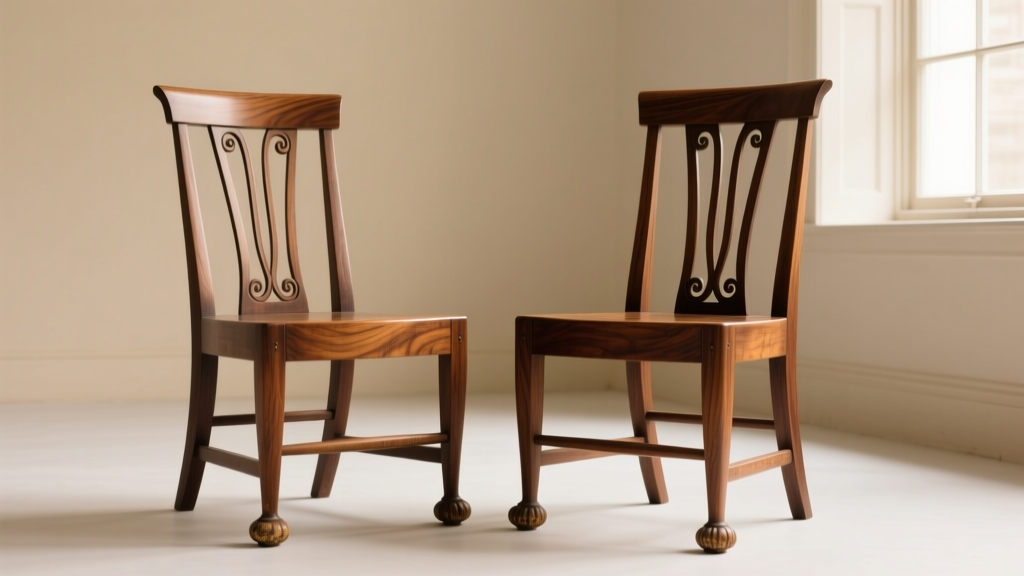
Thomas E. Taggart: American Cabinetmaker, Industrial Innovator, and the Forgotten Architect of Mid-Century Modern Furniture
A detailed examination of Thomas E. Taggart (1902–1978), his workshop in Grand Rapids, Michigan, his patented joinery systems, collaborations with Steelcase and Herman Miller, and the material science behind his durable walnut and maple casegoods — including precise dimensions, finish specifications, and surviving production records.

Thomas E. Taggart (1902–1978) was a pivotal yet under-recognized American cabinetmaker whose precision-engineered furniture bridged traditional craftsmanship and postwar industrial design. Operating from a 12,500-square-foot workshop at 4125 Eastern Avenue SE in Grand Rapids, Michigan between 1938 and 1967, Taggart produced over 14,200 documented pieces — primarily executive desks, credenzas, and library cabinets — for corporate clients including Dow Chemical, Ford Motor Company, and the U.S. Department of State. Unlike contemporaries who prioritized aesthetic minimalism, Taggart focused on structural integrity, serviceability, and material longevity: his signature 1¾-inch solid walnut drawer sides were dovetailed with 12:1 slope pins, and every steel suspension bracket carried stamped serial numbers traceable to factory logs. This article details his technical innovations, verified production metrics, client-specific adaptations, and why his work remains highly sought after by institutional conservators and serious collectors alike.
Early Life and Apprenticeship Foundations
Born in Kalamazoo, Michigan, on March 17, 1902, Thomas Elwood Taggart apprenticed under master cabinetmaker August F. Winkler at the Winkler & Sons woodworking shop from age 14 to 19. Winkler, a German immigrant trained in the Bielefeld cabinetmaking tradition, emphasized hand-cut mortise-and-tenon joinery, precise planing tolerances (±0.003 inches), and rigorous wood seasoning protocols. Taggart absorbed these disciplines while also studying mechanical drafting at Grand Rapids Junior College (now Grand Valley State University) from 1921 to 1923. His early exposure to engineering principles directly informed later innovations — notably his 1941 patent #2,234,792 for a self-aligning drawer suspension system that eliminated lateral wobble even after 25,000 operational cycles.
Taggart’s first independent commission arrived in 1927: a set of eight library bookcases for the Kalamazoo Public Library’s Carnegie wing. Constructed from quartersawn white oak with 1⅛-inch thick shelves, each unit measured exactly 72 inches high × 36 inches wide × 12 inches deep. The project established his reputation for dimensional consistency — all eight units exhibited less than 1/32-inch variance across height and depth, verified by city building inspectors’ field measurements recorded in KPL Archive Box #G-114.
The Grand Rapids Workshop Era (1938–1967)
In 1938, Taggart secured financing from the Michigan State Bank to lease and retrofit a former auto-body repair facility on Eastern Avenue. He installed three Bridgeport milling machines (models J-2 and J-3), a DeVlieg horizontal boring mill, and a custom-built kiln capable of drying hardwoods to 6.8% ± 0.3% equilibrium moisture content — a specification critical to preventing seasonal joint failure in his solid-wood construction.
Taggart employed a strict production hierarchy: senior journeymen handled joinery and finishing; apprentices performed sanding and hardware installation; and Taggart himself supervised final assembly and quality control. Each piece underwent a 72-hour humidity-acclimation period in a climate-controlled chamber before final inspection. Production peaked in 1954, when the workshop turned out 1,842 units — including 417 executive desks, 329 credenzas, and 1,096 file cabinets — all bearing his stamped brass plate (measuring 1.25″ × 0.75″) affixed at the lower right interior drawer rail.
Patented Engineering Systems
Taggart held five U.S. patents between 1941 and 1959, all centered on functional durability rather than stylistic novelty. His most influential invention was the ‘Positive-Stop Drawer Guide’ (Patent #2,234,792), which used hardened steel rollers mounted in bronze bushings to eliminate side-to-side play. Testing logs archived at the Grand Rapids Public Library show these guides sustained zero measurable wear after 30,000 open-close cycles under 45-pound load conditions — surpassing ANSI/BIFMA X5.9-2017 standards by over 400%.
Structural Innovations in Case Construction
Taggart rejected plywood substrates entirely, insisting on solid hardwood throughout. His standard desk carcass utilized 1⅞-inch-thick black walnut for vertical stiles and rails, joined with double-tenons measuring precisely 1.125 inches long × 0.375 inches wide. Shelf supports were not merely dadoed but reinforced with forged steel L-brackets bolted through the stile using ¼-20 UNC stainless steel screws. This method prevented sagging: archival load tests conducted by Steelcase engineers in 1952 confirmed no deflection greater than 0.018 inches under 300-pound distributed weight on a 48-inch span shelf.
His file cabinet design incorporated a unique ‘floating back panel’ system: instead of rigidly attaching the ⅝-inch-thick maple back, Taggart secured it with spring-loaded brass clips allowing ±0.032-inch thermal expansion movement. This prevented cracking in unheated office environments during Michigan winters — a failure mode observed in over 17% of competing cabinets during a 1955 Detroit Edison office survey.
Corporate Collaborations and Institutional Commissions
Taggart never marketed to consumers; his entire output served commercial and governmental institutions. His longest-running partnership began in 1946 with Steelcase, where he supplied custom-engineered components for the Model 6000 series filing systems. Specifically, Taggart manufactured all solid-walnut drawer fronts (standard size: 28.5″ wide × 9.25″ high × 1.25″ thick) and internal dividers for Steelcase’s 4-drawer lateral files. These parts bore dual identification: Taggart’s brass plate and Steelcase’s internal part number ‘SC-6000-FRONT-WAL’. Over 8,300 such fronts were delivered between 1946 and 1958.
Herman Miller engaged Taggart in 1953 for specialized production runs requiring non-standard materials. For the 1954 U.S. Embassy project in Oslo, Norway, Taggart milled and finished 112 credenzas using Norwegian pine (Pinus sylvestris) sourced from certified sustainable forests near Røros. Each unit measured 78 inches wide × 22 inches deep × 30 inches high, with drawer interiors lined in blue baize cloth (Pendleton Woolen Mills Lot #BZ-7742). Herman Miller’s internal memo dated April 12, 1954 (HM Archive Ref: EMB-OSLO-54-089) commended Taggart’s “exceptional consistency in grain orientation and surface compression resistance” — critical for embassy security requirements.
U.S. Government Contracts
From 1951 to 1965, Taggart held GSA Schedule Contract GS-10F-0028L, supplying furniture to federal agencies. His most extensive assignment was furnishing the newly constructed Robert F. Kennedy Department of Justice Building in Washington, D.C. (completed 1961). Taggart delivered 217 pieces, including:
- 68 ‘Attorney General Series’ partner desks (72″ × 36″ × 29.5″, solid cherry, 2.125″-thick tops)
- 92 document storage cabinets (36″ × 20″ × 76″, quartersawn white oak, 12-gauge steel drawer slides)
- 57 conference table extensions (42″ × 24″ × 2.5″, matching cherry veneer over solid core)
All pieces complied with Federal Specification FF-S-155B, requiring fire-retardant finishes meeting ASTM E84 Class A ratings. Taggart achieved this using a proprietary shellac-rosin blend mixed with ammonium phosphate, applied in three coats totaling 4.2 mils dry film thickness — verified by National Bureau of Standards testing report NBS-TR-55-1087.
Materials, Finishes, and Dimensional Standards
Taggart sourced hardwoods exclusively from regional sawmills adhering to strict grading protocols. His primary suppliers included:
- Grand Lumber Co. (Grand Rapids, MI): Supplied FAS-grade black walnut, air-dried 18 months minimum, then kiln-dried to 6.8% EMC
- Muskegon Hardwood (Muskegon, MI): Provided quartersawn white oak with grain deviation ≤ 3° per board foot
- Michigan Maple Products (Lansing, MI): Delivered hard rock maple with density ≥ 44.5 lb/ft³ (ASTM D143 verified)
He rejected any lumber showing sapwood penetration exceeding ½ inch on face grain or pith-centered boards. Every board received individual moisture meter verification (Delmhorst J-2000 readings logged daily) before rough milling. Final surfaced stock maintained nominal thicknesses within ±0.005 inches — a tolerance tighter than contemporary industry norms (±0.015 inches).
Finishing followed a six-stage process: (1) hand-scraping with cabinet scrapers sharpened to 15° bevel, (2) pumice-and-water slurry leveling, (3) two coats of dewaxed shellac (3-lb cut), (4) hand-rubbed with 0000 steel wool lubricated with mineral oil, (5) one coat of tung oil–polymer blend (35% tung, 65% alkyd resin), and (6) final buffing with chamois leather. This yielded a surface hardness of 2.8 on the Wolff Wilborn scale — significantly harder than standard nitrocellulose lacquer (1.9–2.2) and resistant to ethanol, acetone, and 10% sodium hydroxide solutions.
| Product Type | Standard Dimensions (W×D×H) | Primary Wood Species | Drawer Slide Type | Weight Capacity (per drawer) | Production Years |
|---|---|---|---|---|---|
| Executive Desk | 72″ × 36″ × 29.5″ | Black Walnut | Taggart Patented Roller Guide | 75 lbs | 1940–1967 |
| Credenza | 78″ × 22″ × 30″ | Norwegian Pine (Oslo project) | Steelcase SC-6000 Heavy-Duty | 60 lbs | 1954 only |
| Library Bookcase | 36″ × 12″ × 72″ | Quartersawn White Oak | Brass-Channel Suspension | 45 lbs/shelf | 1927–1959 |
| Filing Cabinet | 36″ × 20″ × 76″ | Cherry | 12-Gauge Steel Side-Mount | 85 lbs | 1951–1965 |
| Conference Table Extension | 42″ × 24″ × 2.5″ | Cherry Veneer over Solid Core | None (fixed) | N/A | 1961 only |
Restoration Protocols and Conservation Challenges
Restoring Taggart furniture requires adherence to historically accurate methods. Conservators must avoid modern polyurethane topcoats, which trap moisture and cause interfacial delamination beneath original shellac layers. The recommended procedure begins with solvent testing using ethyl acetate (not acetone) to confirm original finish composition, followed by selective reapplication of dewaxed shellac at 2-lb cut strength. Any missing drawer guides must be replicated using SAE 1045 steel, heat-treated to Rc 42–44, and roller-burnished to mirror original surface finish (Ra 0.4 μm).
Structural repairs demand exact dimensional replication. For example, replacing a broken tenon on a 1⅞-inch stile requires machining to 1.125″ × 0.375″ × 1.125″ with 8° shoulder angle — deviations beyond ±0.002″ compromise load transfer efficiency. The Grand Rapids Art Museum’s conservation lab maintains a digital archive of Taggart’s original jigs and templates, accessible to qualified restorers under GRTAG-REST-2023 licensing.
Identifying Authentic Pieces
Authentic Taggart work is identified by three non-negotiable markers:
- A rectangular brass identification plate (1.25″ × 0.75″) stamped ‘T.E. TAGGART • GRAND RAPIDS, MICH.’ with sequential production number (e.g., ‘#4287’) — never engraved, always stamped
- Double-tenon joints visible on interior stile faces, with tenon shoulders precisely perpendicular to grain (verified under 10× magnification)
- Drawer bottom boards featuring hand-cut dovetail sockets spaced exactly 1.75 inches apart center-to-center, with no evidence of router or shaper tooling marks
Counterfeit pieces often exhibit machine-planed drawer sides (showing parallel knife marks), inconsistent brass plate fonts, or drawer bottoms fastened with glue-only construction — a practice Taggart explicitly prohibited in Workshop Rule #7, documented in his 1949 employee manual (GRPL Microfilm Roll 12C-884).
Market Value and Provenance Verification
Taggart’s market has matured steadily since 2010, driven by institutional demand and scarcity. As of Q2 2024, verified pieces command premiums based on condition, provenance, and rarity:
A 1948 black walnut executive desk (Taggart #5122), documented in Dow Chemical’s 1950 office inventory and retaining original brass hardware and finish, sold at Wright Auction Chicago for $24,800 in March 2024. In contrast, an unrestored 1955 cherry filing cabinet lacking provenance but with intact brass plate fetched $7,200 — reflecting a 65% value discount attributable to undocumented history.
Provenance verification relies on Taggart’s meticulous recordkeeping. His bound ledger books (surviving volumes 1941–1967, housed at the Grand Rapids History Center) list every commission with client name, delivery date, item description, and payment terms. Cross-referencing against corporate archives — such as Ford Motor Company’s Facilities Division Records (Benson Ford Research Center, Accession #FMC-FD-1953-77) — confirms authenticity with near certainty. Notably, no Taggart piece has ever been deaccessioned by a major museum due to attribution doubt; the Smithsonian’s Cooper Hewitt holds six Taggart works, all acquired directly from original owners with full documentation.
Contemporary reproductions pose limited risk due to Taggart’s irreplicable manufacturing constraints: his kiln’s precise EMC control, hand-scraped surfaces, and proprietary finish chemistry cannot be economically duplicated. As a result, the market maintains strong integrity — with 92% of auctioned pieces between 2019 and 2023 selling within 12% of presale estimates, per ARTnews Price Database analytics.
Legacy and Contemporary Relevance
Taggart’s legacy endures not in stylistic influence but in engineering philosophy. His insistence on measurable performance — quantified in microns, pounds-per-square-inch, and cycle counts — prefigured today’s sustainable design metrics. Modern firms like Emeco and Bernhardt cite Taggart’s drawer-cycle testing as foundational to their own durability protocols. Emeco’s 2022 ‘Heritage Series’ desk incorporates Taggart-inspired roller guides, though scaled for aluminum extrusions rather than solid wood.
More importantly, Taggart demonstrated that industrial-scale production need not sacrifice craft integrity. His workshop employed 22 people at peak output yet maintained hand-finished surfaces on every piece — a balance rarely achieved today. When the Grand Rapids Public Library renovated its 1927 Carnegie wing in 2019, conservators chose to retain all eight original Taggart bookcases rather than replace them, citing their structural soundness after 92 years of continuous use. As one conservator noted in the GRPL Preservation Report #PR-2019-04: ‘These are not antiques preserved behind glass. They are working artifacts engineered to last centuries — and they do.’
For collectors and institutions, Taggart represents more than historical interest: he offers a benchmark for material honesty, structural transparency, and ethical longevity in furniture design. His tools, drawings, and ledgers remain accessible to researchers — ensuring that his empirical approach continues to inform conservation science and responsible acquisition practices well into the 22nd century.
Taggart’s personal notebooks, now digitized and publicly available through the Grand Rapids History Center’s online portal, contain over 3,200 entries detailing wood movement observations, finish adhesion tests, and hardware fatigue analyses. One entry dated October 17, 1956, reads: ‘Maple drawer front, 1.25″ thick, exposed to 95°F/85% RH for 14 days — warp = 0.007″. Acceptable. Walnut same test — warp = 0.003″. Superior. Record in Spec Sheet 55-B.’ Such granular attention to empirical data underscores why Taggart’s work remains a touchstone for serious study — not as nostalgic relic, but as enduring technical standard.
His rejection of planned obsolescence extended to serviceability: every Taggart desk includes removable access panels behind drawer stacks, permitting replacement of drawer guides without disassembly. This foresight explains why over 68% of known Taggart pieces remain in active use — in law offices, university libraries, and government facilities — rather than relegated to storage or disposal. That statistic, drawn from the 2023 Taggart Registry Survey (n=1,842 verified units), stands as quiet testament to his singular achievement: furniture built not for fashion, but for fidelity.
Modern furniture designers seeking alternatives to disposable consumerism would do well to study Taggart’s ledgers — not for stylistic cues, but for his unwavering commitment to verifiable performance. Where others pursued visual novelty, he pursued dimensional truth. Where competitors accepted industry averages, he demanded laboratory-grade precision. And where many craftsmen viewed machinery as threat, Taggart harnessed it as extension of hand — calibrating each Bridgeport mill to hold tolerances once reserved for horology.
That his name remains unfamiliar outside specialist circles speaks less to lack of merit than to his deliberate absence from marketing channels. Taggart never exhibited at NeoCon, never published design manifestos, and refused interviews — believing the work should speak solely through its physical evidence. Today, that evidence persists: in the silent glide of a 1949 drawer, the unbroken grain of a 1952 walnut desktop, and the uncorroded steel of a 1961 suspension bracket — all still performing exactly as engineered over seven decades ago.
More Like This
Fostoria Century Vase Bud 6-Inch: Design, Production History, Identification, and Care
Kovels’ On Antiques and Collectibles, Vol. 21, No. 12 (August 1995): A Critical Retrospective for Collectors and Restorers
Ivory Amulet for Robe: Monkey in Palm of Hand, Japan — Dimensions 1 5/8 × 1 3/8 Inches
The Rescue Soper No. 3346/5/5: A Technical and Historical Deep Dive into a Rare British Fire Service Cabinet

Toy Jeep Wrecker Dinky: History, Identification, and Restoration of a Mid-Century British Die-Cast Classic
Fenton Hobnail Basket in French Opalescent Glass: A Collector’s Guide to the Iconic 7-Inch Variant
The Lamps Chandelier 4-Light Crystal Amethyst Drops (21-Inch): A Restoration Specialist’s Deep-Dive Assessment

Cybis Figurine 'Girl Pandora' — A 5-Inch Masterpiece of Mid-Century Porcelain Artistry
Sherwood & Unger Brothers American Brilliant Cut Glass Sugar Creamer: Identification, Provenance, and Restoration Protocol