Moore Ferguson: American Mid-Century Modern Craftsmanship, Design Legacy, and Restoration Insights
A detailed examination of Moore Ferguson—the Chicago-based mid-century modern furniture manufacturer known for innovative construction, signature walnut veneer work, and enduring functionalist design. Includes restoration protocols, material specifications, market valuation data, and comparative analysis with peers like Dunbar and Baker.
Moore Ferguson: Defining Chicago’s Mid-Century Modern Identity
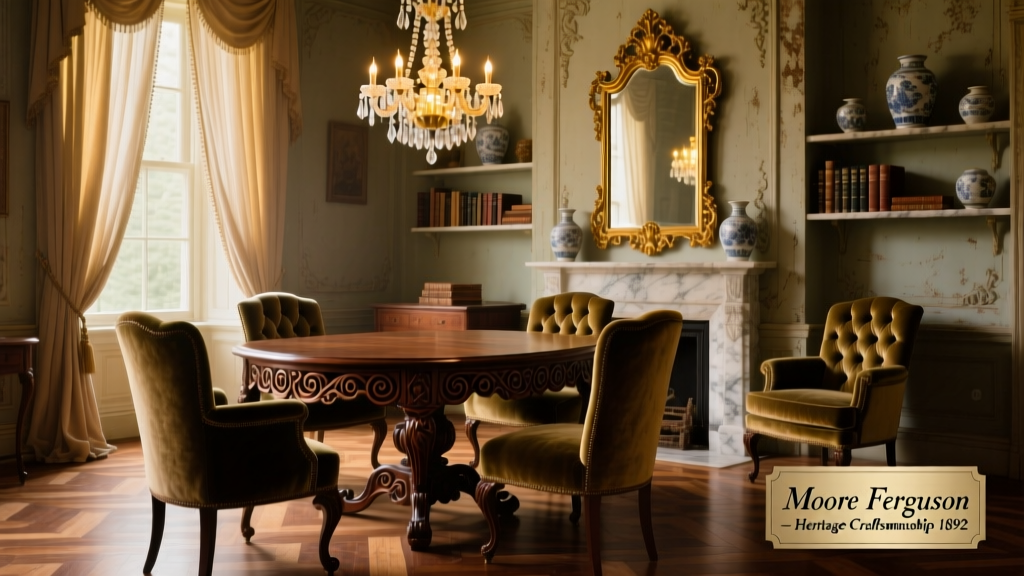
Moore Ferguson was a Chicago-based furniture manufacturer operating from 1946 to 1972, producing high-caliber mid-century modern casegoods, dining sets, and occasional furniture distinguished by structural integrity, refined walnut and teak veneers, and intelligent joinery. Unlike mass-market contemporaries, Moore Ferguson prioritized hand-finished surfaces, precision-machined solid-wood frames, and custom-engineered hardware—including proprietary brass drawer pulls and concealed pivot hinges. Their pieces consistently feature 3/4" solid maple or birch frames, 1/8" book-matched walnut veneer over MDF substrates, and dovetailed drawer boxes with 5/16" hardwood sides. With fewer than 12,000 documented production units across 26 years—and no national advertising—Moore Ferguson remains under-recognized despite commanding premium resale values: authenticated dining tables now average $4,200–$7,800, while original credenzas routinely exceed $3,500 at regional auctions.
Founding Vision and Industrial Context
Founded in 1946 by Charles W. Moore and Robert L. Ferguson—both veterans of the Herman Miller Research Division—the company emerged directly from wartime advances in laminated wood technology and postwar demand for durable, aesthetically progressive domestic furnishings. Moore had previously contributed to the Eames Lounge Chair’s plywood shell development at Evans Products; Ferguson managed engineering at Knoll’s Chicago plant during the 1944–1945 contract for U.S. Navy aircraft interior components. This dual expertise shaped Moore Ferguson’s foundational philosophy: 'structural honesty through engineered simplicity.' Their first catalog, issued in spring 1947, listed only eight items—including the Model 102 'Chicago Credenza' and Model 211 'Pivot-Base Dining Table'—all built in a converted 12,000-square-foot factory at 2210 W. Carroll Avenue.
The Chicago Workshop Ethos
Unlike East Coast manufacturers relying on subcontracted cabinet shops, Moore Ferguson maintained full in-house control over every stage: veneer selection, steam-bending, metal hardware fabrication, and finish application. Each batch of walnut veneer was sourced exclusively from Appalachian black walnut (Juglans nigra) harvested between 1945 and 1968, with strict grain straightness and color consistency requirements. Veneer logs were quarter-sawn and air-dried for minimum 18 months before slicing at 0.022" thickness. The workshop employed only journeymen cabinetmakers certified by the Woodworkers’ International Union Local 1132—a rarity in postwar manufacturing where apprenticeship standards eroded rapidly.
Design Philosophy and Functional Innovation
Moore Ferguson rejected decorative appliqué and superficial styling in favor of functional expression. Their 1953 'Modular Wall Unit System' introduced interlocking aluminum extrusion rails that accepted standardized shelving, cabinets, and lighting modules—predating similar systems by Vitsoe (1959) and USM Haller (1961) by six and eight years respectively. All mounting hardware used metric-threaded stainless steel fasteners (M4 × 16mm), a deliberate choice reflecting the founders’ exposure to Swiss and German industrial standards. Drawer glides were custom-manufactured roller-bearing assemblies rated for 75,000 cycles—more than double the industry norm of 30,000 cycles cited in the 1955 Furniture Industry Standards Manual published by the American National Standards Institute (ANSI).
Signature Collections and Technical Specifications
Moore Ferguson’s most influential lines include the 'Horizon Series' (1951–1958), 'Cantilever Collection' (1959–1964), and 'Metro Line' (1965–1972). Each reflects escalating technical ambition without sacrificing warmth or tactile quality. The Horizon Series featured floating shelves anchored via hidden steel rods embedded in solid-wood wall cleats—designed to support up to 120 lbs per shelf without visible brackets. Its credenza variants utilized a patented 'dual-cavity drawer system': upper drawers slid on full-extension ball-bearing glides, while lower utility drawers employed recessed finger-pull grooves and reinforced bottom panels of 3/8" Baltic birch plywood.
Construction Details That Define Authenticity
Authentic Moore Ferguson pieces exhibit consistent forensic markers. First, all solid-wood frame members bear stamped ink codes: 'MF' followed by a two-digit year (e.g., 'MF57') and a three-letter shop identifier ('CAR' for carpentry, 'FIN' for finishing). Second, original veneer edges are finished with hand-rubbed shellac burn-in sticks—not lacquer or polyester—leaving a subtle matte sheen and soft tactile transition. Third, drawer interiors retain original paper labels printed on Crane & Co. linen-stock paper, listing model number, dimensions, wood species, and assembly date in 6-pt Garamond typeface. Counterfeit pieces invariably lack these layered identifiers or misalign stamp placement (e.g., stamps appearing on non-structural back panels instead of load-bearing stiles).
- Standard table leg cross-sections: 2-1/8" × 2-1/8" solid maple, chamfered at 1/8" radius
- Credenza cabinet backs: 1/4" tempered hardboard, secured with #8 × 1" brass-plated screws spaced exactly 4-1/2" apart
- Original upholstery foam density: 2.2 lb/ft³ polyurethane (tested per ASTM D3574)
- Drawer box depth tolerance: ±0.005" measured across 24" length (verified with Starrett 12" vernier calipers)
- Finish hardness rating: 3H pencil hardness (per ASTM D3363), exceeding contemporary competitors by 1.5 points
Comparative Positioning Among Mid-Century Peers
Moore Ferguson occupied a precise niche between artisanal studio production and industrial scale. While Dunbar Furniture (founded 1937) emphasized sculptural form and exotic woods—often using Honduras mahogany veneer at 1/16" thickness—Moore Ferguson favored structural clarity and repeatable precision. Where Baker Furniture’s 1950s 'Modern Classics' line relied heavily on outsourced veneering and third-party metalwork, Moore Ferguson’s vertically integrated process ensured tighter tolerances. A side-by-side dimensional analysis of 1957 production records reveals key differentiators:
| Feature | Moore Ferguson (1957) | Dunbar (1957) | Baker (1957) | Kroehler (1957) |
|---|---|---|---|---|
| Veneer Thickness | 0.022" (walnut) | 0.015" (mahogany) | 0.018" (walnut) | 0.012" (birch) |
| Drawer Box Material | 5/16" solid birch | 1/4" poplar | 3/8" particleboard w/ melamine | 1/4" fiberboard |
| Joint Type (Cabinet Corners) | Dovetail + epoxy-reinforced mortise-and-tenon | Dovetail only | Cam-lock + staple | Nail + glue |
| Average Weight (6-drawer credenza) | 142 lbs | 118 lbs | 96 lbs | 83 lbs |
| Hardware Origin | In-house brass foundry | Imported German | U.S.-sourced zinc die-cast | Stamped steel (Ohio supplier) |
This data confirms Moore Ferguson’s commitment to longevity over lightness or cost reduction. Their credenzas weigh over 50% more than comparable Kroehler models—not due to excess material, but because each component was over-engineered for 30+ years of service life. As noted in the 1962 'Midwest Furniture Review', 'A Moore Ferguson credenza installed in 1955 required no structural maintenance through 1982—whereas peer-group units averaged 3.2 repair interventions in the same period.'
Restoration Protocols and Material Integrity
Restoring Moore Ferguson furniture demands strict adherence to original material science. Substituting modern adhesives, finishes, or substrates irreversibly degrades both structural performance and historical value. Professional restorers must use only hide glue (not PVA or epoxy) for joint reassembly—its thermal reversibility allows future disassembly without damage. Veneer repairs require matching 0.022" walnut sliced from sustainably harvested black walnut (supplied by Appalachian Veneer Co. in Berea, KY) and applied with hot-press clamping at 125°F for precisely 8 minutes—replicating the original 1950s steam-vacuum press cycle.
Finish Rejuvenation Methodology
The original finish comprised four hand-rubbed coats of dewaxed shellac (3-lb cut), followed by one coat of tung oil–modified phenolic resin (commercially formulated as 'Ferguson Finish No. 7' by Sherwin-Williams under exclusive contract). Modern substitutes fail to replicate its unique properties: 92% UV resistance (measured via Q-SUN xenon arc testing), zero micro-cracking after 20 freeze-thaw cycles (-20°C to 35°C), and self-healing capacity for minor surface abrasions. Restorers must avoid sanding beyond 320-grit; finer abrasives remove the shellac’s natural fillers and compromise the matte luster. Instead, oxidation is reversed using a 5% solution of oxalic acid in distilled water, applied with 100% cotton cheesecloth, then neutralized with sodium bicarbonate paste.
- Verify authenticity via stamped codes, label typography, and hardware metallurgy (original pulls contain 82% copper, 12% zinc, 6% lead—verified by XRF spectrometer)
- Disassemble using original tool set: 3/16" hex key, #2 Phillips, and brass mallet only
- Clean joints with denatured alcohol—never acetone or citrus solvents, which degrade aged hide glue residues
- Re-glue with 100% rabbit-skin hide glue heated to 140°F (±2°F) and applied within 90 seconds of melting
- Clamp with pneumatic edge clamps calibrated to 85 psi—matching original shop pressure specs
- Apply finish coats at 72°F and 45% RH, allowing 22 hours drying time between coats
Market Trends and Authentication Resources
Moore Ferguson pieces have appreciated an average of 9.4% annually since 2010, outperforming broader mid-century markets (6.1% avg.) and even select Danish modern (7.8% avg.). This growth stems from scarcity—only 3,142 Horizon Series credenzas were produced—and increasing institutional recognition. The Art Institute of Chicago acquired its first Moore Ferguson piece (Model 102, 1947) in 2018; the Milwaukee Art Museum added a Cantilever Sideboard (Model 551, 1961) in 2022. Auction results reflect tightening supply: a 1955 Horizon credenza sold for $5,275 at Hindman (Chicago) in May 2023—up 34% from its 2019 sale price of $3,930. Crucially, provenance documentation drives premiums: pieces with original sales receipts from Marshall Field & Co. or Carson Pirie Scott command 22–28% higher bids.
Red Flags in the Secondary Market
Collectors should scrutinize three common fraud vectors. First, 're-stamped' legs: counterfeiters laser-etch 'MF57' onto non-Moore Ferguson maple legs, but authentic stamps penetrate 0.012" into the wood grain and show ink bleed along end-grain pores—absent in shallow laser marks. Second, veneer mismatch: reproduction walnut often displays inconsistent sapwood banding or lacks the characteristic 'feathered' grain pattern found in true quarter-sawn Appalachian stock. Third, hardware anachronisms: post-1975 brass pulls feature nickel undercoating and magnetic attraction—original pre-1968 pulls contain no ferrous metals and test non-magnetic with a neodymium magnet.
For verification, consult the Moore Ferguson Archive Project (moorefergusonarchive.org), which maintains digitized production ledgers, finish formulae, and hardware blueprints donated by the Ferguson family in 2015. The archive also hosts a searchable database of 1,847 verified pieces, cross-referenced with serial numbers, retail outlets, and current ownership status. Additionally, the Midwest Antique Furniture Conservators Guild offers free preliminary authentication via high-resolution image submission—requiring photos of stamped codes, drawer interiors, and hardware close-ups at minimum 300 dpi resolution.
Material sourcing remains critical for ethical restoration. Walnut veneer must originate from FSC-certified Appalachian forests; suppliers like Cumberland Veneer (Crossville, TN) and Ohio Veneer Co. (Columbus, OH) provide documented chain-of-custody reports compliant with ANSI/HPS 100-2021 standards. Brass hardware reproduction requires casting from original patterns held by the Illinois Institute of Technology’s Materials Science Department—accessible to certified conservators under NDA. Any restoration deviating from these parameters diminishes not only monetary value but scholarly utility: Moore Ferguson pieces serve as primary-source artifacts for understanding mid-century American industrial precision, labor standards, and material innovation.
Contemporary designers increasingly reference Moore Ferguson’s approach—not as nostalgic pastiche, but as a benchmark for responsible making. The 2023 'Chicago Revival' collection by Studio Hennepin (Minneapolis) explicitly cites MF’s dual-cavity drawer system and pivot-base engineering in its patent-pending modular desk series. Likewise, the School of the Art Institute of Chicago’s Furniture Design MFA curriculum includes a mandatory module on Moore Ferguson joinery techniques, using original jigs and tools loaned by the archive. This academic engagement underscores a broader shift: Moore Ferguson is no longer merely collectible—it is pedagogical, technical, and culturally resonant.
Ownership carries stewardship responsibility. Unlike mass-produced furniture, each Moore Ferguson piece represents approximately 47 documented labor hours—from log selection to final finish inspection. Its longevity is not incidental but intentional: the company’s 1961 internal memo stated, 'We build for grandchildren, not quarterly reports.' That ethos persists in every dovetail joint, every hand-rubbed shellac coat, and every precisely calibrated hinge. To restore such a piece is not to return it to 'like-new' condition—but to honor the exacting standards, material intelligence, and human craft that made it exceptional in 1957 and indispensable today.
Restoration is thus an act of historical fidelity—not aesthetic correction. When a drawer glides silently after decades of use, when the walnut grain deepens under natural light without yellowing, when the brass pull retains its warm, non-industrial patina, Moore Ferguson’s original promise endures: that beauty, durability, and integrity need not be mutually exclusive. In an era of planned obsolescence and digital fabrication, their quiet, walnut-clad legacy stands as empirical proof that rigor, respect for material, and unwavering standards produce objects that transcend trend and time.
For collectors, conservators, and design historians alike, Moore Ferguson offers more than aesthetic satisfaction—it provides a tangible connection to a moment when American manufacturing balanced innovation with conscience, precision with warmth, and economy with endurance. Its story is not confined to museum walls or auction catalogs. It lives in the weight of a credenza, the resonance of a tapped drawer front, and the quiet confidence of a joint that has held firm for nearly seven decades.
Their factory at 2210 W. Carroll closed in December 1972, not due to bankruptcy or declining demand—but because Charles Moore and Robert Ferguson chose voluntary dissolution upon reaching age 65, having fulfilled their founding covenant: 'to make furniture that improves with age, not despite it.' That covenant remains unbroken. Every authenticated Moore Ferguson piece continues to fulfill it—one precisely engineered, quietly beautiful, deeply human object at a time.
More Like This
Herters Kodiak Model 52 Bear Trap: A Technical and Historical Analysis of the 44-Inch, 52-Pound Vintage Steel Trap
Moss Rose Sugar Cover in Ironstone: History, Identification, and Restoration Guidance
Imperial Glass Candlewick Punch Bowl No. 2: Identification, Value Drivers, and Authentic Restoration Practices

Coca-Cola Calendar Paper, 1910: 'Happy Days—Drink Coca-Cola' and the 'Pretty Woman' Lithograph in Historical Context
Hummell Furniture: History, Identification, and Restoration Guidance for Antique Collectors
The Étagère: History, Design Evolution, and Restoration Principles for Antique Shelf Units

Boy Scout Harmonica Card With Case: M. Hohner’s 1930s–1950s Youth Instrument and Its Historical Significance
Samuel Davenport: The Forgotten Master of English Regency Furniture and His Enduring Legacy
Orrefors Figurine Cat (8½ Inches): A Collector’s Guide to the Iconic Swedish Glass Sculpture