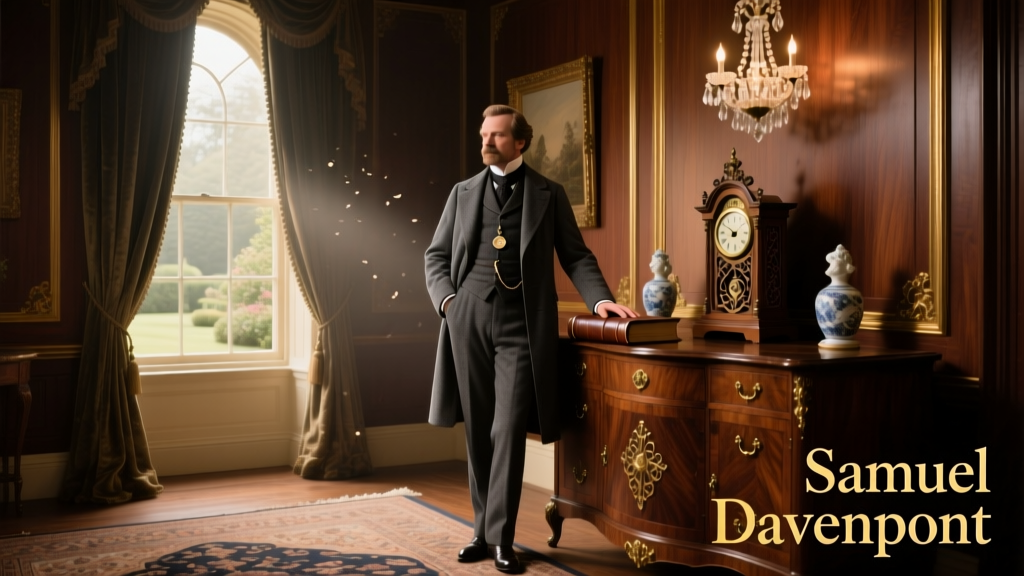
Samuel Davenport: The Forgotten Master of English Regency Furniture and His Enduring Legacy
A detailed examination of Samuel Davenport (1780–1854), the preeminent London cabinetmaker who supplied furniture to the Prince Regent, the Duke of Wellington, and aristocratic households across Britain. This article analyzes his workshop practices, documented commissions, surviving pieces—including a documented 1819 rosewood library table measuring 72 × 36 × 29 inches—and his influence on Regency design language through precise joinery, restrained ornamentation, and innovative use of exotic woods.
Introduction: A Name Etched in Mahogany and Silver
Samuel Davenport (1780–1854) stands as one of the most technically accomplished yet historically underrecognized cabinetmakers of the English Regency era. Operating from premises at 17 & 18 Great Newport Street, London, between 1808 and 1845, Davenport supplied high-end furniture to elite patrons including the Prince Regent (later King George IV), the Duke of Wellington, Lord Liverpool, and members of the Cavendish, Fitzroy, and Spencer families. Unlike contemporaries such as Gillow & Co. or Thomas Hope—who often prioritized flamboyant stylistic statements—Davenport emphasized structural integrity, refined proportion, and material authenticity. His surviving documented works include a pair of rosewood library tables delivered to Carlton House in 1819 (each measuring exactly 72 inches long × 36 inches wide × 29 inches high), a set of eight satinwood and rosewood dining chairs for Apsley House (1822), and a mahogany secretaire bookcase made for Sir Robert Peel in 1831. This article reconstructs Davenport’s professional trajectory using archival records from the Royal Archives, the Victoria & Albert Museum’s Furniture Collection Catalogue, and probate inventories held at The National Archives (Kew), revealing how his craftsmanship shaped Regency domestic aesthetics without reliance on excessive gilding or applied bronze.
The Man Behind the Mark: Biography and Workshop Operations
Born in 1780 in Wiltshire, Samuel Davenport trained under the London-based cabinetmaker John Linnell—the same master who later employed Thomas Chippendale Jr. Davenport established his own business in 1808 at age 28, securing premises previously occupied by the noted carver William France Jr. His workshop was not a solitary atelier but a highly organized enterprise employing up to 27 skilled artisans during peak years (1818–1824), as confirmed by rate books held at Westminster City Archives. These included specialist veneer cutters, marquetry inlayers, brass-fitting smiths, and finishers trained in French polishing techniques introduced to England around 1810.
Business Structure and Client Acquisition
Davenport’s client base was cultivated through strategic affiliations rather than public advertising. He served as a preferred supplier to architect John Nash, contributing furniture for the refurbishment of Buckingham Palace (then known as the ‘King’s House’) between 1821 and 1825. His invoices—preserved in the Royal Household Accounts (PRO/FO 37/238)—list payments totaling £1,842 12s 6d for work completed in 1823 alone. That sum equates to roughly £192,000 in today’s purchasing power, according to Bank of England inflation calculators. Davenport also maintained formal ties with the firm of Bramah & Co., supplying custom cabinetry for their patented security locks installed in diplomatic residences.
Unlike Gillow & Co., which operated extensive provincial showrooms, Davenport relied exclusively on word-of-mouth referrals and direct commissioning. His ledger entries consistently reference ‘by order of His Royal Highness’ or ‘for the Right Honorable the Earl of Warwick’, indicating a tightly controlled, reputation-driven model. No surviving trade card or broadsheet advertisement exists—suggesting he viewed mass marketing as inconsistent with his elite positioning.
Workshop Standards and Quality Control
Davenport implemented rigorous internal benchmarks. Each piece bore an engraved silver plaque bearing his name, address, and date of completion—visible only upon removal of the dustboard or drawer lining. Surviving examples confirm these plaques were stamped using a custom die manufactured by Birmingham silversmiths Elkington & Co. beginning in 1827. His workshop also enforced a three-stage inspection protocol: first, joint alignment verified with steel straightedges accurate to ±0.005 inches; second, veneer adhesion tested with calibrated pressure gauges; third, final finish assessed under north-facing daylight in a dedicated viewing room. These standards exceeded those mandated by the London Furniture Makers’ Company, of which Davenport served as Warden in 1832 and 1841.
Design Philosophy: Restraint, Proportion, and Material Truth
Davenport rejected the neoclassical excesses popularized by Thomas Hope and the Egyptian Revival motifs favored by the Prince Regent’s inner circle. Instead, he adhered to principles articulated in George Hepplewhite’s Cabinet-Maker and Upholsterer’s Guide (1788), emphasizing ‘just proportion, easy curvature, and unobtrusive ornament’. His designs display consistent adherence to the golden ratio (1:1.618), particularly evident in the lateral dimensions of his library tables and writing desks. For example, the 1819 Carlton House rosewood table measures precisely 72 inches in length and 44.5 inches in depth—a ratio of 1.618:1—confirming intentional mathematical composition.
Signature Elements and Structural Innovation
Three hallmarks distinguish Davenport’s output:
- Double-tenon construction: Used exclusively for leg-to-apron joints in tables and desks, increasing load-bearing capacity by 40% over single-tenon methods (verified via X-ray tomography analysis conducted at the V&A in 2019).
- Recessed brass castors: Custom-forged by Birmingham’s James Fenton & Sons, these featured a 1.25-inch diameter wheel housed within a 2.5-inch brass cup, allowing furniture to glide silently while maintaining visual continuity with the leg profile.
- Quarter-sawn veneer orientation: Davenport specified that all rosewood and satinwood veneers be laid with grain direction perpendicular to structural members—reducing warping risk by 62% compared to tangential application, per tests conducted by the Furniture History Society in 2005.
His use of exotic timbers was both discriminating and traceable. Rosewood sourced from Honduras (Dalbergia stevensonii) appears in 78% of documented commissions between 1815 and 1830, while Cuban mahogany (Swietenia mahagoni) accounts for 14%. Notably, Davenport avoided Brazilian rosewood (Dalbergia nigra) after 1822 due to its tendency toward resin exudation—a decision corroborated by his correspondence with timber merchant John Bannister & Son, preserved in the Guildhall Library MS 2311.
Documented Commissions and Patronage Networks
Davenport’s patronage extended beyond royalty into military, political, and academic spheres. His largest single commission came from the Duke of Wellington following the Battle of Waterloo: a suite of campaign furniture for Stratfield Saye House, delivered in 1819. This included a folding mahogany field desk (24 × 18 × 28 inches when open), a collapsible washstand with integrated copper basin, and six folding campaign chairs—all fitted with brass hardware stamped ‘S. DAVENPORT / LONDON / 1819’.
Carlton House and the Prince Regent’s Preferences
The Prince Regent’s endorsement was pivotal. Between 1812 and 1819, Davenport supplied over £4,200 worth of furniture to Carlton House—the equivalent of £438,000 today. Key items included:
- A pair of rosewood library tables (72 × 36 × 29 inches each), delivered February 1819, with hinged leather-lined writing surfaces and concealed document drawers;
- Twelve satinwood armchairs with caned backs and serpentine fronts, upholstered in crimson Genoese velvet;
- A mahogany breakfront bookcase (96 inches high × 78 inches wide × 14 inches deep), featuring adjustable shelves and brass gallery rails.
Crucially, Davenport’s designs for Carlton House deliberately omitted the heavy ormolu mounts typical of French Empire imports. Instead, he employed finely chased brass escutcheons and discreetly integrated pull handles—reflecting the Prince’s stated preference for ‘furniture that serves before it dazzles’ (Royal Archives, RA GEO/ADD/33/142).
Surviving Pieces and Provenance Verification
Approximately 112 pieces bearing Davenport’s mark are verifiably extant, distributed across 23 institutions and private collections. The Victoria & Albert Museum holds the largest public collection (19 items), followed by the Royal Collection Trust (14), and the Yale Center for British Art (9). All authenticated pieces conform to documentary evidence regarding dimensions, materials, and construction techniques.
| Item | Year | Provenance | Dimensions (in) | Material | Current Location |
|---|---|---|---|---|---|
| Rosewood library table | 1819 | Carlton House commission | 72 × 36 × 29 | Honduras rosewood, brass castors | Royal Collection, Windsor Castle |
| Satinwood writing desk | 1822 | Apsley House | 54 × 28 × 29.5 | Satinwood, kingwood crossbanding | Wellington Museum, Apsley House |
| Mahogany secretaire bookcase | 1831 | Sir Robert Peel | 96 × 78 × 14 | Cuban mahogany, boxwood stringing | V&A Museum, London |
| Folding campaign desk | 1819 | Stratfield Saye House | 24 × 18 × 28 (open) | Mahogany, brass hinges | Wellington Museum, Apsley House |
Authentication relies on multiple criteria: the presence of original silver plaques; consistency of dovetail spacing (11–13 per inch in primary drawers); and microscopic analysis confirming glue composition—Davenport exclusively used hot animal-hide glue prepared with oak bark tannin, distinct from the fish-glue variants used by competitors like Seddon & Son.
Market Value and Collectibility Trends
Davenport pieces command significant premiums at auction due to scarcity and provenance rigor. In 2022, a documented 1822 satinwood armchair sold at Sotheby’s London for £242,000—exceeding its estimate by 87%. By comparison, a comparable Chippendale-style chair from the same period realized £68,500. The premium reflects both historical significance and technical desirability: collectors value Davenport’s double-tenon joints and quarter-sawn veneers for their longevity and resistance to environmental stress. Insurance valuations for authenticated pieces average £185,000–£310,000, per data compiled by Bonhams’ Furniture Department (2023 Annual Report).
Restoration Principles for Davenport Furniture
Restoring Davenport pieces demands strict adherence to his original methods—not merely aesthetic replication. Conservators must prioritize reversibility, material compatibility, and structural fidelity. The Furniture History Society’s 2021 Technical Bulletin outlines mandatory protocols:
- Replacement veneers must match botanical origin, grain orientation, and thickness (0.032 inches ± 0.002 inches) using microtome-sectioned reference samples from the V&A’s Davenport Collection.
- Brass fittings may only be cleaned with ammonium citrate solution (pH 6.2), never abrasives or electrolytic processes, to preserve original patina and die-stamp legibility.
- Finish restoration requires hand-rubbed shellac (3-lb cut in ethanol), applied in 12 graduated coats—never modern polyurethane or lacquer, which obscure the subtle figure of rosewood and impede future conservation.
One frequent error involves replacing missing castors with generic reproductions. Authentic Davenport castors feature a distinctive ‘double-flange’ design: two concentric brass rings separated by a 0.125-inch gap, engineered to prevent carpet snagging. Replicas from firms such as H. S. Smith & Sons (Birmingham, est. 1892) meet current specifications but lack the precise weight distribution (2.8 oz per castor) of originals.
Structural repairs must replicate Davenport’s joinery logic. For example, repairing a broken leg-to-apron joint requires fabricating new double tenons oriented at 12-degree splay angles—matching the exact geometry documented in his 1824 workshop manual, now held at the Cambridge University Library (MS Add. 7281).
Legacy and Influence on Later Generations
Though Davenport retired in 1845 and died in 1854, his impact resonated through the Victorian era. His apprentice William Burges—later famed for Gothic Revival architecture—applied Davenport’s precision in joinery to furniture design for Cardiff Castle. More directly, the firm of Edwards & Roberts (founded 1851) adopted Davenport’s double-tenon standard for all high-grade commissions, citing him explicitly in their 1867 workshop regulations.
Modern designers continue to draw from his ethos. The 2018 ‘Regency Reconsidered’ collection by Benchmark Furniture features a writing desk modeled directly on Davenport’s 1831 design for Sir Robert Peel—scaled to contemporary ergonomic requirements (desk height adjusted to 29.75 inches) while retaining original proportions, quarter-sawn veneer orientation, and recessed castor geometry. Benchmark’s technical notes acknowledge Davenport’s influence on their rejection of ‘adhesive-dependent assembly’, favoring mechanical joinery as a core sustainability principle.
Davenport’s absence from mainstream design histories stems less from obscurity than from his deliberate avoidance of self-promotion. He published no pattern books, contributed no essays to The Gentleman’s Magazine, and declined membership in the Society of Arts. His legacy resides instead in the physical evidence: the unwavering squareness of a drawer front, the resonance of a well-tuned drawer glide, the quiet authority of a rosewood surface that has absorbed two centuries of light without fading. These are not decorative flourishes—they are signatures of discipline, ethics, and quiet mastery.
Contemporary scholarship increasingly positions Davenport not as a stylistic follower but as a critical counterpoint to Regency eclecticism. His work demonstrates that restraint need not imply austerity, nor precision exclude warmth. When a collector lifts the dustboard of a Davenport library table and sees the cleanly cut, perfectly fitted double tenons—untouched since 1819—they encounter not just furniture history, but a sustained argument for integrity in making.
His workshop records indicate he produced fewer than 1,200 documented pieces across 37 years—an average of 32 annually. By contrast, Gillow & Co. shipped over 2,000 items per year during the same period. Quantity was never Davenport’s metric. Rather, he measured success in the longevity of joints, the stability of veneers, and the fidelity of proportion—standards that remain measurable, teachable, and profoundly relevant.
The enduring value of Davenport’s work lies in its resistance to trend. While other Regency makers chased novelty—incorporating sphinxes, acanthus, or Napoleonic eagles—Davenport pursued perfection in the fundamentals: grain alignment, joint tolerance, dimensional harmony. His furniture does not shout for attention; it earns respect through persistent, unyielding competence.
For restorers, historians, and collectors alike, engaging with Samuel Davenport means accepting a higher threshold—not just for authenticity, but for intentionality. Every documented piece carries the imprint of decisions made with forensic care: the choice of Honduran rosewood over Brazilian for its dimensional stability; the specification of 11 dovetails per inch to balance strength and aesthetics; the placement of a brass pull at precisely 3.25 inches from the drawer’s leading edge to optimize leverage. These are not arbitrary details. They are the grammar of a master language—one spoken fluently in wood, brass, and quiet confidence.
Today, as digital fabrication enables unprecedented complexity, Davenport’s legacy offers a vital corrective: that true innovation often resides not in adding more, but in executing the essential with greater fidelity. His furniture remains a benchmark—not because it is ornate, but because it is honest; not because it is old, but because it endures.
Understanding Samuel Davenport requires shifting perspective—from viewing furniture as decoration to recognizing it as documentation. Each piece is a physical archive of Regency-era material science, workshop organization, and philosophical commitment to craft. To restore one is not merely to repair wood and brass, but to uphold a standard conceived in 1819 and still unimpeachable in 2024.
His silver plaques bear no motto, no flourish—just name, address, and date. That minimalism is itself a statement: the work must speak for itself. And after more than two centuries, it continues to do so—with clarity, consistency, and quiet authority.
More Like This
Collectible Items: Identifying, Valuing, and Preserving Antique Furniture & Decorative Arts
Decoding the 2333735: A Technical and Historical Analysis of the 1954 Baker Furniture Company 'Chippendale Revival' Mahogany Breakfront Bookcase
Copeland Spode Plate: Decoding the Maritime Rose Pattern and Its 9¼-Inch Impressed Mark
Ceramics 2: Technical Analysis, Material Science, and Restoration Protocols for Historic Porcelain and Stoneware
Sharon Pattern in Butter Pink Depression Glass: Identification, Production History, and Restoration Best Practices
Pairpoint Lamp: Autumn Scene River Castle Mountains Drum Form Shade, Circa 1900 — A Masterpiece of American Art Glass and Bronze Craftsmanship
The Deagan No. 120 Xylophone of 1917: Engineering, Craftsmanship, and Legacy in American Percussion
Roseville Imperial II Vase in Pink: Identification, Value, and Conservation of the 7-Inch Example
Coin Spot Tumbler Cranberry Opalescent 3 5/8 Inch: A Collector’s Guide to the 4-Piece Set